1.1 String Pattern Fundamentals
What Are the Fundamentals of Open String Patterns & Spin?
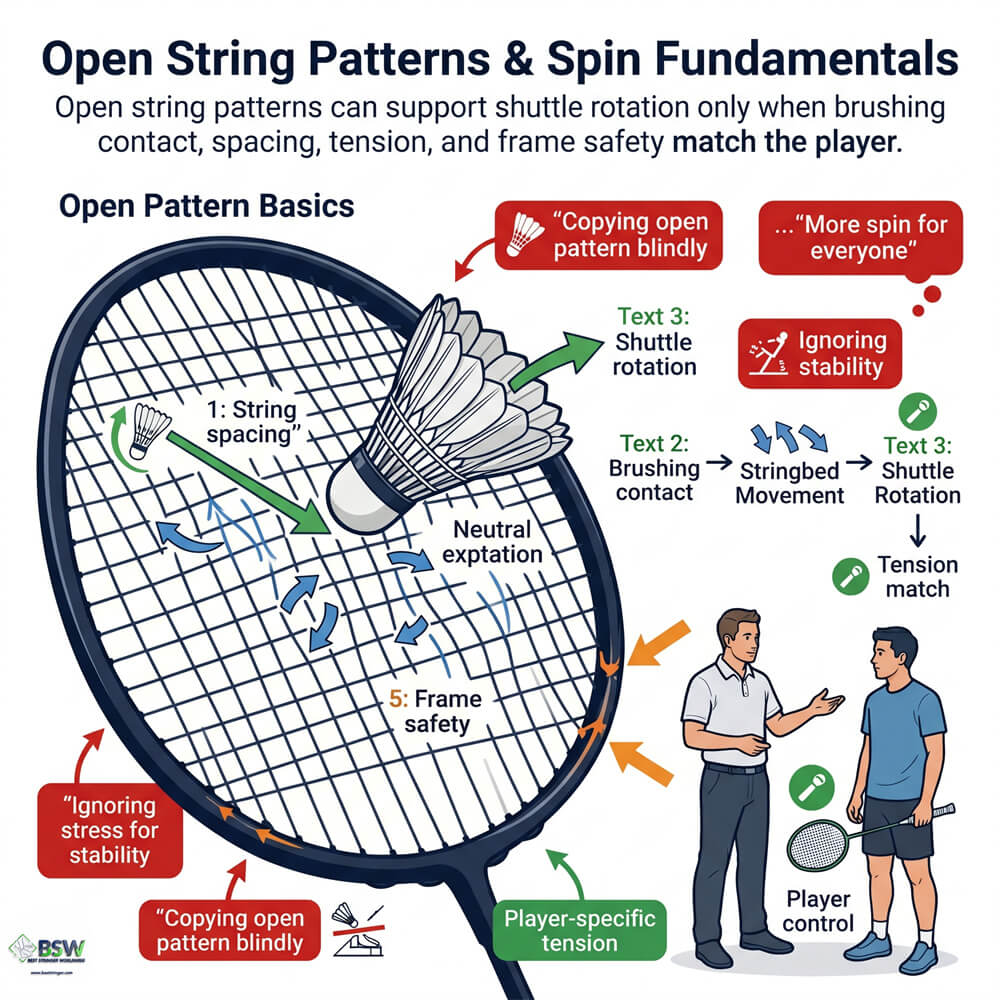
String pattern fundamentals refer to how specific racquet characteristics, particularly string density, combine to enhance your playstyle. In this guide, you will learn why lower badminton string density can help produce more shuttle rotation under similar conditions, alongside other key specs like string spacing, tension, and frame safety.
In short, an open string pattern dictates your stringbed movement, while string texture and tension dictate your feedback. Mastering these concepts is crucial for any badminton player aiming to improve, as “more spin” does not automatically mean “better control for every player.”
Here is a simple decision flow:
Step 1: Assess your brushing contact and timing honestly.
Step 2: Understand that ‘more bite’ from an open pattern is only beneficial if you can control the slice without losing stability.
Step 3: Consult a certified stringer to select a string gauge and tension that perfectly matches your racquet’s designed hole pattern and your sweet spot accuracy.
1.2 String Density & Spacing
String Specs Explained: Density and Stringbed Movement
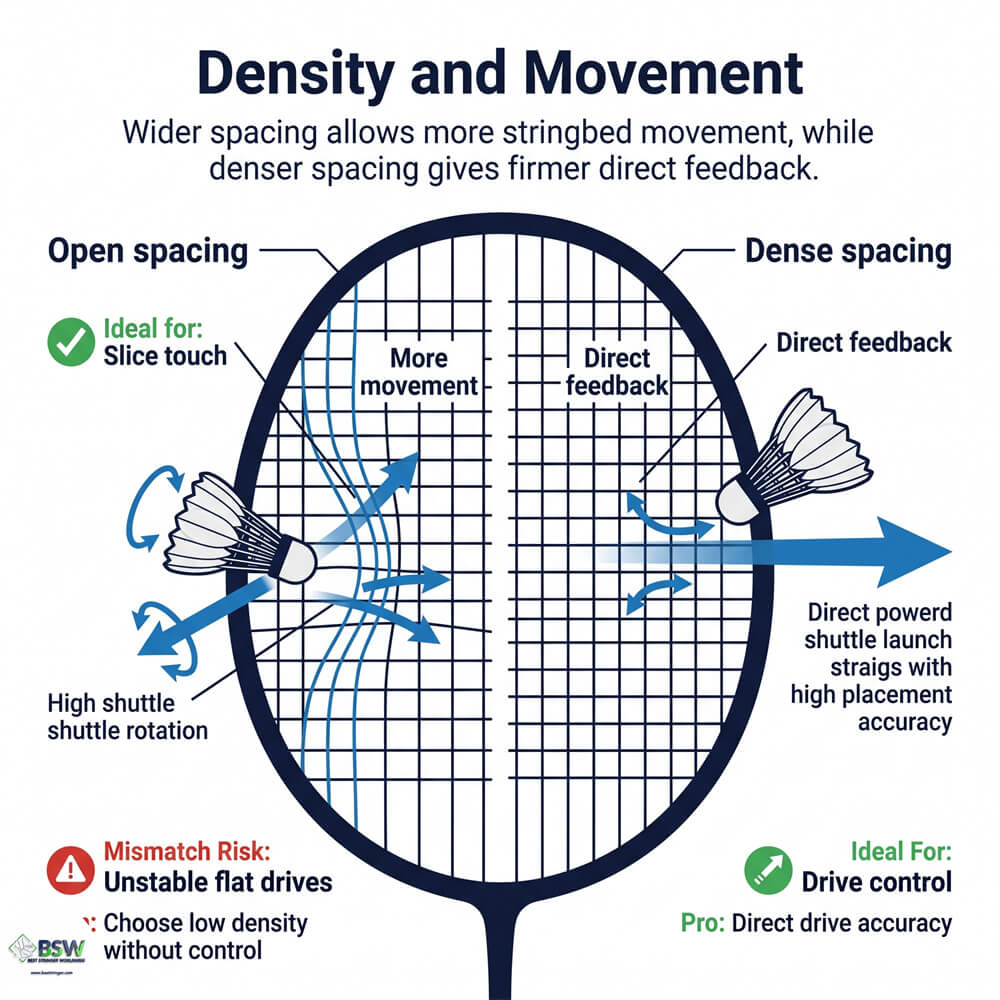
The core rule of stringing physics is that lower badminton string density can usually help produce more shuttle rotation when all other conditions are equal. This happens because wider string spacing allows more stringbed movement during angled contact. An open string pattern provides this extra movement, offering clearer bite feeling, heavier cut effects, and more responsive tumbling net shots. However, a denser string pattern is often the starting point for sharper, flatter placement control.
Changing string density drastically alters how the stringbed behaves, and the racquet’s designed hole pattern distributes this spacing. Open patterns generate more responsiveness for front-court slice and touch shots, but they can naturally feel less firm during high-paced flat drives. Denser string patterns sacrifice some of that string movement for highly stable and direct feedback during rapid defensive exchanges.
A badminton player needs the right balance between spin feel, stability, and directness. For players needing sharp drive accuracy, a standard or dense pattern is generally preferred. Players who utilize varied slice attacks and cut drops often benefit from the extra stringbed movement and lively grip of an open pattern.
1.3 Angled Contact & String Bite
Understanding Angled Contact and String Bite
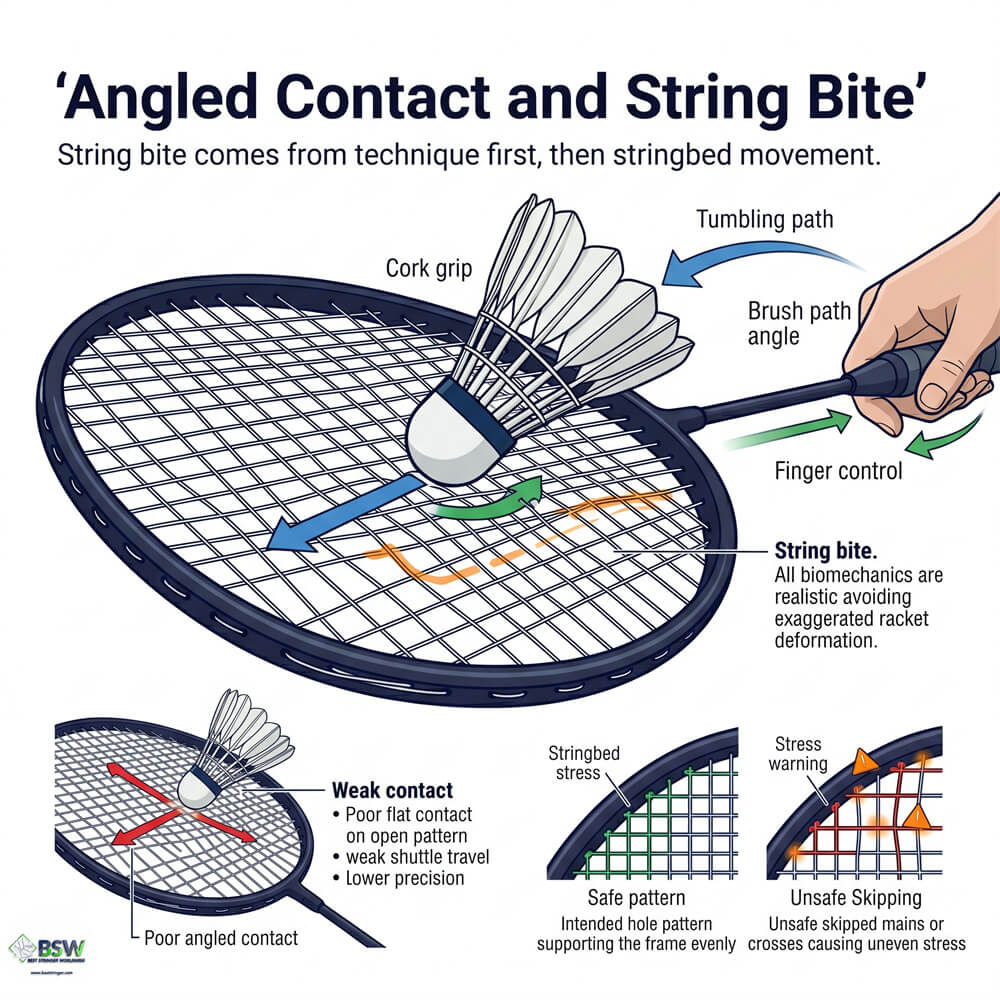
While an open string pattern provides the spacing for stringbed movement, your technique dictates how that spin is generated. Brushing contact provides maximum shuttle rotation and cut effect, but only if the badminton player has the correct timing, wrist control, and finger control to grip the shuttle cork. If you lack solid technique, pairing an open pattern with poor angled contact punishes you with weak shots and potential loss of precise control.
A correct contact angle is highly effective. It acts like a brush, gripping and rolling the shuttle smoothly to help players effortlessly execute a tumbling net shot or sliced smash, even if their swing speed is focused more on placement than raw power.
Frame safety also plays a massive role in stringing. An intended open hole pattern offers a safe stringbed, ensuring that the tension from your string pull still supports the frame effectively. Stringers must never skip mains or crosses randomly to create fake lower density, saving your racquet from collapsing early under stress.
1.4 Tension & Pattern Basics
Badminton String Setup for Open Patterns
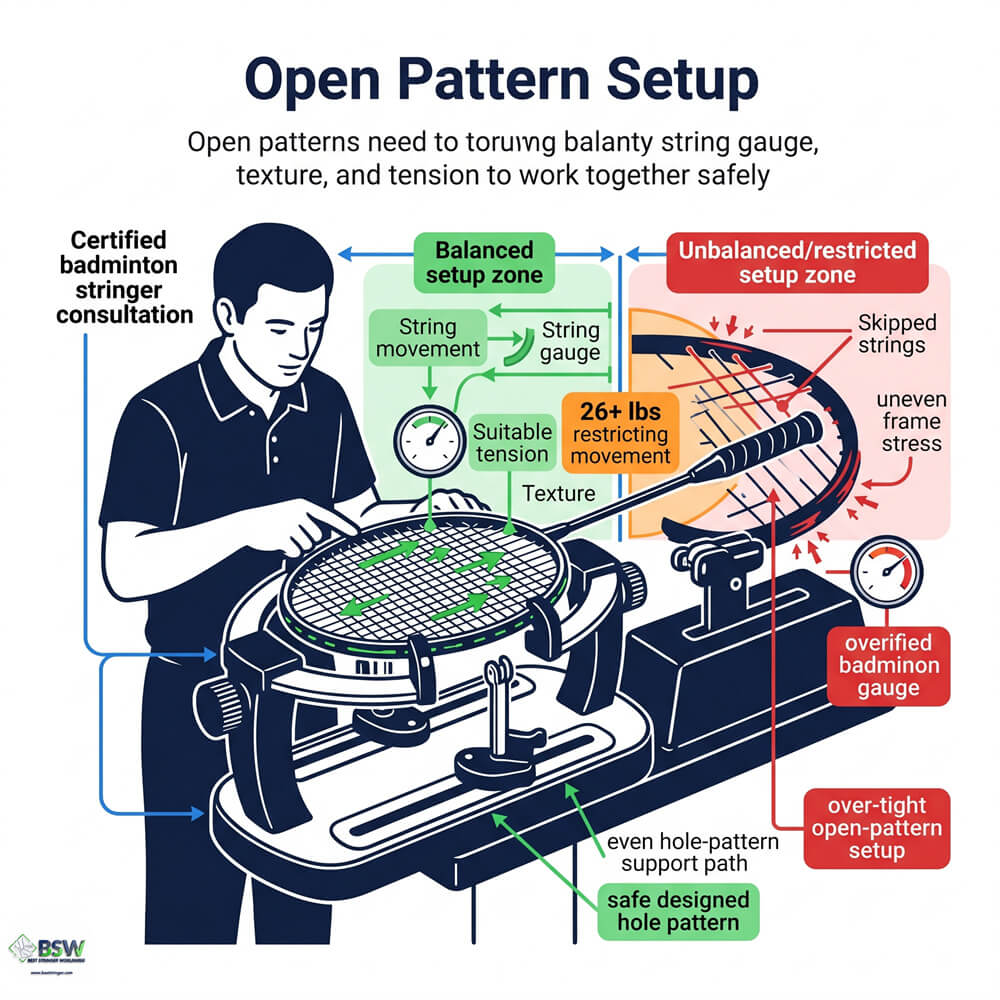
An open badminton string pattern requires the correct string gauge, texture, and tension to truly unlock its spin potential. Understanding this synergy is essential for all levels:
What is String Texture? Gauge and coating refer to the physical traits of the string. Textured strings (e.g., rough coating) offer incredible bite and slice effect, while smooth strings sacrifice a bit of grip for faster repulsion and easier restringing.
Tension Basics. Tension is how tightly the strings are pulled. High tension (26+ lbs) offers firm control, but it restricts string movement and reduces the natural spin responsiveness of an open pattern. Suitable tension allows the strings to shift slightly, boosting shuttle rotation for brushing swings.
The Safety Risk. If you desire an open string pattern for slice effect but ask a stringer to skip mains or crosses, the sheer uneven force will stress the frame almost immediately. A professional badminton stringer will always align the string density with the racquet’s designed hole pattern.
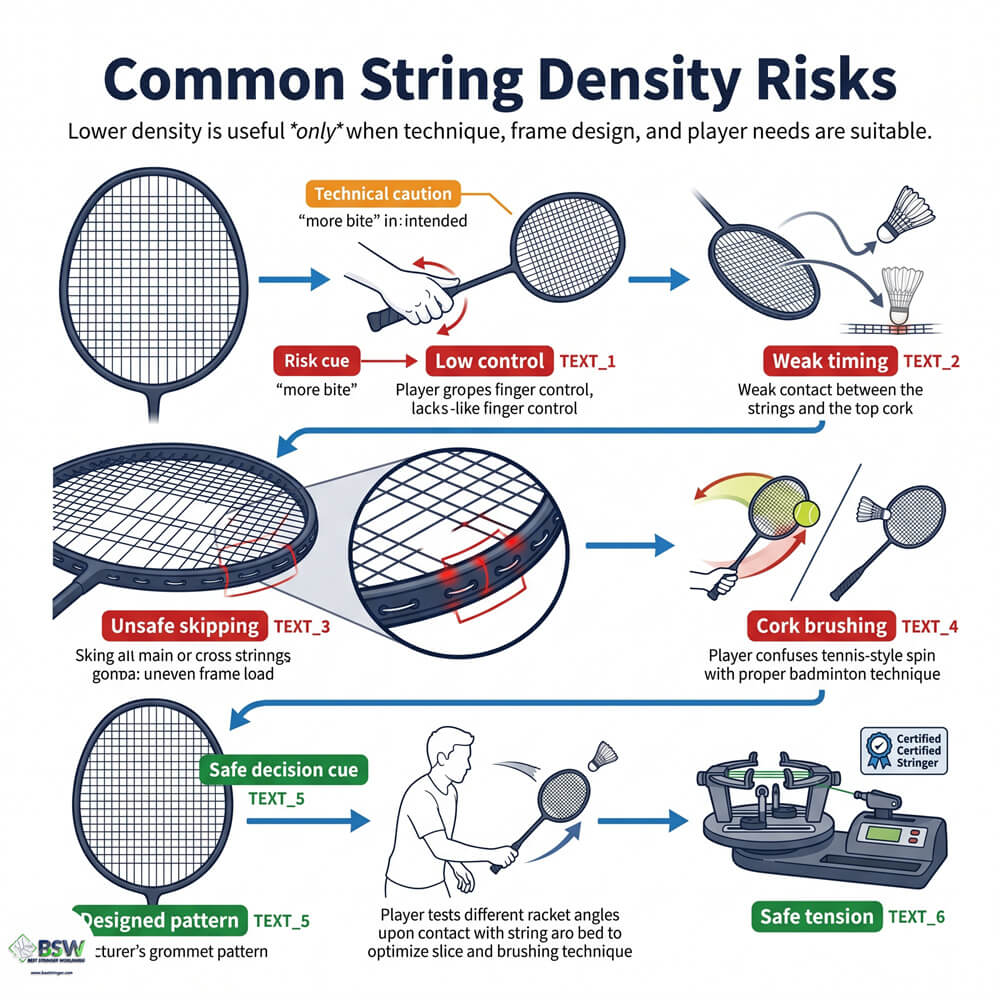
1.5 Common Stringing Mistakes
Common String Density Mistakes
Mistake 1: Assuming Lower Density is Always Better.
While an open string pattern produces greater bite under similar conditions, choosing an open frame without the necessary finger control guarantees sluggish placement, poor timing, and lack of direct stringbed feedback.
Mistake 2: Unsafe String Skipping.
Chasing pure spin by asking a stringer to remove cross strings often means sacrificing frame safety. If your stringbed lacks intended structural support, the extra string movement is dangerous and risks snapping the frame under tension.
Mistake 3: Confusing Tennis and Badminton Spin.
Treating a shuttlecock like a tennis ball is a common error. Advanced cut drops require brushing contact on the cork; otherwise, an open string pattern simply wastes your swing energy and ruins your placement consistency.
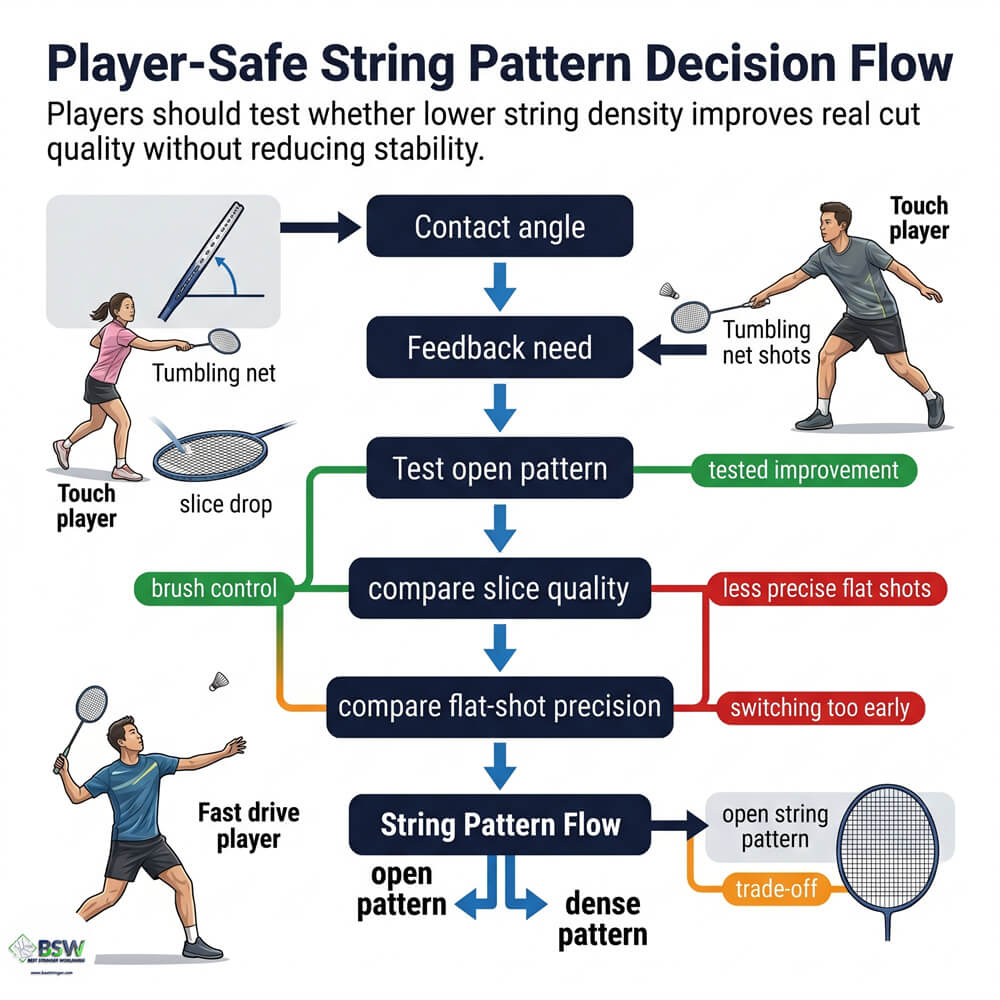
1.6 Player Selection Framework
Player-Safe String Pattern Decision Flow
A step-by-step decision flow is crucial for balancing spin and control safely. Use this simple framework before upgrading your string setup:
Step 1: Check Your Contact Angle. An open badminton string pattern will only yield more shuttle rotation if you can maintain brushing contact. Beginners should often start with a standard density pattern to develop proper stroke mechanics before transitioning to highly open frames.
Step 2: Identify Your Feedback Needs. Determine if you are primarily a fast-paced drive player requiring firm, direct response, or a touch player needing the liveliness and stringbed movement of extra spacing for tumbling net shots.
Step 3: Test for Actual Improvement. Try a racquet with lower string density and test whether it genuinely improves your cut effect and slice quality, or if it only makes your flat shots feel less precise and less stable.
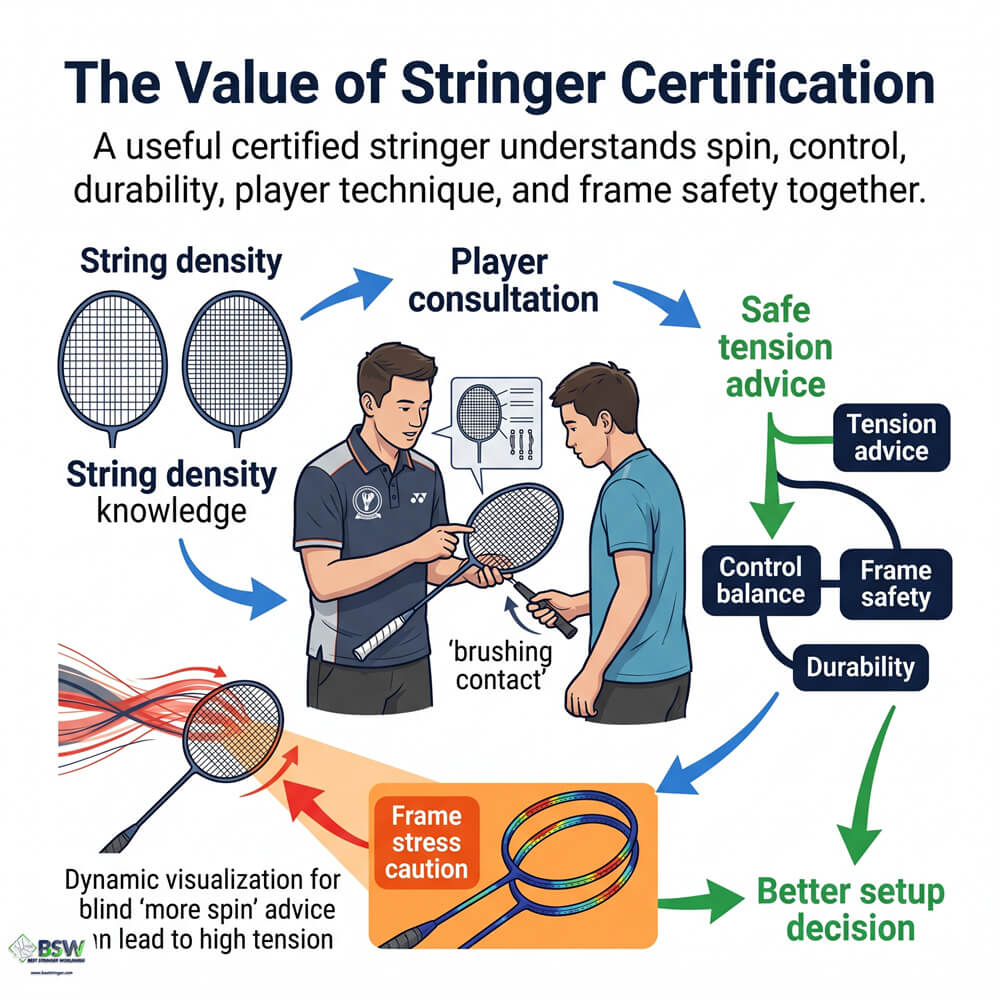
1.7 Stringer Education
The Value of Stringer Certification
Proper stringing education is a core part of a professional badminton stringing course and good stringer certification standards. A certified stringer understands that recommending “more spin” blindly without considering a player’s real technique is a disservice.
At Best Stringer Worldwide, we know that string density directly influences the advice given to players. The skill is not just in buying a textured string, but in the precise consultation logic a badminton stringer uses to match string type and tension to your racquet’s hole pattern.
By prioritizing accurate stringbed knowledge, our stringer certification ensures that every setup perfectly balances spin, control, and durability. You eliminate guesswork, avoid frame stress from unsafe skipping, and focus purely on improving your game.
String Density & Spin Quick FAQ
Quick, definition-first answers to common questions about badminton string density and spin basics.
Does lower string density create more spin?
Generally, yes. Lower badminton string density can usually produce more shuttle rotation under similar conditions because wider string spacing allows more stringbed movement. However, this only applies if the player has the wrist and finger control to use proper brushing contact.
What is an open string pattern?
An open string pattern is a racquet design with fewer mains and crosses across the face, leading to wider spacing between the strings. This extra spacing provides a clearer bite feeling, especially during sliced shots and tumbling net shots.
Is lower density better for all players?
Not every badminton player will benefit equally. While it offers more spin potential and string movement, an open string pattern may also feel less stable, too lively, and less precise, making it less suitable for players who demand sharp, direct control.
What does spin mean in badminton?
Spin in badminton relies on shuttle rotation, slice effect, cut effect, and tumbling net shots. A shuttlecock behaves differently from a tennis ball, so spin is generated by brushing contact on the cork to change its flight, rather than heavy topspin baseline rallies.
Should a stringer skip strings?
Absolutely not. A badminton stringer must follow the racquet’s intended hole pattern. Randomly skipping mains or crosses to create fake lower string density is unsafe, weakens frame support, and can cause the racquet to collapse under tension.
How does tension affect open patterns?
An open string pattern paired with inappropriate tension can restrict stringbed movement. A certified stringer will adjust tension based on the string spacing and the player’s technique to ensure the bite feeling remains accessible and responsive for slice shots.
What should a stringer consider before changes?
A professional badminton stringer should always evaluate the player’s contact angle, wrist control, and playing style. They should never just recommend an open pattern or skip strings for “more spin” without prioritizing frame safety and the player’s true control needs.
Why is stringer certification important?
A comprehensive badminton stringing course teaches the science behind string density, stringbed movement, and safe tension advice. A certified stringer provides educated guidance on spin and frame safety rather than relying on brand hype or unsafe shortcuts.
Are stringing courses necessary?
For those wanting to master equipment consultation, yes. A stringer learns proper frame support, safe stringing practices, and the logic to match open or dense string setups to player levels, eliminating guesswork from equipment selection.
The Mechanics of Spin: Why String Density Matters
String Density & Spin Analyzer
Dense Pattern
Closer spacing creates a firmer stringbed with less string movement. Excellent for fast-paced drives, highly stable feedback, and sharp placement control.
Proven Stringing Methods
Our stringing approach is based on verified racquet parameters used by top professionals. We prioritize frame safety, proper string density evaluation, and spin efficiency over pure tension hype.
| String Pattern Type | Open String Pattern | Denser String Pattern |
|---|---|---|
| String Spacing & Bite | Wider spacing allows more stringbed movement and clearer bite feeling. | Closer spacing creates a firmer stringbed with less string movement. |
| Spin Potential | More potential for shuttle rotation and slice effect with correct technique. | Neutral rotation, requires more effort to generate tumbling net shots. |
| Placement Control | May feel less direct or too lively if tension is not matched properly. | Sharper placement control and highly stable response for flat drives. |
| Stringbed Feedback | Responsive, lively touch that is highly sensitive during angled contact. | Compact, direct feedback that clean hitters prefer for fast pacing. |
| Player Suitability | Ideal for players who use slice, cut drops, and tumbling actions frequently. | Ideal for fast attacking players who prefer a stable and firm feel. |
| Stringer Advice | Must come from racquet design; stringers should never skip strings. | Excellent standard baseline for developing technique and assessing tension. |
Master Racquet Education with Best Stringer Worldwide
Ready to upgrade your knowledge? Best Stringer Worldwide offers professional stringing consultation to teach you how string density and tension affect spin safely. We serve badminton players worldwide especially in Singapore, Hong Kong, Malaysia, Indonesia, UK, France and Europe. Contact a certified stringer to find the perfect string setup for your game.