1.1 String Gauge Fundamentals
How Do Thinner Badminton Strings Affect Shuttle Spin?
Equipment fundamentals refer to how specific badminton string characteristics, particularly string gauge, combine to influence your playing feel. In this guide, you will learn why thinner badminton strings can often help produce more shuttle rotation under similar conditions, alongside other key factors like string tension, texture, and player technique.
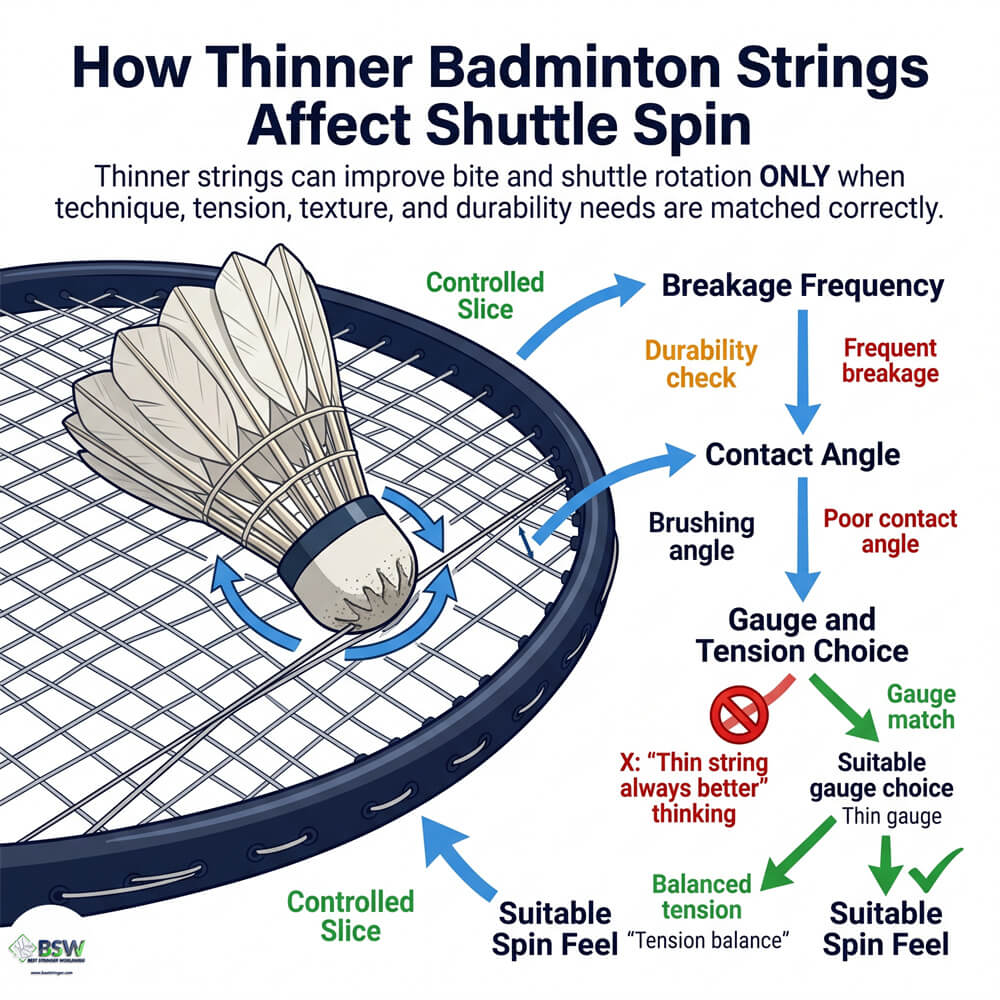
In short, badminton string gauge dictates your stringbed feedback and contact bite. Mastering this concept is crucial for any badminton player aiming to understand equipment, as thinner strings do not automatically create better spin without correct brushing technique.
Here is a simple decision flow: Step 1: Assess your string breakage frequency honestly. Step 2: Understand that ‘more spin’ from a thinner string is only beneficial if you have the correct contact angle. Step 3: Consult a certified stringer to select a string gauge and tension that perfectly balances your touch needs with your durability expectations.
1.2 String Bite & Sensitivity
String Gauge Explained: Feedback and Shuttle Rotation
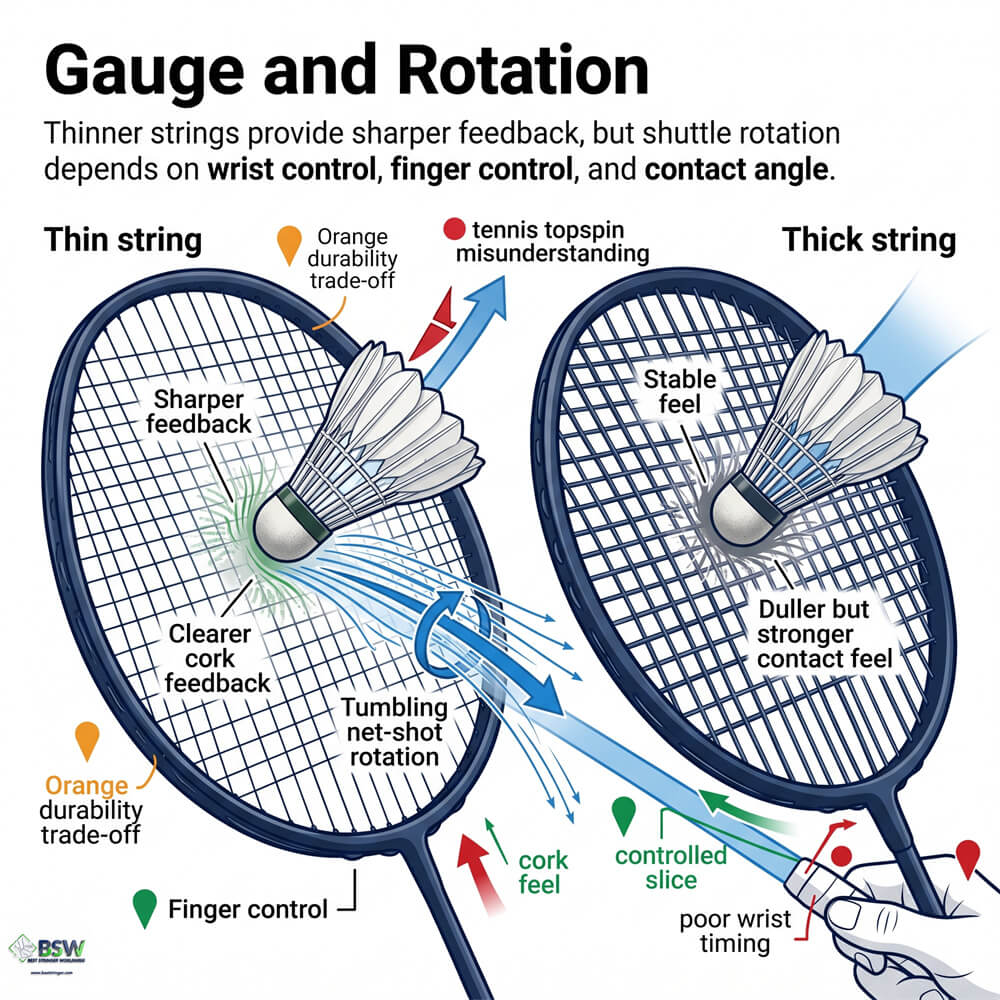
The core concept of badminton string gauge is that when all other conditions are equal, thinner badminton strings can often provide better bite and more shuttle rotation. Because the string diameter is smaller, it offers a sharper stringbed feedback and increased sensitivity during angled or brushing contact. This can help players feel the cork more clearly when executing a tumbling net shot or a sliced smash.
However, badminton spin is completely different from tennis topspin. Due to the shuttlecock’s cork, skirt, and aerodynamic drag, “spin” in badminton primarily refers to the slice effect, cut effect, and flight stabilization changes. A thinner string helps grip the shuttle cork during these delicate, angled brushing motions much more noticeably than a thicker, smoother string might.
While thinner strings can enhance touch and spinning net shots, the actual rotation generated still heavily relies on your wrist control, finger power, and contact angle. Proper timing is required to truly take advantage of the sensitive stringbed response that thin strings provide.
1.3 Spin vs. Durability Trade-offs
Understanding String Bite and Durability
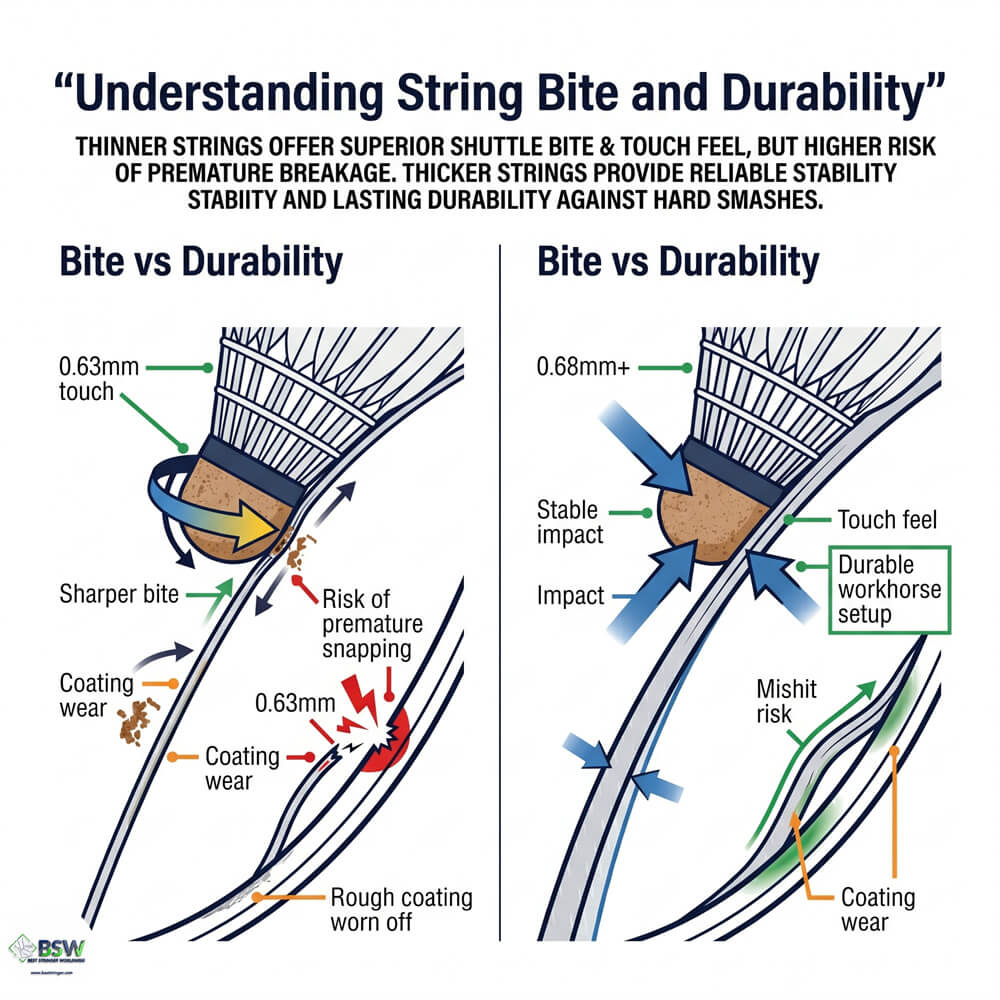
While thinner badminton strings give excellent sensitivity and support for cut drops, they come with a significant trade-off: durability. The smaller diameter makes them much more vulnerable to friction and sheer force. If a player frequently mishits the shuttle near the racquet frame, a thin string is highly likely to snap prematurely, regardless of how much spin it helps create.
Thicker strings (e.g., 0.68mm and above) act as the reliable workhorses of badminton equipment. They offer a much more solid, stable feel and will endure the heavy impact of powerful smashes far longer. However, they may feel slightly duller during delicate tumbling net shots compared to thinner alternatives.
The string coating and texture also play a role. A rough-textured thin string provides maximum initial bite, but the coating can wear off rapidly. Choosing the right badminton string gauge is about finding the perfect balance between the crisp contact feel you want and the lifespan you need.
1.4 Stringbed Feedback & Contact Angle
Badminton String Setup for Sliced and Cut Shots
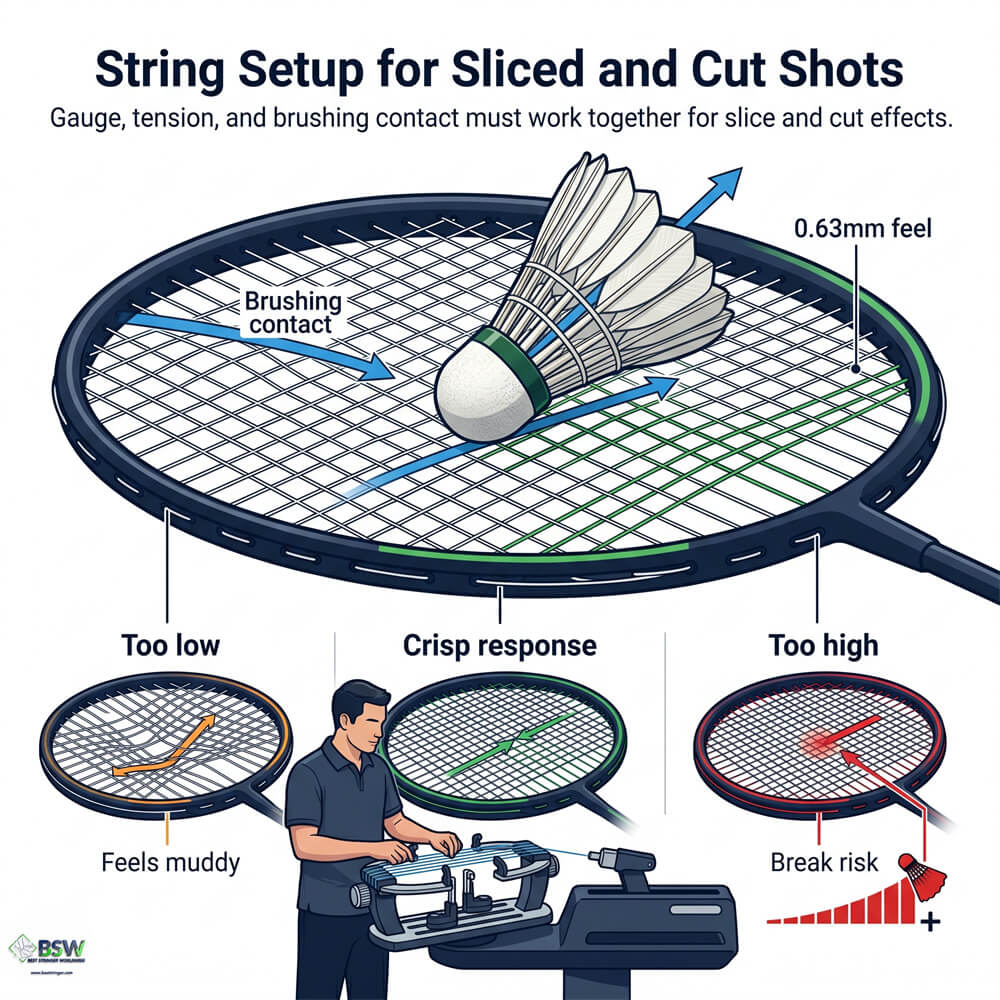
To truly utilize thinner badminton strings for slice and cut shots, the player must understand the interaction between gauge, tension, and brushing contact:
Brushing Contact Basics. Shuttle rotation is created by slicing across the shuttlecock’s cork at a specific angle. Thinner strings (e.g., 0.63mm) can provide a sharper, more distinct feeling when the stringbed grips the cork, enhancing your sensory feedback.
The Role of Tension. Tension affects how the stringbed behaves during this contact. A properly selected string tension ensures the thin string feels crisp and responsive. If tension is too low, the stringbed may feel muddy; if it is too high for the player’s ability, it may kill the spin feel and snap easily.
The Durability Risk. If you pair a very thin gauge with very high tension in hopes of maximizing control and spin, the sheer force of an off-center hit can break the string immediately. A professional badminton stringer will help you align string gauge with a sensible tension to prevent this.
1.5 Common String Selection Mistakes
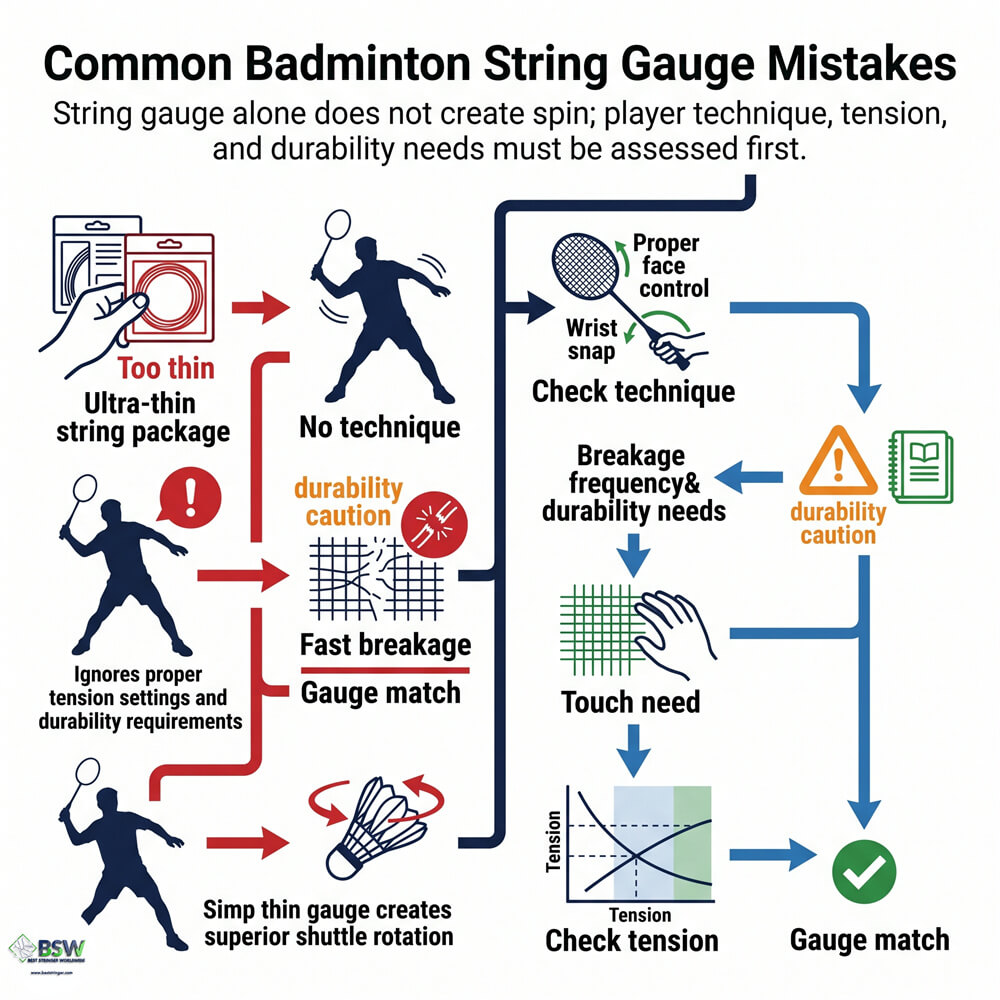
Common Badminton String Gauge Mistakes
Mistake 1: Assuming Thinner is Always Better.
While thinner strings can enhance the feeling of bite and sensitivity, selecting the thinnest option without having refined technique will not magically generate spin. Furthermore, it will likely lead to rapid string breakage if you hit the shuttle forcefully.
Mistake 2: Ignoring Tension and Durability.
Chasing the sharpest stringbed feedback with thin strings often means sacrificing longevity. If you cannot afford to restring frequently, a medium or thicker string is a much wiser, more stable choice.
Mistake 3: Forgetting the Importance of Technique.
String gauge alone does not determine spin. Shuttle rotation is fundamentally created by your wrist, fingers, and contact angle. Thin strings merely provide the sensory feedback to help you execute those brushing motions more effectively.
1.6 String Gauge Selection Framework
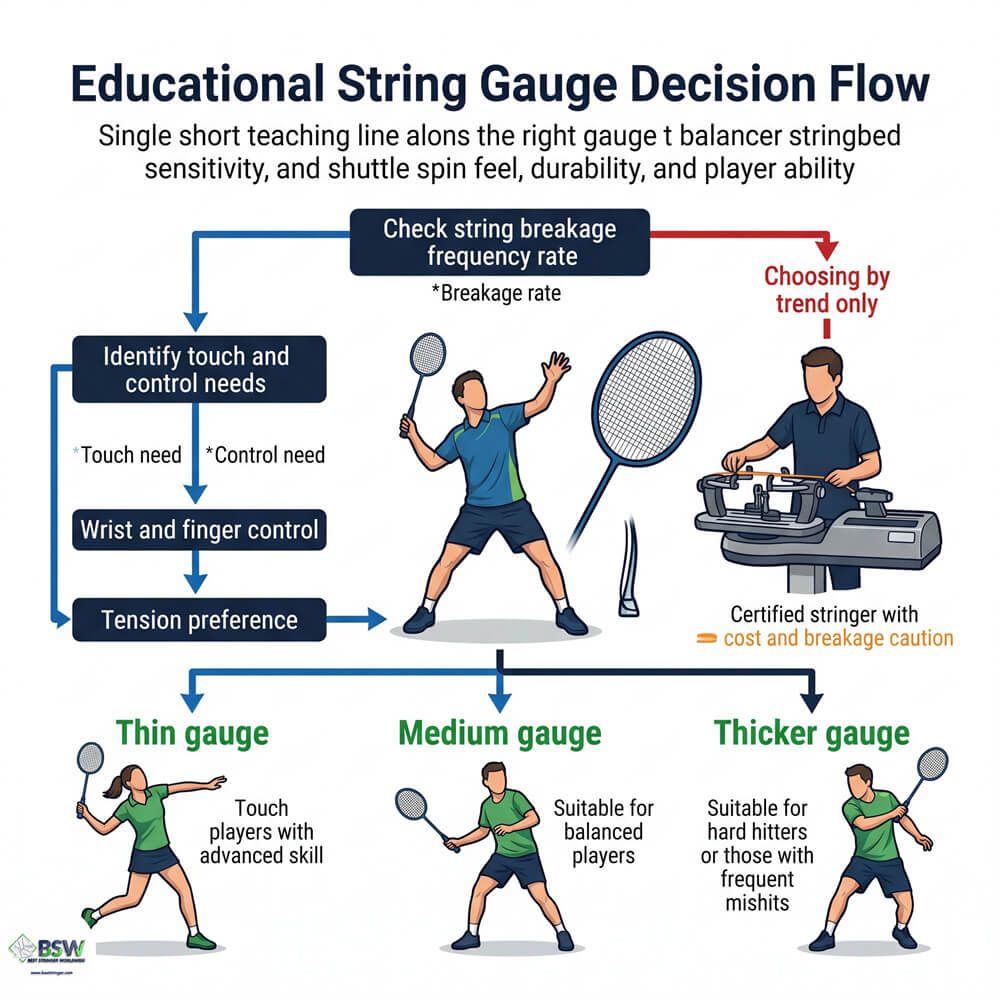
Educational String Gauge Decision Flow
A step-by-step decision flow is crucial for balancing stringbed sensitivity and durability safely. Use this simple framework before asking for the thinnest string available:
Step 1: Check Your String Breakage Frequency. If you already snap strings every few weeks from hard hitting or frequent mishits, thinner strings will only increase your replacement costs. Thicker strings are much more forgiving for heavy hitters.
Step 2: Identify Your Touch and Control Needs. Determine if you primarily rely on delicate tumbling net shots, cut drops, and sliced smashes. If you have fine wrist control and prioritize contact feel over durability, a thinner string might suit your style.
Step 3: Consult a Certified Stringer. Have an honest conversation with a professional badminton stringer about your playing level, tension preferences, and desired shuttle rotation so they can recommend the exact gauge that balances your needs.
1.7 Professional Stringing Education
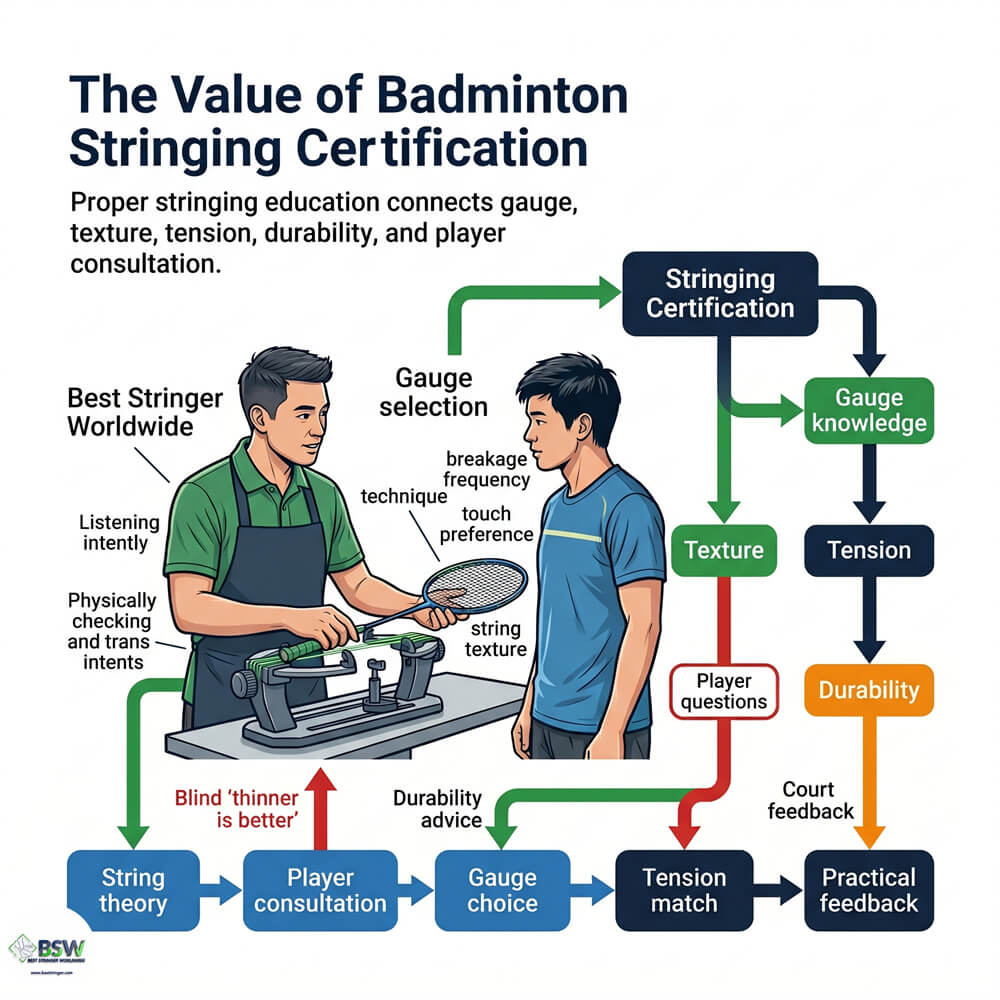
The Value of Badminton Stringing Certification
Proper equipment education is a core part of a professional badminton stringing course and good stringer certification standards. A certified stringer understands that blindly recommending thinner strings for “more spin” without considering a player’s real technique is a disservice.
At Best Stringer Worldwide, we know that string gauge directly influences the playing feel and advice given to players. The value is not just in pulling tension on a machine, but in the precise player consultation logic a badminton stringer uses to match string gauge, texture, and tension to the player’s abilities.
By prioritizing accurate equipment knowledge, our stringer certification ensures that every setup perfectly balances spin feel, tension stability, and durability. You eliminate guesswork, prevent rapid tension loss, and help players understand exactly what their strings are doing.
String Gauge & Shuttle Spin Quick FAQ
Quick, direct answers to common questions about badminton string gauge, shuttle rotation, and contact feel.
Do thinner badminton strings create more spin?
Generally, yes. When all other conditions are equal, thinner strings can help create more shuttle rotation because they may provide better string bite and sharper feedback during angled or brushing contact. However, correct player technique is still required.
Why do thinner strings help shuttle rotation?
The smaller diameter provides a sharper stringbed response, improving the player’s contact sensitivity. This makes it slightly easier to feel the shuttle cork gripping the strings when performing delicate slice effects or tumbling net shots.
Should every player use thin strings?
Not every badminton player will benefit. While they offer more sensitive touch and better potential for cut drops, thinner strings break much faster and lose playability quicker. Players needing durability should opt for medium or thicker gauges.
How does string gauge affect cut drops?
During a cut drop or sliced smash, a thinner string may help the player feel the brushing contact more clearly. This immediate stringbed feedback allows players to adjust their wrist control and contact angle more precisely.
Why do some players prefer thicker strings?
Players who break strings often, hard hitters, and those who mishit frequently usually prefer thicker strings. They offer better longevity, a more stable stringbed feel, and can handle repetitive heavy impact much better than thin options.
How does tension affect spin feel?
A thinner string paired with inappropriate tension can feel unstable or break prematurely. A certified stringer will recommend a tension that supports the crisp bite of the thin string while keeping the sweet spot accessible for your swing speed.
What should stringers ask before advising?
A professional badminton stringer should evaluate the player’s technique, breakage frequency, and touch preferences. They must understand the player’s real needs rather than blindly recommending the thinnest option just because it claims to offer more spin.
Why is stringer certification important?
A comprehensive badminton stringing course teaches how gauge, string texture, tension, and durability interact. A certified stringer provides safe, educated guidance based on these mechanics to give players practical equipment advice.
Are stringing courses necessary?
For those wanting to master equipment consultation, yes. A proper course teaches stringers how to systematically match string gauge to player needs, ensuring the final setup accurately balances spin, durability, and stringbed control.
The Physics of Spin: Why Badminton String Gauge Matters
String Gauge & Spin Analyzer
Thick Gauge (0.68mm+)
Acts as a reliable workhorse. Offers a highly stable, solid feel and absorbs heavy smash impacts without breaking easily. Less sensitive for delicate spin shots.
Proven Specifications
Our stringing approach is based on verified equipment parameters used by top professionals. We prioritize balanced durability, proper stringbed sensitivity evaluation, and playstyle efficiency over pure tension hype.
| Feature | Medium/Thick (0.68mm+) | Thinner Strings (0.61mm – 0.65mm) |
|---|---|---|
| Spin & Rotation | Less sensitive for angled shots. | Stronger “bite” for slices/tumbling. |
| Sensitivity | Solid, stable, occasionally dull feel. | Highly sensitive touch/feedback. |
| Durability | High; great for heavy hitters. | Lower; prone to breaking on mishits. |
| Tension | Holds tension longer. | Loses playability faster. |
| Suitability | Beginners & Power players. | Technical players & Touch specialists. |
Master Your Stringing Knowledge with Best Stringer Worldwide
Ready to upgrade your knowledge? Best Stringer Worldwide offers a professional badminton stringing course to teach you exactly how string gauge, shuttle rotation, and tension affect playing feel safely. We serve badminton players and stringers worldwide especially in Singapore, Hong Kong, Malaysia, Indonesia, UK, France and Europe. Contact a certified stringer to learn the ideal tension and gauge for your exact needs.