1.1 Frame Dynamics
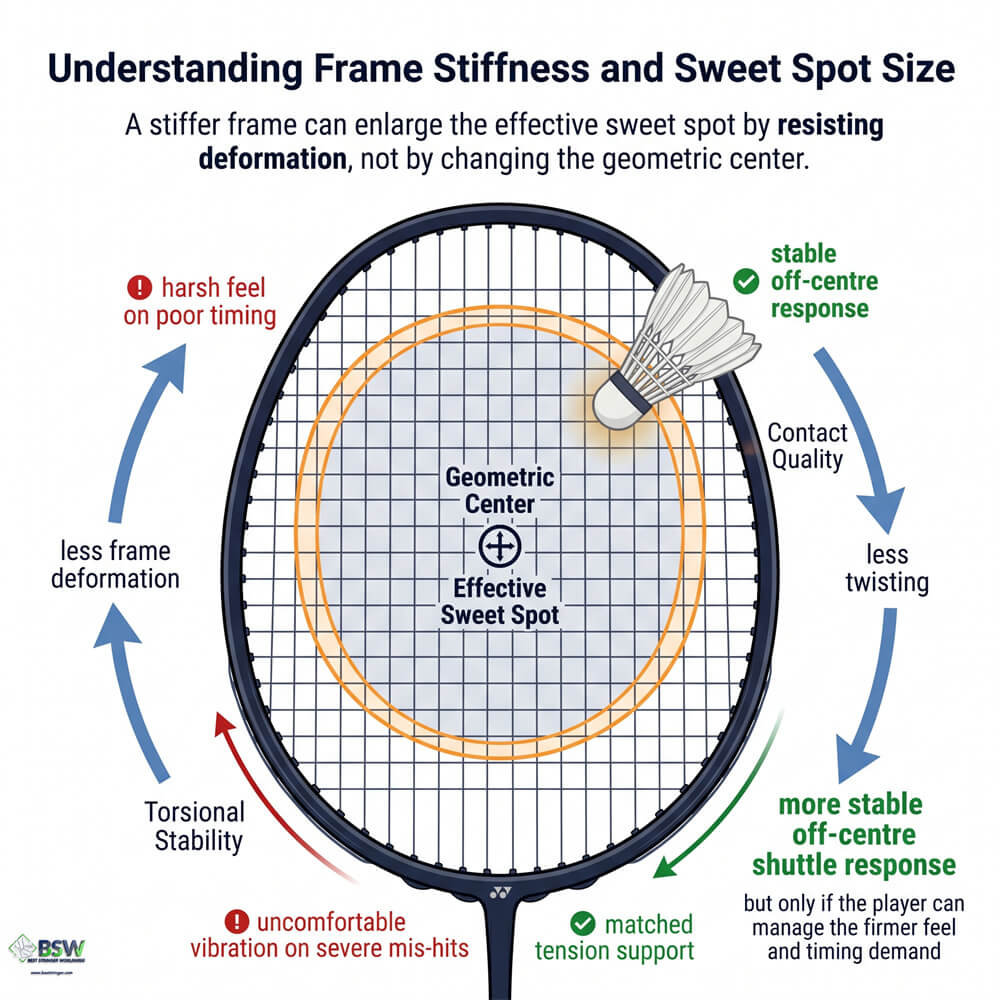
Understanding Frame Stiffness and Sweet Spot Size
One of the most essential concepts in badminton equipment is how frame rigidity affects off-centre stability. When all other conditions are kept the same, a stiffer badminton racquet frame tends to have a larger effective sweet spot. This occurs because a firmer frame deforms less upon impact, reducing unwanted twisting and providing a highly stable shuttle response across a slightly wider usable area.
While a stiffer frame is structurally capable of preserving shot quality on slight mis-hits, it is not a magical guarantee of better performance for every badminton player. A stiffer frame demands excellent contact quality and timing. If your technique is inconsistent, the frame’s rigidity will result in a harsh feel and uncomfortable vibrations, rather than a forgiving response.
This is why informed setup advice is crucial. Step 1: Understand that stiffer frames maximize stability only if you can handle the firm feel. Step 2: Evaluate your own comfort limits and strength honestly. Step 3: Consult a certified stringer to balance your racquet’s natural frame stiffness with a string tension that perfectly complements your playing level.
1.2 Impact Physics
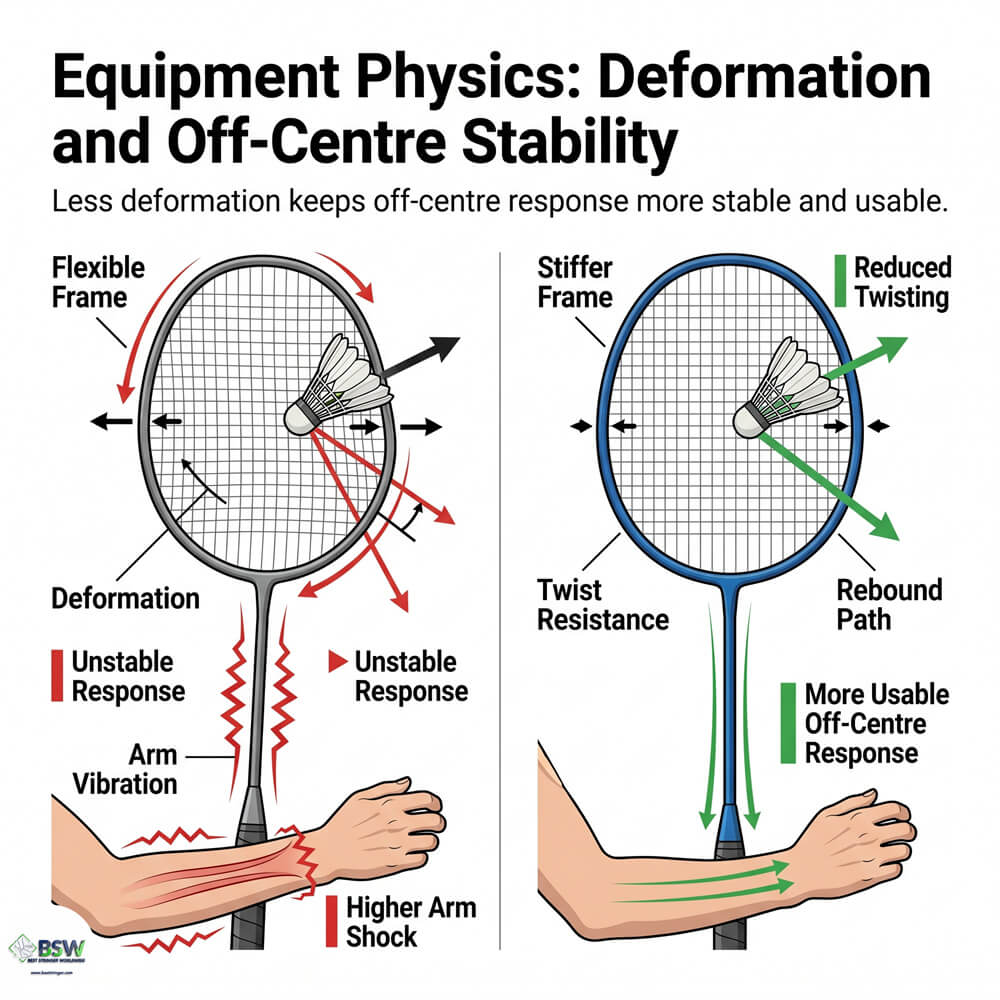
Equipment Physics: Deformation and Off-Centre Stability
To understand why a stiffer badminton racquet frame tends to have a larger effective sweet spot, you must look at the exact moment of impact. When the shuttlecock hits the stringbed outside the geometric centre, a highly flexible frame will physically warp and twist under the pressure. This deformation causes the shot to feel weak, unstable, and poorly controlled.
Conversely, a stiffer frame maintains its structural integrity remarkably well during a slightly off-centre collision. By resisting deformation, the firm frame anchors the stringbed securely. The player perceives a more usable, forgiving hitting area because the racquet still returns a solid shot even when contact isn’t perfect.
However, this stability comes with trade-offs. Because the stiff frame doesn’t bend to absorb the shock of a bad mis-hit, it transmits more vibration directly to your arm. Evaluating whether you prefer off-centre stability over raw vibration dampening is a crucial part of setup selection for any serious badminton player.

1.3 Stiffness Distinctions
Frame Stiffness vs Shaft Stiffness
While the claim that a stiffer frame creates a larger effective sweet spot is technically correct, players often confuse frame stiffness with shaft stiffness. Frame stiffness refers purely to the rigidity of the racquet head at the moment of shuttle impact. Shaft stiffness refers to how much the racquet bends down near the handle during your swing.
You can have a racquet with a highly stiff frame for off-centre stability, paired with a medium-flex shaft to assist with timing and swing speed. If both the frame and the shaft are extremely stiff, the racquet will demand flawless technique, punishing any slight mis-hit with a very harsh, jarring vibration that completely masks the sweet spot.
Therefore, advanced players with explosive swing speeds can fully unlock a stiff frame/stiff shaft combination. For intermediate players, finding a racquet with a stiff frame (for impact stability) but a slightly more forgiving shaft behavior is often the key to maximizing both comfort and effective sweet spot feel.
1.4 Stringbed Interaction
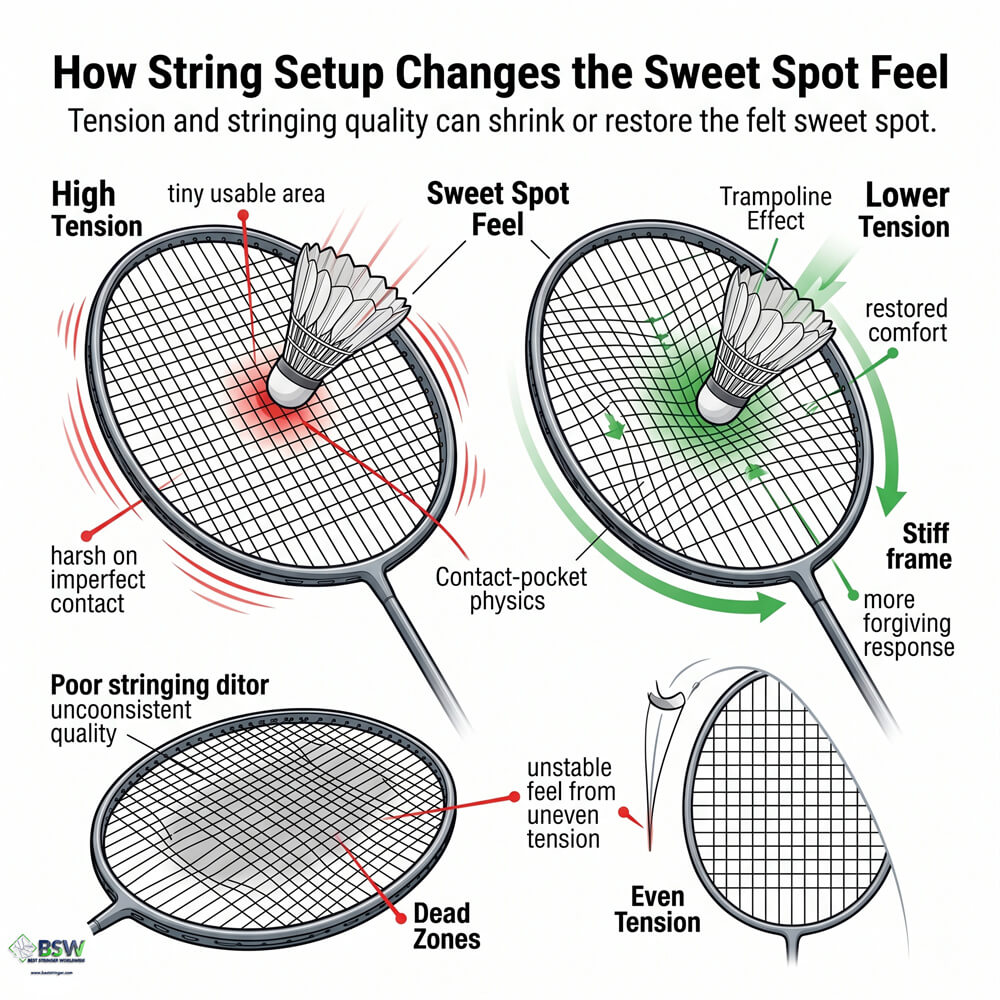
How String Setup Changes the Sweet Spot Feel
Even the stiffest, most stable badminton racquet frame can feel entirely unresponsive if the string setup is wrong. A certified stringer knows that tension directly interacts with frame rigidity to define your final sweet spot size.
String Tension and Forgiveness. Stringing an already stiff frame at an excessively high tension (28+ lbs) creates a setup with almost zero stringbed deformation. If you lack professional swing speed, this setup shrinks the sweet spot drastically. Lowering the tension allows the stringbed to act like a trampoline, restoring the forgiving feel while the stiff frame keeps the shot stable.
The Role of Stringing Quality. Poor stringing consistency can completely confuse a player’s feedback. If tension is uneven, the racquet will feel unstable and weak, leading players to mistakenly believe their frame has a tiny sweet spot.
The Stringer’s Influence. This is why any reputable badminton stringing course teaches setup synergy. A trained badminton stringer must analyze the stiffness of your frame and adjust the tension to optimize your specific sweet spot size, rather than just pulling strings to a random number.
1.5 Common Mistakes
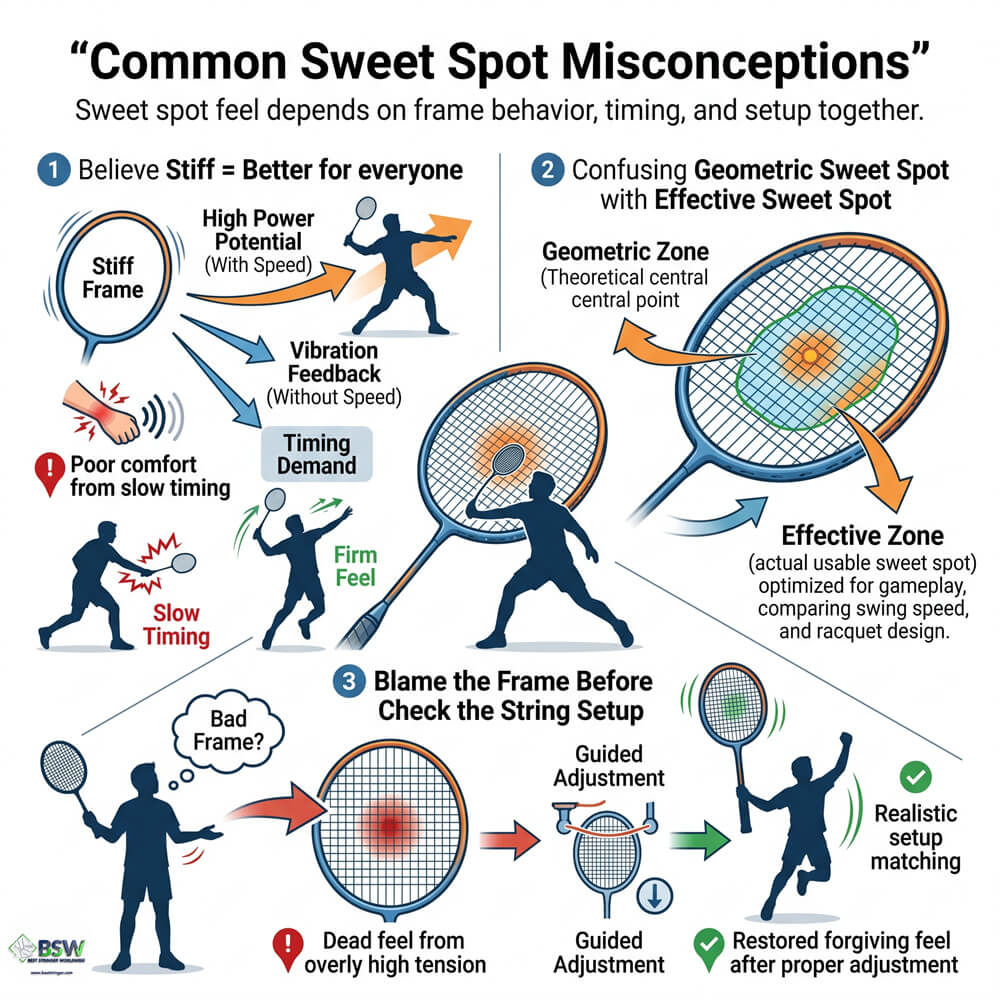
Common Sweet Spot Misconceptions
Mistake 1: Believing Stiff Equals Better For Everyone.
While a stiffer badminton racquet frame provides a larger effective sweet spot on slight mis-hits, it demands good timing. If your swing is too slow, the rigidity of the frame will actually make the racquet feel totally unforgiving and uncomfortable.
Mistake 2: Confusing Geometric and Effective Zones.
The physical size of the stringbed (the geometric sweet spot) doesn’t change with frame stiffness. What changes is how stable the shot feels when you miss that dead centre, known as the effective sweet spot.
Mistake 3: Ignoring the Stringer’s Advice.
Blaming a frame for feeling “dead” without analyzing the string setup is a frequent error. In many cases, consulting a trained badminton stringer to slightly lower the tension will instantly restore a massive, forgiving sweet spot feel.
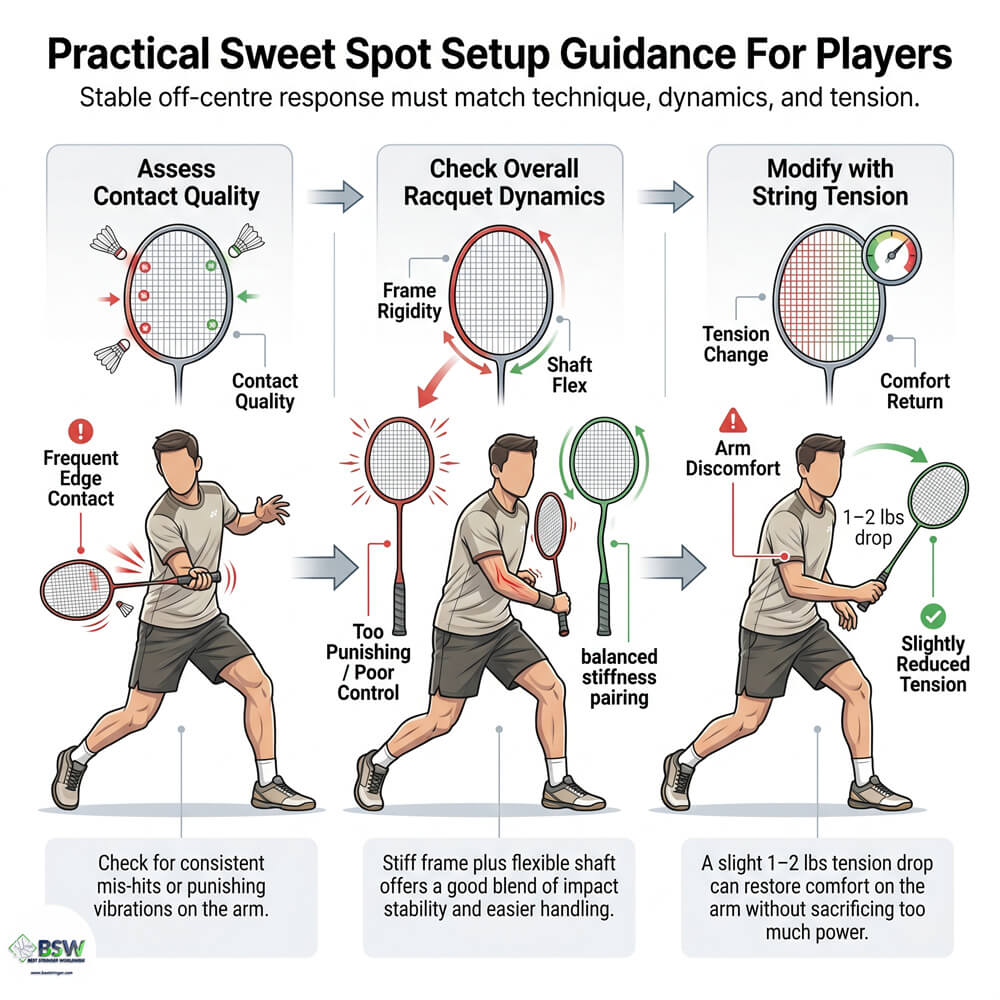
1.6 Selection Framework
Practical Sweet Spot Setup Guidance For Players
When searching for a more stable off-centre response, understanding your own limits is vital. Use this guidance to navigate frame stiffness safely:
Step 1: Assess Your Contact Quality. Can you consistently hit the geometric sweet spot? A stiffer frame will reward slight mis-hits with better stability, but if you frequently hit near the frame edge, the vibration harshness will outweigh the stability benefits.
Step 2: Check Overall Racquet Dynamics. Evaluate the frame’s rigidity alongside the racquet’s weight, balance, and shaft flexibility. A stiff frame paired with a flexible shaft often provides the perfect blend of a large effective sweet spot and easy handling.
Step 3: Modify with String Tension. Use string type and tension to fine-tune the feel. If your new stiff frame feels too punishing on the arm, ask your stringer to lower the tension by 1-2 lbs to increase stringbed deformation and restore comfort.

1.7 Further Learning
The Value of Stringer Certification
True equipment mastery goes beyond simple marketing claims. This is why a professional badminton stringing course emphasizes the interaction between frame stiffness, stringbed response, and actual player ability.
At Best Stringer Worldwide, we train stringers to understand that a stiffer frame limits deformation and improves off-centre stability, but only if the player’s technique can support the firmer feel. A certified stringer won’t blindly suggest high tension on a stiff frame if the player is already struggling to find the sweet spot.
Stringer certification ensures that technical advice is grounded in reality. By understanding the physics of badminton racquet frame deformation, our stringers provide setup recommendations that truly enhance your perceived sweet spot size while protecting your arm.
Frame Stiffness Quick FAQ
Clear, honest answers about how frame rigidity impacts your effective sweet spot and shuttle response.
Does a stiffer badminton racquet frame have a larger sweet spot?
Yes, under similar conditions, it provides a larger effective sweet spot. While the geometric stringbed size remains the same, a stiffer frame deforms less upon shuttle impact. This resistance to twisting makes off-centre hits feel more stable and usable.
Why can a stiffer frame feel more stable on off-centre hits?
It provides a much firmer base for the stringbed. Instead of the whole head warping backward when hitting the shuttle near the edge, a stiffer frame stays solid, creating a very crisp, reliable response that forgives slight inaccuracies.
Is frame stiffness the same as shaft stiffness?
No. Frame stiffness relates to the racquet head’s rigidity during the exact moment of impact. Shaft stiffness determines how the long stick of the racquet bends and kicks back during the actual swing phase before impact.
Does a stiffer frame suit every badminton player?
No. While the sweet spot is effectively wider, the firmer frame absorbs very little shock. Severe mis-hits will vibrate harshly, and if the player lacks good basic timing, the racquet will feel stiff and uncomfortable rather than forgiving.
Can string tension change sweet spot feel?
Yes, significantly. If you pair a stiff frame with very high string tension, the stringbed won’t deform either, resulting in a tiny, dead-feeling sweet spot for most players. Lowering tension allows the string to trampoline, expanding the comfortable hitting area.
Why can poor stringing confuse a player’s feedback?
If stringing quality is inconsistent, tension drops rapidly or unevenly. This creates dead zones on the stringbed, making a stable, stiff frame feel muddy or weak, leading the player to misjudge the racquet’s actual sweet spot capability.
What should a stringer consider before advising?
A badminton stringer must assess the player’s technique and comfort limits. Suggesting a highly stiff frame for a larger effective sweet spot requires verifying that the player can handle the firmer feel, and adjusting string tension to prevent arm injuries.
Why do certification and course knowledge matter?
A badminton stringing course teaches the physics of frame deformation and setup synergy. Stringer certification guarantees the professional understands how to manipulate string tension to maximize the forgiving sweet spot response of a stiffer frame.
Can a flexible frame ever hit harder?
Yes, for certain players. If a player has a slower swing, a more flexible frame and shaft will act like a slingshot, generating easy depth that they couldn’t achieve with a stiffer, more demanding racquet. A certified stringer helps find this balance.
The Physics of Stability: Why Frame Rigidity Matters
Structural Stability & Effective Sweet Spot
Highly Flexible Frame
A flexible racquet frame physically warps and twists upon shuttle impact. Because it struggles to hold its shape, the effective sweet spot is small.
👆 Tap the targets on the stringbed to test structural stability.
Severe Torsion
Striking outside the geometric centre causes the flexible frame to twist violently. Energy is lost, vibration increases, and the shuttle rebounds weakly.
Rigid / Stiff Frame
A stiff frame resists structural twisting. By anchoring the stringbed securely, it provides a highly stable shuttle response, creating a larger effective sweet spot.
👆 Tap the targets on the stringbed to test structural stability.
High Stability Maintained
Despite missing the geometric centre, the stiff frame resists deformation. The shuttlecock still launches cleanly with preserved power and direct feedback.
Perfect Centre Strike
When you hit the exact geometric centre, almost no twisting forces are applied to the frame. The shot is pure, utilizing maximum string trampoline effect.
Proven Specifications
Our stringing approach is based on verified equipment parameters used by top professionals. We prioritize arm safety, proper racquet frame evaluation, and playstyle efficiency over pure tension hype.
| Racquet & Setup Trait | Stiffer Frame (All else equal) | Flexible Frame (All else equal) |
|---|---|---|
| Effective Sweet Spot Feel | Feels larger and more stable on off-centre hits. | Feels smaller; requires precise centre contact. |
| Frame Deformation at Impact | Resists warping, maintaining structural integrity. | Warps and twists more, absorbing impact energy. |
| Off-Centre Stability | Highly stable, preserving shot quality on slight mis-hits. | Prone to twisting, resulting in weaker off-centre shots. |
| Vibration & Comfort | Harsher vibration; firmer impact feel on the arm. | Absorbs shock better; softer and more comfortable. |
| Player Suitability | Players seeking maximum stability and crisp response. | Players needing arm comfort and easy handling. |
| Advice from a Certified Stringer | Adjust tension carefully to prevent a punishing, dead feel. | Optimize tension to control the natural trampoline effect. |
Master Racquet Setup with Best Stringer Worldwide
Ready to upgrade your knowledge? Best Stringer Worldwide offers professional stringing consultation to teach you how frame stiffness and string setups affect the sweet spot safely. We serve badminton players worldwide especially in Singapore, Hong Kong, Malaysia, Indonesia, UK, France and Europe. Get a certified stringer certification to find the perfect tension and gauge for players everywhere.