1.1 Frame Dynamics
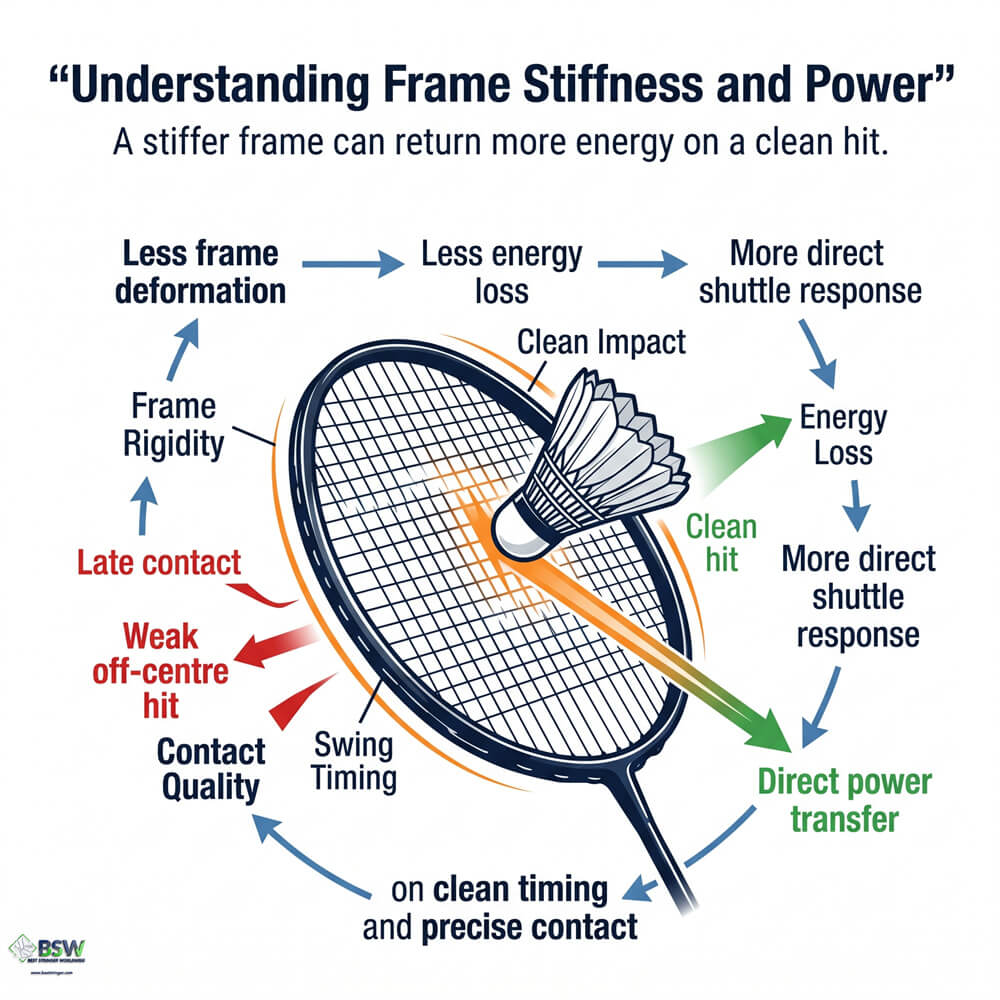
Understanding Frame Stiffness and Power
One of the most essential concepts in badminton equipment is how frame rigidity affects energy transfer. When all other conditions are kept the same, a stiffer badminton racquet frame will usually produce greater power. This occurs because a firmer frame deforms less upon impact, reducing unwanted energy loss and providing a highly direct shuttle response.
While a stiffer frame is structurally capable of returning more force to the shuttle, it is not a magical guarantee of better performance for everyone. A stiffer frame demands excellent swing timing and precise shuttle contact. If your technique is inconsistent, the frame’s rigidity will result in a harsh feel and weaker shots, rather than explosive power.
This is why informed setup advice is crucial. Step 1: Understand that stiffer frames maximize power only on clean hits. Step 2: Evaluate your own swing speed and strength honestly. Step 3: Consult a certified stringer to balance your racquet’s natural frame stiffness with a string tension that perfectly complements your playing level.
1.2 Impact Physics
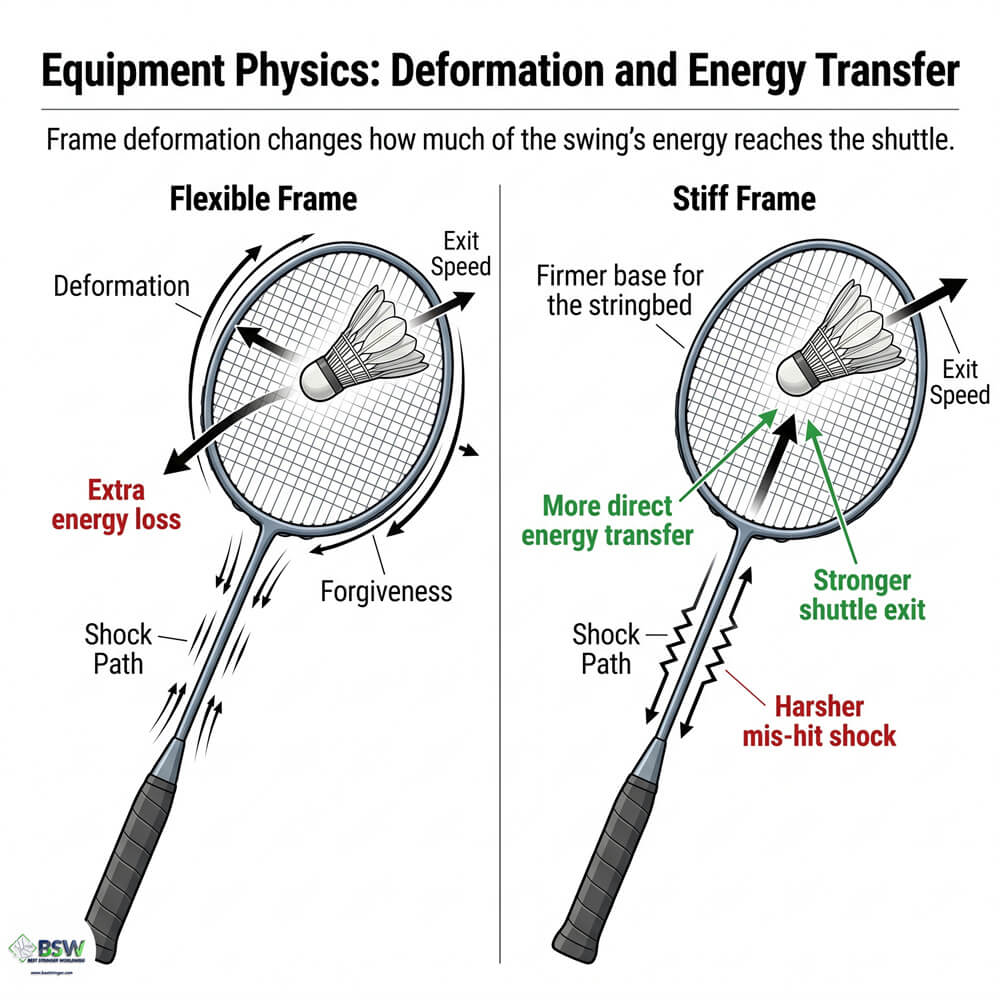
Equipment Physics: Deformation and Energy Transfer
To understand why a stiffer badminton racquet frame generates more power, you must look at the exact moment of impact. When the shuttlecock hits the stringbed at high speed, a flexible frame will slightly bend and warp under the pressure. This frame deformation absorbs a portion of your swing’s energy, meaning less of it is transferred back into the shuttle’s exit speed.
Conversely, a stiffer frame maintains its structural integrity incredibly well during a collision. By resisting deformation, the firm frame acts as a solid base for the stringbed. The energy from your swing is forcefully and directly channeled into the shuttle, resulting in a heavier, more penetrating smash.
However, this direct shuttle response comes with trade-offs. Because the frame doesn’t bend to absorb shock, it offers less forgiveness and transmits more vibration to your arm on mis-hits. Evaluating whether you can handle this demanding feel is a crucial part of racquet selection for any serious badminton player.
1.3 Stiffness Distinctions
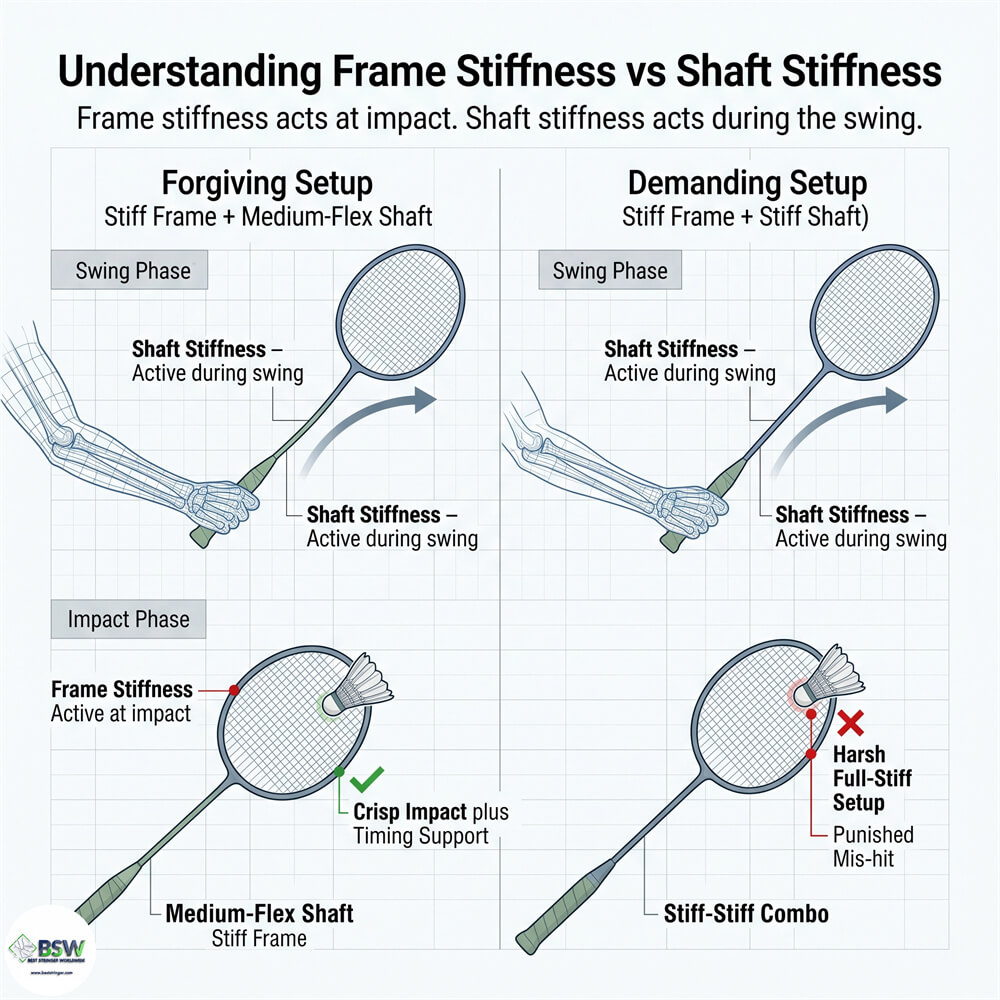
Understanding Frame Stiffness vs Shaft Stiffness
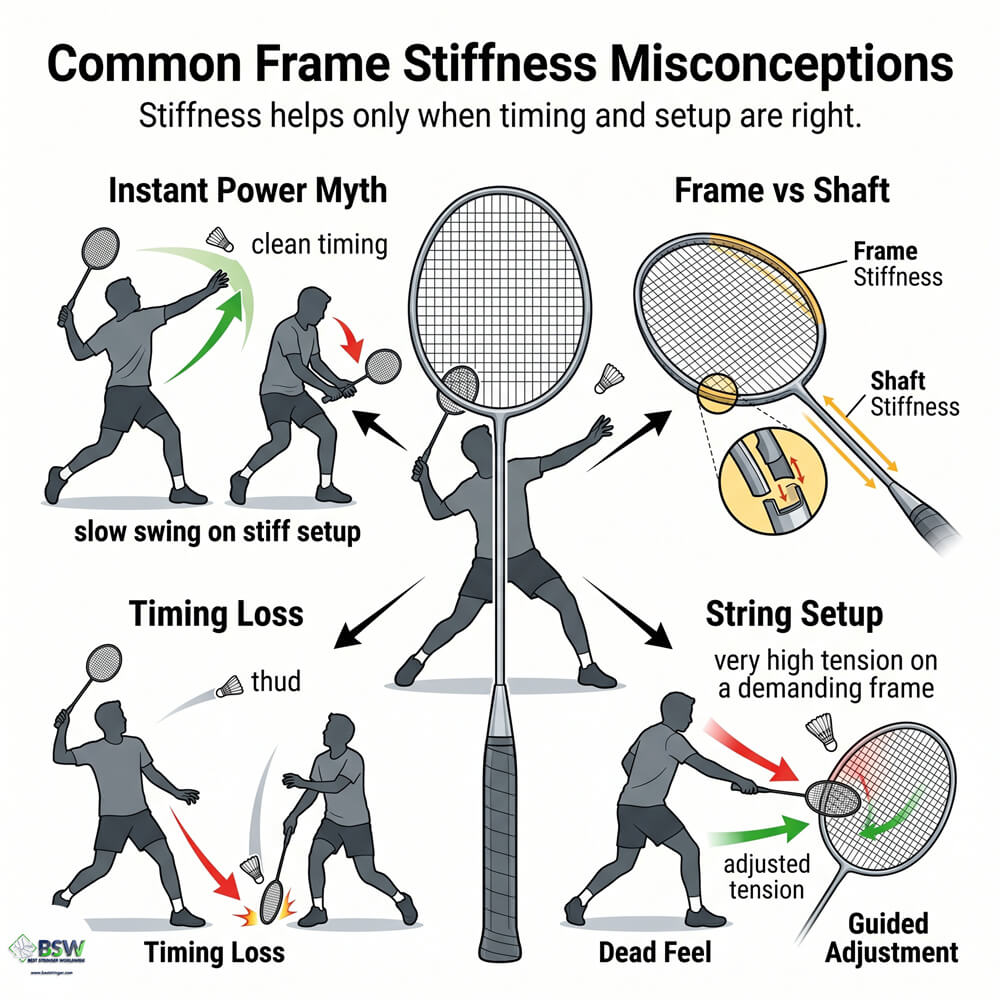
While the claim that a stiffer frame equals more power is technically correct, players often confuse frame stiffness with shaft stiffness. Frame stiffness refers purely to the rigidity of the racquet head at the moment of shuttle impact. Shaft stiffness refers to how much the racquet bends down near the handle during your swing.
You can have a racquet with a highly stiff frame for direct power transfer, paired with a medium-flex shaft to assist with timing and swing speed. If both the frame and the shaft are extremely stiff, the racquet will demand flawless technique, punishing any slight mis-hit with a very harsh, jarring vibration.
Therefore, advanced players with explosive swing speeds can fully unlock a stiff frame/stiff shaft combination. For intermediate players, finding a racquet with a stiff frame (for crisp impact) but a slightly more forgiving shaft behavior is often the key to maximizing both comfort and raw shuttle speed.
1.4 Stringbed Interaction
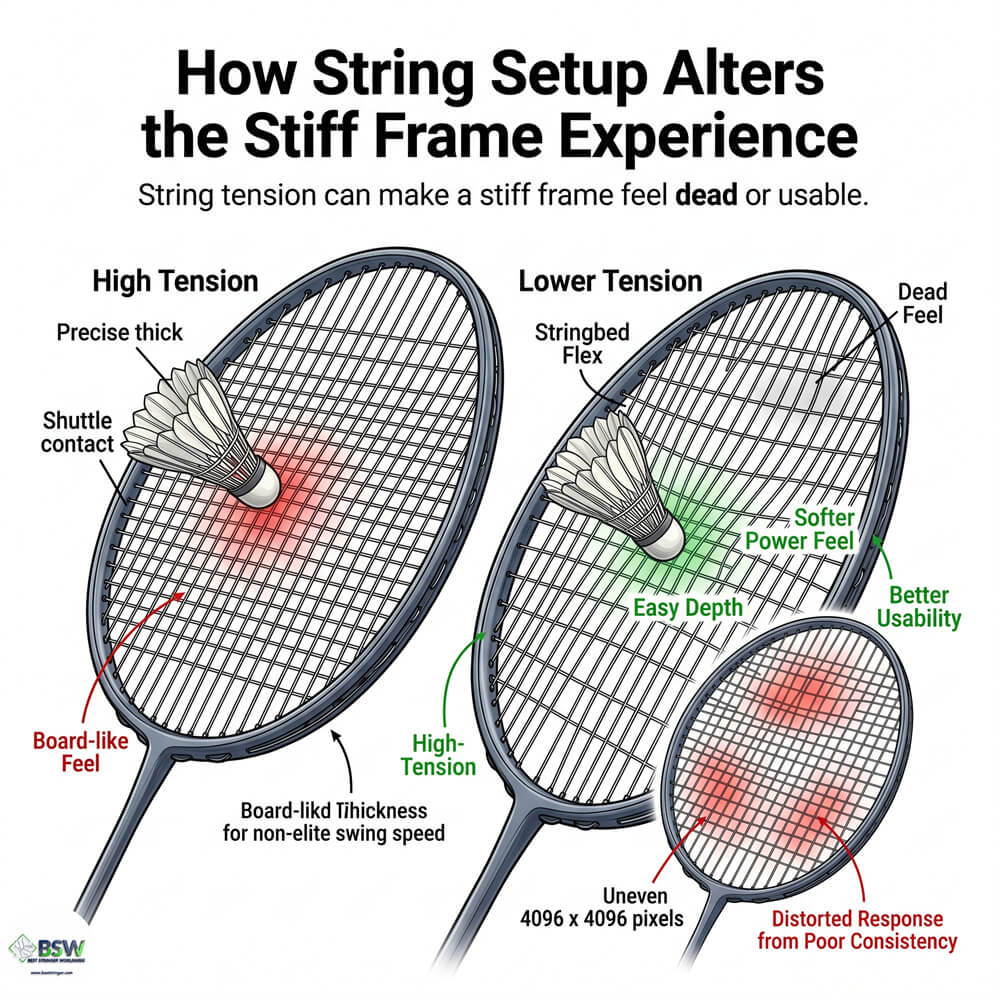
How String Setup Alters the Stiff Frame Experience
Even the stiffest, most powerful badminton racquet frame can feel entirely unresponsive if the string setup is wrong. A certified stringer knows that tension directly interacts with frame rigidity.
String Tension and Power Feel. Stringing an already stiff frame at an excessively high tension (28+ lbs) creates a setup with almost zero deformation. If you lack professional swing speed, this setup will feel like hitting with a wooden board. Lowering the tension allows the stringbed to flex and provide easy depth, softening the harshness of the rigid frame.
The Role of Stringing Quality. Poor stringing consistency can completely confuse a player’s feedback. If tension is uneven, the racquet will feel unstable and weak, leading players to mistakenly blame the frame stiffness.
The Stringer’s Influence. This is why any reputable badminton stringing course teaches setup synergy. A trained badminton stringer must analyze the stiffness of your frame and adjust the tension to optimize your specific power generation, rather than just pulling strings to a random number.
1.5 Common Mistakes
Common Frame Stiffness Misconceptions
Mistake 1: Believing Stiff Equals Instant Power.
While a stiffer badminton racquet frame can produce greater power on a perfect impact, it does not magically create energy. If your swing is slow or your timing is off, the stiffness will actually make the racquet feel powerless and unforgiving.
Mistake 2: Confusing Frame and Shaft Stiffness.
Many players buy an “extra stiff” racquet expecting pure frame power, only to discover the shaft is also too rigid to bend during their swing, completely ruining their clearing depth.
Mistake 3: Ignoring the Stringer’s Advice.
Blaming a frame for feeling “dead” without analyzing the string setup is a frequent error. In many cases, consulting a trained badminton stringer to lower the tension will instantly restore the power feel of a stiff frame.
1.6 Selection Framework
Practical Power Setup Guidance For Players
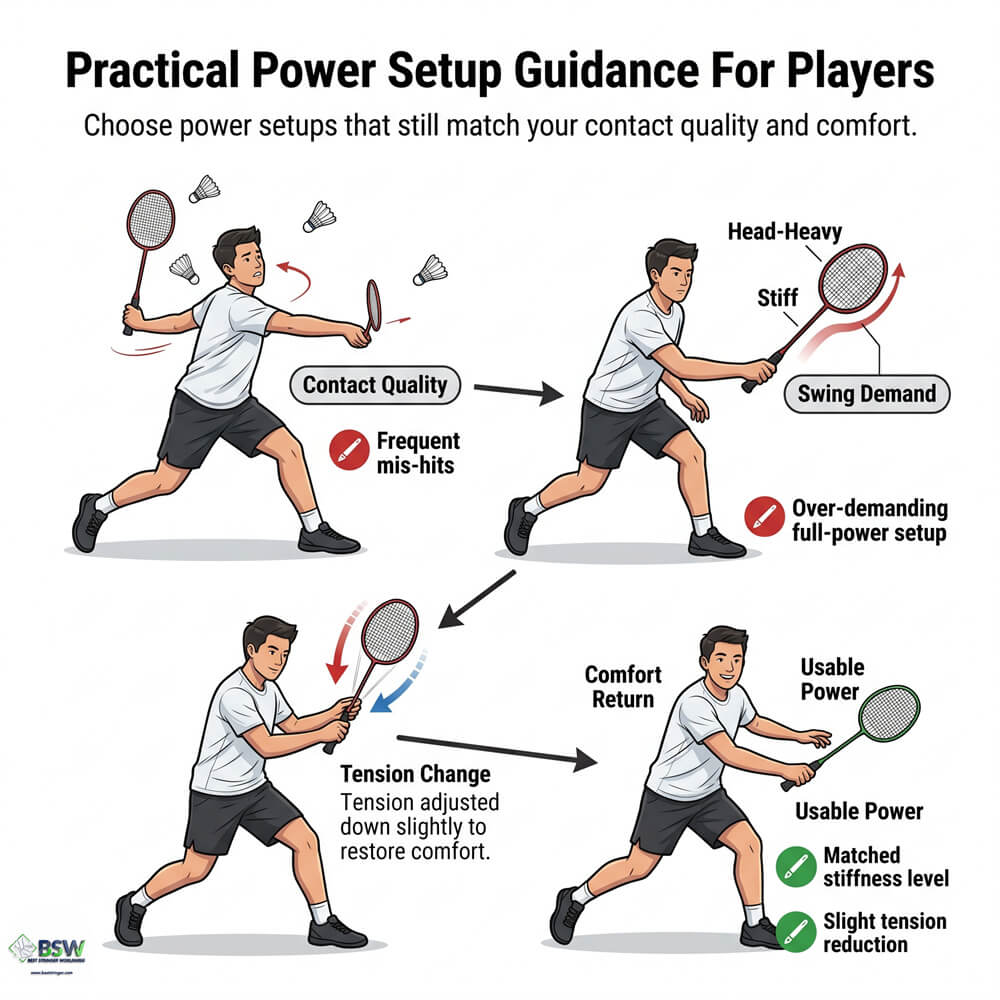
When searching for a more direct shuttle response, understanding your own limits is vital. Use this guidance to navigate frame stiffness safely:
Step 1: Assess Your Contact Quality. Can you consistently hit the sweet spot? A stiffer frame will reward clean hits with massive energy transfer, but if you frequently mis-hit, the harshness and lack of forgiveness will outweigh the power benefits.
Step 2: Check Overall Racquet Dynamics. Evaluate the frame’s rigidity alongside the racquet’s weight and balance. A stiff, head-heavy racquet is the ultimate power weapon, but it demands elite physical strength to swing quickly.
Step 3: Modify with String Tension. Use string type and tension to fine-tune the feel. If your new stiff frame feels too punishing, ask your stringer to lower the tension by 1-2 lbs to increase stringbed deformation and restore comfort.

1.7 Further Learning
The Value of Stringer Certification
True equipment mastery goes beyond marketing claims. This is why a professional badminton stringing course emphasizes the interaction between frame stiffness, stringbed response, and actual player ability.
At Best Stringer Worldwide, we train stringers to understand that a stiffer frame limits deformation and improves power transfer, but only if the player’s technique can support it. A certified stringer won’t blindly suggest high tension on a stiff frame if the player is already struggling with comfort.
Stringer certification ensures that technical advice is grounded in reality. By understanding the physics of badminton racquet frame deformation, our stringers provide setup recommendations that truly enhance your power generation while protecting your arm.
Frame Stiffness Quick FAQ
Clear, honest answers about how frame rigidity impacts your power and shuttle response.
Does a stiffer badminton racquet frame produce more power?
Yes, under similar conditions. A stiffer frame deforms less upon shuttle impact. Because it does not bend and absorb your swing’s energy, it transfers that force more efficiently into the shuttle, producing a heavier, faster exit velocity.
Why can a stiffer frame feel more powerful?
It provides a much firmer base for the stringbed. Instead of the whole head warping backward when hitting the shuttle, a stiffer frame stays solid, creating a very crisp, direct shuttle response that feels highly responsive on clean hits.
Is frame stiffness the same as shaft stiffness?
No. Frame stiffness relates to the racquet head’s rigidity during the exact moment of impact. Shaft stiffness determines how the long part of the racquet bends and kicks back during the actual swing phase before impact.
Does a stiffer frame suit every badminton player?
No. Because it absorbs very little impact energy, it is far less forgiving. Mis-hits will vibrate harshly, and if the player lacks the timing and swing speed to generate power, the racquet will actually feel difficult and punishing to use.
Can string tension change power feel?
Yes, significantly. If you pair a stiff frame with very high string tension, the stringbed won’t deform either, resulting in a “dead” feel for most players. Lowering tension allows the string to trampoline, bringing usability back to a stiff frame.
Why can poor stringing confuse player feedback?
If stringing quality is inconsistent, tension drops rapidly or unevenly. This creates dead zones on the stringbed, making a powerful, stiff frame feel muddy or weak, leading the player to misjudge the racquet’s actual capability.
What should a stringer consider before advising?
A badminton stringer must assess the player’s technique and comfort limits. Suggesting a highly stiff frame requires verifying that the player can handle the reduced forgiveness and adjusting string tension to prevent arm injuries.
Why do certification and course knowledge matter?
A badminton stringing course teaches the physics of frame deformation and setup synergy. Stringer certification guarantees the professional understands how to manipulate string tension to perfectly suit the power response of a stiffer frame.
Can a flexible frame ever hit harder?
Yes, for certain players. If a player has a slower swing, a more flexible frame and shaft will act like a slingshot, generating easy depth that they couldn’t achieve with a stiffer, more demanding racquet. A certified stringer helps find this balance.
The Physics of Power: Why Frame Rigidity Matters
Stiffness & Power
Press and hold the racket head to load energy, then release to shoot. Notice how a flexible frame bends deeply, absorbing energy, while a stiffer frame resists bending to transfer maximum speed to the shuttle.
Proven Specifications
Our stringing approach is based on verified equipment parameters used by top professionals. We prioritize arm safety, proper racquet frame evaluation, and playstyle efficiency over pure tension hype.
| Racquet & Setup Trait | Stiffer Frame (All else equal) | Flexible Frame (All else equal) |
|---|---|---|
| Directness of Response | Instant, direct shuttle exit speed on impact. | Slightly delayed, holds the shuttle longer before release. |
| Power Transfer on Clean Hits | Maximum energy return, resulting in higher peak power. | Some energy is absorbed by frame deformation. |
| Forgiveness & Comfort | Harsher vibration, demanding on technique and timing. | Highly forgiving, softer impact feel on the arm. |
| Player Suitability | Advanced badminton players with excellent swing speed. | Beginners to intermediates seeking easy depth and comfort. |
| Setup Sensitivity | Highly sensitive to string tension changes; easily feels dead. | More tolerant of imperfect stringing or tension drops. |
| Advice from a Certified Stringer | Balance tension carefully to prevent excessive harshness. | Optimize setup to help generate easy clear depth. |
Master Racquet Setup with Best Stringer Worldwide
Ready to upgrade your knowledge? Best Stringer Worldwide offers professional stringing consultation to teach you how frame stiffness and string setups affect power safely. We serve badminton players worldwide especially in Singapore, Hong Kong, Malaysia, Indonesia, UK, France and Europe. Get a certified stringer certification to find the perfect tension and gauge for players everywhere.