






1.1 Starting Point
What are the signs your stringing is at exam standard?
You are ready to apply for stringer certification when your work shows the signs, not when a clock says you have practised enough. The signs are plain to see. Your delivered tension matches the set tension racket after racket. Your knots sit clean and hold. Your grommet habits protect every frame without being reminded. And your self checks are honest, written down and repeatable. Best Stringer Worldwide, founded by Eric Chuar and based in Kuala Lumpur, Malaysia, examines exactly those things, in a practical exam assessed and approved by the BSW certification board.
Hours and racket counts feel reassuring, but they measure attendance at your own machine, not standard. A stringer can repeat one weaving fault for a long time and call it experience. Another can reach clean, repeatable work sooner because every practice racket was checked. Readiness lives in the finished rackets and the records, which is where this guide teaches you to look for it.
Read each sign in this guide as a question you answer with evidence. Not, do I feel ready, but, can I show it: the tension checks, the knot close ups, the grommet work, the record book. If the evidence is there across several sessions, applying is a sensible next step. If it is patchy, the same signs tell you exactly what to practise next.

1.2 Preparation
What will the exam ask of you that practice must prove?
The exam will ask for the same work your signs describe, performed once, under observation, on rackets you did not choose for comfort. Frame inspection before mounting. Safe mounting without distortion. Clean weaving of mains and crosses. Delivered tension at the set number, checked rather than assumed. Clamp control that leaves no marks on thin badminton string at 0.65mm to 0.70mm gauges. Starting and finishing knots tied the same clean way every time. Grommet care throughout, including shared holes and worn grommets spotted early. Practice must prove each task, not just the whole job.
Observation changes performance, so readiness includes working calmly while watched. Practise with someone looking over your shoulder, or talk through your steps aloud as you string, so exam day attention feels familiar. A candidate whose standard only exists alone, in silence, at home pace, is not yet showing the full sign set an exam needs.
The exam also asks for judgement, not only technique. What do you do when a frame shows damage, a grommet is split, or a cross will not sit right? Ready candidates slow down, state the problem and handle it the careful way. Practising only perfect rackets leaves this sign untested, so include awkward frames in your preparation on purpose.
1.3 Working Method
How does checked practice turn signs into readiness?
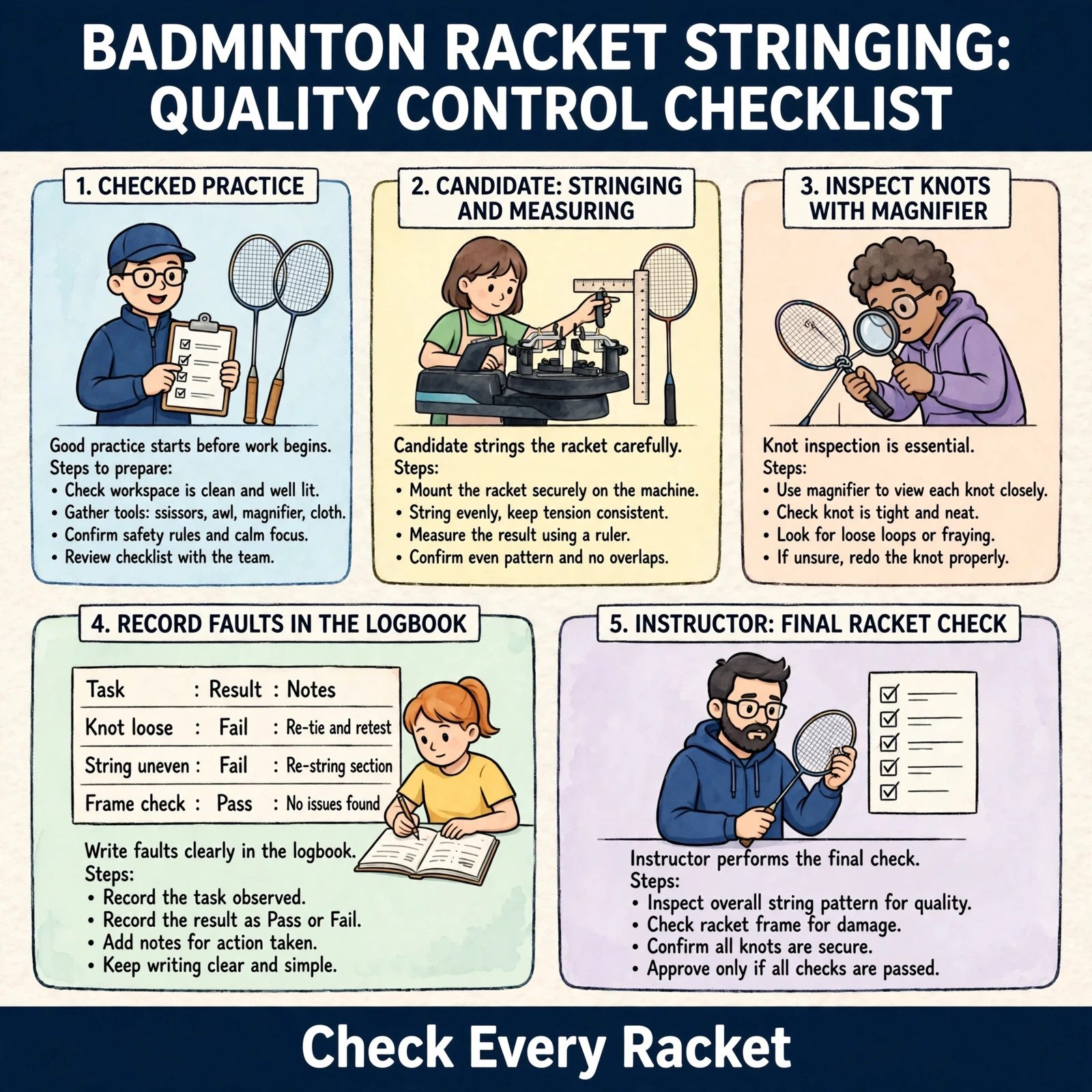
Checked practice is what turns occasional good rackets into reliable signs. The loop is simple. String a racket, then check it like an examiner: measure the delivered result against the set tension, inspect both knots closely, run your eye along the grommets and crosses, and write down every fault you find. Then string the next racket aiming at those faults specifically. An instructor or experienced stringer checking some of your rackets sharpens the loop, because self checking misses the faults your own habits feel normal.
Vary the practice on purpose. Use different rackets, different strings such as Yonex BG65, BG66 Ultimax and Exbolt 63, and typical tensions of 25 to 27 lbs, so your signs are not tied to one comfortable setup. Readiness that only appears with your favourite string on your favourite frame is a local habit, not an exam standard that travels with you.
Keep the record brutally plain. Date, racket, string, set tension, delivered check, knot notes, grommet notes, one line per job. When the same fault appears three times, that fault becomes your next practice target. When a whole page shows no repeats of an old fault, that sign is earned. Feelings fade by exam morning. Records do not.

1.4 Practical Review
Which costs and commitments come with getting ready?
Getting ready costs more than the exam fee, and honest planning lists every category. Training or course fees where you take one. The exam or assessment fee itself. String and materials for real practice across varied rackets, because signs are proven on many jobs, not one. Machine and tool upkeep so your equipment is not the variable. Travel and stay if your body tests in another city or country. Time set aside weekly for checked practice. And the retake arrangement, understood before you need it, not after a bad day.
Check the details. This guide puts no figures on those categories, on purpose. Fees differ by body and by year, and readiness advice that quotes tidy totals is guessing. Ask each provider for the current figure for every category, in writing, and keep the answers with your practice records, so your decision to apply rests on complete information.
Review the process. The practice commitment is the part candidates try to compress. Signs become reliable over weeks of checked sessions, because hands learn consistency slowly and records need several sessions to mean anything. If you string for a shop, arrange cover for training days early. If you travel for the exam, arrive rested, with your last practice sessions calm rather than frantic.
Plan the next step. There is a cost to applying too early, and it is worth naming. An exam taken on hope can end in a fail that better timing would have avoided, plus retake costs and a dent in confidence. Waiting until your signs hold is not delay. It is the cheapest route to a pass, because you pay for preparation once instead of paying for the exam twice.

1.5 Key Checks
How do you score your readiness honestly, sign by sign?
Record the context.
Score your readiness sign by sign, in writing, against the exam scope. Delivered tension: does it match the set number across your last several rackets, on different strings? Knots: clean, consistent and holding on every job, or tidy only when you slow down? Grommets: spotted, protected and replaced without prompting? Frame care: inspection first, every time? Self checks: recorded honestly, including the bad sessions? Mark each sign ready, nearly or not yet, using your records as evidence. Any sign marked not yet is a practice plan, not a verdict on you.
Check the details.
Use another pair of eyes for the final scoring if you can. Hand an experienced stringer or instructor your recent rackets without explaining them first, and ask what they see. Outside eyes catch the marked string, the slightly proud knot and the rushed cross that your own checking has learned to skip. Their notes belong in your record beside your own.
Review the process.
Decide by the pattern, not the best day. One excellent racket proves you can do it. Several ordinary sessions at the same clean standard prove you do it. Examiners meet the second kind of candidate gladly, because exam day nerves cost everyone a little polish. Readiness with margin is the goal: standard high enough that a nervous day still passes.

1.6 Service Record
How does the BSW route fit a ready candidate?
For a candidate whose signs hold, the BSW route fits in a specific way. The course is short and practical: 3 and a half days in Kuala Lumpur, classes from 10am to 5pm, flexible timing, with the practical exam on the last day. That shape suits ready candidates, because training corrects and polishes existing skill rather than building it from zero, and the exam then tests the finished standard on real rackets. Results are assessed and approved by the BSW certification board, and the scope is badminton specific throughout.
Check the details. The same honesty applies in reverse. If your signs do not hold yet, BSW training alone is not a substitute for weeks of checked practice, and this guide will not pretend a short course manufactures readiness from nothing. Do the practice first, arrive with your record, and the course days become correction and confirmation instead of a gamble.
Review the process. Founder Eric Chuar teaches from his Kuala Lumpur stringing and coaching base, while the certification decision belongs to the BSW certification board as an organisation. For ready candidates that separation matters: the person who polished your knots is not the whole of the body that records your pass, which is part of what makes the credential checkable afterwards.
Plan the next step. Before applying, ask BSW the questions this guide asks of every body. What exactly does the exam test, task by task? How can an employer verify my pass? What happens if I fail? BSW answers in the enquiry, before enrolment. A ready candidate asks sharp questions, and judges the answers as carefully as the body will judge the rackets.

1.7 Guided Practice
What should you ask before applying for stringer certification?
A readiness based enquiry sounds different from a hopeful one. State your signs with evidence: the tensions and strings you have checked, the state of your knots and grommet work, and the records you keep. Then ask the deciding questions. What does the exam test, task by task? Is it practical, written or both? Who assesses the result, and can an employer verify my pass? What does the full cost look like, category by category, including retakes? What happens if I fail? Write the answers down and set your application date against them, not against impatience.
Timing questions complete the picture. Ask when training runs, how long each day lasts and whether dates can flex around your work. At BSW, training is in Kuala Lumpur only, classes run from 10am to 5pm, the course takes 3 and a half days with the exam on the last day, and timing is flexible for learners travelling in. Any provider should state its own shape just as plainly.
Use the time before your course well. Keep checked practice going at a steady pace, revisit your weakest sign once more, and arrive with your record book in your bag. Candidates who apply on evidence tend to walk into the exam room calm, because the decision was already made by their rackets. That calm is itself one of the signs.
Stringer Certification Readiness Quick FAQ
Short answers to the questions candidates ask first about readiness signs, self checks, practice records and applying at the right time.
What are the readiness signs?
Readiness shows in signs, not hours: delivered tension matching the set tension repeatedly, clean knots that hold, careful grommet habits on every frame and honest written self checks. If those signs hold across several sessions, applying is a sensible next step.
What will the exam ask of you?
The exam asks for frame inspection, safe mounting, clean weaving, delivered tension, clamp control, knots and grommet care on real rackets under observation, plus calm judgement when a frame shows damage or a grommet is split. Practice must prove each task.
How does checked practice help?
String, then check like an examiner: delivered tension against the set number, both knots, grommets and crosses, with every fault written down and targeted next session. Vary rackets, strings and tensions so the standard travels, and let another experienced eye check some rackets.
Which costs and commitments come with readiness?
Getting ready costs more than the exam fee, and honest planning lists every category. Training or course fees where you take one. The exam or assessment fee itself. String and materials for real practice across varied rackets, because signs are proven on many jobs, not one. Machine and tool upkeep so your equipment is not the variable. Travel and stay if your body tests in another city or country. Time set aside weekly for checked practice. And the retake arrangement, understood before you need it, not after a bad day.
How do you score your readiness?
Write each sign down and mark it ready, nearly or not yet, using your practice records as evidence: repeatable tension, clean knots, grommet habits, frame care and honest self checks. A sign marked not yet simply becomes your next practice target.
How does the BSW route fit?
For a candidate who can already show the readiness signs, the BSW route is a direct fit. Training is hands on in Kuala Lumpur, running 3 and a half days with classes from 10am to 5pm, flexible timing and the practical exam on the last day, so your existing standard is corrected, polished and then tested on real rackets. Results are assessed and approved by the BSW certification board. BSW publishes no hour count or racket count that makes you ready, and neither should anyone else: your signs, checked honestly, are the evidence that matters.
What should you ask before applying?
A readiness based enquiry sounds different from a hopeful one. State your signs with evidence: the tensions and strings you have checked, the state of your knots and grommet work, and the records you keep. Then ask the deciding questions. What does the exam test, task by task? Is it practical, written or both? Who assesses the result, and can an employer verify my pass? What does the full cost look like, category by category, including retakes? What happens if I fail? Write the answers down and set your application date against them, not against impatience.
What should you keep from your preparation?
Keep your practice records: date, racket, string, set tension, delivered check, knot and grommet notes per job, plus any outside checker notes. They are your readiness evidence before the exam and your standard reference after it, showing how your work was proven.
How can I start with BSW?
Start with an enquiry that states your readiness signs and the records behind them, your machine and the work you want certification for. BSW trains in Kuala Lumpur only, with flexible timing, classes from 10am to 5pm over 3 and a half days and the practical exam on the last day.
Stringer Certification Readiness: Explore the Practical Decisions
Build a Clear Working Method
The method is simple: write the signs first, score your recent sessions against them using your records, and keep the evidence so your decision to apply can be explained to anyone.
| Readiness Check | Rushed Approach | Planned Approach |
|---|---|---|
| Signs | Count hours and assume you are ready | Judge readiness by repeatable signs in your work |
| Exam | Hope exam tasks feel familiar on the day | Rehearse each exam task until it is routine |
| Practice | Practise only your favourite string jobs | Practise weakest tasks with records and checks |
| Scorecard | Decide you are ready from one good racket | Score your last sessions against the exam scope |
| Your record | Keep readiness judgements in your head | Write each sign and your evidence down |
| Next action | Remember only your best practice racket | Use the full record to judge your standard |
Apply at Exam Standard with Best Stringer Worldwide
If your signs hold, apply while your standard is proven and current. Train on real rackets in Kuala Lumpur with Best Stringer Worldwide, with classes from 10am to 5pm over 3 and a half days, flexible timing, and the practical exam on the last day after your training is complete. Your work is assessed and approved by the BSW certification board. Send an enquiry that states your readiness evidence, your machine and your goal, and start with your questions answered in writing.

