






1.1 Starting Point
What does stringer certification for women actually offer?
Stringer certification for women is the same tested credential any stringer earns, reached through routes that are open, visible and judged on skill. A woman entering the trade does not need a separate standard or a softer exam. She needs what every serious candidate needs: a named body, a practical exam on real rackets, honest feedback while she learns, and a result that a body records. Best Stringer Worldwide, founded by Eric Chuar and based in Kuala Lumpur, Malaysia, runs that route for badminton: hands on training, then a practical exam assessed and approved by the BSW certification board.
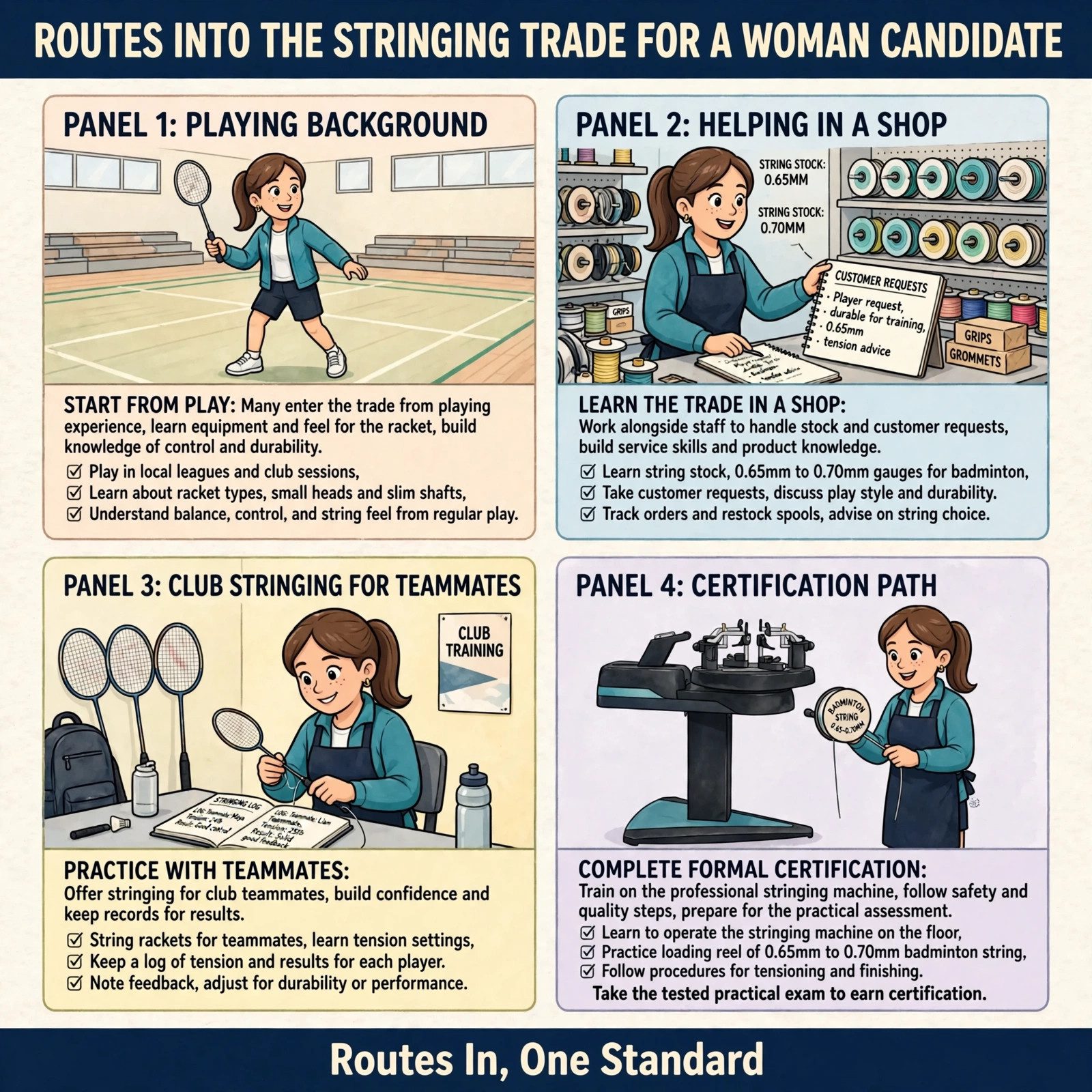
The routes in are ordinary and open to anyone who strings. Some women come from playing, some from helping in a family shop, some from club stringing for teammates, and some start from zero with a machine at home. None of those starting points is the test. The test is the work on exam day, and that is good news: a practical exam can be prepared for, task by task.
What certification offers a woman entering the trade is proof that does not depend on who she knows. A shop owner, a tournament organiser or a player can check a recorded pass. In a trade where work often arrives through introductions, a tested credential gives a newcomer a way to be judged on her stringing first, which is exactly how it should be.

1.2 Preparation
What does the certification exam reward, whoever sits it?
The exam rewards tested skill only, and it helps to say plainly what that means. The examiner watches frame inspection, safe mounting, clean weaving, delivered tension at the set number, clamp control, starting and finishing knots and grommet care, all on real rackets. Nothing on that list asks who taught you, how long you have been around the game, or whether stringing runs in your family. Badminton strings run thin, at 0.65mm to 0.70mm gauges, so the touch being tested is fine, patient work that any careful pair of hands can learn and demonstrate.
That also means preparation can be honest and specific. If your knots are untidy, you practise knots. If your delivered tension drifts, you practise checking tension. There is no hidden social part of the marking to guess at. Ask the body for the exam scope in writing before you apply, and build your practice around the tasks named there, nothing more and nothing less.
A fair exam does not remove every barrier outside the exam room, and this guide will not pretend otherwise. Finding practice rackets, machine time and people who take your goal seriously can still take persistence. But inside the assessment itself, the standard is the standard. Candidates who prepare against the published scope give themselves the cleanest possible chance.

1.3 Working Method
How do mentors and feedback help women entering the trade?
Mentors and feedback are how a newcomer turns solitary practice into exam standard work. A mentor does not have to be a famous name. It can be an experienced stringer at a local shop, a senior club stringer, or an instructor on a course, as long as that person watches your rackets and corrects what they see: clamp pressure before it marks string, weaving angle while crosses go in, knot tails trimmed to length. A woman entering the trade should ask directly for that kind of watching and correcting, and treat a clear yes as a strong sign.
Shop placements work the same way. Ask a shop if you can help with restrings under supervision, even for a few sessions, and ask what standard they would need before trusting you with customer rackets. Some shops will say yes, some will not, and both answers teach you something. Supervised customer work builds the habits home practice cannot: checking frames, recording requests and finishing to a deadline.
Be careful with encouragement that never looks at your work. Praise is pleasant, but it does not fix a knot. The people who help most are the ones who pick up your finished racket, test the bed, look at the grommets and tell you one true thing to improve. Seek those people out, keep their corrections in your practice record, and work through the list.

1.4 Practical Review
Which costs and commitments come with this route?
The costs of this route are the same categories every candidate faces, and listing them early keeps the plan honest. Training or course fees where you take a course. The exam or assessment fee itself. A machine and tools if you do not already have access to them, plus string and materials for real practice. Travel and stay if your chosen body tests in another city or country. Time away from work, family duties or your current stringing. And the retake arrangement, understood before you need it, not after a hard exam day.
Check the details. This page puts no figures on those categories, because fees differ by body and by year. Ask each provider for the current figure for every category, in writing. If machine access is your gap, price that honestly too: borrowing shop machine time, joining a club setup or saving for your own machine are all real routes, and each changes the total.
Review the process. Time is the commitment women entering the trade often plan last, so plan it early. Practice needs regular sessions spread over weeks, and travel for training needs cover at home and at work. Say what you need plainly to the people around you, the way you would for any serious course, and book the practice sessions like appointments.
Plan the next step. There is also a cost to waiting for a perfect invitation. Stringing work grows through practice and proof, and both take time to build. Starting with honest practice now, even on a small scale, costs less than restarting your confidence later. The tested route lets you begin where you are and measure progress against a published standard.
1.5 Key Checks
How should women compare routes into stringing fairly?
Record the context.
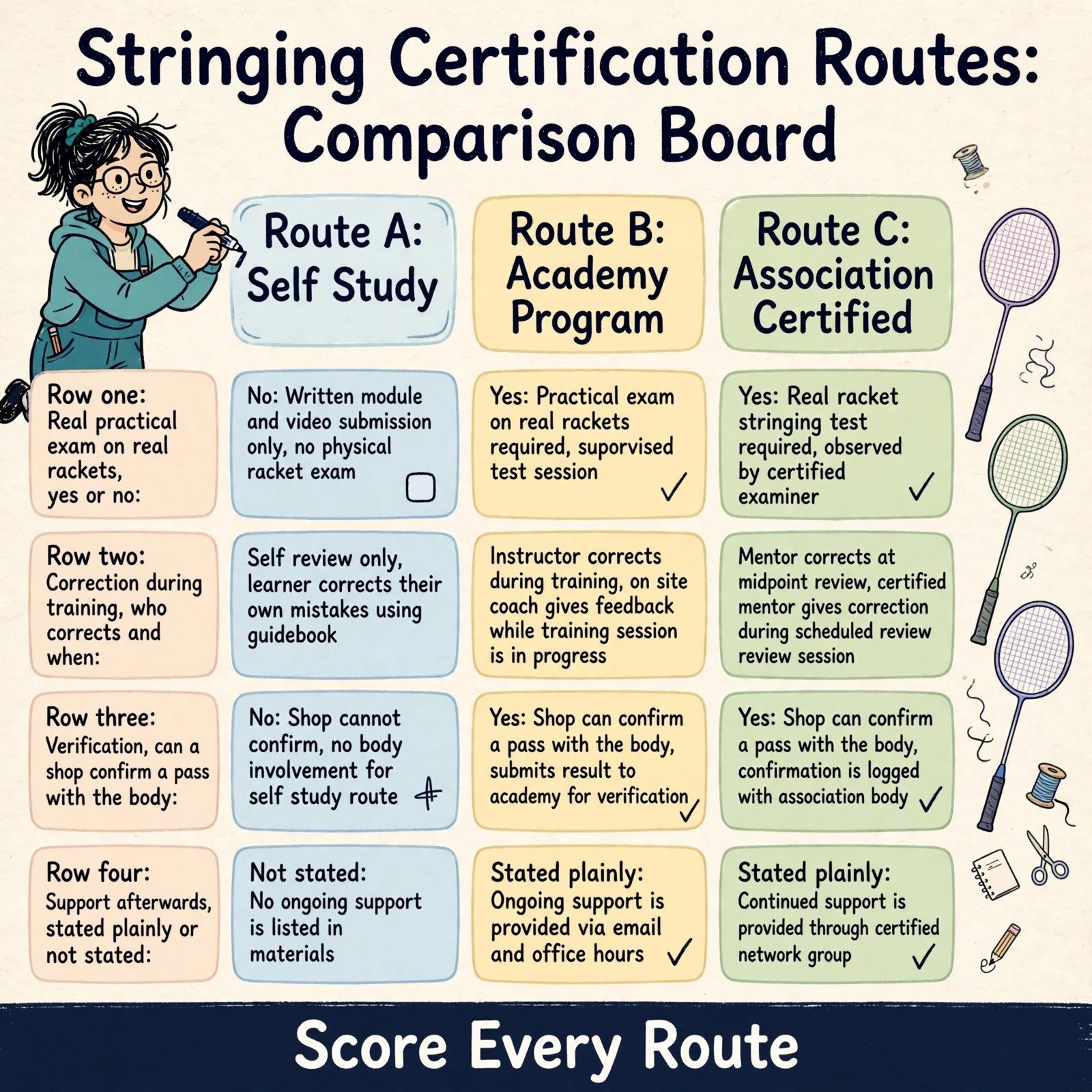
Compare routes into the trade on the same four points, whoever is offering them. First, is there a real exam at the end, practical and on real rackets? Second, who corrects your work during training, and when? Third, can a shop or player verify a pass with the body afterwards? Fourth, what support exists after training: mentoring, placement introductions, or nothing stated at all? Write each route and its answers down side by side. A route that answers clearly is easy to judge. A route that offers only welcome and warmth is asking you to hope.
Check the details.
Apply the same fairness to informal routes. Years of helping in a shop can build real skill, and this guide respects that. What it cannot give you is a recorded standard a stranger can check. If a shop placement is your route, ask whether it leads to any tested assessment, or whether you will add an exam later to make your skill portable.
Review the process.
Watch for one specific warning sign: any provider who suggests the exam will be easy for you, or that standards bend for some candidates. A standard that bends is worth nothing to the people who hold it, including you. The credential you want is the one awarded the same way to everyone, because that is the one shops trust.
1.6 Service Record
How does the BSW route measure up for women?
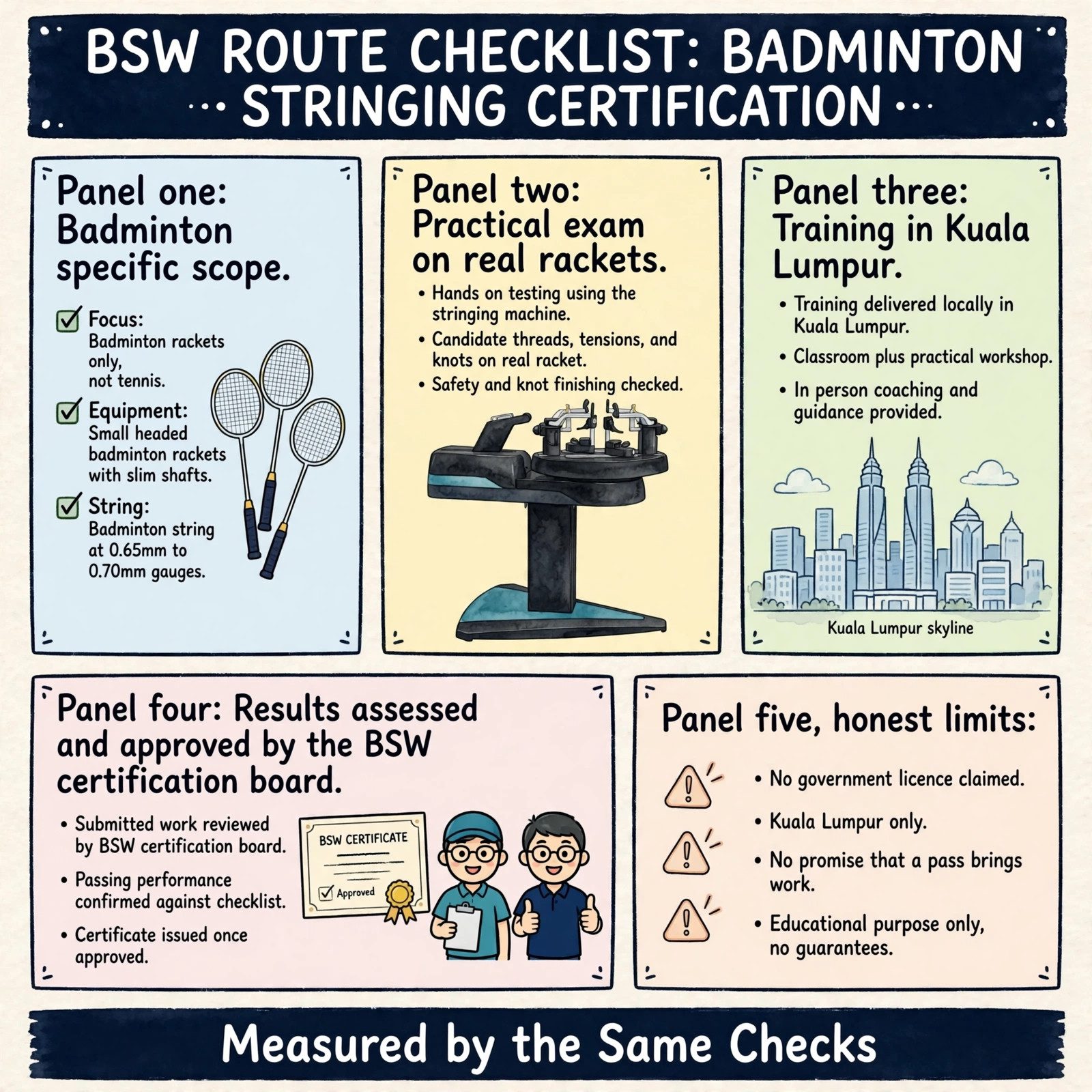
Now hold the BSW route against those same four points, with no special pleading. Exam: practical, on real rackets, covering tension accuracy, knots, grommet care and frame handling, at the end of training. Correction: hands on training in Kuala Lumpur with instructor feedback while you string. Verification: results are assessed and approved by the BSW certification board and recorded by the organisation. Support and limits, stated plainly: BSW runs no separate programme for women, claims no government licence, and trains in Kuala Lumpur only.
Check the details. The training shape is fixed and public: 3 and a half days, classes from 10am to 5pm, flexible timing on dates, and the practical exam on the last day. Learners string real rackets with strings such as Yonex BG66 Ultimax at typical tensions of 25 to 27 lbs, the same work the exam then tests.
Review the process. Where might another route suit a woman candidate better? If you already work inside a good shop with a senior stringer who corrects your work daily, an exam only route with a general body may fit your life. If your stringing is mostly tennis, a general racket body tests your actual sport. BSW is built for badminton, and for candidates who want their badminton skill itself examined, recorded and checkable.
Plan the next step. One check protects you with any body, BSW included. Ask how an employer verifies your pass, what the exam tests task by task, and what happens if you fail. BSW answers those questions in the enquiry, before enrolment. Judge every provider by how directly it answers a woman who asks plainly, because that directness is what you will meet again on exam day.
1.7 Guided Practice
What should a woman ask before applying for stringer certification?
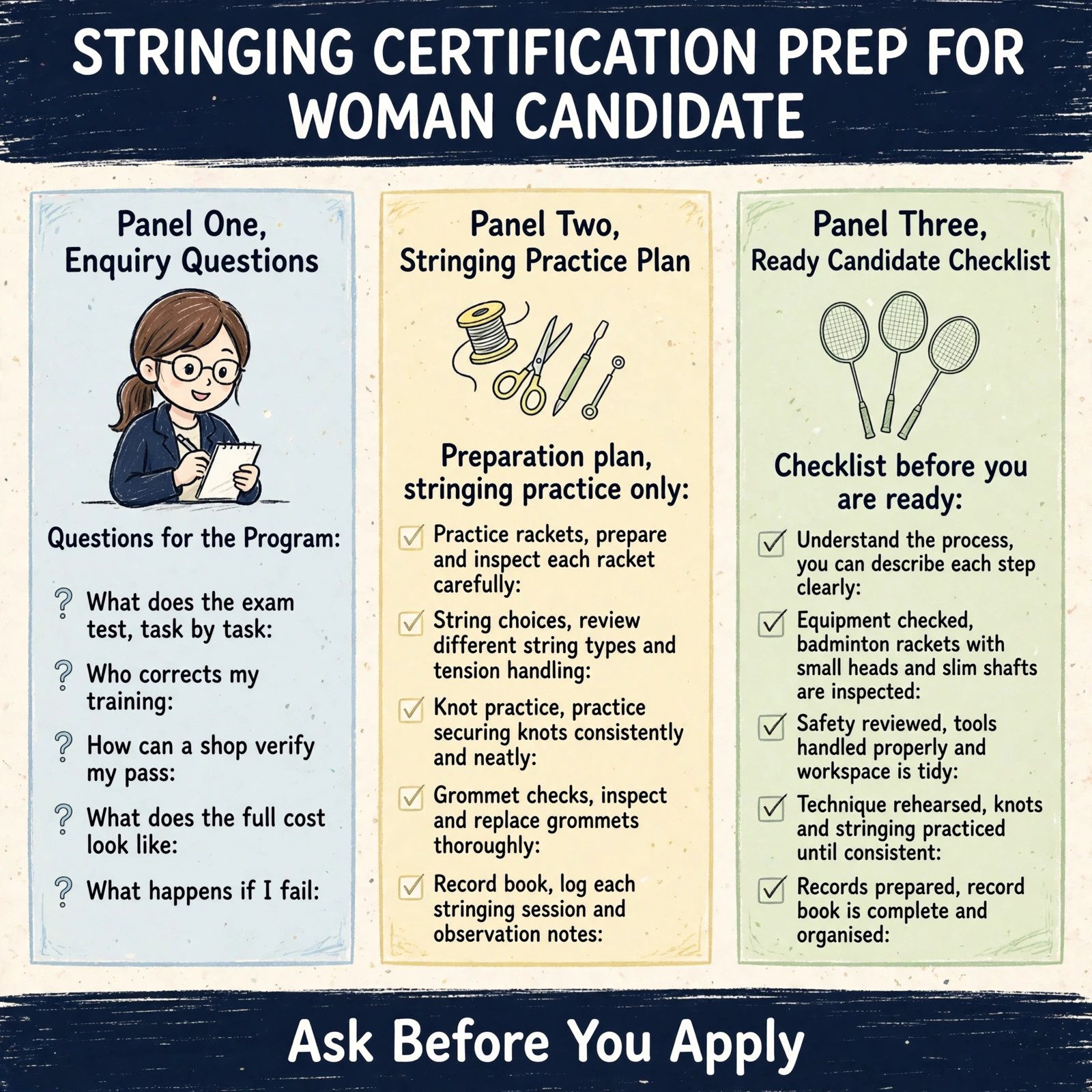
A good enquiry states your position plainly and asks the deciding questions. Say how you came to stringing, how many rackets you string now, what machine you use, and the work you want: shop counter, club, tournament help or your own small service. Then ask what the exam tests task by task, who corrects your training, how a shop can verify your pass, what the full cost looks like category by category, and what happens if you fail. Write the answers down and score them with the comparison method in this guide before you commit.
Ask about mentors and placements directly too. Does the provider introduce graduates to shops, or help you approach them? At BSW, training is in Kuala Lumpur only, classes run from 10am to 5pm over 3 and a half days with the exam on the last day, and timing is flexible for learners travelling in.
Turn the answers into a preparation plan the same week. List your weakest exam tasks, the rackets and string you will practise with, who will check your work, and the shops you will approach about supervised practice. A written plan is how a newcomer starts being assessed on her stringing.
Stringer Certification for Women Quick FAQ
Short answers to the questions women candidates ask first about routes in, the exam, mentors, costs and the BSW route.
What does stringer certification for women offer?
It is the same tested credential any stringer earns: a practical exam set by a named body, passed on real rackets and recorded by that body. For a woman entering the trade it offers proof of skill that shops and players can check, without needing introductions first.
What does the exam reward?
The exam rewards the tested work only: frame inspection, safe mounting, clean weaving, delivered tension, clamp control, knots and grommet care on real rackets. Background, connections and playing history are not marking criteria. At BSW the exam is practical and badminton specific.
How do mentors and feedback help?
A mentor who watches your rackets and corrects clamp pressure, weaving, knots and grommet habits turns practice into exam readiness. Shop placements under supervision add real customer habits: frame checks, records and deadlines. Encouragement without correction does not build skill.
Which costs and commitments come with it?
The costs of this route are the same categories every candidate faces, and listing them early keeps the plan honest. Training or course fees where you take a course. The exam or assessment fee itself. A machine and tools if you do not already have access to them, plus string and materials for real practice. Travel and stay if your chosen body tests in another city or country. Time away from work, family duties or your current stringing. And the retake arrangement, understood before you need it, not after a hard exam day.
How do routes into stringing compare?
Score every route on exam reality, correction during training, verification of a pass and support afterwards. Welcome and encouragement are pleasant, but they are not criteria. Written answers side by side show which route actually tests and records your skill.
How does the BSW route measure up?
Measured by the same checks used for any candidate, the BSW route suits a woman entering the trade for plain reasons. The scope is badminton specific. The exam is practical, on real rackets, and rewards the tested work: tension accuracy, knot work, grommet care and frame handling. Training is hands on in Kuala Lumpur, running 3 and a half days with classes from 10am to 5pm, flexible timing and the exam on the last day. Results are assessed and approved by the BSW certification board. BSW claims no special programme for women and no government licence, and the course runs in Kuala Lumpur only.
What should you ask before applying?
A good enquiry states your position plainly and asks the deciding questions. Say how you came to stringing, how many rackets you string now, what machine you use, and the work you want: shop counter, club, tournament help or your own small service. Then ask what the exam tests task by task, who corrects your training, how a shop can verify your pass, what the full cost looks like category by category, and what happens if you fail. Write the answers down and score them with the comparison method in this guide before you commit.
What should you keep from your route in?
Keep your exam result record, the body’s confirmation of your pass, your training notes and your practice records: strings, tensions, knots and grommet work per racket. Keep any mentor corrections in the same file. These records show your standard to shops long after exam day and guide your next step.
How can I start with BSW?
Start with an enquiry that states your stringing background, your machine and the work you want certification for. BSW trains in Kuala Lumpur only, with flexible timing, classes from 10am to 5pm over 3 and a half days and the practical exam on the last day. Your result is assessed and approved by the BSW certification board.
Stringer Certification for Women: Explore the Practical Decisions
Build a Clear Working Method
The method is simple: write the criteria first, score every route against the same criteria, and keep the record so your choice can be explained to any shop, player or mentor who asks.
| Route Check | Rushed Approach | Planned Approach |
|---|---|---|
| Route | Wait to be invited into stringing work | Choose a tested route in and prepare for it |
| Exam | Assume the exam rewards background or connections | Prepare for tested skill: tension, knots and grommet care |
| Support | Learn alone with nobody checking your work | Find a mentor and ask shops about placements |
| Scorecard | Judge routes by encouragement and promises | Score every route against the same written criteria |
| Your record | Keep route comparisons in your head | Write each route and its exam scope down |
| Next action | Rely on memory of your practice sessions | Use your practice record to plan the next step |
Start Your Route into the Trade with Best Stringer Worldwide
If badminton stringing is the trade you want, enter it by the tested route. Train on real rackets in Kuala Lumpur with Best Stringer Worldwide, with classes from 10am to 5pm over 3 and a half days, flexible timing, and the practical exam on the last day after your training is complete. Your work is assessed and approved by the BSW certification board. Send an enquiry that states your experience, your machine and your goal, and start with your questions answered in writing.

