






1.1 Starting Point
What are knot and grommet standards in stringer certification?
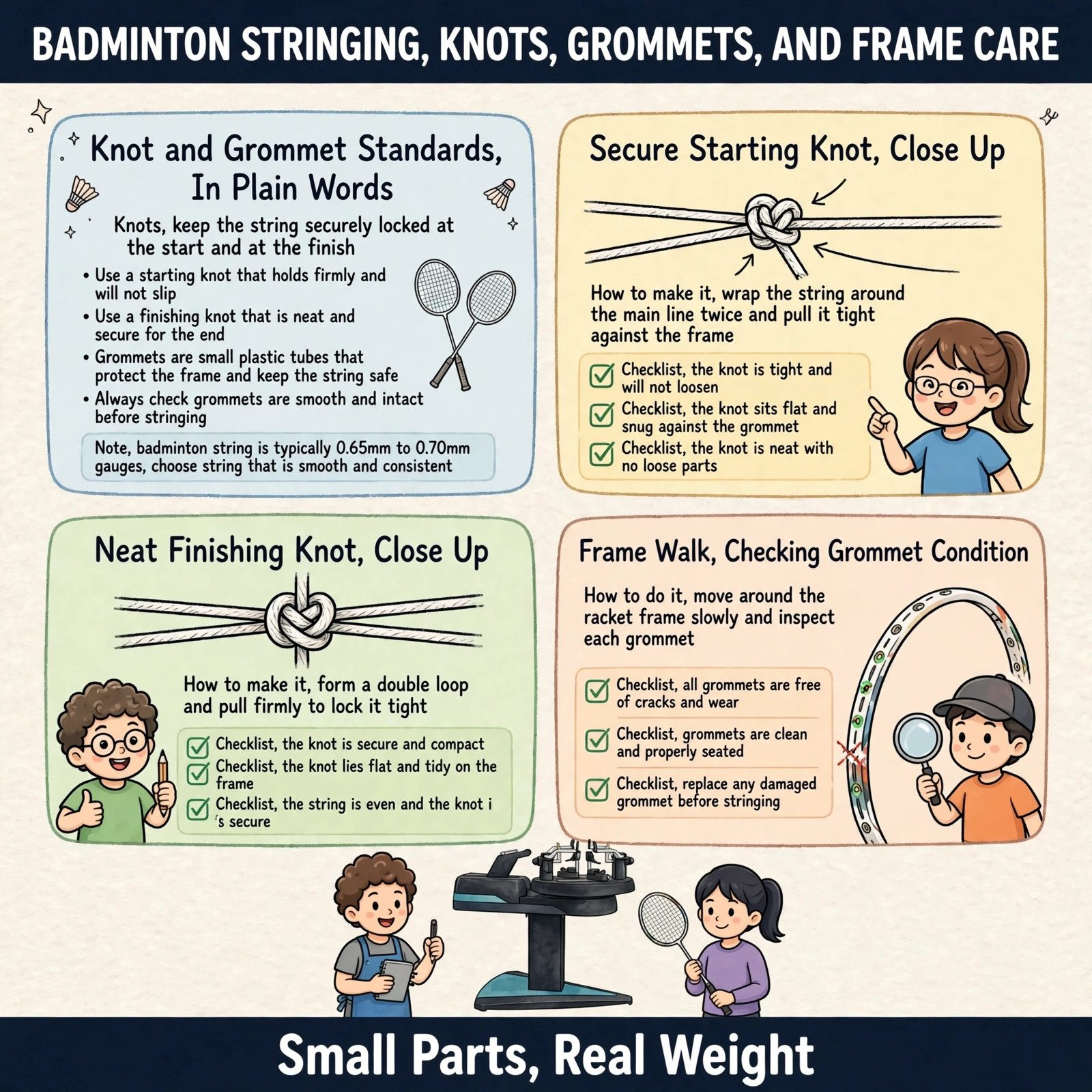
Knot and grommet standards in stringer certification are where careful stringing becomes visible. A starting knot that slips, a finishing knot that gives up string, or a worn grommet left in the frame will undo an otherwise tidy bed, and examiners know it, which is why these small parts carry real weight in a practical exam. Best Stringer Worldwide, founded by Eric Chuar and based in Kuala Lumpur, Malaysia, judges knot work and grommet care as part of its badminton practical exam, with results assessed and approved by the BSW certification board. This guide explains what examiners watch for in your knots and your grommets, and the habits that meet the standard.
The two areas belong together because they share one job: protecting the bed after the machine work ends. Knots anchor the tension you built. Grommets protect thin badminton string, at 0.65mm to 0.70mm gauges, from the frame it passes through on every shot. A stringer can weave beautifully and still fail the player at either point, so certification treats both as core skill, not finishing detail.
No measurements are invented in this guide. You will find no knot tail lengths or millimetre rules presented as any body’s standard, because honest bodies describe their expectations to candidates directly and invented figures would mislead you. What can be described faithfully is what examiners look at, what faults they record, and which working habits produce knots and grommet care that pass inspection.
1.2 Preparation
What do examiners inspect on knots and grommets?
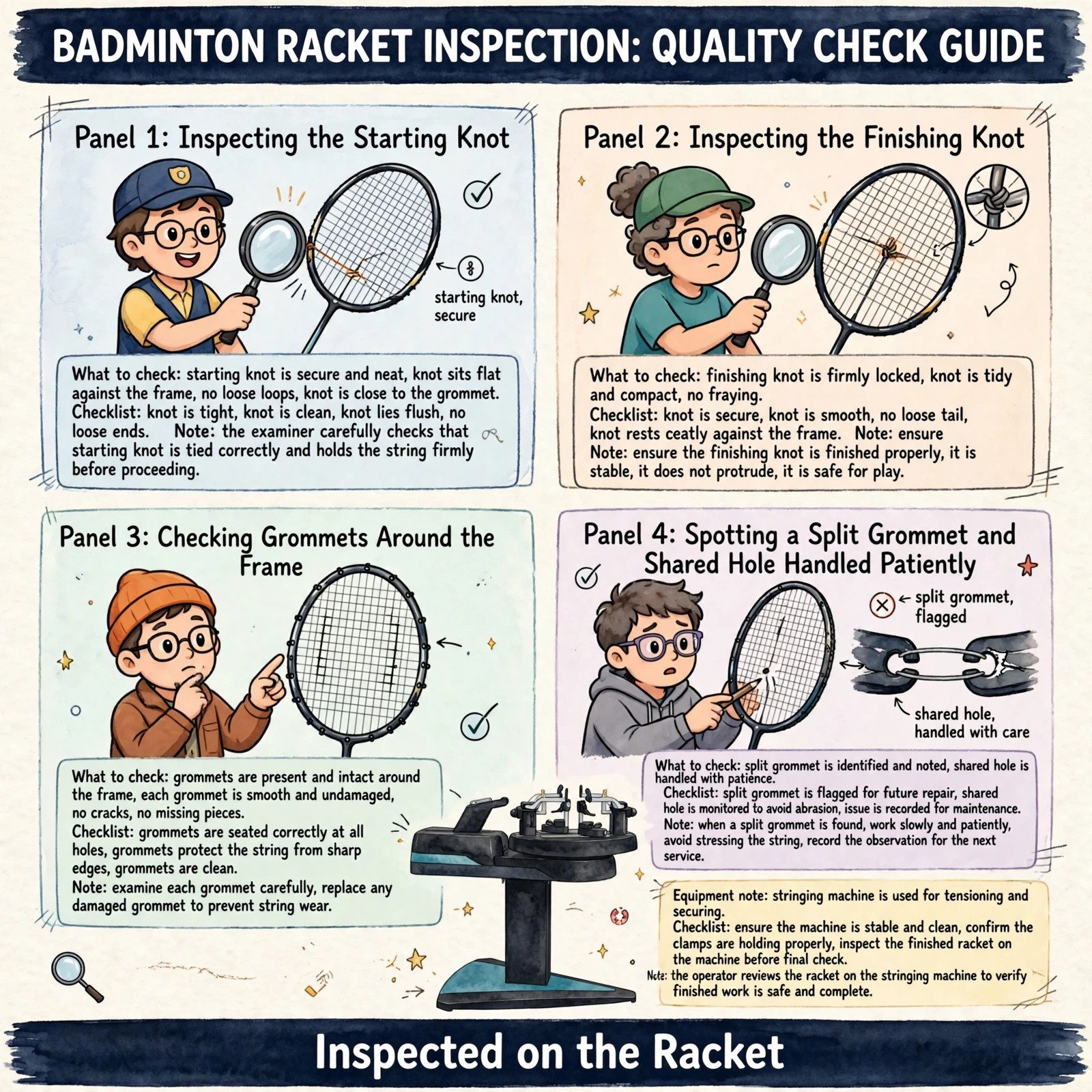
Start with the starting knot. It anchors the first cross string, and the examiner checks that it sits securely, holds under the bed’s tension and does not damage the string or the grommet it works against. A starting knot that slips lets the whole cross pattern drift loose from one end. The finishing knot closes the job: it must lock the last string so the bed keeps what the machine delivered, sit neatly without a loose tail waving at the player, and leave the surrounding string unmarked by careless pulling or cutting.
Grommet inspection begins before any string is pulled. The examiner’s own habit, and the habit they reward, is to walk the frame first: look for cracked, split, flattened or missing grommets, check the shared holes where two strings pass through one grommet, and replace what is worn before it can cut a fresh string. A candidate who strings over a split grommet has announced that inspection is not part of their routine, and the finished racket carries the evidence.
During the job, grommet care continues. String should be guided through holes rather than dragged across sharp edges, tight shared holes should be worked patiently with an awl rather than forced, and a grommet damaged during stringing should be dealt with honestly rather than hidden. Examiners watch for these habits in the finished racket: cut string near a hole, a freshly split grommet, or scoring on the frame all tell the story of how the work was done.
1.3 Working Method
How does inspected training build knot and grommet habits?
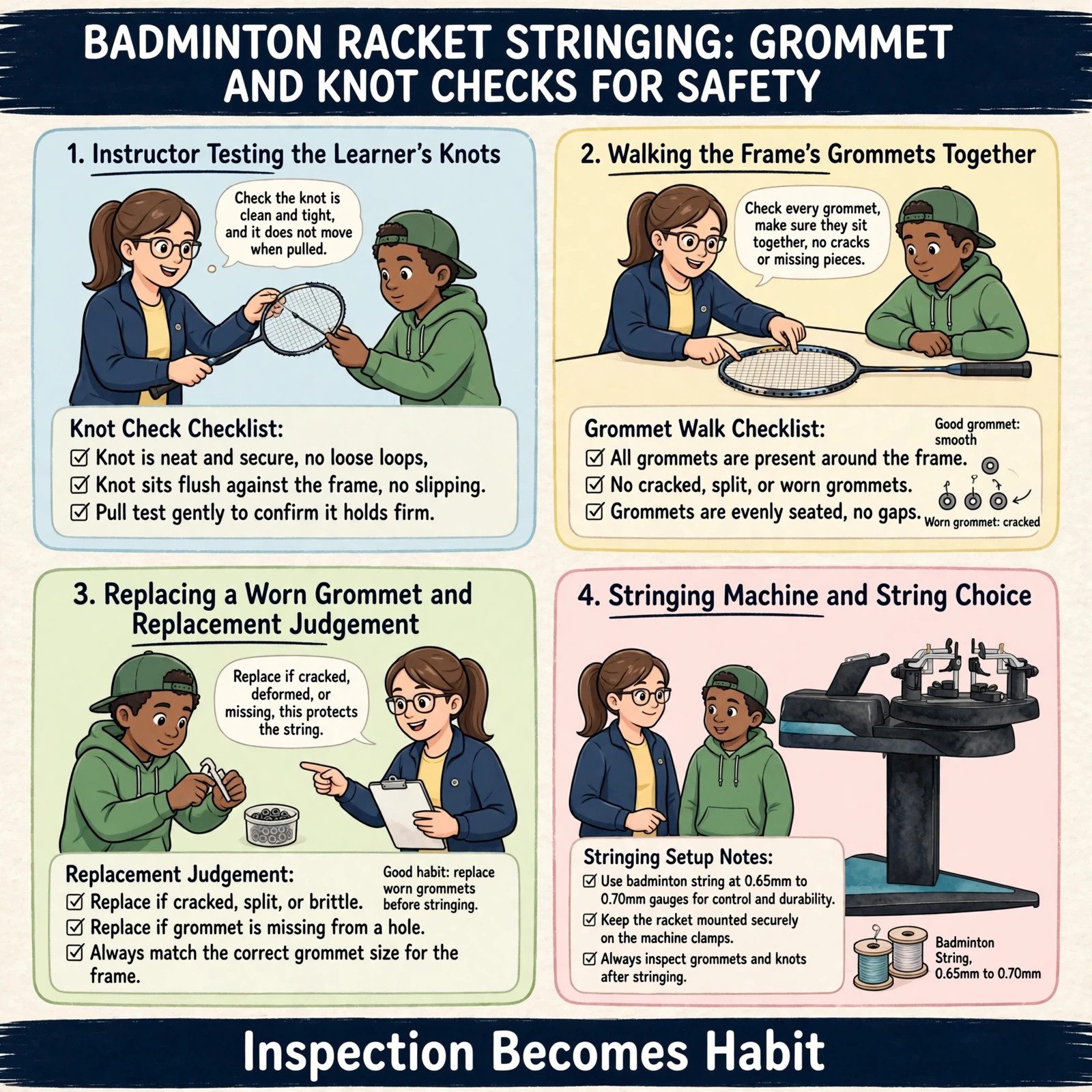
Knot and grommet standards are built by inspection during training, not by tying one good knot in a lesson. The loop that works is simple: finish a practice racket, then have the knots tested and the grommets walked with an instructor who names every fault the way an examiner would record it. Repeat that across many rackets and the inspection becomes your own habit. Learners who practise alone often tie the same slightly loose finishing knot for months, because nothing in solo practice tells them it is loose, until an examiner’s fingers find it in seconds.
Good training also builds replacement judgement. Knowing a grommet looks worn is one skill; deciding to replace it, having the right spares and tools ready, and fitting the replacement cleanly without slowing the whole job into chaos is another. Instructors teach that judgement on real frames with real wear, including the awkward shared holes badminton rackets are full of, which no diagram fully prepares you for.
Ask any provider who inspects your knots and grommets during training, and when. If the answer is after every practice racket, with faults named against the exam standard, your hours are building the exact habits the exam rewards. If knots are taught once and never checked again, expect your first real inspection to be the exam itself, which is the most expensive classroom there is.
1.4 Practical Review
Which costs and commitments come with this standard?
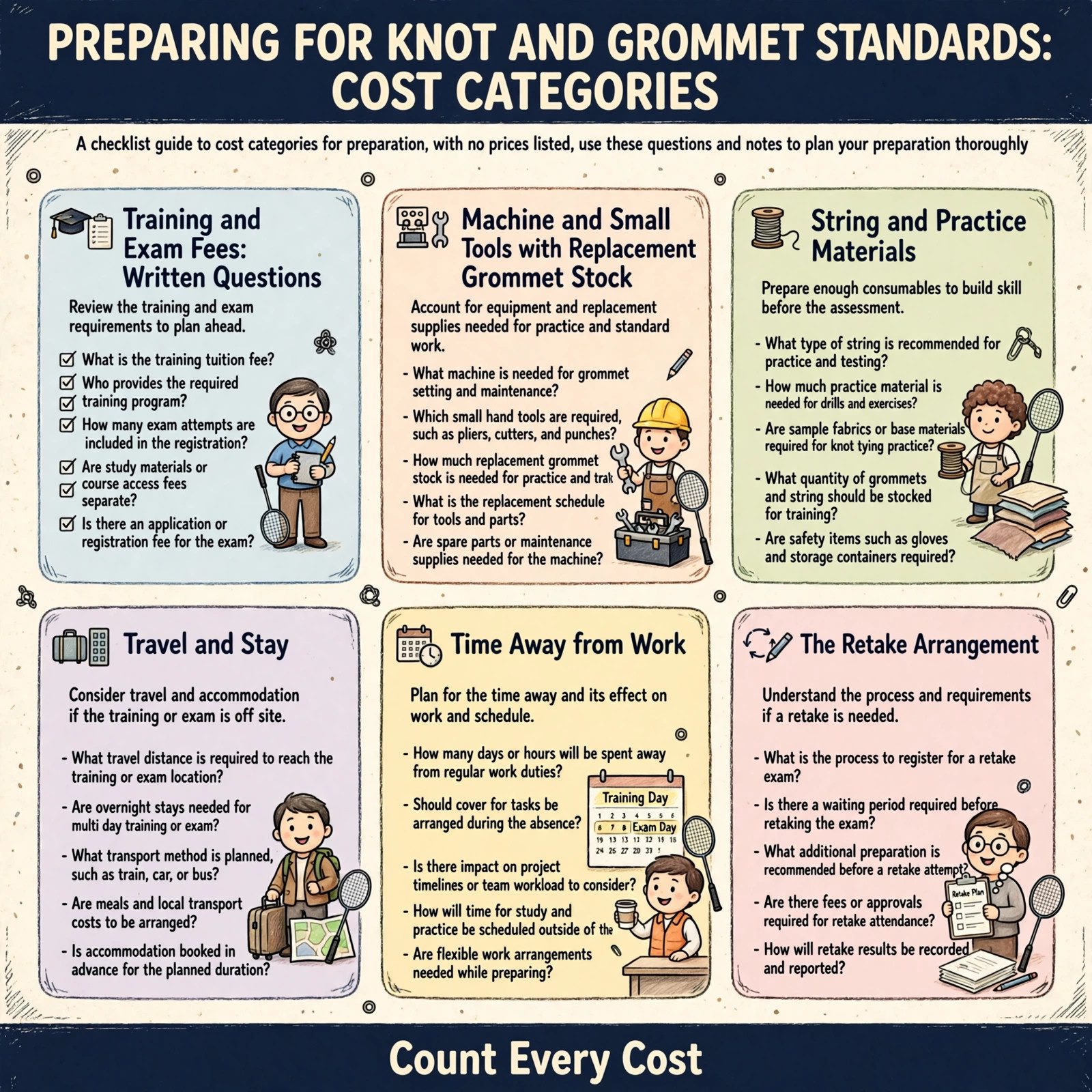
Preparing for knot and grommet standards carries the usual cost categories, and honest planning lists them all before you commit. The course or training fee, where you take one. The exam or assessment fee itself. A machine and tools if you do not already own them, including the small tools this work depends on: awl, cutters, starting clamp and a stock of replacement grommets in the sizes your rackets use. String and materials for practice rackets. Travel and stay if your body tests in another city. Time away from work. And the retake arrangement, understood in advance.
Check the details. This guide puts no figures on those categories, on purpose. Fees differ by body, country and year, and any page quoting a tidy total without naming the body and the date is guessing. Ask each provider for the current figure for every category in writing. Note that grommet stock and small tools are cheap individually but easy to forget entirely, and arriving at an exam without them is a self inflicted fault.
Review the process. Commitment matters as much as money. Knot security and grommet judgement come from inspected repetitions spread over weeks: many knots tied and tested, many frames walked before stringing. Candidates who cram cannot fake the inspection habit, because it shows in the finished racket whether it was built slowly or bolted on the night before the exam.
Plan the next step. There is a cost to the careless route, paid later at the counter. A stringer whose knots slip or who strings over worn grommets meets the consequences as broken strings, lost tension and players who do not return. Retraining those habits under a real body, after they have hardened, costs more time than learning them properly once. Small parts, large bills.
1.5 Key Checks
How do bodies compare on knots and grommets?
Record the context.
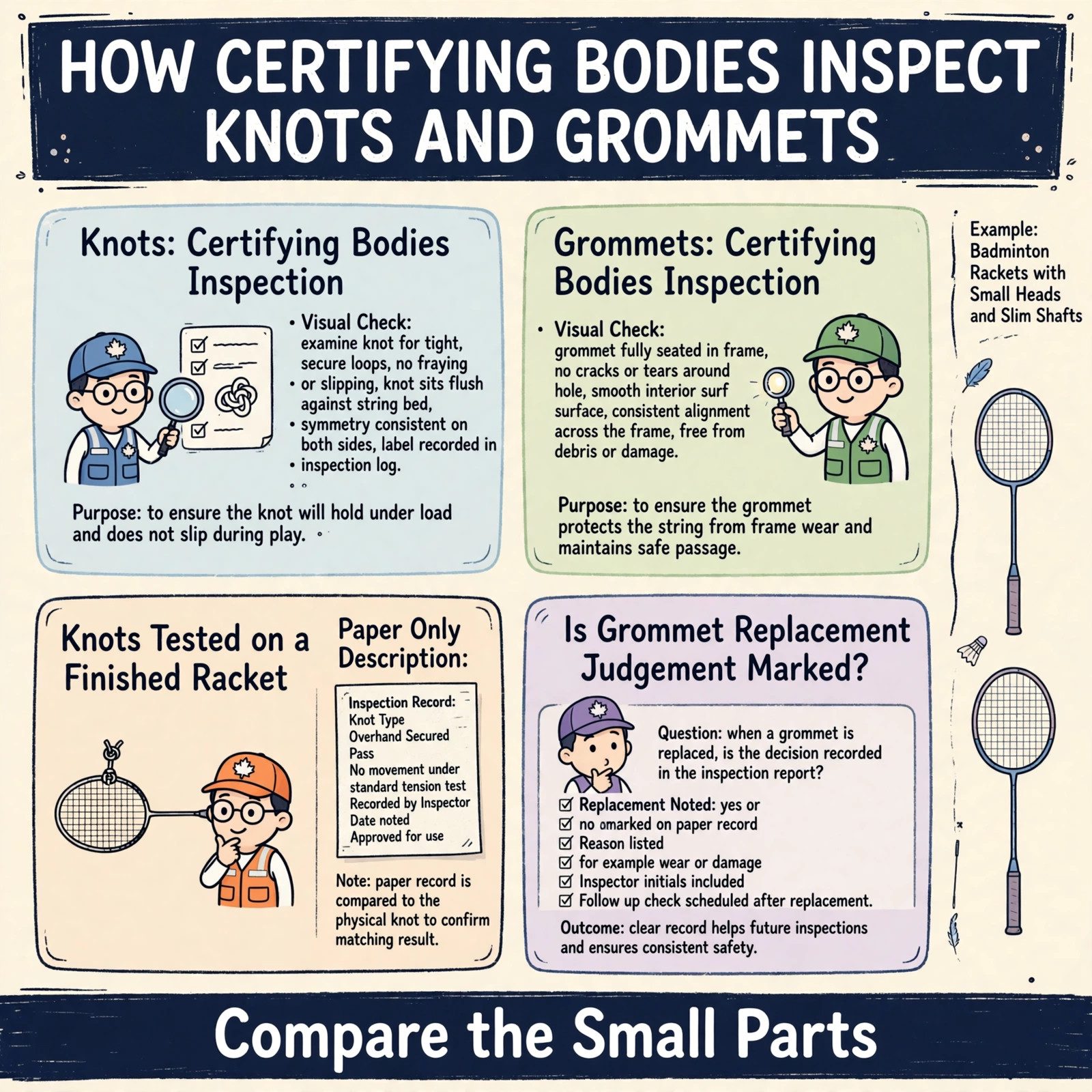
Compare knot and grommet standards across bodies with the same questions for each. Are the starting and finishing knots inspected on the finished racket? Does the marking include grommet condition and replacement judgement, or only the string bed itself? Are candidates told beforehand that these areas are watched? Does feedback after a fail name the knot or grommet fault, so practice can target it? Write the answers side by side. Bodies that inspect the small parts and say so are telling you their exam mirrors real shop standards.
Check the details.
Established bodies approach the detail from different directions. USRSA, through its Certified Stringer, Master Racquet Technician and Professional Racquet Advisor credentials, combines written and practical sections, so knot and grommet knowledge can be tested on paper as well as on the frame. Other bodies lean on the practical racket alone. Paper can test whether you know what a good knot is. Only fingers on your finished racket test whether you tied one.
Review the process.
Badminton raises the stakes on both areas. Thin strings at high tensions load knots harder than heavier gauges do, light frames carry small grommets that wear and split, and shared holes are everywhere in a badminton pattern. When you compare bodies, ask whether their knot and grommet expectations were written around badminton frames or borrowed from general racket work, and judge the answer against the rackets on your own machine.
1.6 Service Record
How does the BSW route judge knots and grommets?
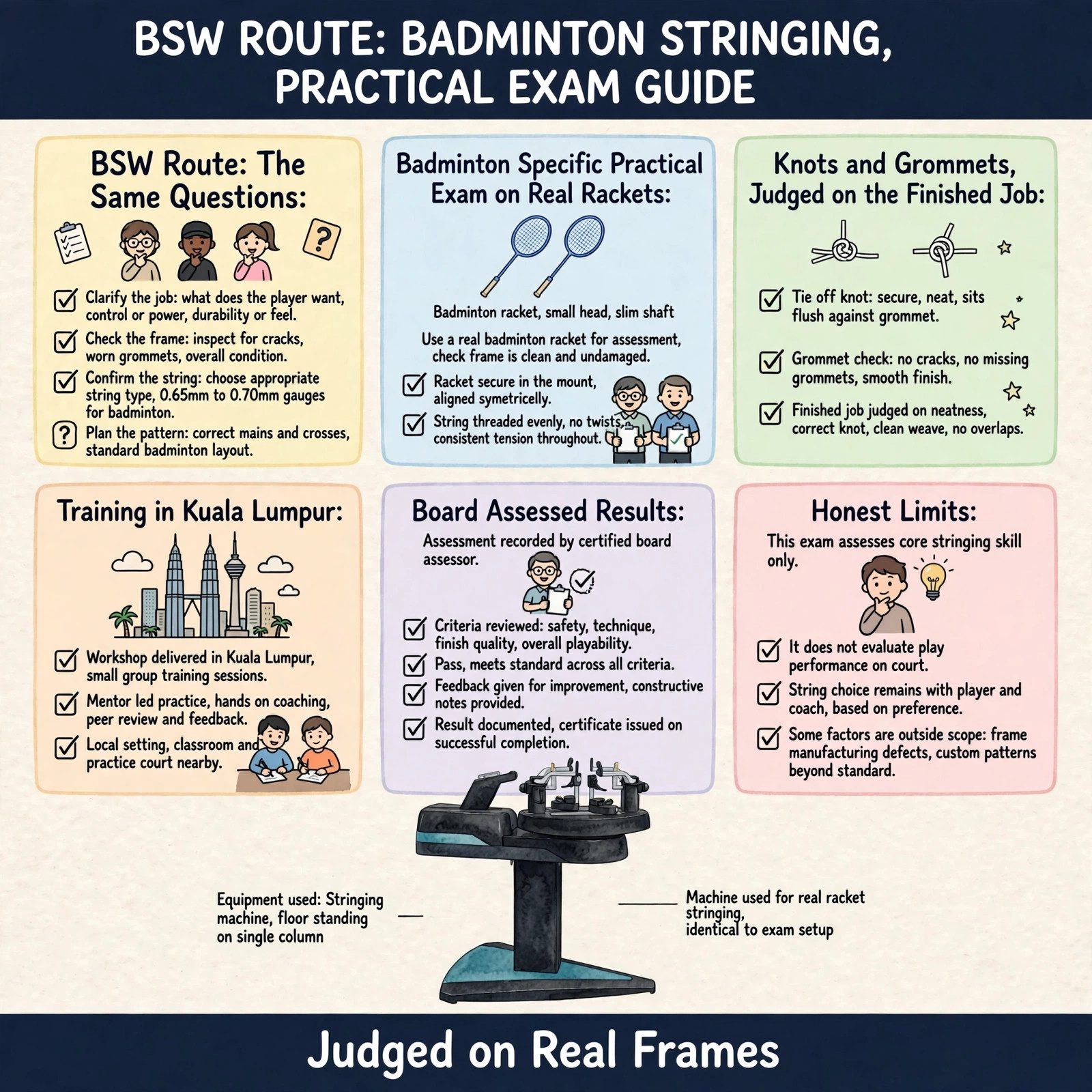
Hold the BSW route against the same questions, plainly. The BSW practical exam is badminton specific and worked on real rackets, and the finished job is judged including its knots and its grommets: starting knot security, finishing knot security and neatness, grommet condition, replacement judgement and care through shared holes. Training runs in Kuala Lumpur over 3 and a half days, classes from 10am to 5pm with flexible timing on dates, and the exam sits on the last day. Results are assessed and approved by the BSW certification board. BSW publishes no invented knot measurements as standards, and candidates should ask how inspection happens before they enrol.
Check the details. Training matches the standard directly. Learners work on real frames with instructor correction, knots are checked and grommets are walked during practice, and replacement judgement is taught on worn frames rather than described in theory. Founder Eric Chuar teaches from his Kuala Lumpur stringing base, while the certification decision itself belongs to the BSW certification board as an organisation, not to one person.
Review the process. The honest limits stand as well. BSW is a private certification body, not a government licence, and it runs its course in Kuala Lumpur only. The older general bodies have longer histories and wider name recognition outside badminton. If your stringing is mostly tennis, their knot and grommet expectations may match your daily work. If your work is badminton, an exam that inspects badminton knots and badminton grommets tests the small parts your players depend on.
Plan the next step. One question protects you with any body: ask what happens when an examiner finds a split grommet on your exam racket, and whether replacing it is expected or penalised. The answer reveals whether the body values inspection or only speed. BSW answers knot and grommet questions inside the enquiry, before enrolment. Judge every body, BSW included, by how directly it answers questions about the smallest parts of the job.
1.7 Guided Practice
What should you ask about knots and grommets before you apply?
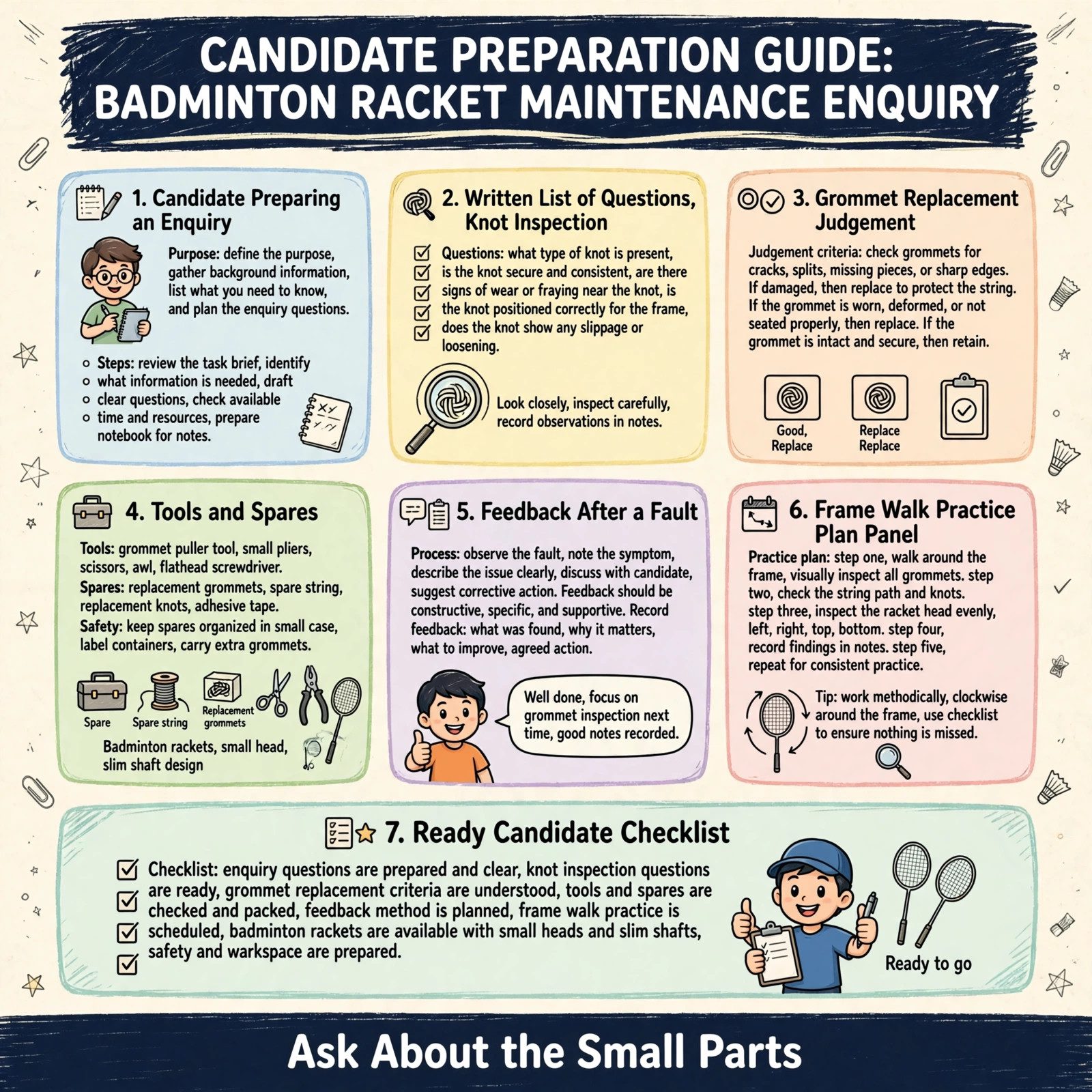
A good enquiry asks about knots and grommets directly, because most candidates never think to. State your sport, your stringing volume, the machine you use and the work you want the credential for. Then ask: are starting and finishing knots inspected on the finished racket? Is grommet replacement judgement part of the exam? What tools and spare grommets should I bring or have ready? What feedback follows a knot or grommet fault? Write the answers down and compare them with the method in this guide before you commit money or travel.
Timing questions matter as much as inspection questions. Ask when training runs, how long each day lasts and whether dates can flex around your work. At BSW, training is in Kuala Lumpur only, classes run from 10am to 5pm, the course takes 3 and a half days with the practical exam on the last day, and timing is flexible so travelling learners can plan around flights and work. Any provider should be able to state its own shape just as plainly.
Turn the answers into a preparation plan the same day. Build the frame walk into every practice job: inspect grommets before mounting, replace what is worn, then test both knots before you call the racket finished, and record what you found per racket. Practise shared holes patiently until they stop slowing you down. By exam day, inspection should be the first and last thing you do, which is exactly what examiners are watching for.
Knot and Grommet Standards in Stringer Certification Quick FAQ
Short answers to the questions candidates ask first about starting and finishing knots, grommet inspection and replacement habits.
What are knot and grommet standards?
Knot and grommet standards in stringer certification are the expectations examiners apply to your starting knot, your finishing knot and the grommets your string passes through: knots that hold the bed without slipping or damaging string, and grommets inspected before stringing, protected during it and replaced when worn or split.
What do examiners inspect?
Examiners watch knot and grommet work closely because both decide whether a bed keeps its tension. They inspect the starting and finishing knots on the finished racket, check grommet condition around the frame, look for damaged pieces that should have been replaced, and note whether shared holes and sharp edges were handled with patience.
How does inspected training build habits?
Training builds knot and grommet standards when an instructor inspects your knots and walks the frame’s grommets with you after every practice racket, naming what would be recorded in an exam. Videos can show a knot being tied but cannot feel whether yours holds, and no video pauses your stringing to point at a split grommet you walked past.
Which costs and commitments come with it?
Preparing for knot and grommet standards carries the usual cost categories, and honest planning lists them all before you commit. The course or training fee, where you take one. The exam or assessment fee itself. A machine and tools if you do not already own them, including the small tools this work depends on: awl, cutters, starting clamp and a stock of replacement grommets in the sizes your rackets use. String and materials for practice rackets. Travel and stay if your body tests in another city. Time away from work. And the retake arrangement, understood in advance.
How do bodies compare on the small parts?
Compare knot and grommet standards by asking each body the same questions. Are starting and finishing knots inspected on the finished racket? Is grommet condition part of the marking, including replacement judgement? Are candidates told these habits are watched before the exam? A body that inspects knots and grommets and says so openly runs a standard you can practise toward.
How does BSW judge knots and grommets?
Measured on knot and grommet standards, the BSW route tests exactly the habits this guide describes, on real badminton rackets. Candidates train in Kuala Lumpur over 3 and a half days, classes from 10am to 5pm with flexible timing, and sit the practical exam on the last day, where starting and finishing knots and grommet care are judged as part of the finished job. Results are assessed and approved by the BSW certification board. BSW states no invented measurements as standards and promises no work from a pass. Ask how knots and grommets are inspected on exam day before you enrol, and weigh the answer.
What should you ask before applying?
A good enquiry asks about knots and grommets directly, because most candidates never think to. State your sport, your stringing volume, the machine you use and the work you want the credential for. Then ask: are starting and finishing knots inspected on the finished racket? Is grommet replacement judgement part of the exam? What tools and spare grommets should I bring or have ready? What feedback follows a knot or grommet fault? Write the answers down and compare them with the method in this guide before you commit money or travel.
What should you keep from your certification route?
Keep a knot and grommet record with your stringing log: grommets replaced per racket, worn pieces you spotted before stringing, and any knot faults found in training or in your exam record. Add your result confirmation and training notes. That record proves inspection is your habit, and it is the fastest way to target practice before a retake.
How can I start with BSW?
Start with an enquiry that states your sport, your stringing experience, your machine and the tools you own, and ask how knots and grommets are inspected in the exam. BSW trains in Kuala Lumpur only, with flexible timing, classes from 10am to 5pm over 3 and a half days and the practical exam on the last day. Your result is assessed and approved by the BSW certification board.
Knot and Grommet Standards in Stringer Certification: Explore the Practical Decisions
Build a Clear Working Method
The method is simple: judge every body by whether it inspects knots and grommets on the finished racket, keep the written answers, and keep your own inspection records so your preparation rests on evidence.
| Knot and Grommet Check | Rushed Approach | Planned Approach |
|---|---|---|
| Knots | Tie knots from habit and hope they hold | Tie starting and finishing knots to be inspected |
| Grommets | String over whatever grommets are fitted | Inspect every frame and replace worn grommets first |
| Costs | Budget for the course fee only | List exam, tools, grommet stock, travel and time together |
| Compare | Choose the body with the boldest claim | Score every body on knot and grommet inspection |
| Your record | Keep body comparisons in your head | Write each body’s knot and grommet inspection down |
| Next action | Judge a credential from the certificate design alone | Use your inspection record to choose the route that fits |
Get the Small Parts Judged with Best Stringer Worldwide
If the small parts of your stringing are strong, take the route that inspects them. Train on real rackets in Kuala Lumpur with Best Stringer Worldwide, with classes from 10am to 5pm over 3 and a half days, flexible timing, and the practical exam on the last day. Your work is assessed and approved by the BSW certification board. Send an enquiry that states your experience, your machine and your goal, and ask how your knots and grommets will be judged.
