






1.1 Starting Point
What is tension accuracy in stringer certification?
Tension accuracy in stringer certification is the gap, or the lack of one, between the tension you set on the machine and the tension the finished string bed actually delivers. Examiners check your numbers because players feel that gap on court even when they cannot name it. A racket set at one tension and delivered at another plays differently, wears differently and comes back with a complaint attached. Best Stringer Worldwide, founded by Eric Chuar and based in Kuala Lumpur, Malaysia, treats delivered tension as core exam evidence in its badminton practical, with results assessed and approved by the BSW certification board. This guide explains how that checking works and why small misses matter.
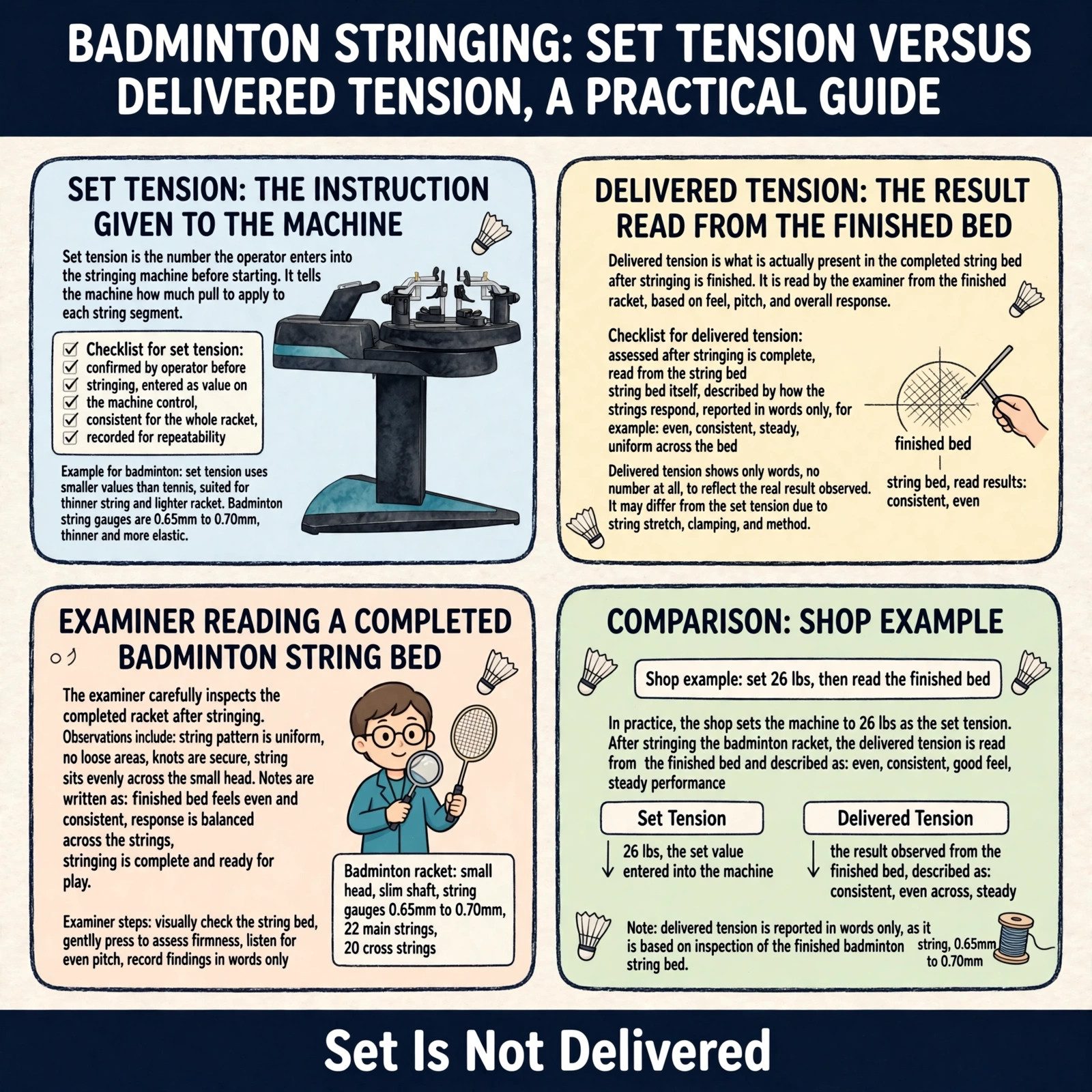
Keep the two numbers separate in your mind. Set tension is what you dial in or pull to, an instruction given to a machine. Delivered tension is what remains in the bed after clamping, weaving, knotting and settling, and it is the only number the player ever meets. Certification that only records the set number is marking your intention. Certification that reads the bed is marking your stringing.
That is why tension accuracy sits near the centre of any serious exam. It cannot be faked by tidy handwriting or a confident manner, and it cannot be rescued by speed. The bed either holds what you set or it does not, and the reasons it does not are written all over your technique: calibration, clamps, weaving and knots, each one examinable in its own right.
1.2 Preparation
How do examiners check your tension numbers?
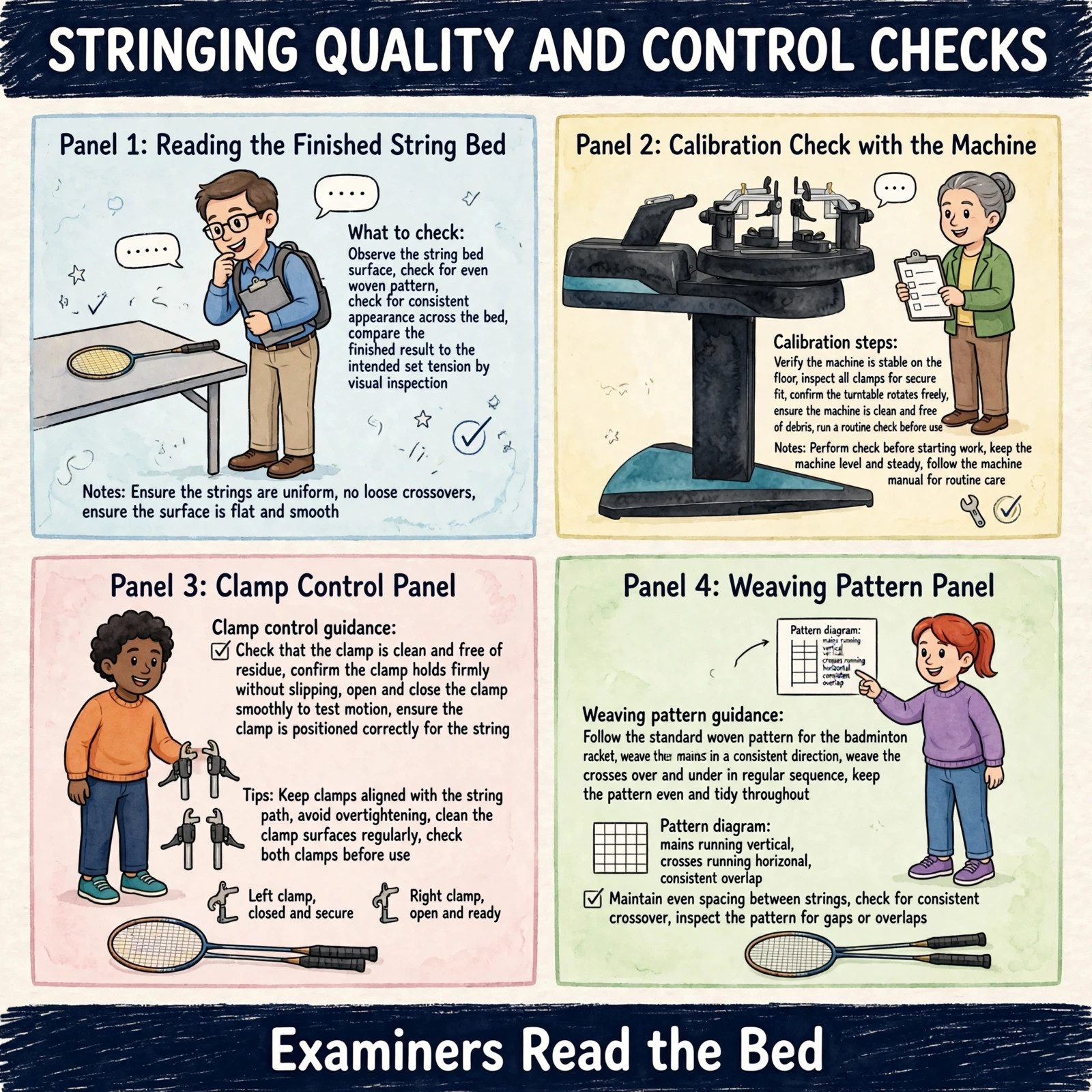
The checking itself is methodical. The examiner knows the tension the candidate was asked to set, because exam tasks state it plainly, the way a shop example might ask for a restring at 25 to 27 lbs. The finished bed is then read and compared with that setting. Examiners also look for the pattern behind the reading: a bed that loses tension evenly suggests one kind of cause, while a bed that varies from area to area points to clamping or weaving habits. The number matters, but the diagnosis matters more, because the diagnosis is what the candidate must fix to pass a retake.
Machine calibration sits behind every reading. A machine that has drifted pulls a different tension from the one its display claims, and a candidate stringing on a drifting machine can do careful work and still deliver the wrong number. Serious exam settings check their machines, and serious candidates learn to ask whether the machine in front of them has been checked, at home as much as on exam day.
No honest guide states a tolerance figure as every body’s standard, because bodies set and publish their own expectations and this page will not invent one. What can be said plainly is the direction of travel: the closer your delivered tension sits to your set tension, repeatably, racket after racket, the stronger your exam evidence. One lucky racket proves little. A record of beds that read where they were set proves control.
1.3 Working Method
How does measured training build tension accuracy?
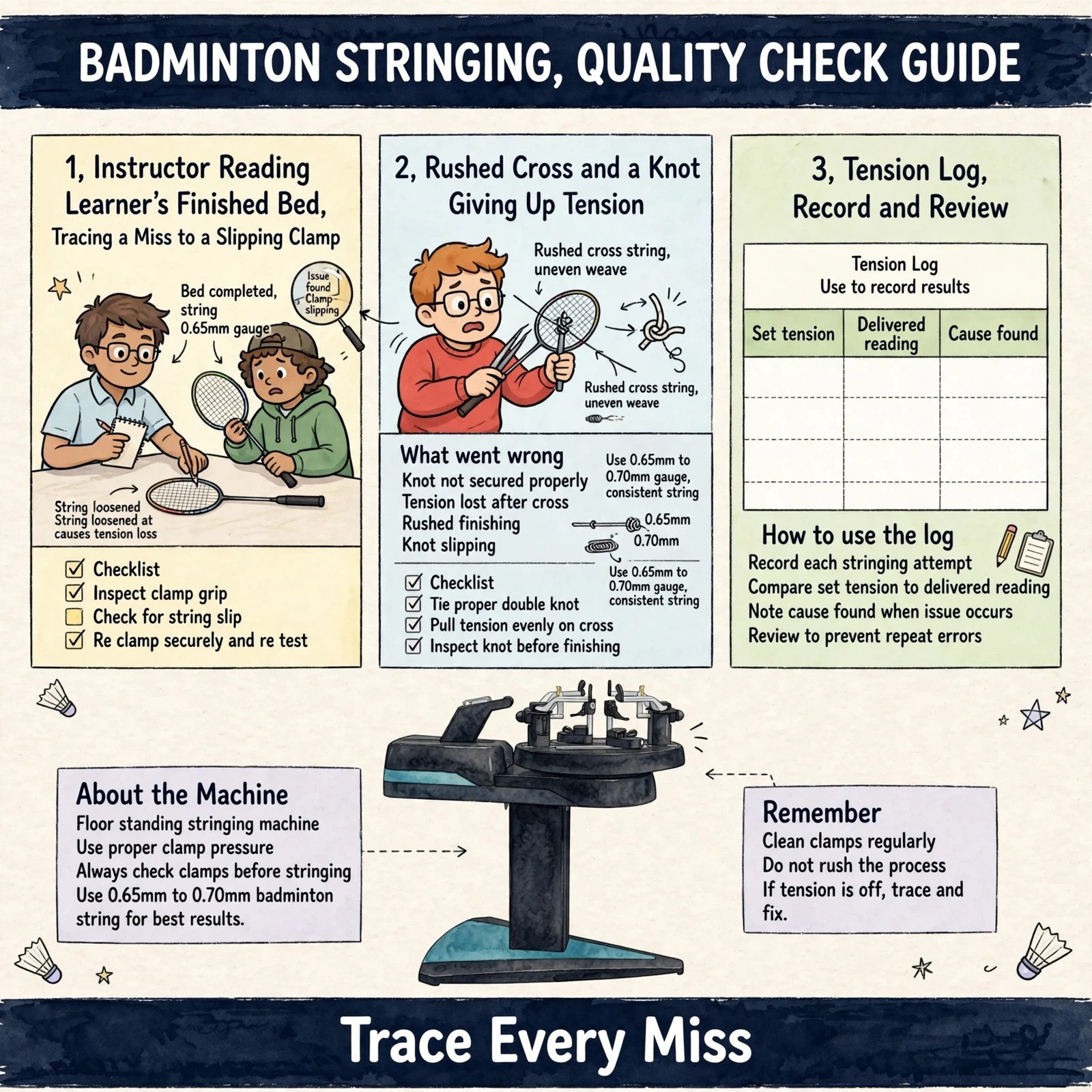
Tension accuracy is trained, not wished for. The training loop starts with a finished racket being read, not admired: what was set, what was delivered, and where the difference came from. An instructor who can trace a miss to a slipping clamp, a rushed cross or a knot that gave up string teaches the candidate to find the same causes alone. Without that reading habit, a learner can string for months, set honest numbers and deliver something else entirely, and only discover the gap when an examiner reads the bed on the day it counts.
Calibration habits are part of the same training. You learn to check your own machine, to notice when a reading feels wrong for the work you did, and to keep a simple record of set and delivered tensions across practice rackets. Those records feel slow at first. By exam day they are proof of the one thing examiners want to see: that your numbers repeat because your process is controlled, not because one racket went well.
Ask any provider who reads your finished tensions during training, and how. If an instructor checks beds and corrects the causes, your practice is aimed at the exam’s central question. If nobody ever reads your rackets, you are training your hands while leaving your numbers unexamined, and tension accuracy is exactly the criterion that punishes that gap.
1.4 Practical Review
Which costs and commitments come with a tension checked exam?
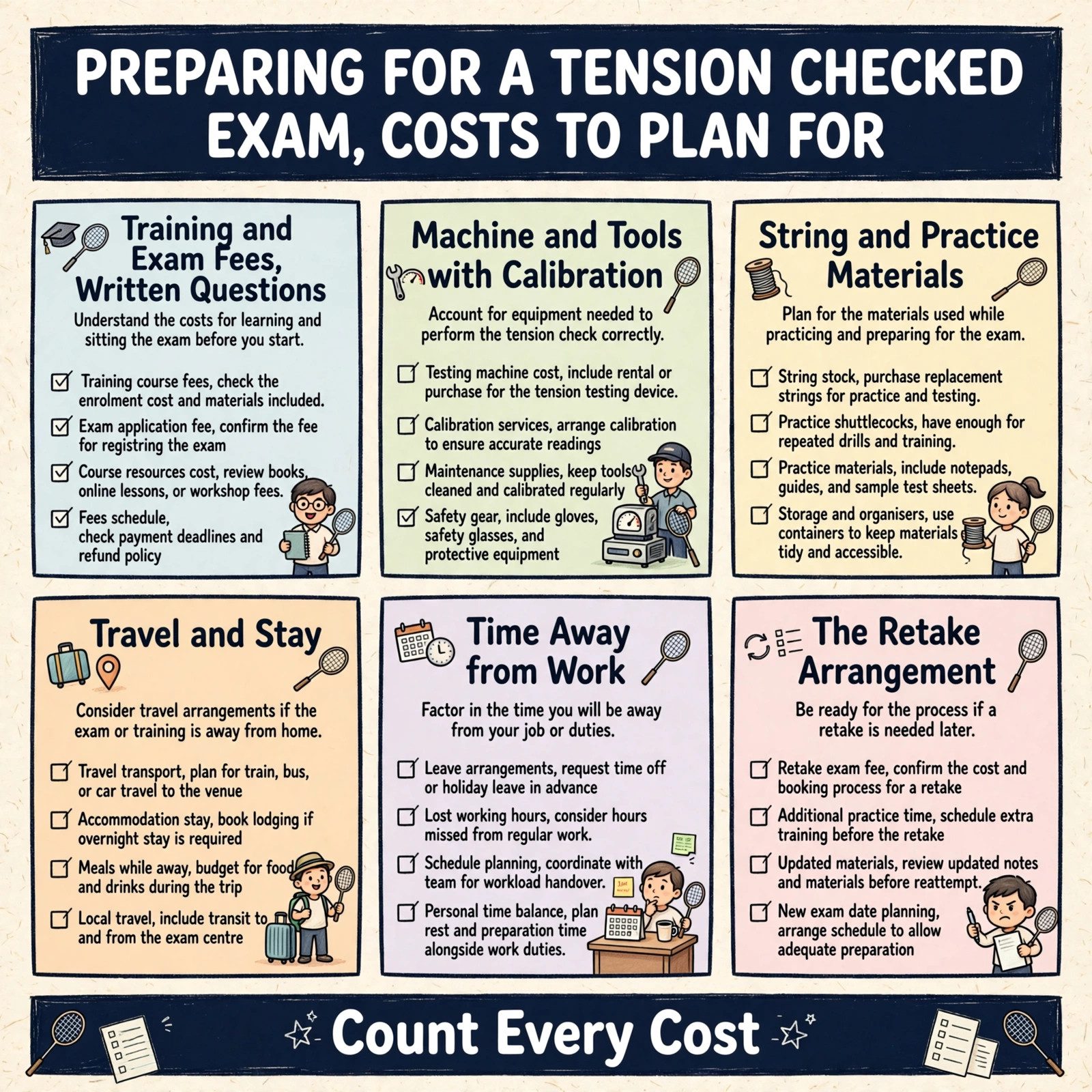
Preparing for a tension checked exam carries the usual cost categories, listed honestly before you commit. The course or training fee, where you take one. The exam or assessment fee itself. A machine and tools if you do not already own them, with calibration part of owning a machine rather than an optional extra. String and materials for practice, because accuracy takes repeated full rackets at working tensions, not one careful demonstration. Travel and stay if your body tests in another city. Time away from work. And the retake arrangement, understood before you need it.
Check the details. This guide puts no figures on those categories, on purpose. Fees differ by body, country and year, and a page quoting a tidy total without naming the body and date is guessing. Ask each provider for the current figure for every category in writing, and ask whether the exam machine is provided and checked, or whether candidates bring their own equipment, because that answer changes what you must budget for.
Review the process. The commitment side is practice volume with measurement attached. Accuracy grows from rackets that were read and recorded, spread over weeks, at the tensions real players ask for. A candidate who practises without ever reading a bed has spent the same hours and bought less skill with them. Count measured practice, not just practice, when you plan your preparation time.
Plan the next step. There is a cost to skipping the numbers at home. A tension fail on exam day usually traces back to a machine or a habit that home checking would have caught in week one. A calibration check and a notebook cost little. A retake, with its fee and its travel repeated, costs much more, and it buys back the same lesson at a higher price.
1.5 Key Checks
How do bodies compare on checking tension?
Record the context.
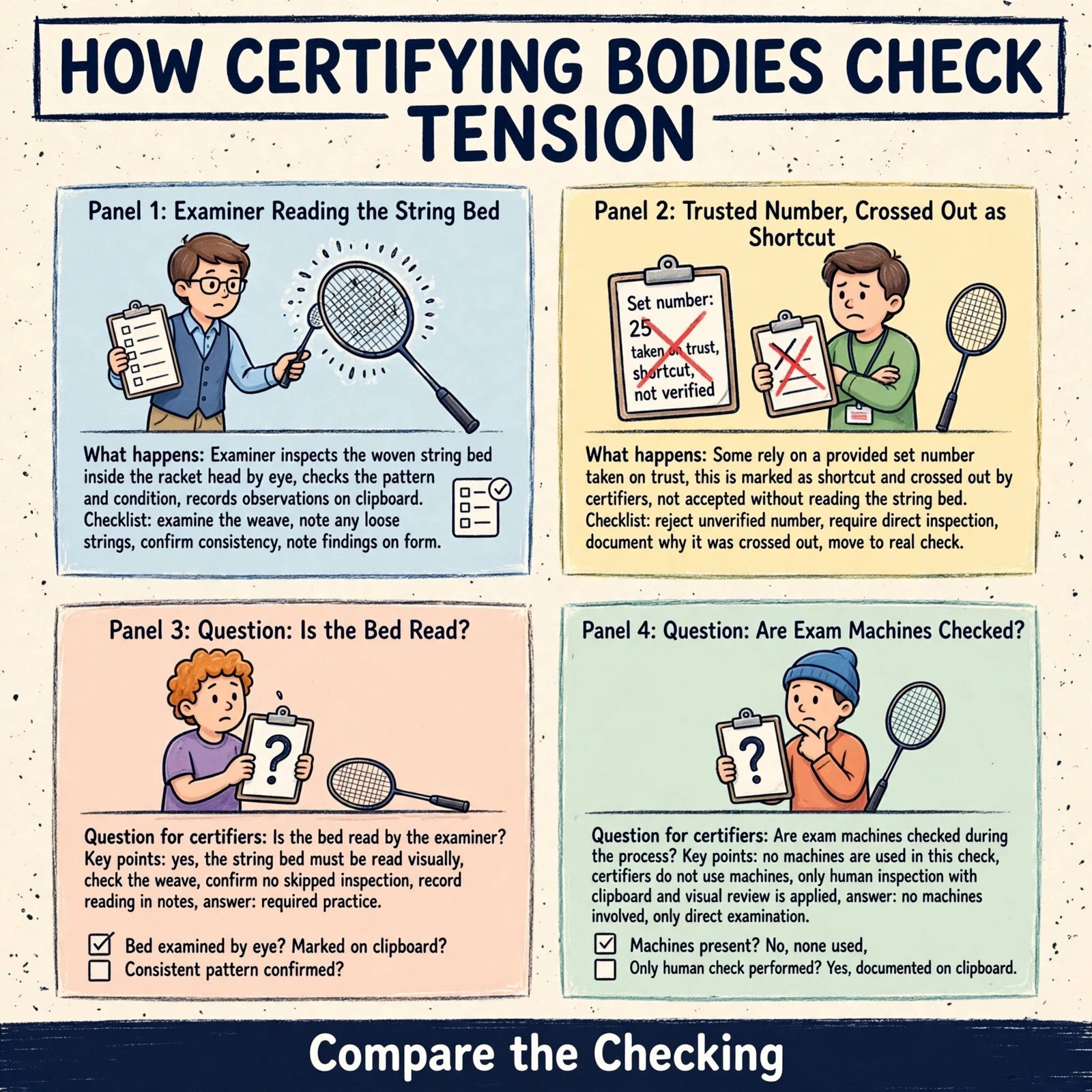
Compare how bodies handle tension using the same questions for each. Is delivered tension read on the finished racket, or is the set number accepted as the result? Is the exam machine checked before candidates string on it? Are candidates told in advance how their tension will be verified? Does feedback after a fail name the likely cause, so practice can target it? Write the answers side by side. A body that reads beds and explains its checking respects the criterion. A body that never reads a finished racket is not testing tension accuracy at all, whatever its exam is called.
Check the details.
Established bodies differ in shape here. USRSA, with its Certified Stringer, Master Racquet Technician and Professional Racquet Advisor credentials, combines written and practical sections, so tension knowledge is examined on paper as well as on the racket. Other bodies lean more heavily on the practical bed alone. The written side can test whether you understand tension. Only the read bed tests whether you can deliver it, which is why this guide treats the bed reading as the evidence that counts.
Review the process.
Badminton sharpens the whole question. Strings at 0.65mm to 0.70mm gauges are thin, frames are light, and playing tensions run high relative to both, so a miss that a heavier string bed might forgive shows up quickly in feel and in wear. When you compare bodies, ask whether their tension checking was designed around badminton equipment or borrowed from general racket work, and weigh the answer against the rackets you will string every week.
1.6 Service Record
How does the BSW route check your numbers?
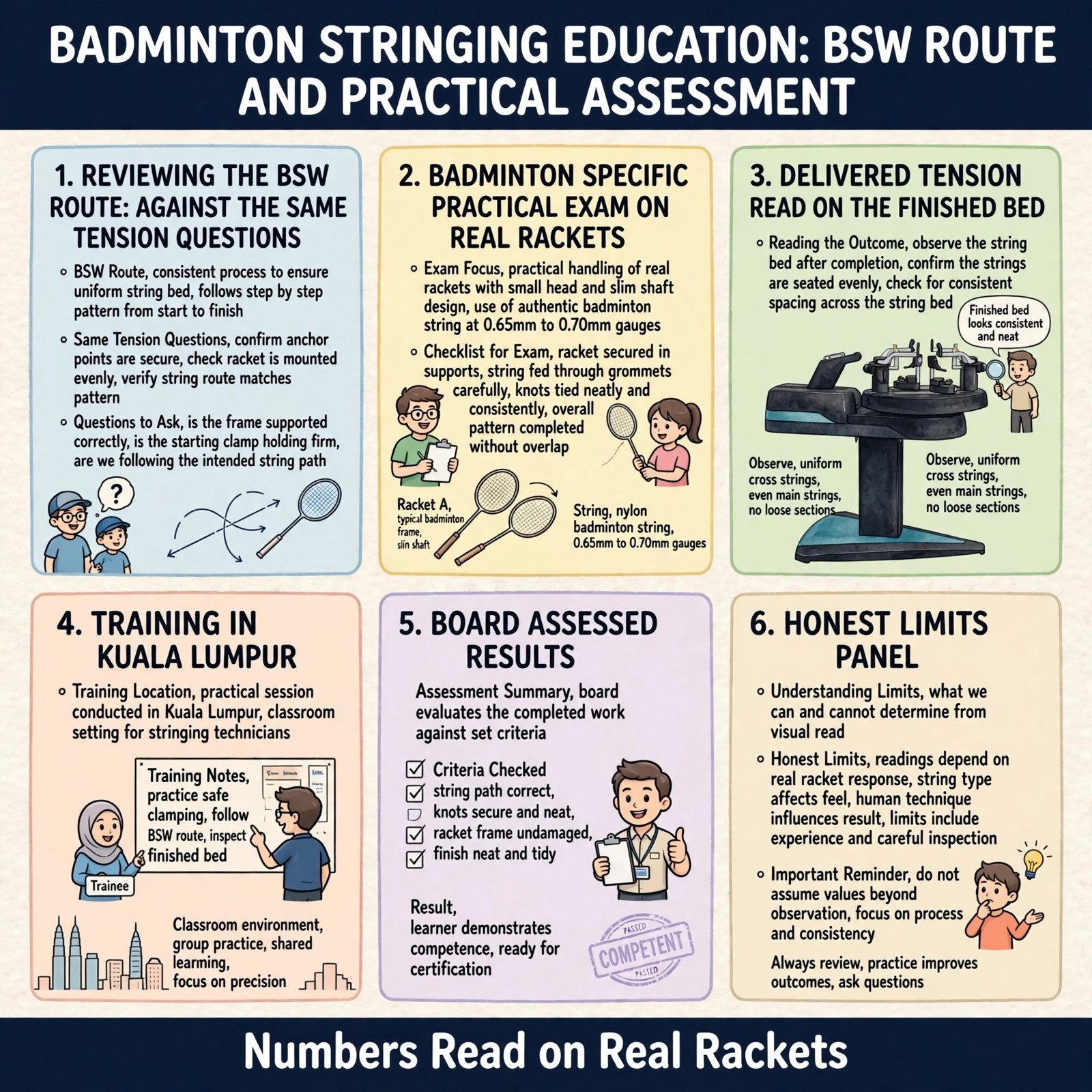
Hold the BSW route against the same tension questions, with no special pleading. The BSW practical exam is badminton specific, worked on real rackets, and the finished bed is the evidence: set tension against delivered tension, read as part of judging the whole job. Training runs in Kuala Lumpur over 3 and a half days, classes from 10am to 5pm with flexible timing on dates, and the exam sits on the last day. Results are assessed and approved by the BSW certification board. BSW does not publish a tolerance figure as a universal standard for other bodies, and candidates should ask how exam machines are checked before they enrol.
Check the details. The training shape matches the criterion. Learners string real rackets at real playing tensions with instructor correction, and finished beds are read back so misses are traced to calibration, clamps, weaving or knots while the fixing is still cheap. Founder Eric Chuar teaches from his Kuala Lumpur stringing base, while the certification decision itself belongs to the BSW certification board as an organisation, not to one person.
Review the process. The limits are plain too. BSW is a private certification body, not a government licence, and its course runs in Kuala Lumpur only. The older general bodies carry longer histories and wider recognition outside badminton, and a tennis centred stringer may be better served by their routes. For badminton stringers, though, tension checking designed around thin gauges and light frames tests the numbers your players will actually feel.
Plan the next step. One question protects you with any body: ask how your delivered tension will be checked, and what happens to the reading if the exam machine is later found to have drifted. BSW answers tension questions inside the enquiry, before enrolment. Judge every body, BSW included, by how directly it answers. A number nobody checks is a promise. A number read off your finished bed is evidence.
1.7 Guided Practice
What should you ask about tension before you apply?
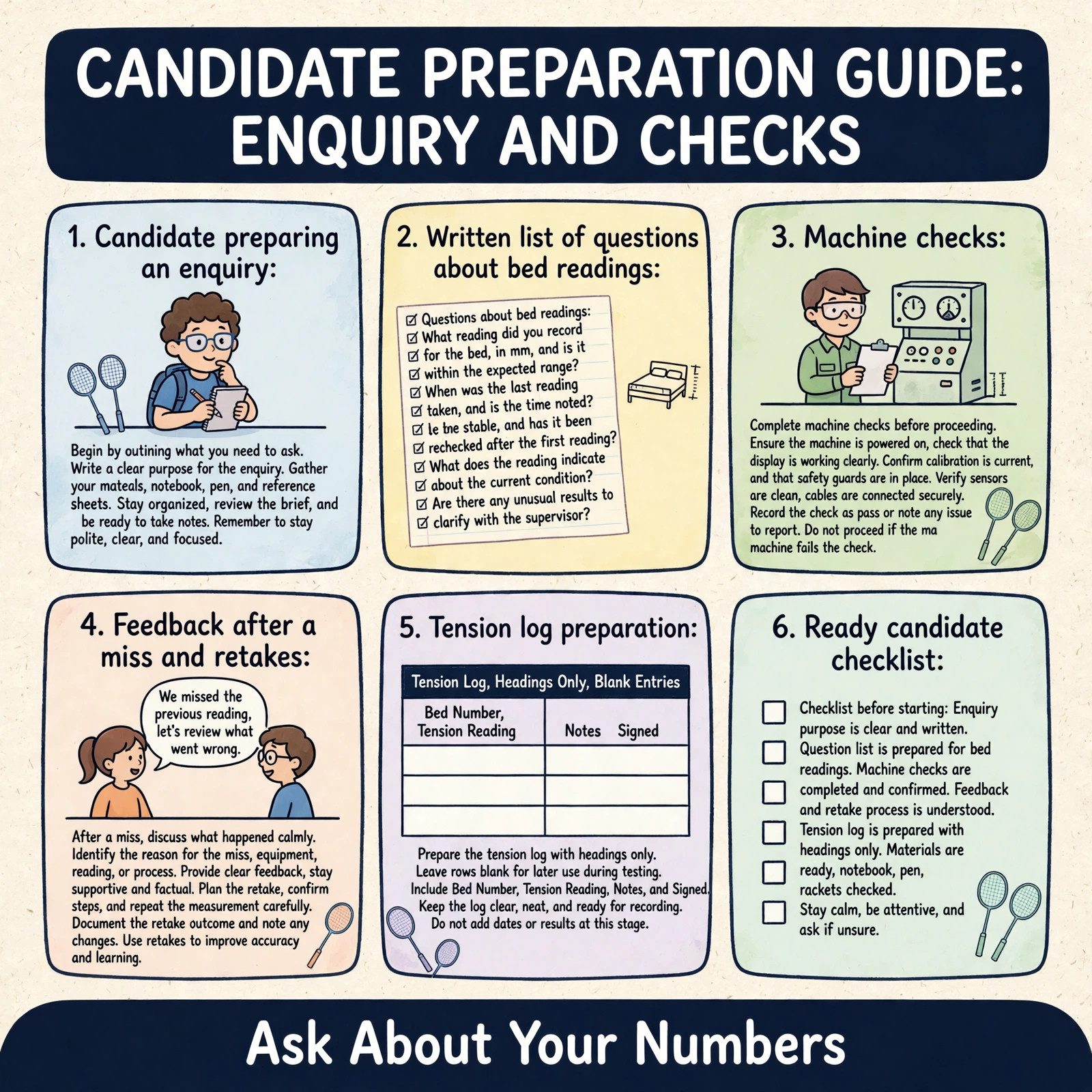
A good enquiry asks about tension checking directly. State your sport, your stringing volume, the machine you use and its calibration habits, and the work you want the credential for. Then ask: will my delivered tension be read on the finished racket? How are exam machines checked? What feedback follows a tension miss? What does a retake involve? Write the answers down and compare them with the method in this guide before you commit money or travel, because tension is the criterion where vague answers cost candidates the most.
Timing questions matter as much as tension questions. Ask when training runs, how long each day lasts and whether dates can flex around your work. At BSW, training is in Kuala Lumpur only, classes run from 10am to 5pm, the course takes 3 and a half days with the practical exam on the last day, and timing is flexible so travelling learners can plan around flights and work. Any provider should state its own shape just as plainly.
Turn the answers into a preparation plan the same day. Start recording set and delivered tension for every practice racket, check your machine, and list which stage loses tension when a bed reads low. Practise at the tensions your players actually request, using shop examples like 25 to 27 lbs, until your delivered readings sit where you set them as a habit. That record is your readiness, written in numbers an examiner will respect.
Tension Accuracy in Stringer Certification Quick FAQ
Short answers to the questions candidates ask first about tension accuracy, set and delivered tension and machine calibration.
What is tension accuracy in certification?
Tension accuracy in stringer certification means the tension the finished string bed actually delivers matches the tension that was set on the machine, checked by the examiner on the completed racket. It is not the number typed into the machine. Set tension is an instruction; delivered tension is the result, and certification marks the result.
How do examiners check your numbers?
Examiners check tension accuracy by reading the finished bed and comparing it with the tension the candidate set, while also watching the habits behind the number: machine calibration, clamp control, weaving consistency and knot security. A bed can only hold its tension if every stage before the reading was done properly.
How does measured training build accuracy?
Training builds tension accuracy when an instructor reads your finished beds and traces misses back to their cause: a drifting machine, slipping clamps, uneven weaving or a knot giving up tension. Videos can explain tension but cannot read your racket. Correction on real rackets is what turns a set number into a delivered number you can repeat.
Which costs and commitments come with it?
Preparing for a tension checked exam carries the usual cost categories, listed honestly before you commit. The course or training fee, where you take one. The exam or assessment fee itself. A machine and tools if you do not already own them, with calibration part of owning a machine rather than an optional extra. String and materials for practice, because accuracy takes repeated full rackets at working tensions, not one careful demonstration. Travel and stay if your body tests in another city. Time away from work. And the retake arrangement, understood before you need it.
How do bodies compare on tension checking?
Compare tension checking by asking each body the same questions. Is the delivered tension read on the finished racket, or is the set number taken on trust? Is the exam machine checked or calibrated before marking? Are candidates told how tension will be verified? A body that reads the bed and can explain its checking runs a test you can prepare for honestly.
How does the BSW route check tension?
Measured on tension accuracy, the BSW route is built around the problem this guide describes. Candidates train on real badminton rackets in Kuala Lumpur over 3 and a half days, classes from 10am to 5pm with flexible timing, and sit the practical exam on the last day. The exam work is judged on the finished racket, including whether the delivered tension matches the set tension the candidate worked to. Results are assessed and approved by the BSW certification board. BSW states no tolerance figure as a universal standard and promises no work from a pass. Candidates should ask how tension is checked on exam day before they enrol, and judge the answer.
What should you ask before applying?
A good enquiry asks about tension checking directly. State your sport, your stringing volume, the machine you use and its calibration habits, and the work you want the credential for. Then ask: will my delivered tension be read on the finished racket? How are exam machines checked? What feedback follows a tension miss? What does a retake involve? Write the answers down and compare them with the method in this guide before you commit money or travel, because tension is the criterion where vague answers cost candidates the most.
What should you keep from your certification route?
Keep your tension log above all: set tension and delivered reading for every practice and exam racket, machine checks you performed, and the causes you found for misses. Add your exam result record and training notes. That log is the evidence that your accuracy is a controlled habit, and it is the first thing to review before any retake or new credential.
How can I start with BSW?
Start with an enquiry that states your sport, your stringing experience, your machine and how you check its calibration, and ask how delivered tension is read in the exam. BSW trains in Kuala Lumpur only, with flexible timing, classes from 10am to 5pm over 3 and a half days and the practical exam on the last day. Your result is assessed and approved by the BSW certification board.
Tension Accuracy in Stringer Certification: Explore the Practical Decisions
Build a Clear Working Method
The method is simple: separate set tension from delivered tension, ask every body how the delivered number is read, and keep the written answers and your own tension log so your choice rests on evidence.
| Tension Check | Rushed Approach | Planned Approach |
|---|---|---|
| Numbers | Trust the number set on the machine | Judge the tension delivered in the finished bed |
| Checking | Assume the exam accepts your setting | Prepare for your bed to be read and compared |
| Costs | Budget for the course fee only | List exam, machine, calibration, travel and time together |
| Compare | Choose the body with the boldest claim | Score every body on how it checks tension |
| Your record | Keep body comparisons in your head | Write each body’s tension checking method down |
| Next action | Judge a credential from the certificate design alone | Use your tension log to choose the route that fits |
Get Your Numbers Checked with Best Stringer Worldwide
If your numbers matter to your players, take the route that reads them. Train on real rackets in Kuala Lumpur with Best Stringer Worldwide, with classes from 10am to 5pm over 3 and a half days, flexible timing, and the practical exam on the last day. Your work is assessed and approved by the BSW certification board. Send an enquiry that states your experience, your machine and your goal, and ask how your delivered tension will be checked.
