






1.1 Starting Point
What is the best badminton stringing certification in France?
For a stringer in France, the best badminton stringing certification is the one that ends in a practical exam on a badminton racket, after training where an instructor corrects your hands. A French learner usually compares two families of routes: European options closer to home, and a badminton only course further away. Compare them by what was tested, not by how familiar the badge sounds. A certificate based on attendance states very little. A certificate earned after tested work states that your tension control, knots and grommet care met a set standard. This guide scores both families against the same criteria.
Name the work you want the certificate for before you compare countries. Restringing for your club, working at a sports shop, or building a paid service for players in your town all rest on the same tested base, but they change how much repeat practice you should log before an exam and how much weight you give to certificate wording.
Write your standard down before you enquire anywhere. Four questions carry most of the weight: was the training on real badminton rackets, did an instructor correct your technique, did a practical exam test the finished racket, and does the certificate state what was tested? A route that cannot answer those plainly has a gap, whether it sits in France, elsewhere in Europe or overseas.
1.2 Preparation
What should a practical exam check for a stringer in France?
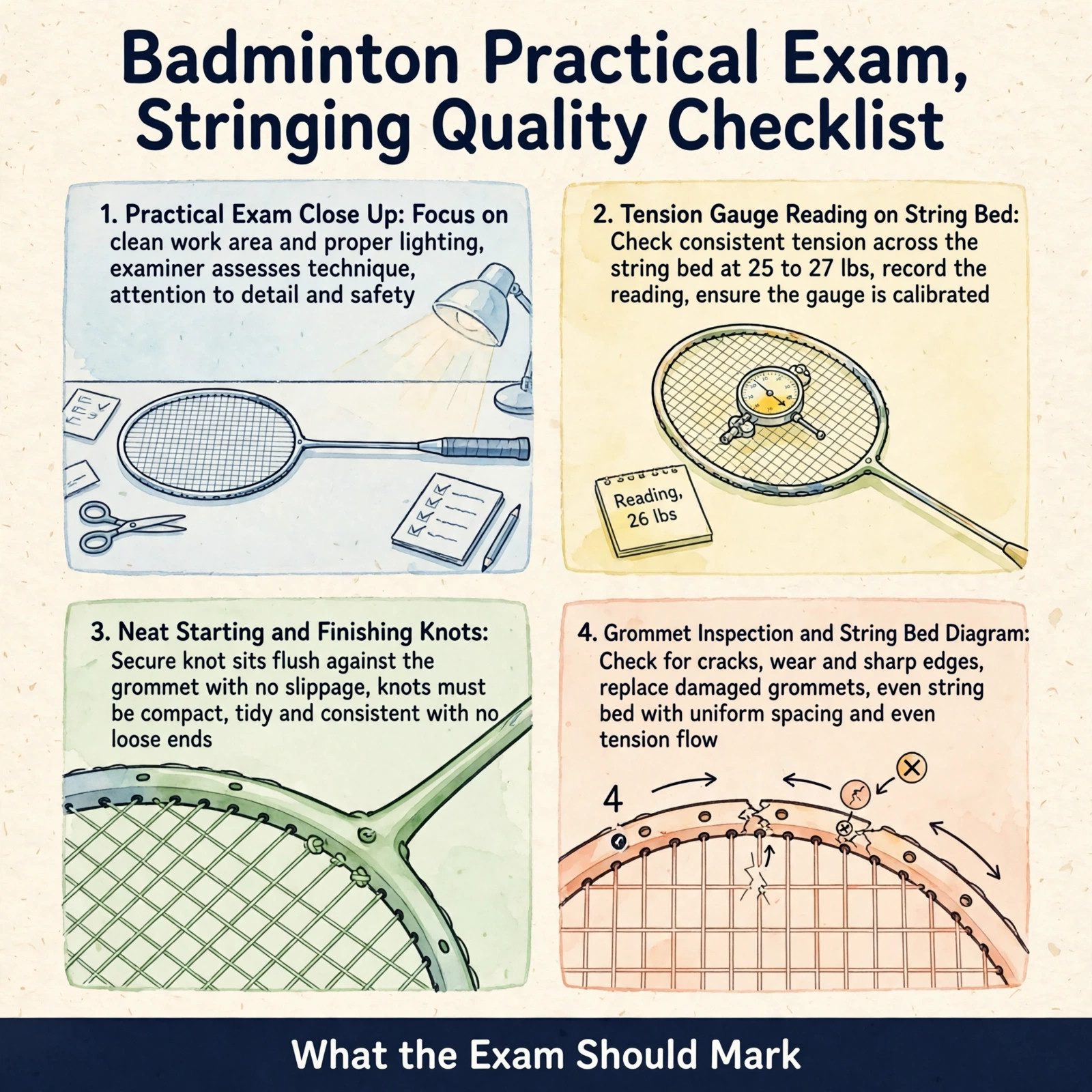
A proper practical exam tells you what good stringing means in plain terms, so read the marking before you choose where to train. The checks that matter are tension accuracy against the setting requested, clean starting and finishing knots, care where strings share grommets, and a straight, even string bed with no damage to the frame. The work is done on badminton rackets at playing tensions such as 25 to 27 lbs, with thin badminton string, and the same standard has to be repeated, not produced once on a good day.
Ask each provider to describe the marking in ordinary words. Which faults fail a racket, how is tension checked after stringing, and does the test include more than one racket? A clear answer points to a real exam behind the certificate. A vague answer about general quality leaves you trusting the paper instead of the test.
Be careful with exams borrowed from general racket work, which is common in Europe. Many racket credentials grew up around tennis, where frames are heavier, string is thicker and the work feels different in the hands. A test that never puts a badminton racket on the machine at badminton tension does not prove badminton skill, however tidy the certificate looks.
1.3 Working Method
How does corrected training compare with learning at a local shop?
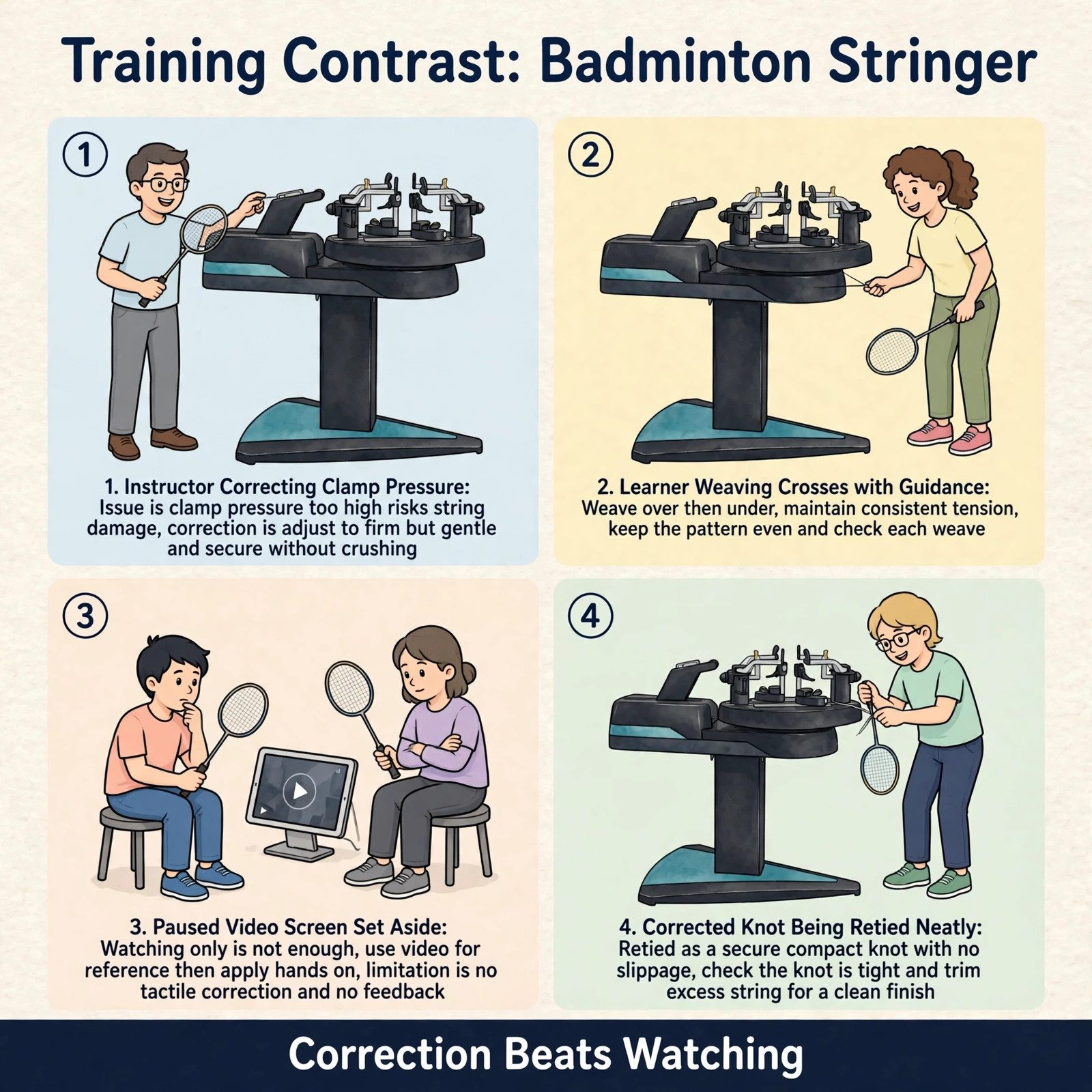
Skill at the machine is built by corrected repetition, and that is where routes in France differ most. Learning beside an experienced stringer at a local shop can teach sound habits if that person watches your rackets and stops faults early. Club learning adds volume, but the feedback depends on who is present that evening. Short workshops help only while your own hands stay on the machine. Videos are the weak substitute: they show the order of the steps well, but they cannot see your clamp pressure, your weaving angle or how you finish a knot.
Ask how training time is actually spent. How many full rackets do you string yourself, on strings such as BG65, BG80 or Exbolt 65, and on rackets such as the Yonex 100ZZ? Who checks each finished racket, and how is a fault shown to you and put right while you are still at the machine?
Whatever route you pick, practise like a candidate between sessions. String complete rackets rather than half jobs, note the string and tension each time, photograph your knots, and write down the one fault you will fix next. That record turns regular club practice into steady progress an examiner can measure.
1.4 Practical Review
Which costs and commitments should a French learner list in full?
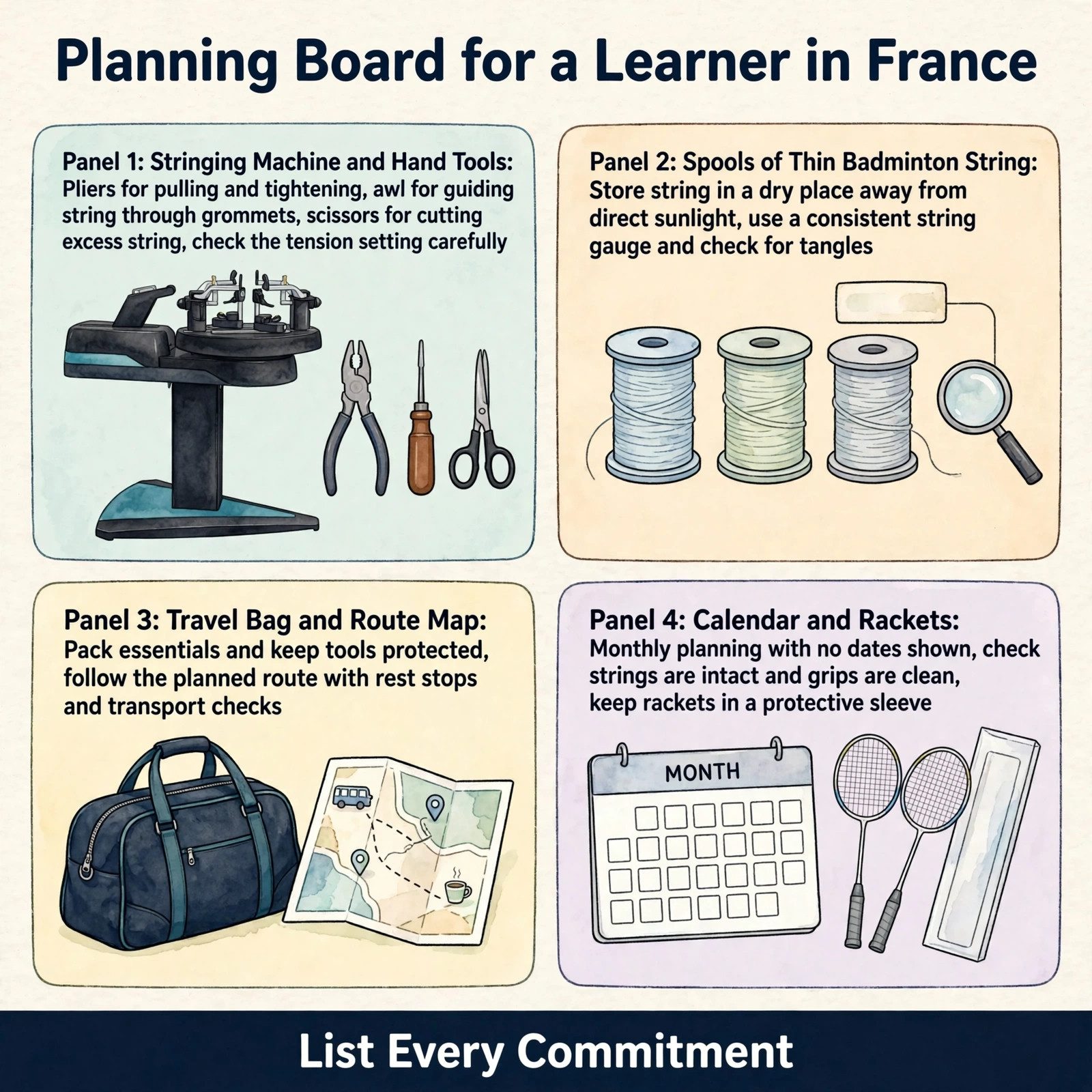
List the full commitment before you call any route cheap or costly. For a learner in France the lines are: the course itself, the exam, a machine and tools if you plan to keep stringing, string and materials for practice, and the retake arrangement if a first exam attempt falls short. Add travel inside Europe for a nearer option, or the flight to Kuala Lumpur and your stay there for the overseas route, plus time away from work and club duties. Write the list before you judge any single price, date or promise from any provider.
Check the details. Give each item its own line and a space beside it: course, exam, machine and tools, string and materials, travel and stay, time away from work. Fill in only what a provider states in writing, and mark every unanswered line as an open question rather than treating it as nothing.
Review the process. Compare totals, not single figures. A nearer European option with no badminton exam can look light, then cost you again when a shop asks what your certificate actually tested. A route with a long flight can still be the complete one if training, exam and retake terms are settled in one written plan.
Plan the next step. Keep the time lines beside the money lines. A long flight, training days and an exam day need you rested and focused, so plan the trip with a buffer either side instead of landing, training and testing while exhausted. Training you rush through while tired wastes more than the fare it tried to save.
1.5 Key Checks
How should I score the routes open to a stringer in France?
Record the context.
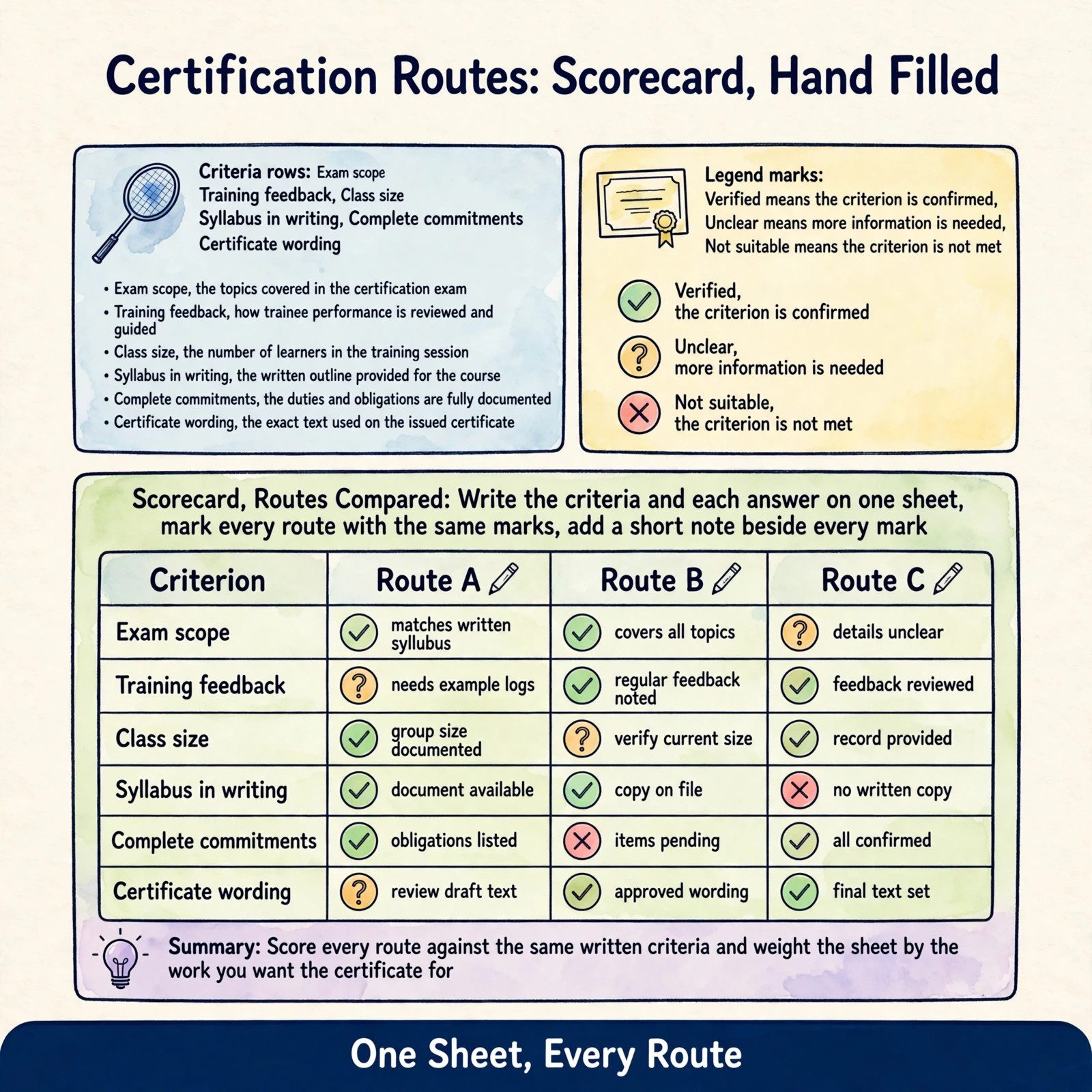
Score every route open to you on one sheet, with the same criteria for each: exam scope, training feedback, class size, syllabus in writing, complete commitments and certificate wording. Beside each criterion write one of three marks: verified, unclear or not suitable for you, with a short note on why. Local shop learning, club learning, a short workshop, online study alone, a general European racket credential and a certification course in Kuala Lumpur can all sit on the same sheet, with the same questions asked of each one in writing.
Check the details.
Be fair to the European options on the sheet. A general racket credential may score well on organisation and poorly on badminton testing. Shop learning may score well on feedback and poorly on exam scope. Writing that split down shows you exactly what each route can and cannot prove to a French shop or club.
Review the process.
Weight the sheet by the work you named at the start. If a shop will judge your certificate when you apply for work, exam scope and certificate wording carry the most weight. If you string mainly for your own club, feedback and repeat practice may matter more. Set the weights before you total anything.

1.6 Service Record
How does the BSW route measure up for learners from France?
Now run the BSW route through that same sheet, with no special treatment. Best Stringer Worldwide (BSW) is a badminton stringing course and certification provider based in Kuala Lumpur, Malaysia, founded by Eric Chuar, and it does not run classes in France. Learners from France travel to Kuala Lumpur, train on real rackets with an instructor correcting their work at the machine, and sit the practical certification exam the day after training. Certification is assessed and approved by the BSW certification board. Nothing in that route asks for special trust. It asks for the same written answers you would want from a provider in Europe.
Check the details. On the scorecard lines, BSW states its scope plainly: badminton only, real rackets, correction during training, and a practical exam at the end of the route. Check the remaining lines the way you checked every other route: class size, syllabus in writing, your full commitment list and the exact wording the certificate carries home to France.
Review the process. The honest cost of this route is the trip itself. France to Kuala Lumpur is a long flight, and travel, stay and time away belong on your sheet beside the course and exam lines. Timing is flexible, which helps you plan around work and the club season, but flexible timing is no reason to leave the plan unwritten.
Plan the next step. Where any line stays unclear, ask about that line only and add the answer to your sheet. Ask how the training covers the work you want to do back in France, what equipment you will learn on, and what practice is expected before you fly. Judge the completed sheet as a whole, not the strongest single answer.
1.7 Guided Practice
What should I ask before I enrol from France?
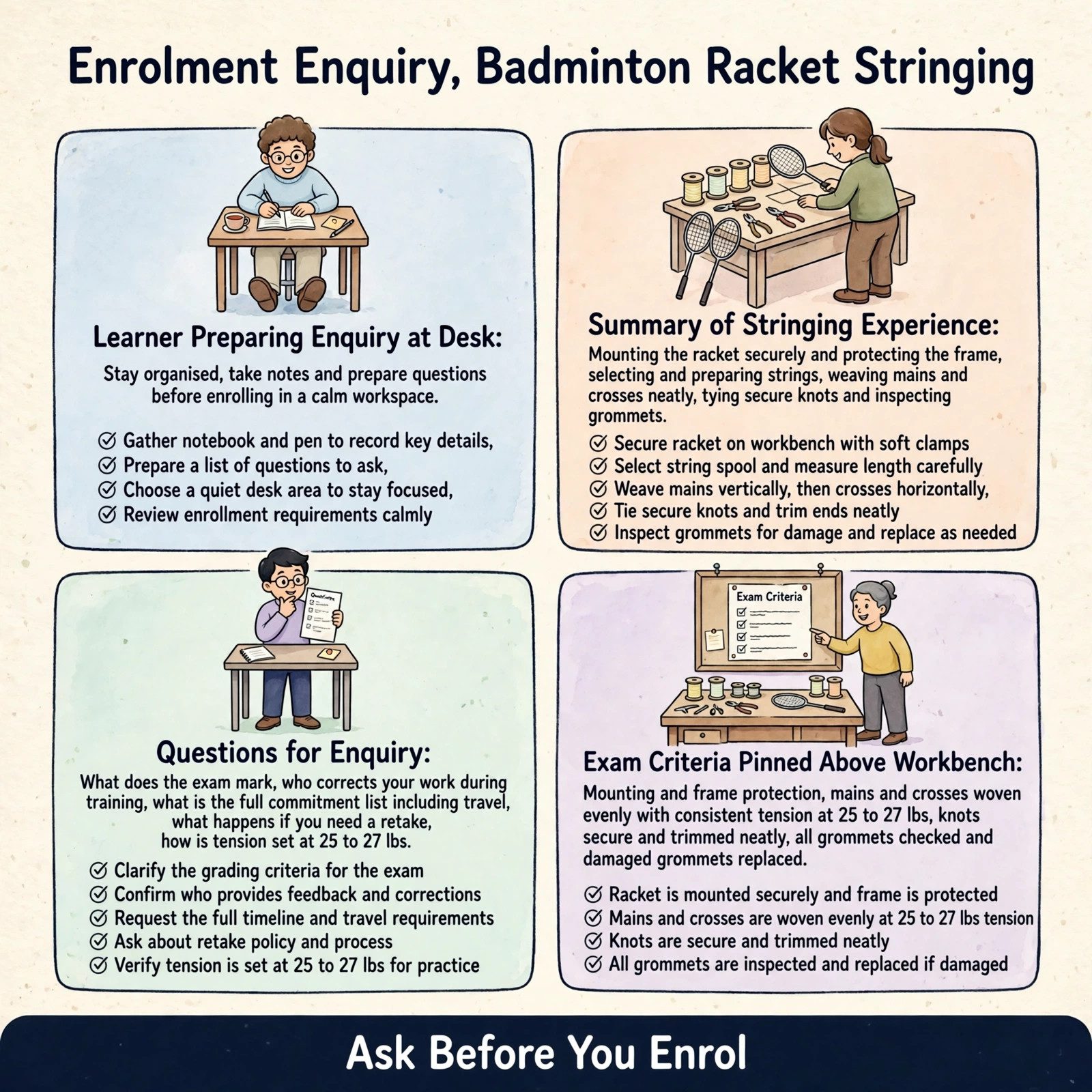
Your enquiry should make a useful answer easy. State your sport, how long you have been stringing, where in France you are based, the machine and tools you can use, and the work you want the certificate for. Then ask the questions still open on your scorecard: what the exam marks, who corrects your work during training, what the full commitment list looks like including travel, and what happens if you need a retake. Send the same enquiry to each route you are seriously comparing.
Cut questions that change nothing. Ask about the exam, the correction and the commitments, in that order. A short enquiry with sharp questions gets a straight answer you can file on your scorecard. A long enquiry full of general questions usually gets a general brochure back, in any country.
Turn the replies into a preparation plan. List the rackets and strings you will practise on, the tensions you will repeat until they feel routine, and the exam criteria pinned where you can see them at your machine. For the Kuala Lumpur route, add your flight and stay plan to the same page, with rest built in.
Best Badminton Stringing Certification in France Quick FAQ
Straight answers for stringers in France on comparing European and overseas certification routes, practical exams, full costs and the Kuala Lumpur option.
What is the best badminton stringing certification in France?
The route that ends in a practical exam on a badminton racket, after hands on training with correction. For a learner in France, judge European options and the Kuala Lumpur route by what was tested and corrected, not by distance or badge familiarity.
What should the practical exam check?
Tension accuracy, clean knots, grommet care and an even string bed, repeated on a badminton racket at playing tension. A general European racket test that never touches badminton work leaves the badminton part of the certificate unproven.
How does corrected training compare with learning alone?
Corrected repetition builds exam skill. Training works when someone watches your hands on real rackets and fixes faults early. Shop and club learning in France can help where feedback is real. Videos cannot see your work, so they cannot correct it.
Which costs and commitments should I list?
List the full commitment before you call any route cheap or costly. For a learner in France the lines are: the course itself, the exam, a machine and tools if you plan to keep stringing, string and materials for practice, and the retake arrangement if a first exam attempt falls short. Add travel inside Europe for a nearer option, or the flight to Kuala Lumpur and your stay there for the overseas route, plus time away from work and club duties. Write the list before you judge any single price, date or promise from any provider.
How should I score the routes open to me?
Use one scorecard for all routes: exam scope, training feedback, class size, syllabus in writing, complete commitments and certificate wording. Mark each line verified, unclear or not suitable, and keep a short note beside every mark.
How does the BSW route measure up?
For a learner in France, the BSW route means one long trip to Kuala Lumpur, because Best Stringer Worldwide runs its course only there and does not run classes in France. You train on real rackets with an instructor correcting your work, then sit the practical certification exam the day after training. Certification is assessed and approved by the BSW certification board, so the result states tested badminton work at real tensions, not attendance. Score it on the same lines as any European option: exam scope, training feedback, class size, syllabus in writing, full commitments including the flight and stay, and the exact certificate wording.
What should I ask before I enrol?
Your enquiry should make a useful answer easy. State your sport, how long you have been stringing, where in France you are based, the machine and tools you can use, and the work you want the certificate for. Then ask the questions still open on your scorecard: what the exam marks, who corrects your work during training, what the full commitment list looks like including travel, and what happens if you need a retake. Send the same enquiry to each route you are seriously comparing.
What should I keep from my certification training?
Your exam feedback, your practice record and the scorecard you chose by, kept together in one file. They show a French shop or club exactly what your certificate covered, how your work was marked, and how you have kept the standard since training.
How can I proceed with BSW from France?
State your experience, where you are based in France and the work you want the certificate for, then plan the Kuala Lumpur route: train on real rackets and sit the practical certification exam the day after training, with flight and stay arranged around those days.
Best Badminton Stringing Certification in France: Explore the Practical Decisions
Build a Clear Working Method
Use the sections, questions and comparison on this page to score your options. Keep your scorecard beside you and let instructor feedback point to your next practice task.
| France Check | Rushed Approach | Planned Approach |
|---|---|---|
| Certificate | Pick the best known European badge by name | Judge what the certificate proves for badminton work |
| Exam | Assume a general racket exam covers badminton | Check the badminton tasks and tensions being marked |
| Costs | Compare headline prices across countries only | List course, travel, tools, materials and time together |
| Scorecard | Rank European and overseas routes differently | Score every route against the same written criteria |
| Your record | Keep each country option in a separate note | Write the criteria and each answer on one sheet |
| Next action | String on without reviewing your finished rackets | Use your record to pick the next fault to fix |
Find the Right Certification Route from France with Best Stringer Worldwide
Ready to choose a certification route from France on evidence, not badge names? Tell Best Stringer Worldwide about your stringing experience, the equipment you can use and the work you want the certificate for. Bring your scorecard or one sharp question so the reply can deal with your real gaps. Train on real rackets in Kuala Lumpur, then take the practical certification exam the day after training, assessed and approved by the BSW certification board.

