1.1 Equipment Fundamentals
What Are the Fundamentals of Racquet Face Size & Sweet Spot?
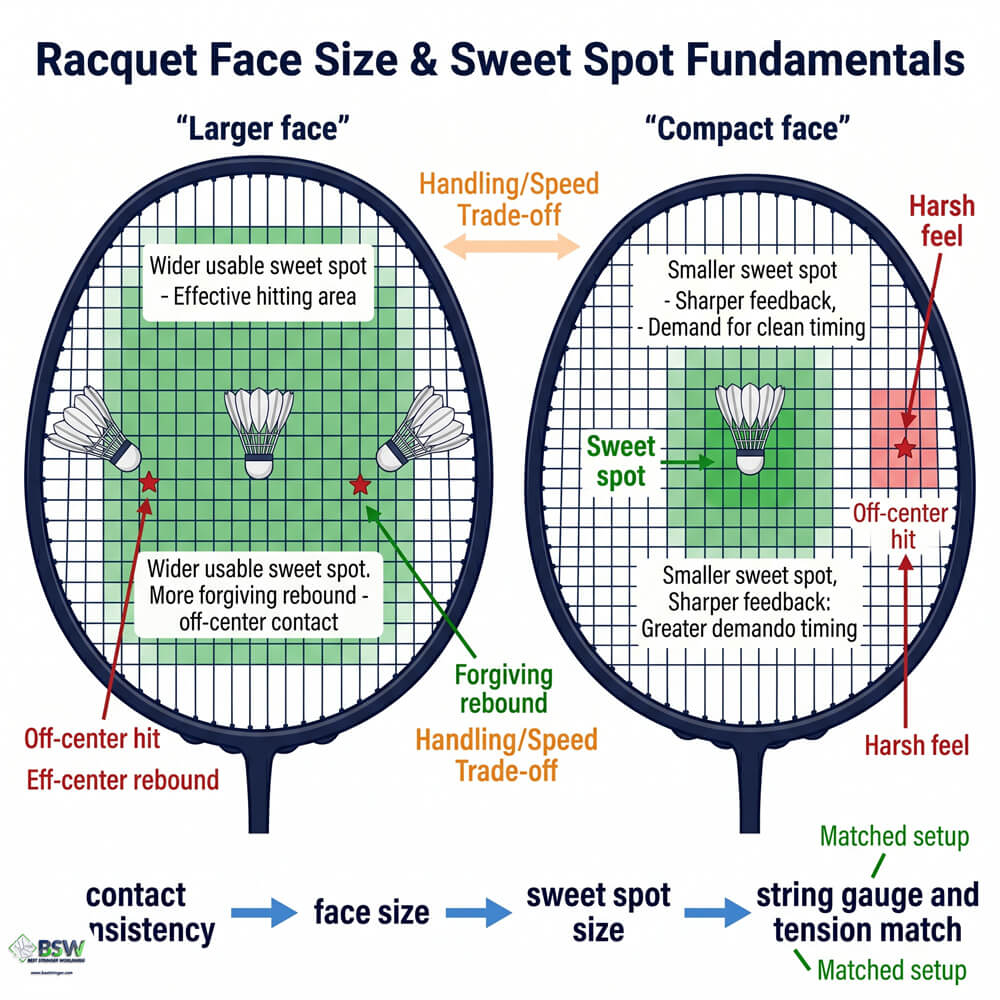
Equipment fundamentals refer to how specific racquet characteristics, particularly racquet face size, combine to enhance your playstyle. In this guide, you will learn why a larger badminton racquet face can provide a bigger sweet spot under similar conditions, alongside other key specs like frame stiffness and string tension.
In short, the size of your racquet face dictates your effective hitting area, while your string choice dictates your feeling and touch. Mastering these concepts is crucial for any badminton player aiming to improve, as “a larger sweet spot” does not automatically mean “better for every player.”
Here is a simple decision flow:
Step 1: Assess your contact consistency honestly.
Step 2: Understand that ‘more forgiveness’ from a bigger racquet face is only beneficial if it matches your handling speed.
Step 3: Consult a certified stringer to select a string gauge and tension that perfectly matches your racquet face size and sweet spot needs.
1.2 Racquet Face Size & The Sweet Spot
Racquet Specs Explained: Face Size and Effective Hitting Area
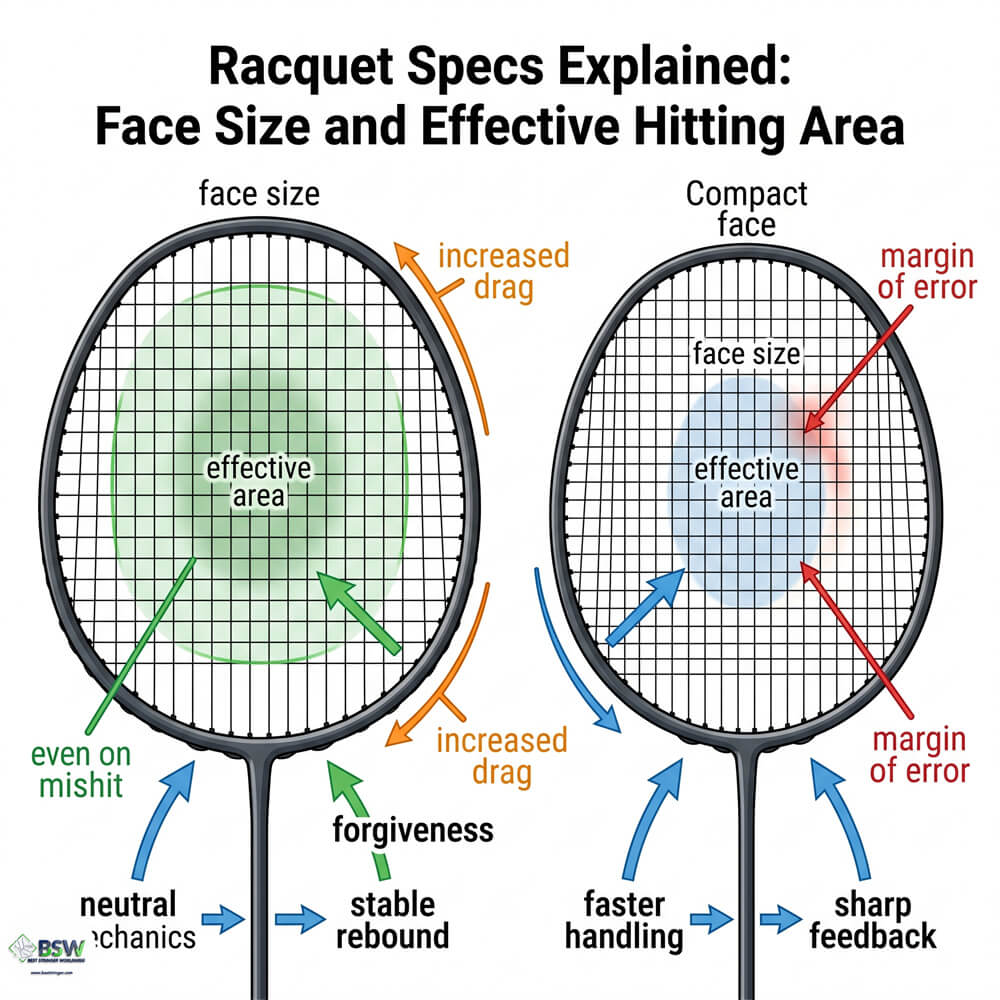
A core rule of equipment design is that a larger badminton racquet face can create a larger sweet spot when all other conditions are equal. This happens because the stringbed offers a wider usable hitting area. A bigger racquet face provides extra forgiveness, helping to stabilize shuttle rebound on slight off-center hits. However, a smaller, more compact racquet face is often the starting point for faster handling and sharper feedback.
Increasing the frame area drastically alters how the stringbed behaves. A larger sweet spot supports more consistent contact for developing players, but it can sometimes slow down racquet aerodynamics slightly. Smaller frames sacrifice some of that forgiveness for rapid maneuverability during fast flat exchanges and precise net control.
A badminton player needs the right balance between forgiveness, maneuverability, and control. For players needing easier access to usable rebound and margin for error, a larger racquet face is generally preferred. Players with clean timing often benefit from the direct, compact feel of a smaller racquet face for sustained fast-paced pacing.
1.3 Stringbed Response & Forgiveness
Understanding Off-Center Contact and Forgiveness
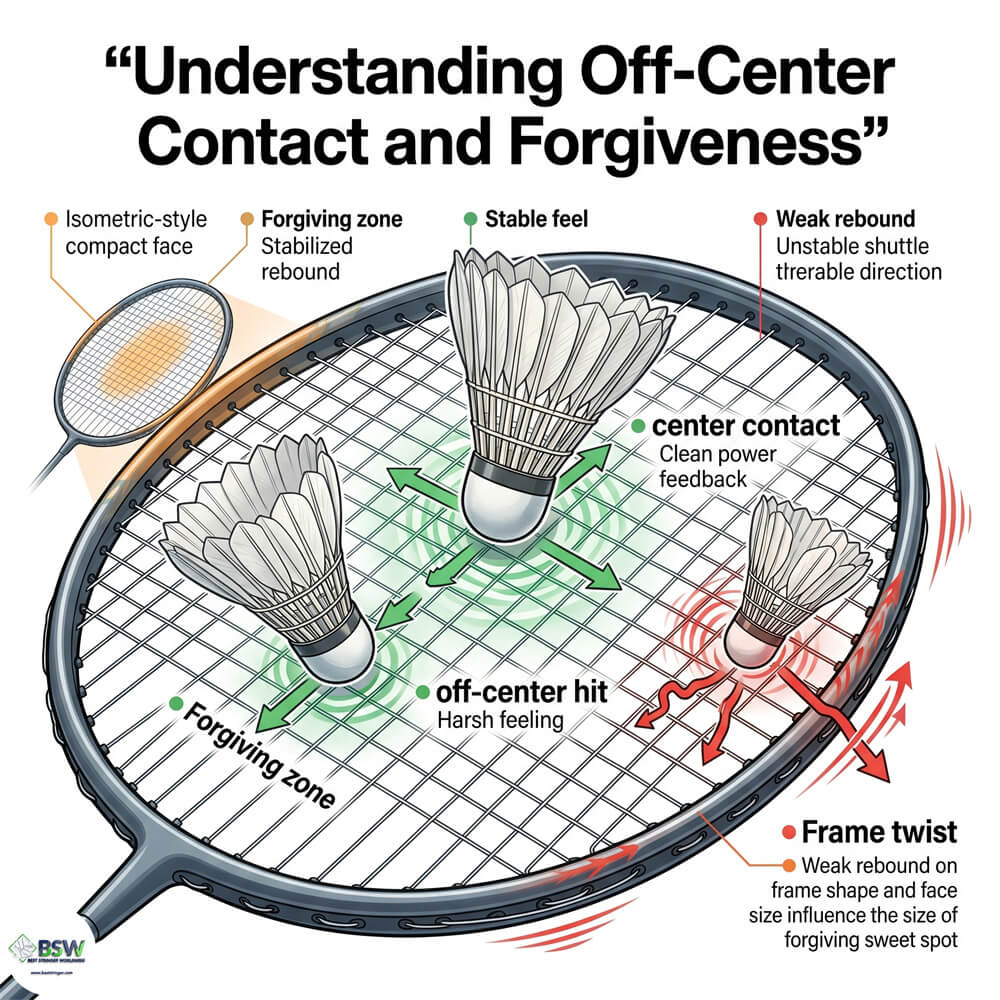
While a larger badminton racquet face provides a wider effective hitting area, the frame’s design dictates how that stringbed response feels. A larger sweet spot helps reduce harsh feedback when the shuttle is contacted slightly away from the exact center. If you lack consistent technique, pairing a compact frame with a high string tension punishes you with weak clears, dead feedback, and potential arm fatigue.
An expanded hitting zone is highly forgiving. It acts as a safety net, allowing the stringbed to stabilize the shuttle rebound smoothly to help players effortlessly clear the shuttle, even if their impact point is slightly off-center.
Frame shape also plays a massive role in this forgiveness. An isometric (squarish) shape combined with a bigger face size offers an even larger sweet spot, ensuring that your swing energy still transfers effectively on slight mishits, saving your timing and confidence during fast rallies.
1.4 Tension & The Sweet Spot
Badminton String Setup for Larger Racquet Faces
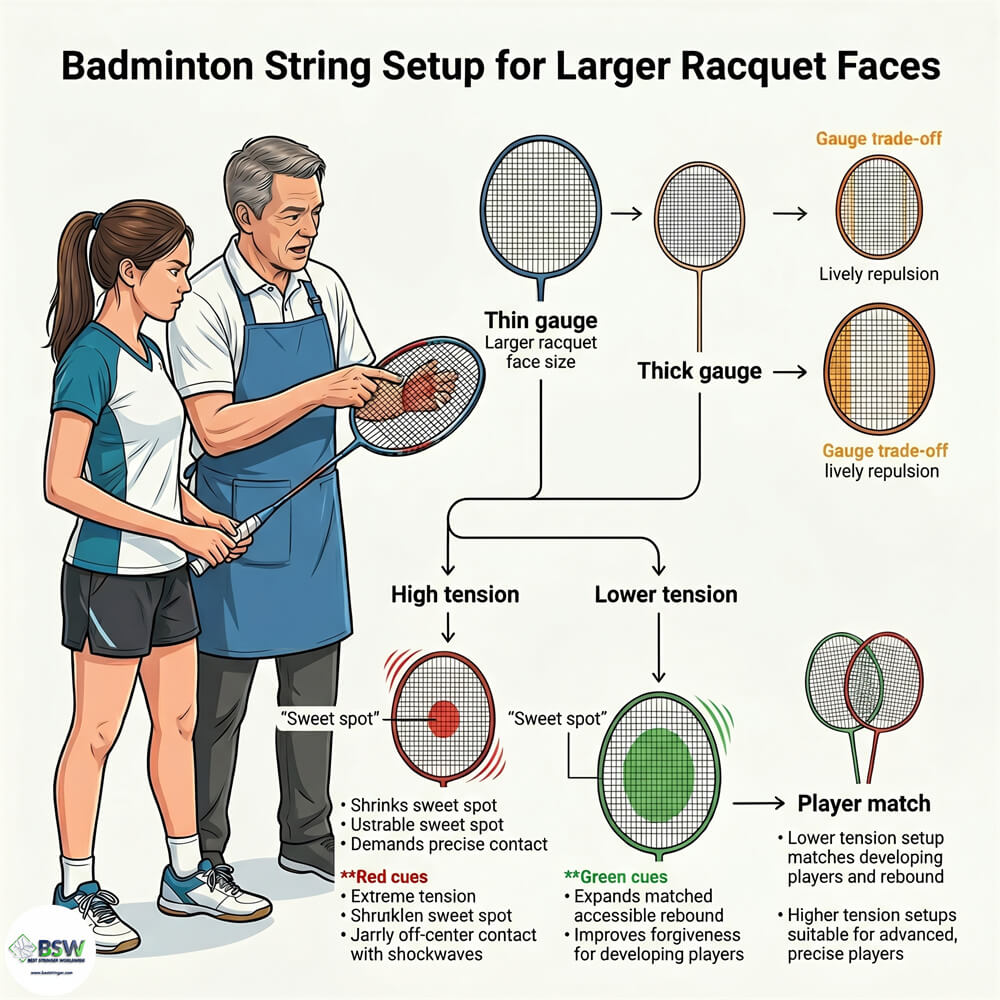
A larger badminton racquet face requires the correct string type and tension to truly optimize its effective hitting area. Understanding this synergy is essential for players and badminton stringers:
The Role of String Gauge. Gauge refers to the thickness of the string. Thin strings (e.g., 0.61mm) offer incredible repulsion across a larger stringbed, while thick strings (e.g., 0.70mm) sacrifice a bit of crispness for robust durability when the frame area is wider.
How String Tension Affects the Sweet Spot. Tension changes how the stringbed responds. High tension (26+ lbs) shrinks the usable sweet spot, demanding highly consistent contact. Low tension acts like a wider trampoline, increasing the sweet spot and boosting forgiveness for developing players.
The Tension Mismatch Risk. If you choose a larger racquet face for forgiveness but string it at an extremely high tension without the required accuracy, the sweet spot shrinks and off-center hits will still feel jarring. A professional badminton stringer will always align tension with your racquet face size and technical ability.
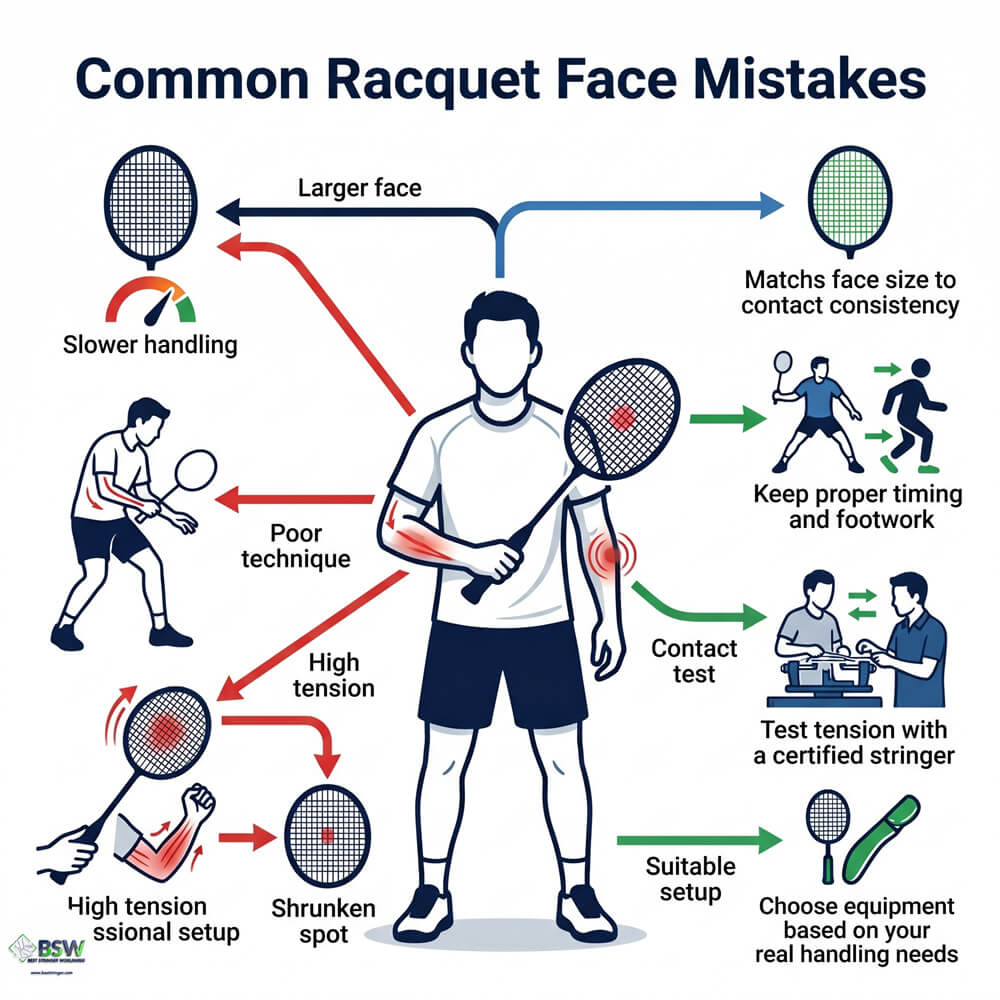
1.5 Common Sweet Spot Mistakes
Common Racquet Face Mistakes
Mistake 1: Assuming a Larger Racquet Face is Always Better.
While a larger badminton racquet face provides a bigger sweet spot under similar conditions, choosing the largest frame available is not perfect for everyone. It can sometimes feel slightly slower or less sharp compared to compact frames.
Mistake 2: Thinking a Bigger Sweet Spot Replaces Technique.
A larger sweet spot improves forgiveness on slight off-center hits, but it does not fix poor swing mechanics. You still need proper timing and footwork to generate quality shuttle rebound and control.
Mistake 3: Blindly Copying High Tension Pro Setups.
Using a large racquet face but copying the extremely high string tension of an elite player is a common error. High tension shrinks the effective hitting area; without advanced timing, it simply tires your arm and ruins your consistency.
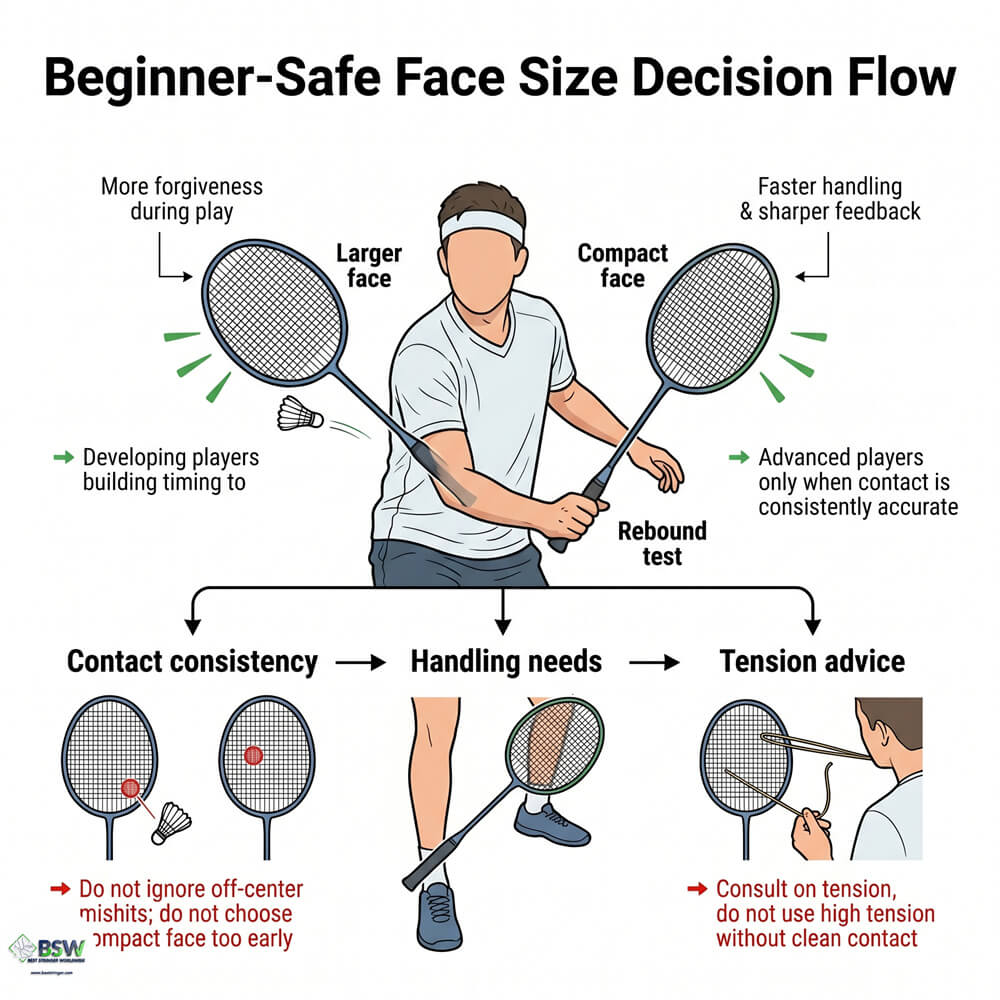
1.6 Selection Framework
Beginner-Safe Face Size Decision Flow
A step-by-step decision flow is crucial for balancing forgiveness and handling speed safely. Use this simple framework before upgrading your badminton equipment:
Step 1: Assess Your Contact Consistency. A smaller, compact racquet face only performs well if you hit the exact center consistently. Developing players should often start with a standard or larger racquet face to ensure adequate forgiveness while learning stroke mechanics.
Step 2: Identify Your Handling Needs. Determine if you value a highly forgiving response for off-center hits, or if you prefer the slightly faster aerodynamic handling and sharper feedback that smaller frames can provide during fast flat exchanges.
Step 3: Consult on String Tension. Once you choose a racquet face size, test different tensions. Remember that string tension directly alters the sweet spot feel, so work with a certified stringer to find the tension that gives you the best shuttle rebound.
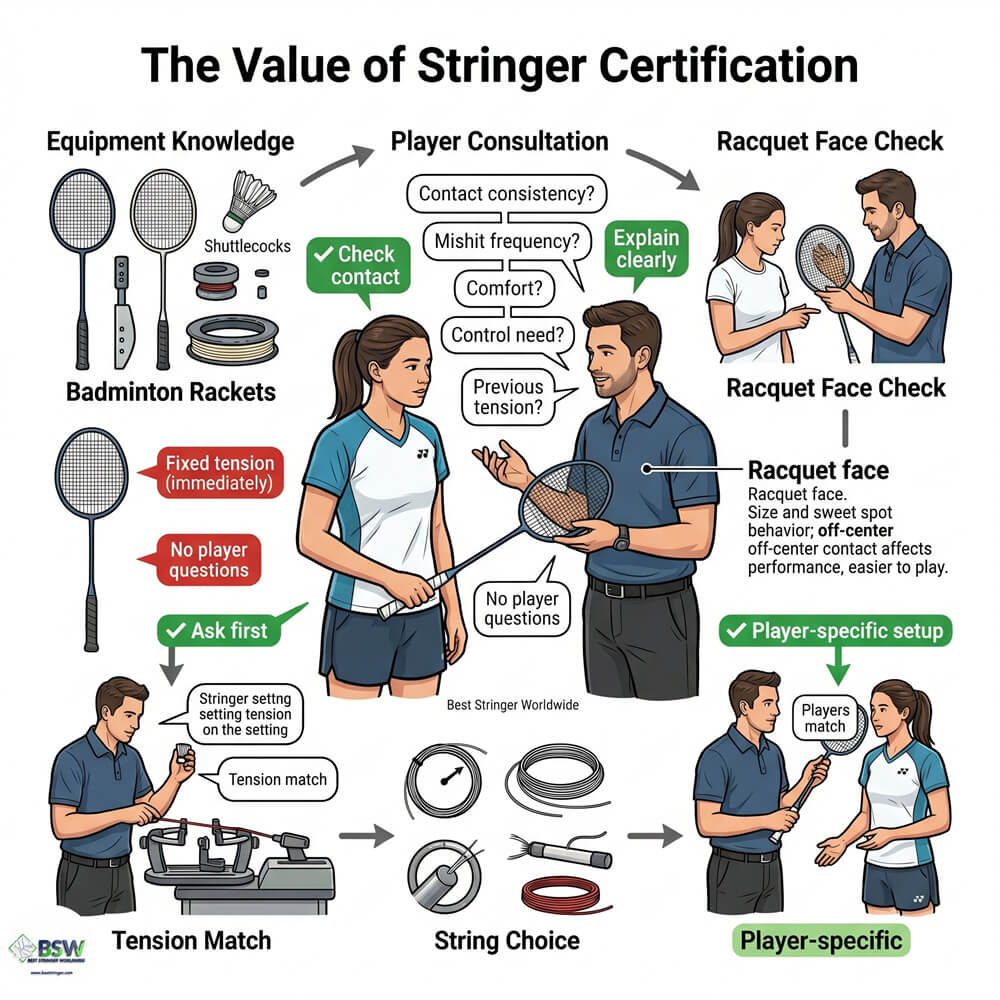
1.7 Professional Education
The Value of Stringer Certification
Proper equipment education is a core part of a professional badminton stringing course and good stringer certification standards. A certified stringer understands that recommending a specific racquet face size without considering a player’s real contact ability is a disservice.
At Best Stringer Worldwide, we know that racquet face size directly influences sweet spot behavior and the advice given to players. The key is not just buying a bigger frame, but using the player consultation logic a badminton stringer applies to match string type and tension to the usable hitting area.
By prioritizing accurate equipment knowledge, our stringing certification ensures that every setup perfectly balances forgiveness, control, and stringbed response. You eliminate guesswork, understand how off-center hits function, and focus purely on improving your game.
Sweet Spot & Face Size Quick FAQ
Quick, direct answers to common questions about badminton racquet face size and sweet spot behavior.
Does a larger racquet face have a bigger sweet spot?
Yes, when all other conditions are equal, a larger badminton racquet face provides a bigger sweet spot. This happens because the stringbed has a wider effective hitting area to rebound the shuttle consistently.
What is the sweet spot in a badminton racquet?
The sweet spot is the most responsive and comfortable area of the stringbed. Hitting the shuttle in this zone provides the best power transfer, control, and feeling, while reducing harsh vibrations to your arm.
Is a larger sweet spot better for beginners?
Often, yes. A larger sweet spot provides more forgiveness on slight off-center hits, which helps developing players and beginners maintain stable shuttle rebound while they refine their timing and technique.
Why do off-center hits feel less stable?
When you contact the shuttle outside the sweet spot, the frame twists slightly and the stringbed cannot flex optimally. A larger badminton racquet face helps minimize this harsh feedback by expanding the forgiving hitting area.
Why do some players prefer smaller racquet faces?
Some advanced players prefer a smaller, compact racquet face because it can offer slightly faster aerodynamic handling and very sharp, direct feedback, provided their timing is highly accurate.
How does string tension affect the sweet spot?
Higher string tension shrinks the effective sweet spot, requiring more precise contact. Lower tension expands the sweet spot and provides a more forgiving stringbed response. A certified stringer can advise the best balance for you.
What should a stringer know about face size?
A professional badminton stringer should understand that a player’s racquet face size changes how tension behaves. They must ask about contact consistency and off-center mishits before giving stringing advice.
How does this connect to stringer certification?
A thorough badminton stringing certification teaches how racquet face size, sweet spot behavior, and string tension work together. A certified stringer uses this knowledge for proper player consultation, not just pulling tension.
Are stringing courses useful for equipment knowledge?
Absolutely. A modern badminton stringing course covers racquet behavior, effective hitting areas, and player analysis, ensuring stringers can confidently advise players on sweet spot optimization and tension selection.
The Physics of Forgiveness: Why Racquet Face Size Matters
Proven Sweet Spot Knowledge
Our stringing approach is based on verified equipment parameters used by top professionals. We prioritize arm safety, proper racquet face analysis, and playstyle efficiency over blindly recommending high tension or inappropriate frame sizes.
| Racquet Design Factor | Larger Racquet Face Options | Smaller/Compact Face Options |
|---|---|---|
| Face Size & Sweet Spot | Larger Face: Bigger sweet spot when all else is equal, wider effective hitting area. | Compact Face: Smaller sweet spot, requires highly accurate and clean timing. |
| Forgiveness & Mishits | More forgiving response, helps stabilize shuttle rebound on off-center hits. | Less margin for error, sharp feedback but penalizes slight off-center contact. |
| Handling & Aerodynamics | May feel slightly slower or broader during fast flat exchanges depending on design. | Faster handling, preferred for quick defensive maneuverability and sharp drives. |
| Player Suitability | Excellent for developing players or those wanting comfortable, consistent contact. | Suited for advanced players with precise timing who want a direct, compact feel. |
| Tension Synergy | Can support slightly higher tensions more safely due to the expanded hitting area. | High tension shrinks the sweet spot further, requiring extreme contact precision. |
| Stringer Advice | Assess if the player needs help with contact consistency before recommending. | Ensure the player has the timing to handle the reduced margin for error. |
Master Your Racquet Knowledge with Best Stringer Worldwide
Ready to upgrade your knowledge? A badminton stringing course from Best Stringer Worldwide teaches you how racquet face size, sweet spot behavior, and string setups affect performance safely. We educate badminton players and certified stringers worldwide, especially in Singapore, Hong Kong, Malaysia, Indonesia, UK, France, and Europe. Contact us to master equipment consultation and player advice.