1.1 String Gauge Fundamentals
What Are the Fundamentals of String Gauge & Power?
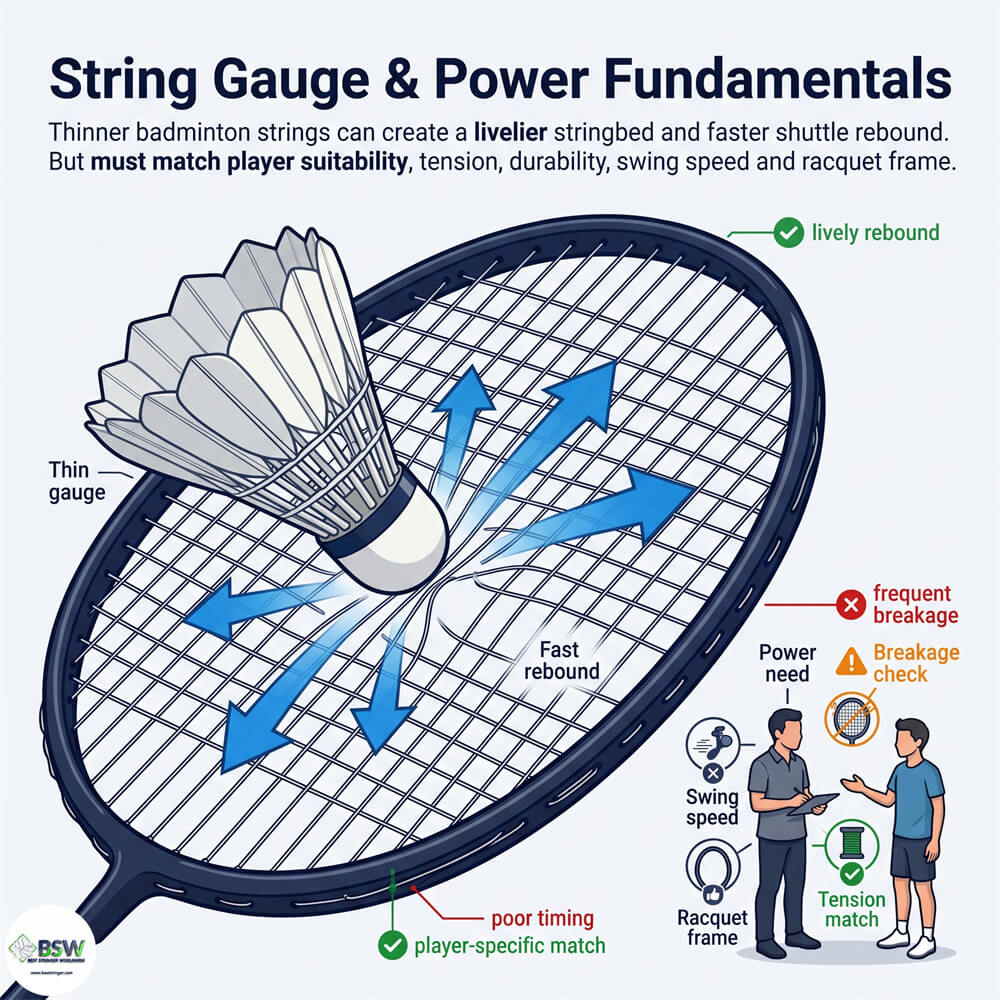
Equipment fundamentals refer to how specific racquet characteristics, particularly badminton string gauge, combine to enhance your playstyle. In this educational guide, you will learn why thinner badminton strings can usually produce more power when all other conditions are equal, alongside crucial factors like string tension, durability, and player suitability.
In short, a thinner badminton string often provides a livelier, more elastic stringbed response. This faster shuttle rebound can help create easier power for many players. However, mastering equipment knowledge means understanding that “more power” from a thin string does not automatically make it the best choice for every player.
Here is a simple decision flow:
Step 1: Assess your power needs and string breakage frequency honestly.
Step 2: Understand that ‘easier power’ from a thin string comes with a durability trade-off.
Step 3: Consult a certified stringer to select a string gauge and tension that perfectly matches your swing speed, contact quality, and racquet frame.
1.2 String Thickness & Repulsion
String Gauge Explained: Repulsion and Rebound
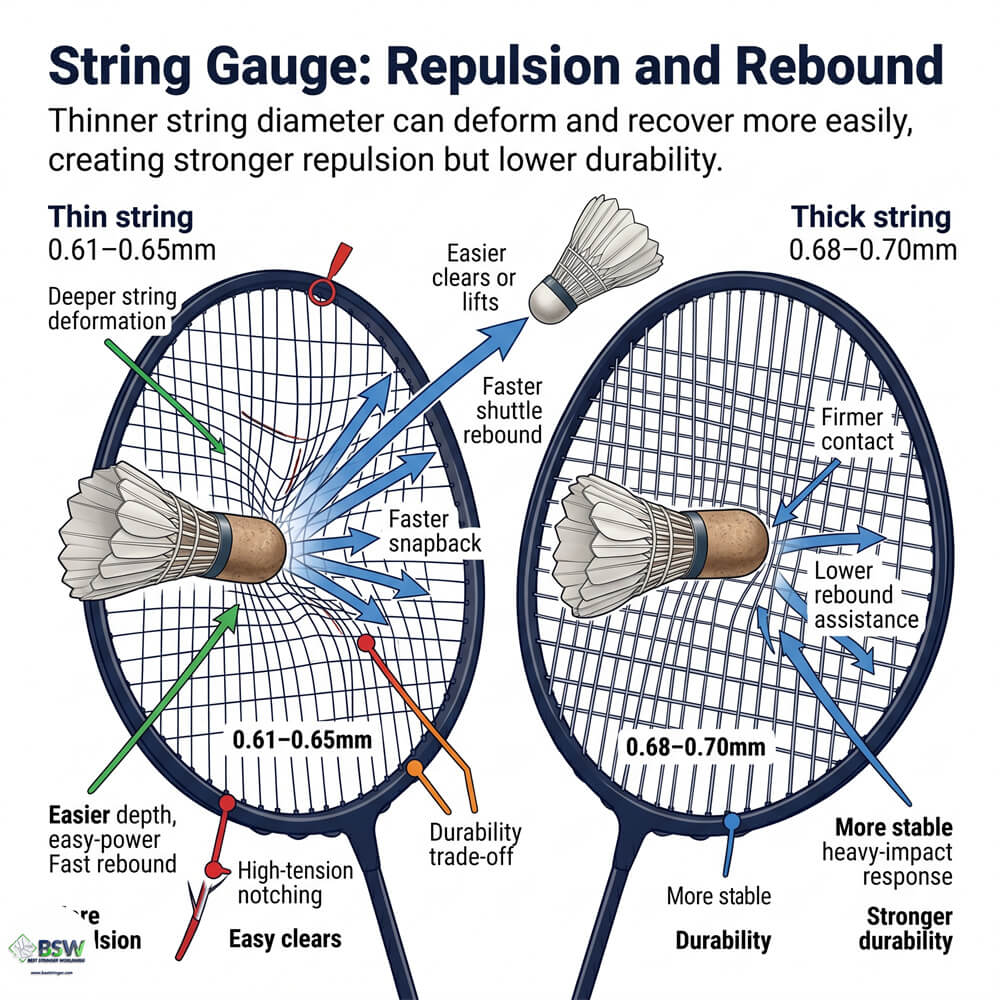
The core concept of string physics is that thinner badminton strings can usually produce more power when all other conditions are equal. This happens because a thinner string diameter (e.g., 0.61mm – 0.65mm) can deform and recover more easily during impact. This elasticity creates a faster, more responsive shuttle rebound, known as repulsion.
For many badminton players, this livelier stringbed response helps make clears, lifts, and quick attacking shots feel much easier. It requires less sheer physical strength to generate decent shuttle depth compared to a very thick, stiff string. However, real power generation still heavily depends on proper swing mechanics and timing.
While thinner strings excel in repulsion, they naturally sacrifice durability. A thinner profile will notch and break faster, especially if the player mis-hits frequently or uses a very high string tension. Therefore, choosing a string gauge is always a calculated balance between easy power and long-lasting performance.
1.3 Stringbed Response & Feel
Understanding Stringbed Response and Sweet Spot Feel
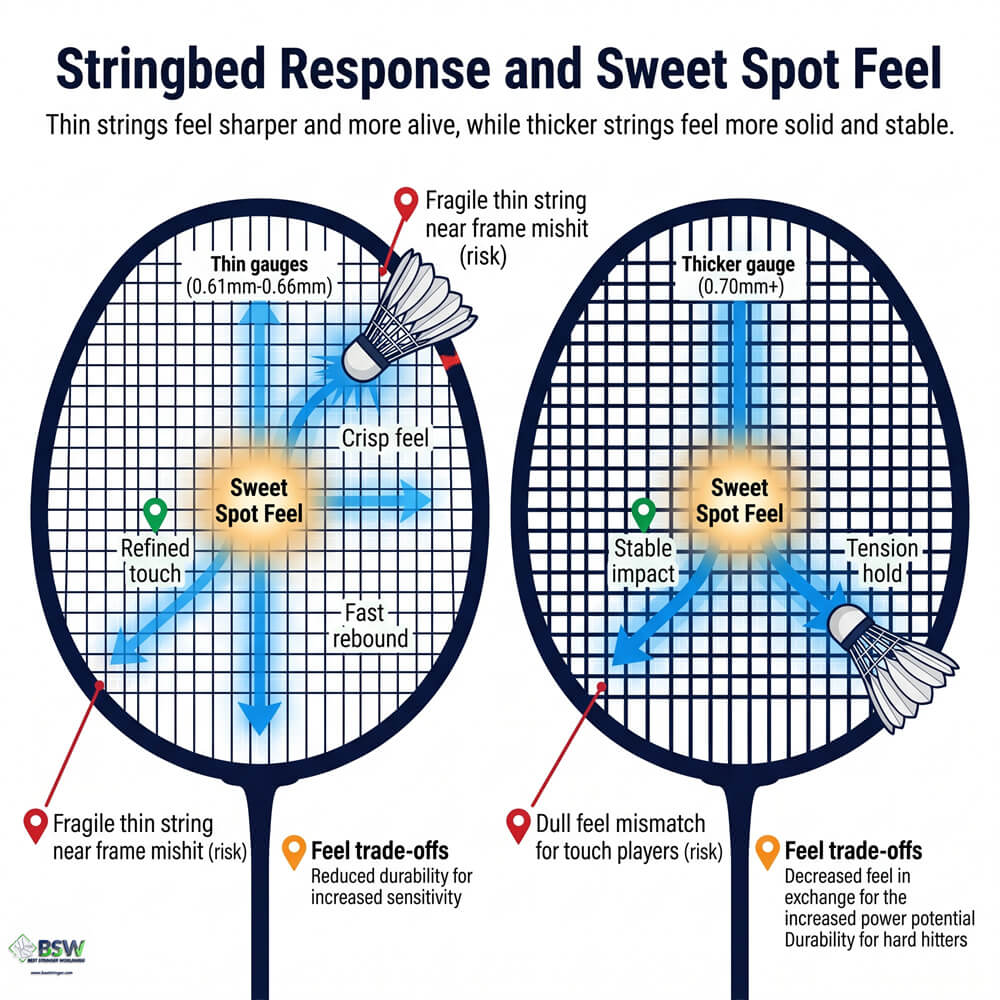
While thinner badminton strings provide excellent repulsion, they also change the overall sweet spot feel. A thin string generally offers a sharper, more sensitive hitting feedback, allowing players with refined touch to excel at net play and slice drops. The stringbed simply feels more alive.
Conversely, thicker badminton strings (e.g., 0.68mm – 0.70mm) provide a more stable and solid feel upon impact. For hard hitters or players who break strings frequently, this stability is crucial. A thicker string absorbs heavy impacts better, holding its structure longer during aggressive smashes without snapping prematurely.
Choosing string gauge is about matching your playstyle to the stringbed response. If you prioritize easy power, crisp sound, and fast rebound, a thinner string is often ideal. If you require maximum durability, tension holding over time, and a dense, solid contact feel, a thicker string may serve you better.
1.4 Tension & Durability Trade-offs
Badminton Tension Setup for Thin Strings
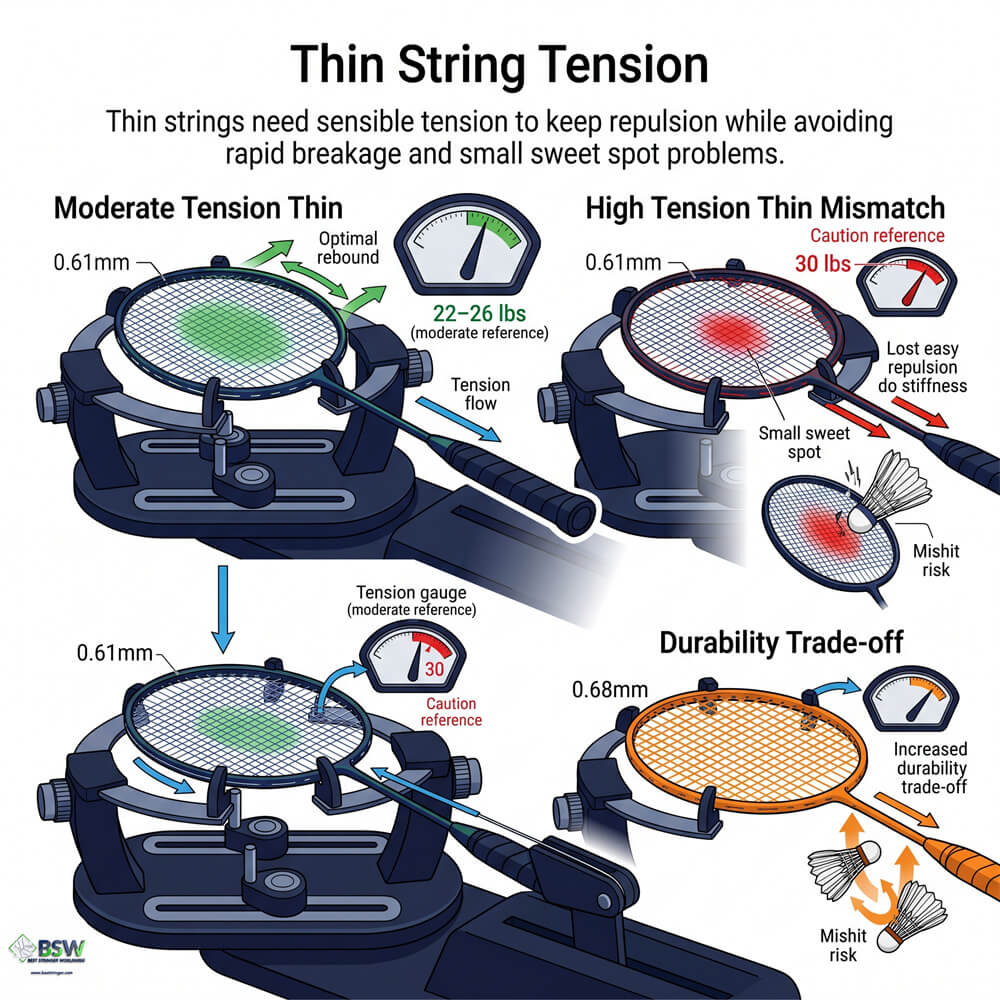
Thinner badminton strings require the correct string tension to truly unlock their power potential without snapping immediately. Understanding this synergy is essential for players and stringers:
String Gauge vs Tension. The thinner the string, the less physical material there is to withstand high-tension pulling. Pulling a 0.61mm string to 30 lbs dramatically decreases its lifespan, while a 0.68mm string can handle high tensions with much greater stability.
Power and Tension Synergy. If you want the easy power of a thinner string, pairing it with moderate tension (e.g., 22-26 lbs) allows the stringbed to stretch and rebound optimally. Extremely high tension on a thin string can actually stiffen the stringbed so much that you lose that easy repulsion.
The Mishit Risk. If you use a thin string for repulsion power but string it at a very high tension, your sweet spot becomes smaller. The sheer force of an off-center hit (mishit) near the frame will snap the fragile thin strings almost immediately. A certified stringer will always advise against this mismatch.
1.5 Common String Mistakes
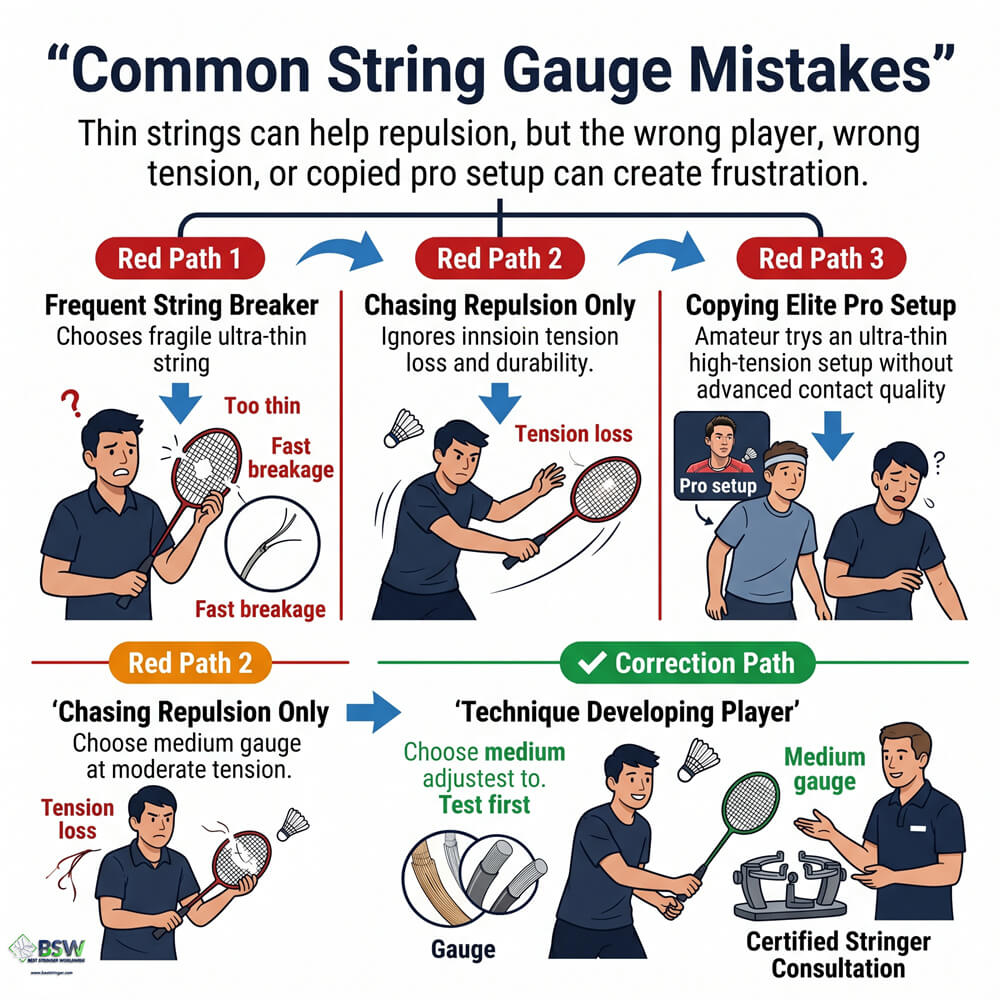
Common String Gauge Mistakes
Mistake 1: Assuming Thinner is Always Better.
While thinner badminton strings can produce more power and repulsion under similar conditions, recommending a fragile string to a frequent string breaker or a heavy smasher with poor timing only guarantees frustration and constant restringing.
Mistake 2: Ignoring Tension Loss and Durability.
Chasing pure repulsion power with a thin gauge often means sacrificing tension stability. Thin strings can lose their initial crisp playability faster than thicker strings, meaning they may feel “dead” sooner even if they haven’t broken yet.
Mistake 3: Copying Pro Setups Blindly.
Using the exact ultra-thin, high-tension setup of an elite player is a common error. Advanced setups require advanced contact quality. If your technique is still developing, a medium gauge string at moderate tension will serve your game much better.
1.6 Gauge Selection Framework
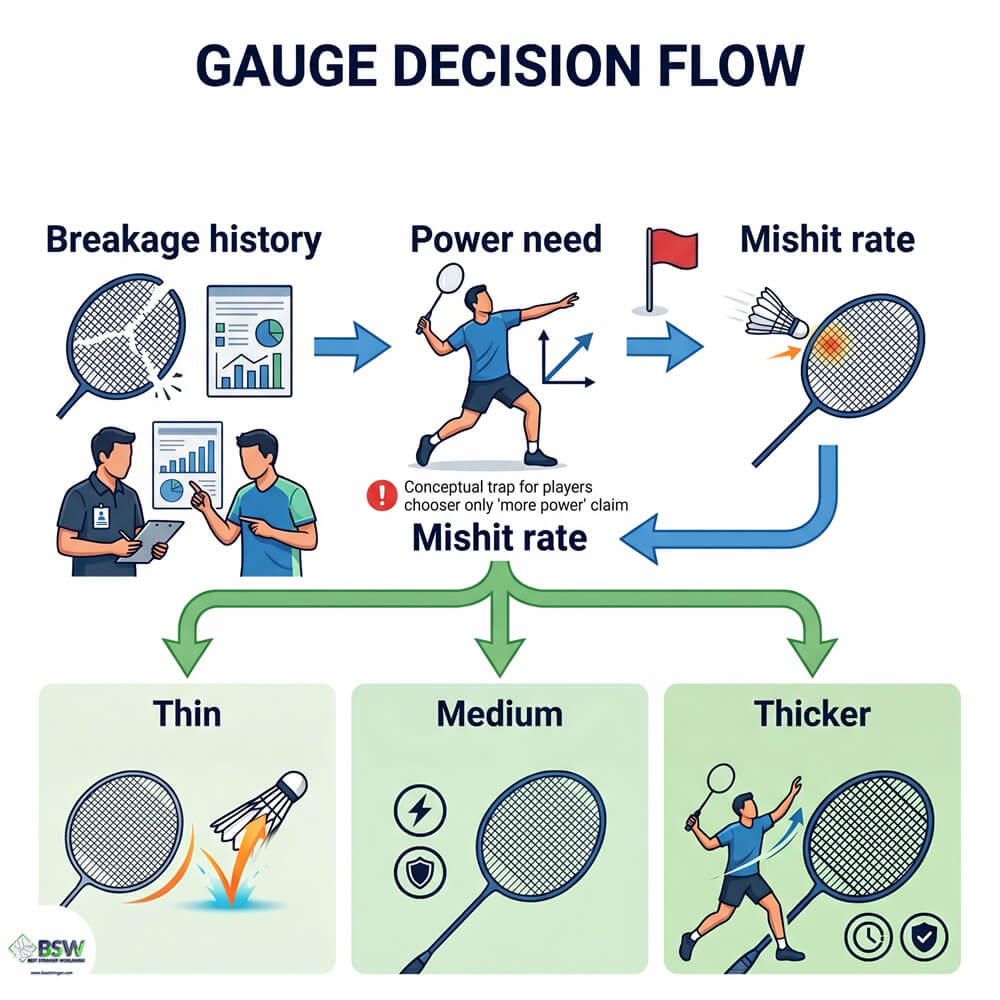
Player-Focused String Gauge Decision Flow
A step-by-step decision flow is crucial for balancing repulsion power and durability safely. Use this simple framework before upgrading your badminton string:
Step 1: Check Your Breakage History. If you snap strings frequently, dropping to an ultra-thin gauge will only worsen the issue. Developing players are often best served starting with a medium gauge (e.g., 0.66mm – 0.68mm) to ensure good performance and reliable lifespan.
Step 2: Identify Your Power Needs. Determine if you struggle with deep baseline clears and need the lively, elastic rebound of a thinner string, or if you already hit very hard and prefer the stable, heavy-impact feel of a thicker gauge.
Step 3: Consult a Professional. Ask a badminton stringer to assess your racquet condition, tension preference, and playstyle. A certified stringer will help you test whether thinner strings genuinely improve your shot quality, or if they just cost you more in restringing fees.
1.7 Professional Stringing
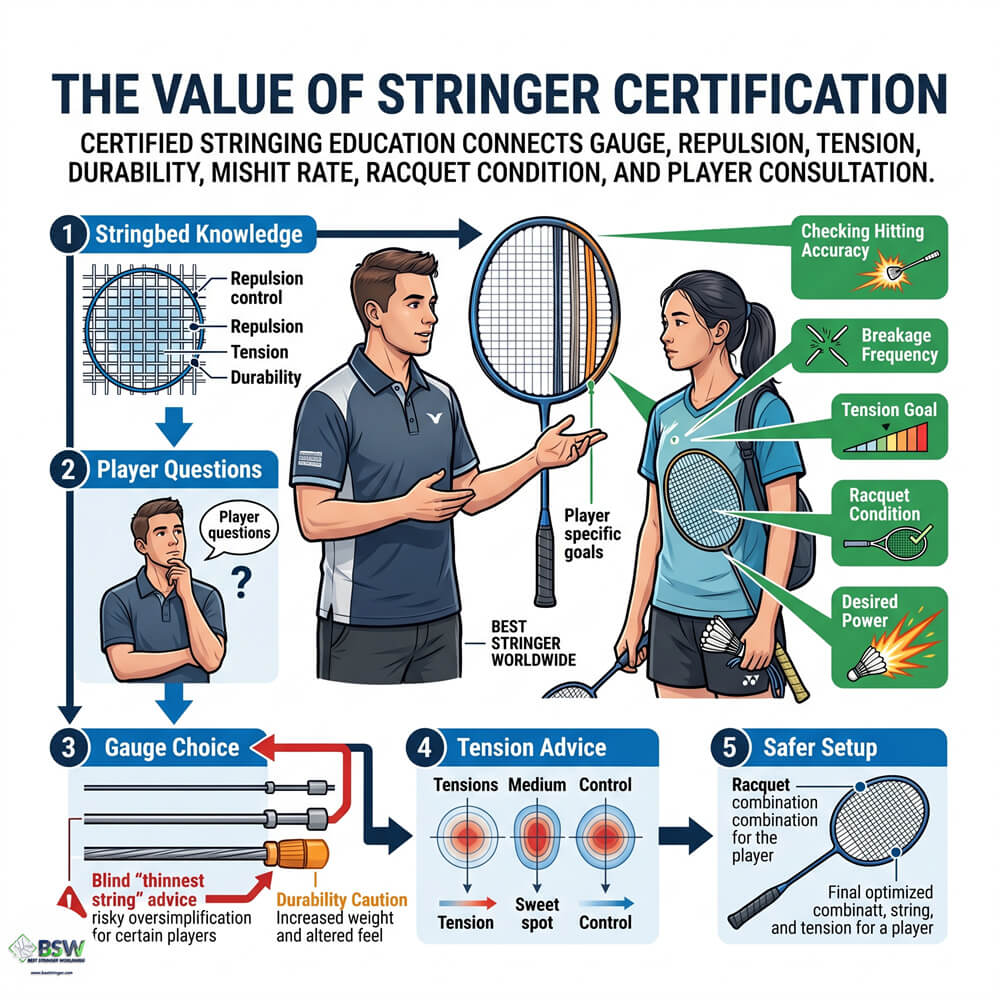
The Value of Stringer Certification
Proper equipment education is a core part of a professional badminton stringing course and reliable stringer certification standards. A certified stringer understands that recommending “thinner strings for more power” blindly without considering a player’s real mishit rate is a disservice.
At Best Stringer Worldwide, we know that string gauge directly influences the tension advice given to players. The magic is not just in stocking the thinnest string on the market, but in the precise player consultation logic a badminton stringer uses to match gauge, durability needs, and tension to your racquet.
By prioritizing accurate stringbed knowledge, our stringer certification ensures that every setup perfectly balances repulsion power, control, and durability. You eliminate guesswork, avoid constant string snapping, and focus purely on enjoying the crisp feel of your shots.
Equipment Selection Quick FAQ
Quick, direct answers to common questions about badminton string gauge, repulsion power, and stringer advice.
Do thinner badminton strings give more power?
Generally, yes. Thinner badminton strings can usually produce more power when all other conditions are equal because they offer a livelier stringbed response. This creates an easier, faster shuttle rebound, helping players generate depth on clears and lifts.
Why do thinner strings feel more powerful?
The smaller diameter allows the string to deform and stretch more easily upon shuttle impact, snapping back with greater elasticity. This higher repulsion means the stringbed actively assists in pushing the shuttle back faster.
Are thinner strings better for all players?
Not every badminton player will benefit equally. While thinner strings offer excellent repulsion and touch, they sacrifice durability. Players who hit very hard, mishit often, or use very high tension may find thin strings snap too quickly.
How does string gauge affect smash power?
Thinner strings can add crisp repulsion to your smash, resulting in a faster initial shuttle rebound. However, maximum smash weight also heavily relies on your timing, swing speed, and racquet frame mass, not just the string alone.
Why do some players use thicker strings?
A badminton player needs the right balance between repulsion and durability. Thicker strings are chosen for their robust lifespan, stable hitting feel, and ability to hold tension longer, making them ideal for heavy practice and hard hitters.
How does string tension affect thin strings?
High tension on a very thin string shrinks the sweet spot and drastically reduces durability, making it prone to early breakage from mishits. A certified stringer will ensure the tension is appropriate for the gauge to maximize repulsion safely.
What should a stringer consider before changes?
A professional badminton stringer should always evaluate the player’s breakage frequency, power needs, and typical hitting accuracy. They should never just recommend the thinnest gauge for “more power” without considering durability and tension goals.
Why is stringer certification important?
A comprehensive badminton stringing course teaches the science behind string elasticity, repulsion, and tension synergy. A certified stringer provides safe, educated gauge recommendations rather than relying on brand hype or blind guesswork.
Are stringing courses necessary?
For those wanting to master equipment consultation, yes. A stringer learns how stringbed response changes with gauge, precise knot tying, and the logic to match string setups to player levels, eliminating guesswork from equipment advice.
The Physics of Power: Why String Gauge Matters
Awaiting Demonstration…
Select a string gauge strategy above and press ‘Play Demo’ inside the diagram to analyze the stringbed physics.
Proven Specifications
Our stringing approach is based on verified equipment parameters used by top professionals. We prioritize arm safety, proper gauge selection, and playstyle efficiency over pure repulsion hype.
| Performance Factor | Thicker Strings (>0.68mm) | Thinner Strings (<0.66mm) |
|---|---|---|
| Repulsion & Power | Less lively rebound; requires more physical effort for baseline depth. | High repulsion; elastic stringbed creates easier power and fast rebound. |
| Durability & Breakage | Highly durable; withstands heavy smashes and mishits reliably. | Lower durability; breaks faster from off-center hits or high tension. |
| Sweet Spot Feel | Dense and stable feeling across the stringbed during impact. | Sensitive touch; provides sharper feedback and lively responsiveness. |
| Tension Holding | Holds tension and core structure longer under heavy, frequent play. | May lose initial crisp playability faster for extremely hard hitters. |
| Best Suited For | Frequent string breakers, heavy smashers, and heavy practice sessions. | Players seeking easy clears, lively touch, and fast defensive blocks. |
| Stringer Advice | Great baseline recommendation when longevity is the player’s priority. | Requires careful tension matching to maximize power without early snapping. |
Master Your String Knowledge with Best Stringer Worldwide
Ready to upgrade your knowledge? Best Stringer Worldwide offers professional stringing consultation to teach you how string gauge, tension, and stringbed response affect power safely. We serve badminton players worldwide especially in Singapore, Hong Kong, Malaysia, Indonesia, UK, France and Europe. Contact a certified stringer to find the perfect tension and gauge for your game.