1.1 Equipment Fundamentals
What is the Badminton Racquet Balance Point (BP)?
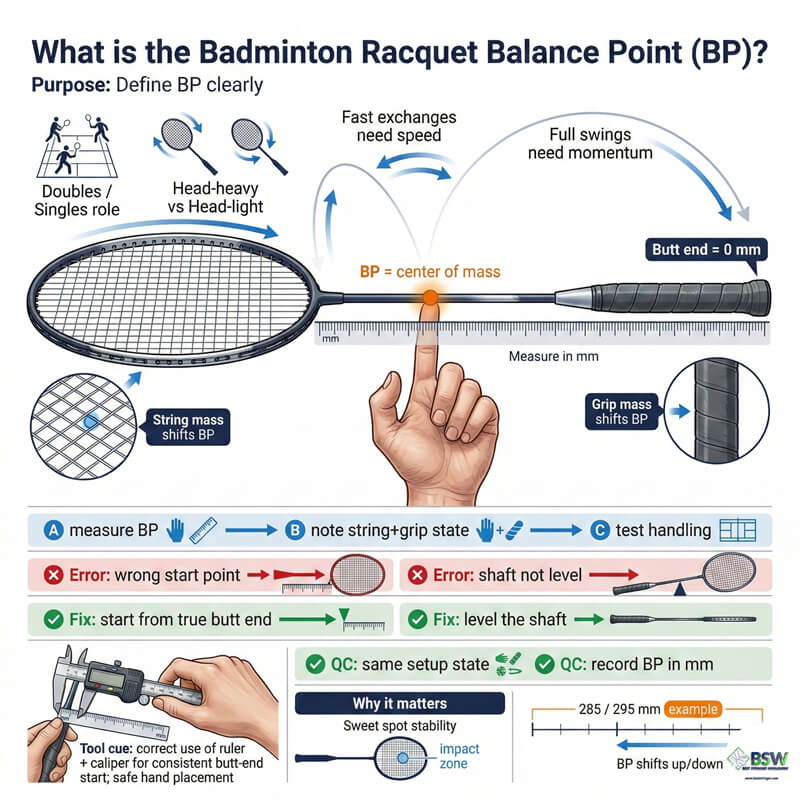
Racquet balance for badminton refers to the exact distribution of weight across the frame, dictating whether a racket feels incredibly fast or solidly heavy during a full swing. Because badminton relies on lightning-fast drive exchanges and split-second net interceptions, choosing the correct badminton racquet balance point (BP) directly impacts your maneuverability and smash power.
In this comprehensive guide, you will learn: 1) What BP is and exactly how to measure your racket balance point in mm from the butt end, 2) The true performance differences between head heavy vs head light vs even balance badminton rackets, and 3) Why BP alone is incomplete without understanding swing feel (moment of inertia).
Here is a simple decision flow you will master: Step 1: Identify your primary role (e.g., doubles front-court or singles). Step 2: Choose a balance direction that complements your reaction speed. Step 3: Run our 10-minute on-court test checklist to validate your equipment choice.
1.2 Measuring BP
What is Racquet Balance and How to Measure It
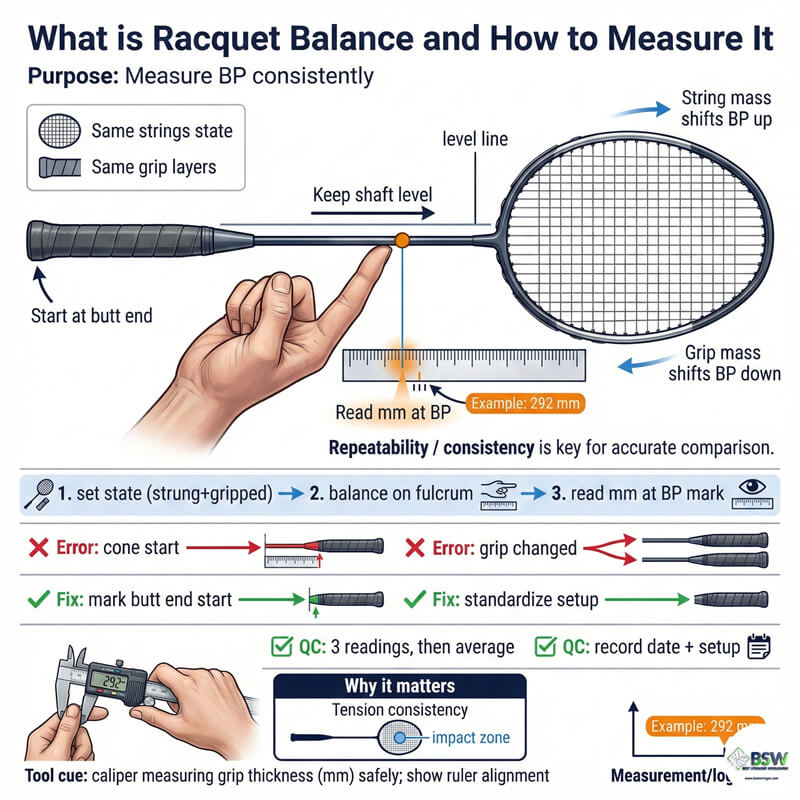
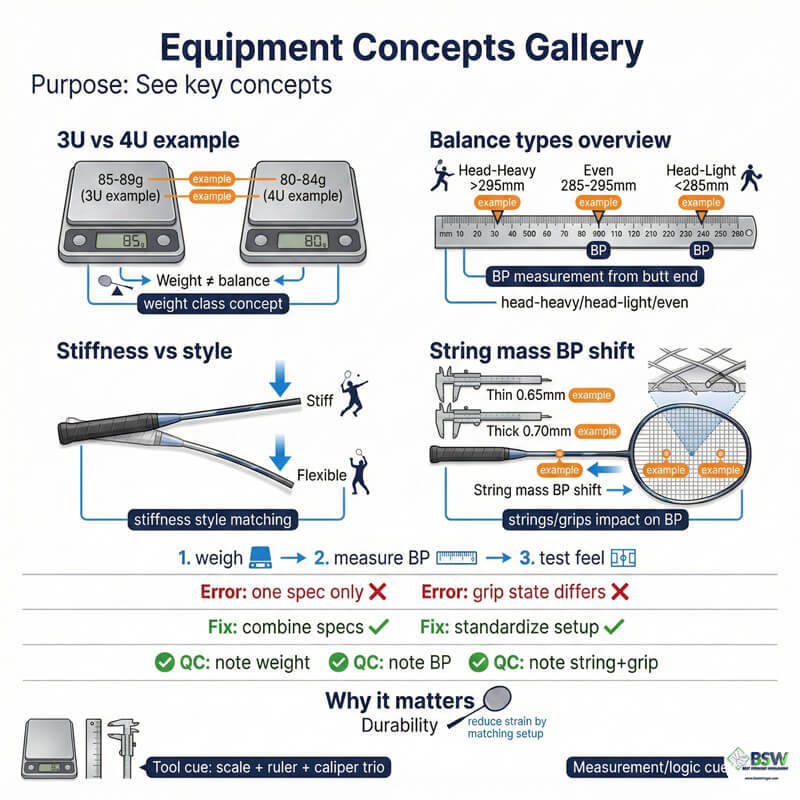
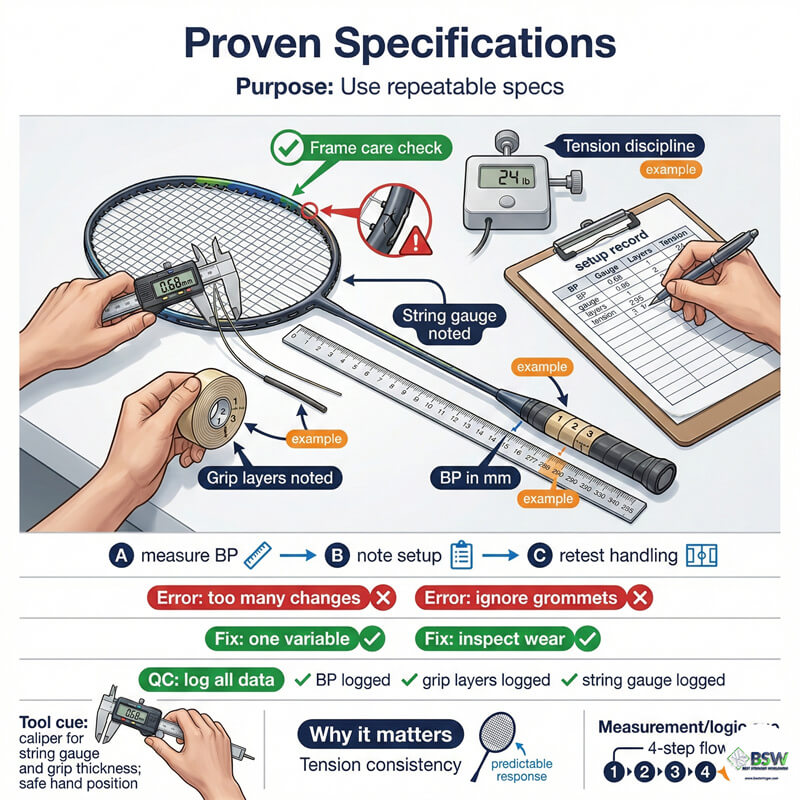
The balance point (BP) is the exact center of mass location on your frame. To measure your BP at home, simply use the finger or nail fulcrum method: balance the racket shaft horizontally on your index finger until it stays perfectly level. Then, measure the distance in millimeters (mm) from the very bottom (butt end) of the handle to that exact balancing point.
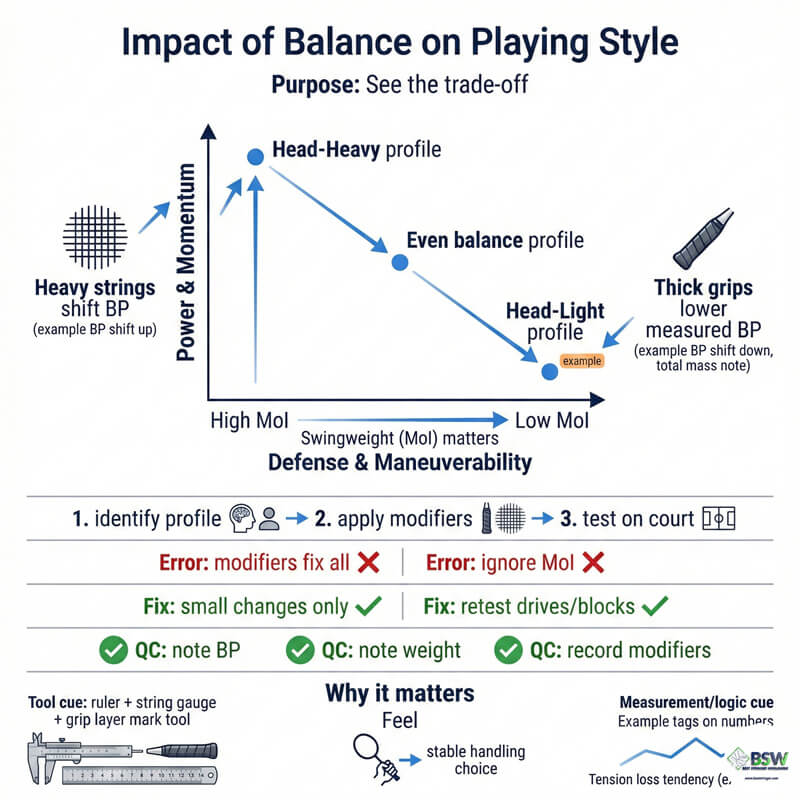
Understanding balance point measurement consistency is critical for accuracy. Strings and grips fundamentally change your measured BP. Adding heavy gauge strings shifts the balance point toward the head (increasing the mm measurement), while adding a thick replacement grip or overgrip shifts it drastically toward the handle (decreasing the mm measurement). Always measure your rackets in the exact same strung-and-gripped state when comparing them.
While total static weight tells you how heavy the racket is on a scale, the BP tells you where that mass lives. Mastering this concept is step one in elevating your doubles vs singles performance through equipment.
1.3 Balance Categories
Types of Balance: Head Heavy vs Head Light vs Even
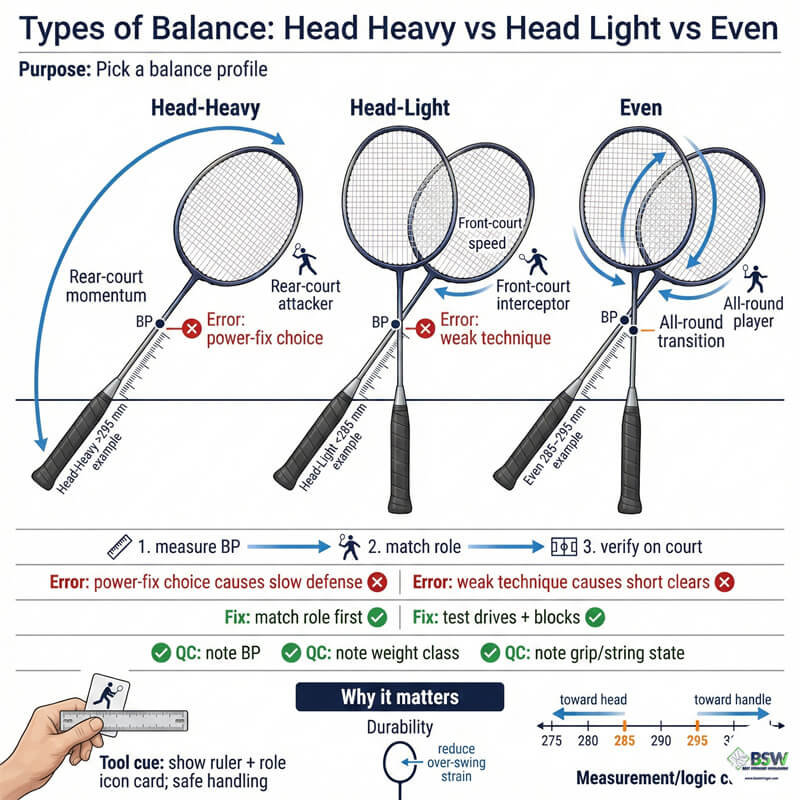
Classifying racquet balance helps players make directional choices for their specific playstyle. While precise measurements vary, here are the three commonly referenced balance profiles:
Head-Heavy Rackets (>295mm): These frames carry a higher percentage of their mass toward the top of the head. They dramatically improve smash momentum and effortless deep baseline clears. They are generally best suited for singles players or dedicated rear-court doubles attackers. A common mistake here is choosing head-heavy to artificially “fix” weak power, which ultimately destroys your defensive speed.
Head-Light Rackets (<285mm): By concentrating mass near the handle, these rackets maximize defense blocks, rapid drive exchanges, and front-court net interceptions. They are heavily preferred for doubles play where speed is prioritized over raw baseline power. However, generating punch requires superior wrist technique.
Even-Balance Rackets (285-295mm): Offering a versatile middle ground, these are perfect for all-round players and beginners. They allow for a seamless transition between attacking and defending without overly punishing late timing.
1.4 Swingweight Physics
The Physics Behind Racquet Balance
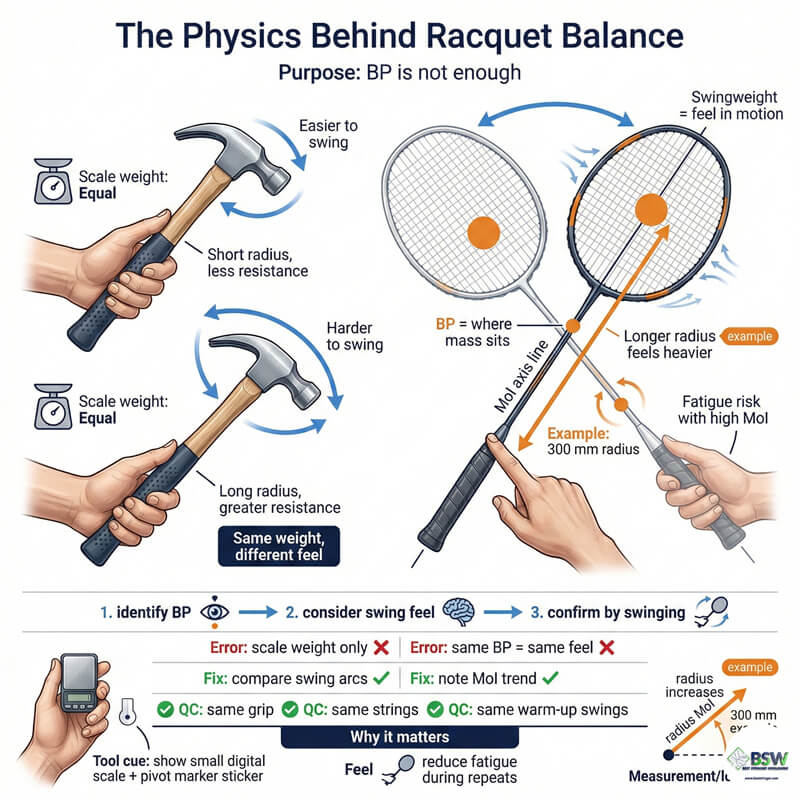
The beginner-friendly physics behind racquet balance is crucial for understanding why BP alone is incomplete without considering swing feel. Think of a hammer analogy: holding a hammer by the heavy metal head makes it feel incredibly light and easy to maneuver, while holding it by the bottom of the handle makes it feel drastically heavier and harder to swing, even though the total scale weight of the hammer never changed.
BP Tells You Where The Mass Is. Measuring the balance point simply gives you a static coordinate of the mass distribution. It does not perfectly predict court performance.
Swingweight Dictates How It Feels. Swingweight (formally known as Moment of Inertia or MoI) tells you how heavy that racket actually feels when moving through the air during a stroke. Moving weight further away from your hand drastically increases the swingweight.
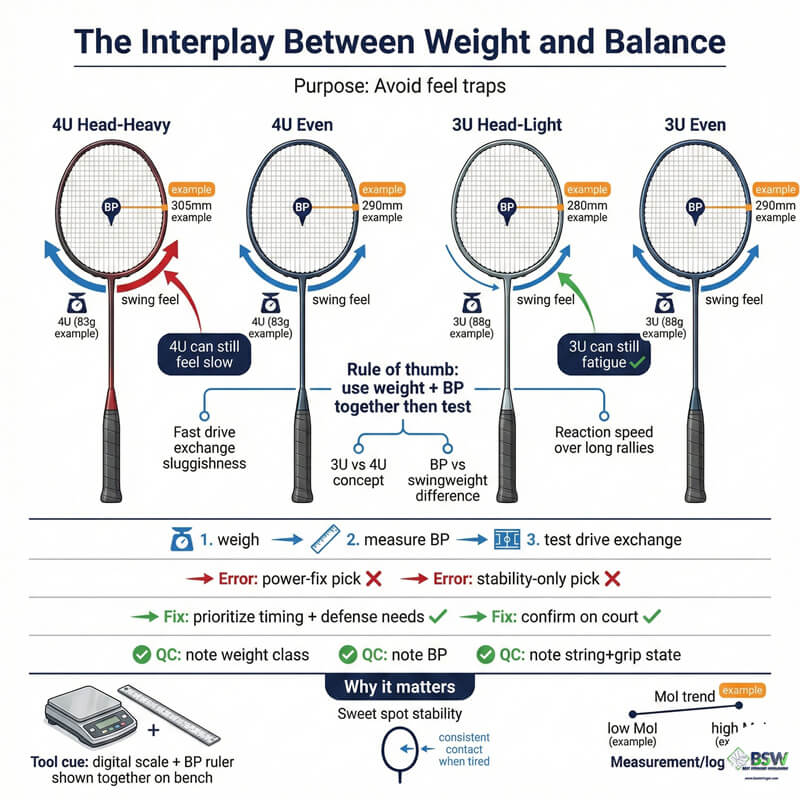
The Scale Weight Illusion. Because of these physics, a lightweight 4U racket with an extreme head-heavy balance point (high swingweight) can actually feel much more fatiguing to swing than a heavier 3U even-balance racket. Never buy based on scale weight alone!
1.5 Weight vs Balance
The Interplay Between Weight and Balance
Why Light + Head Heavy Can Trick You.
Players often purchase a lightweight 4U frame hoping to increase their defense speed, but mistakenly choose a head-heavy version to compensate for a weak smash. Because the mass is concentrated far from the hand, the swingweight remains high, meaning the racket will still feel slow and demanding during rapid drive exchanges.
Why Heavy + Head Light Can Feel Stable.
Conversely, a heavier 3U racket with a head-light balance might feel incredibly stable during impact while feeling deceptively easy to lift. However, the overall static mass will eventually slow down your reaction speed during long, fatiguing rallies.
The Rule of Thumb.
Use the static scale weight and BP measurement together to form your baseline profile, but always confirm the actual handling with real swing feel. BP is a directional guide; on-court testing is your final answer.
1.6 Decision Flow
Choosing the Right Balance Selection Framework
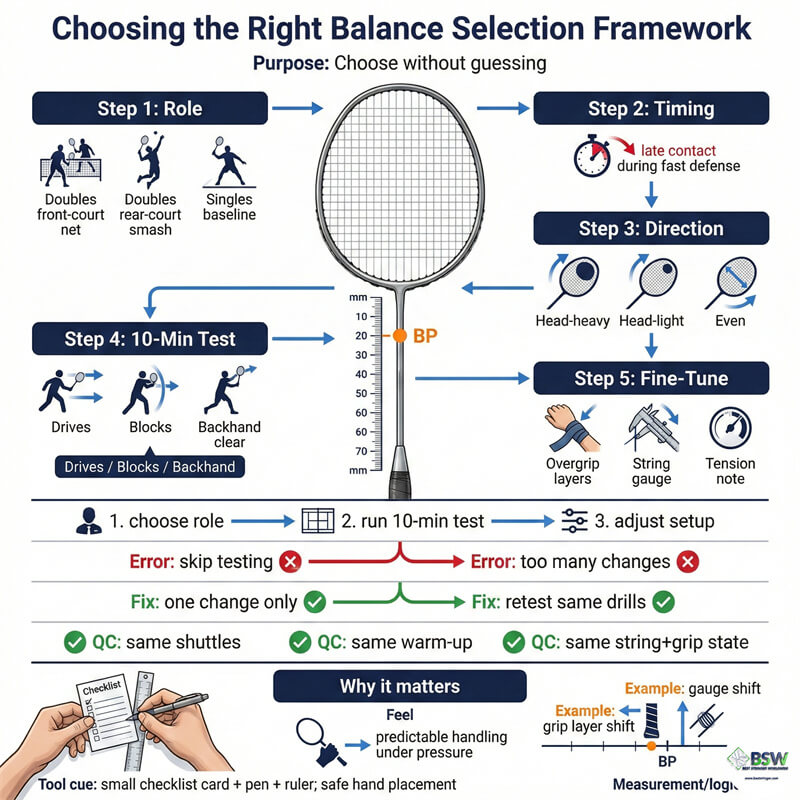
Choosing the right balance requires a systematic approach. Follow this step-by-step decision flow to narrow down your optimal setup without the guesswork:
Step 1: Role. Identify your primary role: doubles front-court, doubles rear-court attacker, or singles grinder.
Step 2: Your Timing. Honestly assess your timing consistency. If you frequently hit late during fast defense, you need higher maneuverability immediately.
Step 3: Direction. Pick a balance direction: head-heavy for clearing power, head-light for reactive speed, or even balance for safety.
Step 4: The 10-Minute Test. Validate with our on-court test checklist: test flat drives, defense blocks, net kill recovery time, and backhand clear comfort.
Step 5: Fine-Tune. Adjust the final swing feel using grip thickness and stringing tension setup.
1.7 Practical Validation
Conclusion: Experimenting with Balance
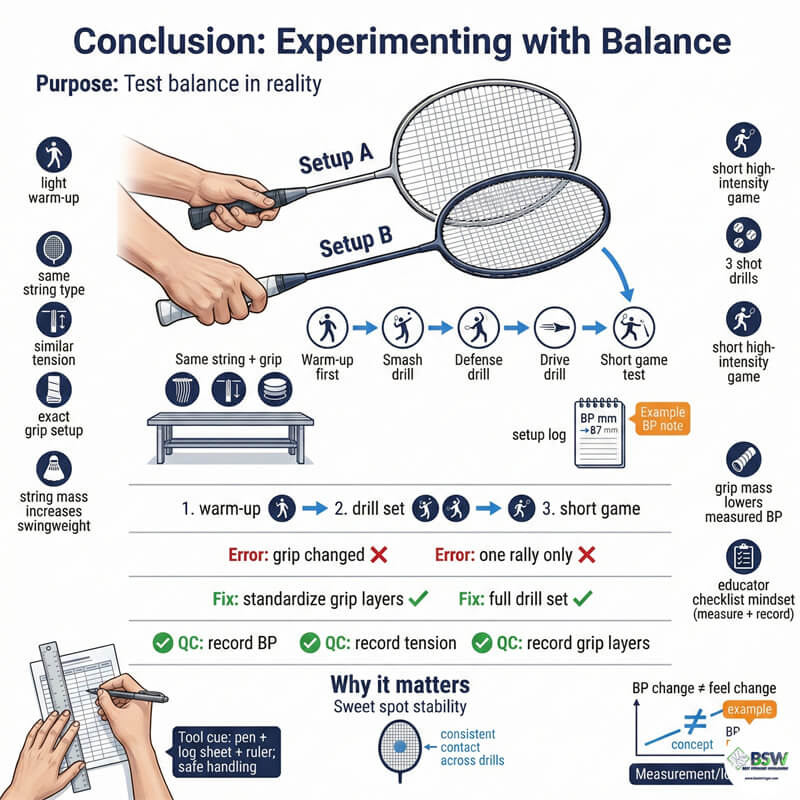
Experimenting with racquet balance requires a practical, controlled trial method to truly understand what works for your biomechanics. To properly test, do a light warm-up, run three specific shot drills (smashes, defensive lifts, drives), and then play a short high-intensity game.
Emphasize consistency when comparing rackets. Ensure you use the same string type, similar tension, and the exact same grip setup, as adding string mass is closer to the head and increases swingweight, while adding grip mass lowers the measured BP.
At Best Stringer Worldwide, our stringing educators follow a strict checklist: we measure your BP consistently, record your setup data, and ask about your specific player role to ensure we don’t accidentally overcorrect your handling with tension alone. To learn more, check out our other equipment analysis guides to master your overall performance.
Racquet Balance Quick FAQ
Quick, definition-first answers to your most pressing questions regarding badminton racquet balance point (BP), swing feel, and measurement techniques.
What is BP and how do I measure it?
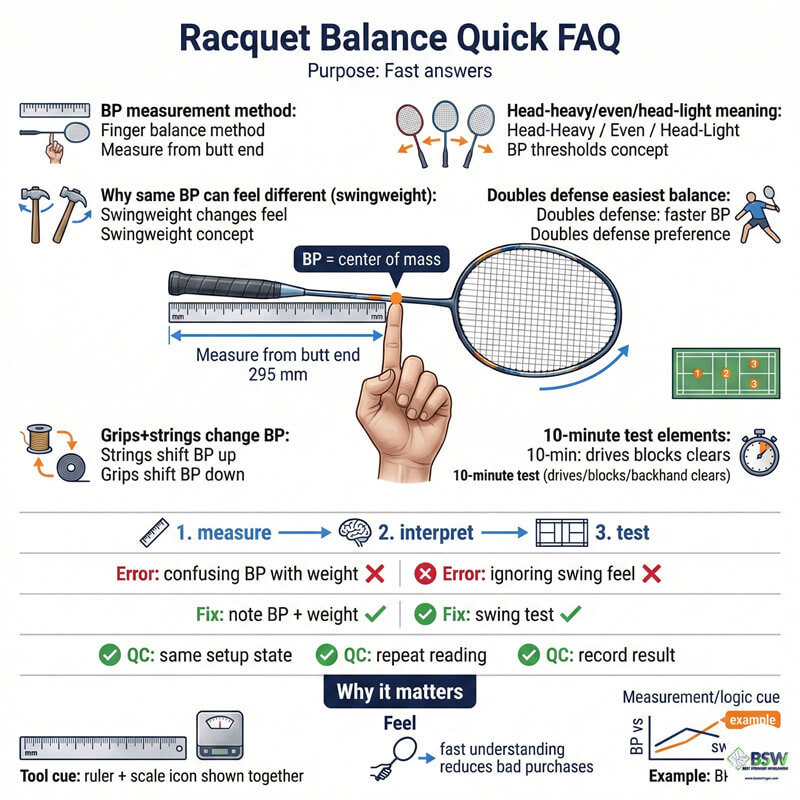
Balance Point (BP) is the exact center of mass of the racket. You measure it by balancing the shaft horizontally on your finger and measuring the distance in millimeters (mm) exclusively from the butt end of the handle to that fulcrum point.
What is meant by head heavy / even / head light?
These terms describe where the mass sits. Head-heavy frames (commonly >295mm) focus mass near the top; head-light frames (<285mm) focus mass near the handle; and even-balance (285-295mm) provides a neutral distribution.
Why can two similar BP rackets feel different?
BP only tells you the static center of gravity, whereas “swingweight” (moment of inertia) tells you how heavy it feels in motion. Two frames with the same BP can have different swingweights if their scale weights or aerodynamic profiles vary.
Is head heavy always better for smashing?
Not necessarily. While it provides more momentum, it strictly requires the physical strength and excellent timing to accelerate that heavy head. If your swing speed drops due to the weight, your smash will actually lose power.
What balance is easiest for doubles defense?
A head-light or even-balance racket is easiest for doubles defense. The mass is positioned closer to your hand, drastically reducing swingweight and allowing for lightning-fast drive exchanges and reactive defense blocks.
What balance helps singles clears?
A slightly head-heavy to moderately head-heavy balance provides the necessary follow-through momentum to comfortably hit deep singles clears baseline-to-baseline without overworking the shoulder, provided you have clean timing.
How do grips and strings change measured BP?
Adding strings (which sit in the frame) pulls the center of gravity higher, increasing the BP measurement. Adding thick overgrips adds mass near the butt end, dragging the center of gravity downward and lowering the BP measurement.
What 10-minute test confirms the right balance?
Test three situations rapidly on court: execute fast flat drives (testing sluggishness), perform defensive blocks to smashes (testing maneuverability), and hit backhand clears (testing comfortable depth generation without strain).
Does 3U vs 4U weight change balance point?
The ‘U’ system measures total static weight (e.g., 4U is 80-84g), not balance. However, a heavier 3U racket with the exact same balance point as a 4U racket will have a much higher swingweight, making it feel slower and heavier in motion.
Equipment Concepts Gallery
Proven Specifications
Our stringing approach is based on verified equipment parameters used by top professionals. We prioritize arm safety and playstyle efficiency over pure tension hype.
| Balance Profile | Power & Momentum | Defense & Maneuverability |
|---|---|---|
| Head-Heavy (>295mm) | Higher momentum on full swings. Excellent energy transfer for deep clears. | Slower in fast drive exchanges. Best suited for singles or rear-court attackers. |
| Head-Light (<285mm) | Requires excellent technique and wrist strength to generate deep rear-court clears. | Peak defense speed and recovery. Best suited for front-court interceptions. |
| Even-Balance (285-295mm) | Moderate, versatile energy transfer. A safe starting point for beginners. | Balanced recovery and reaction time. Best for all-round transition play. |
| Swingweight (MoI) Impact | High MoI feels incredibly demanding but provides maximum smash weight. | Low MoI feels highly maneuverable and allows split-second defensive reactions. |
| Adding Heavy Strings | Shifts measured BP slightly head-heavy, adding marginal swingweight. | Using ultra-thin strings slightly preserves your original head-light speed. |
| Adding Thick Overgrips | Decreases measured BP on paper, but total mass makes the racket heavier overall. | Removing factory grip and using wrap directly on wood shifts BP heavily towards the frame. |
Master Your Equipment with Best Stringer Worldwide
Ready to upgrade your knowledge? Best Stringer Worldwide offers professional stringing consultation to teach you badminton racquet weight and balance analysis safely. We serve students worldwide especially in Singapore, Hong Kong, Malaysia, Indonesia, UK, France and Europe etc. Contact us to find the perfect tension, weight, and gauge for your game.