1.1 Stringing Fundamentals
What Are the Fundamentals of String Tension & Power?
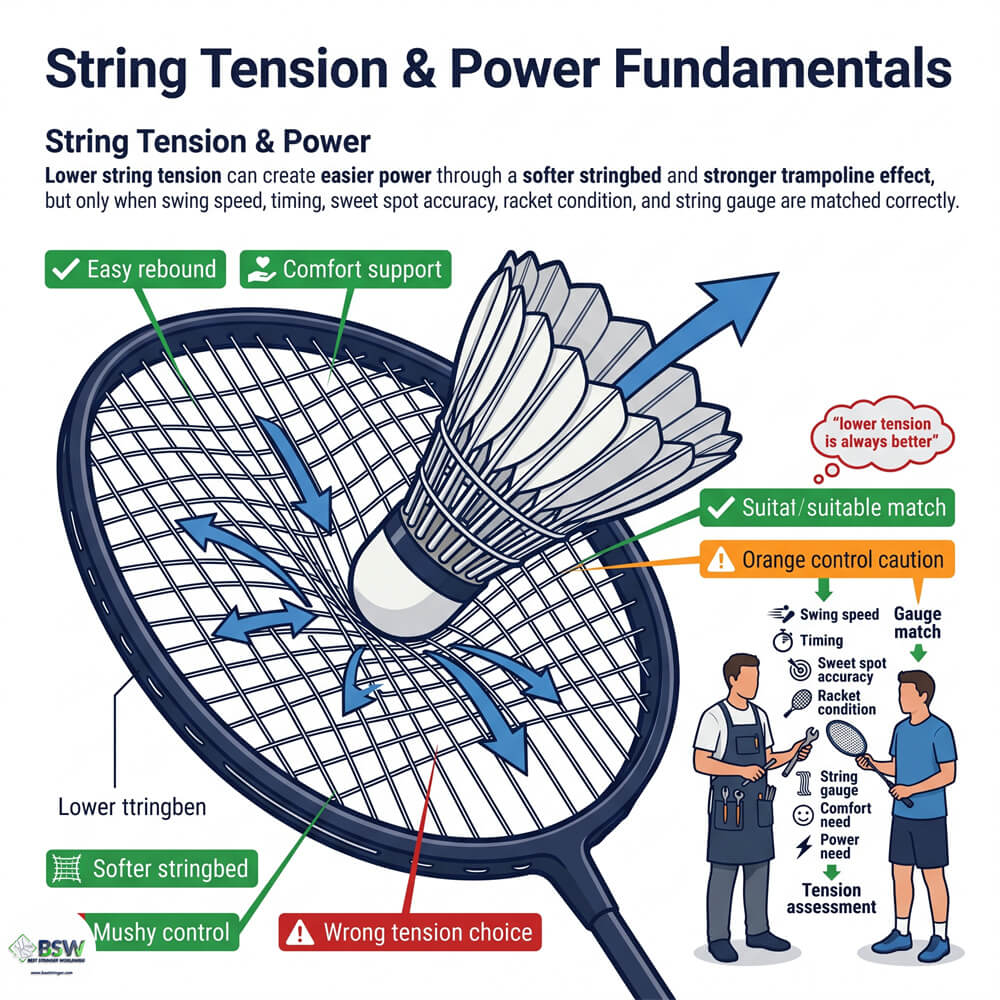
String tension is one factor in stringbed response. In controlled mechanical tests, lower tensions produced higher shuttlecock velocity than higher tensions for the tested racquets and impact conditions; that result does not predict every player’s outcome. See the published badminton racquet-string study, then compare related factors in our stringbed stiffness guide.
In practice, tension changes stringbed deformation, feel and response, while technique, impact location, string construction, gauge, racquet and machine consistency also matter. Mastering these concepts is crucial for any badminton player aiming to improve, as “easier power” does not automatically mean “lower tension is always better for every player.”
Here is a simple decision flow:
Step 1: Assess your swing speed and timing honestly.
Step 2: Understand that ‘easier power’ from a softer stringbed is highly beneficial if you struggle with deep clears.
Step 3: Consult a trained stringer to choose a testable starting setup within the racquet and string manufacturer limits, then adjust from recorded player feedback.
1.2 Stringbed Rebound
String Physics Explained: Rebound and Trampoline Effect
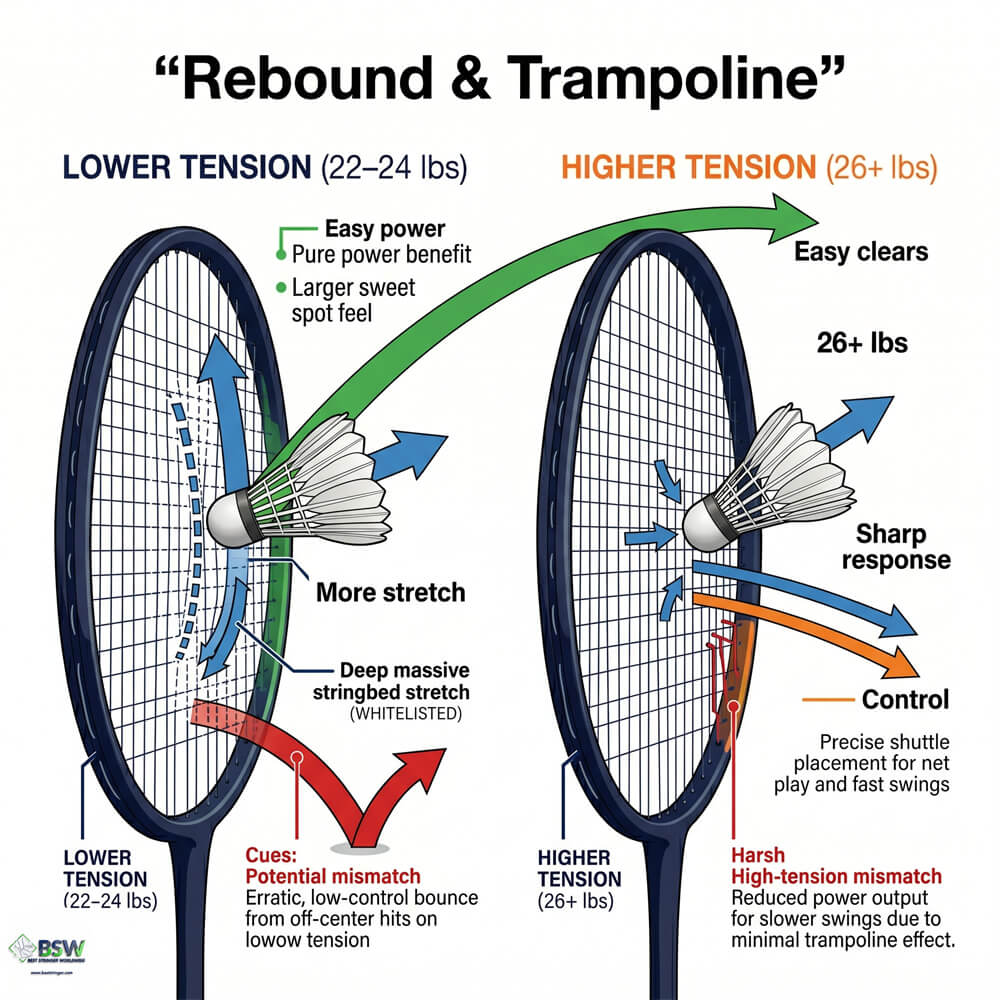
Controlled impact studies have reported higher shuttlecock velocity at lower test tensions, including 22-30 lb and 20-34 lb ranges. A softer stringbed deforms more during impact, but the measured result depends on the complete test setup and should not be treated as a universal player prescription. There is no universal 22-24 lb or 26+ lb boundary for every player. Use manufacturer limits and controlled comparison sessions rather than copying a fixed number.
Changing tension alters stringbed response and perceived feel. Some players report easier length or a softer response at lower tension, while others prefer a firmer response for fast exchanges. Higher tension creates a firmer stringbed, but neither power nor placement is guaranteed by tension alone.
A badminton player needs the right balance between power, control, and comfort. For fast-swinging advanced players needing sharp precision, a higher tension is generally preferred. Developing players often benefit from the extra rebound and larger sweet spot feel of a lower string tension for sustained pacing.
1.3 Swing Speed & Control
Understanding Sweet Spot Feel and Swing Speed
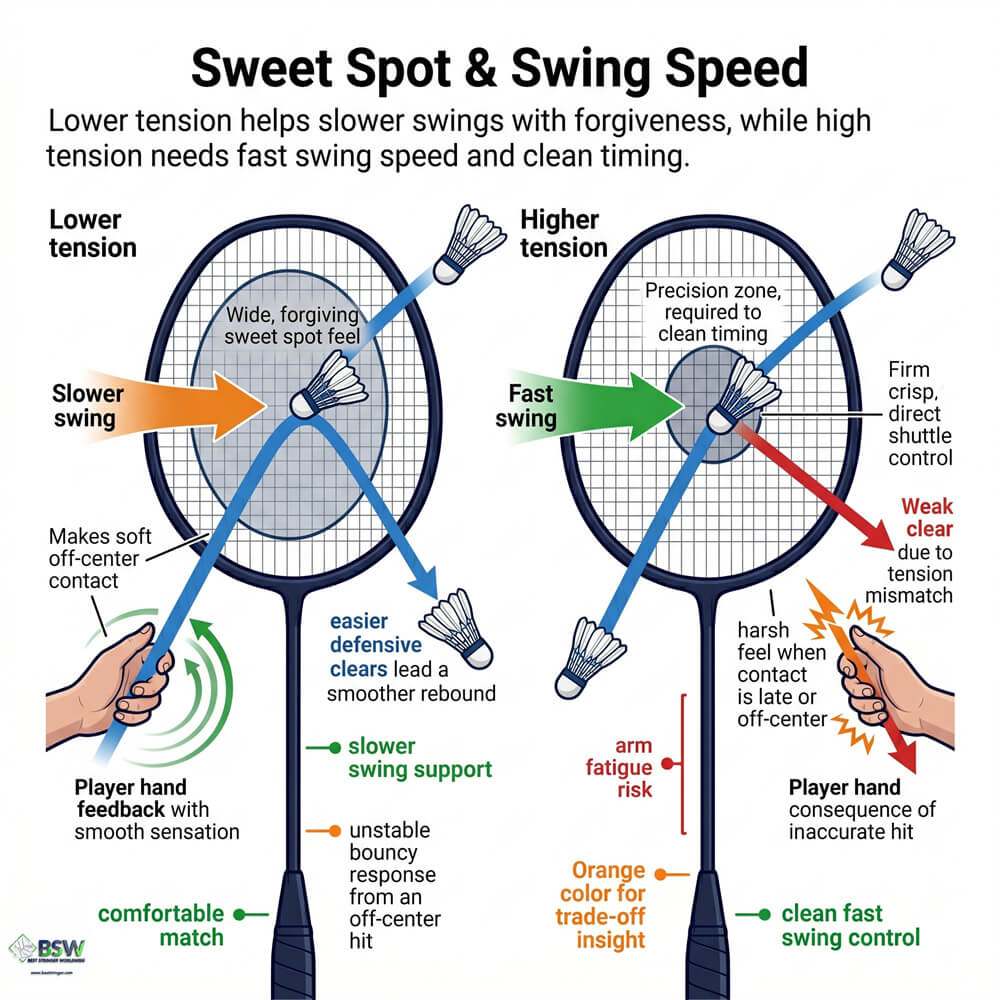
While lower badminton string tension provides the rebound for power, swing speed dictates how that energy is controlled. A higher-tension stringbed gives a firmer, more direct response that some consistent hitters prefer; it does not automatically provide maximum control or precision. If a setup reduces clear length, timing or comfort, lower the test tension within manufacturer limits and reassess technique and equipment together.
A lower-tension setup may feel softer and may help some players produce length, but it does not make clears effortless or replace stroke development.
A softer stringbed may feel more comfortable to some players and less demanding on off-centre impacts. This is a feel observation, not evidence that a tension prevents arm or shoulder injury.
1.4 Gauge & Tension Basics
Badminton String Setup for Easier Power
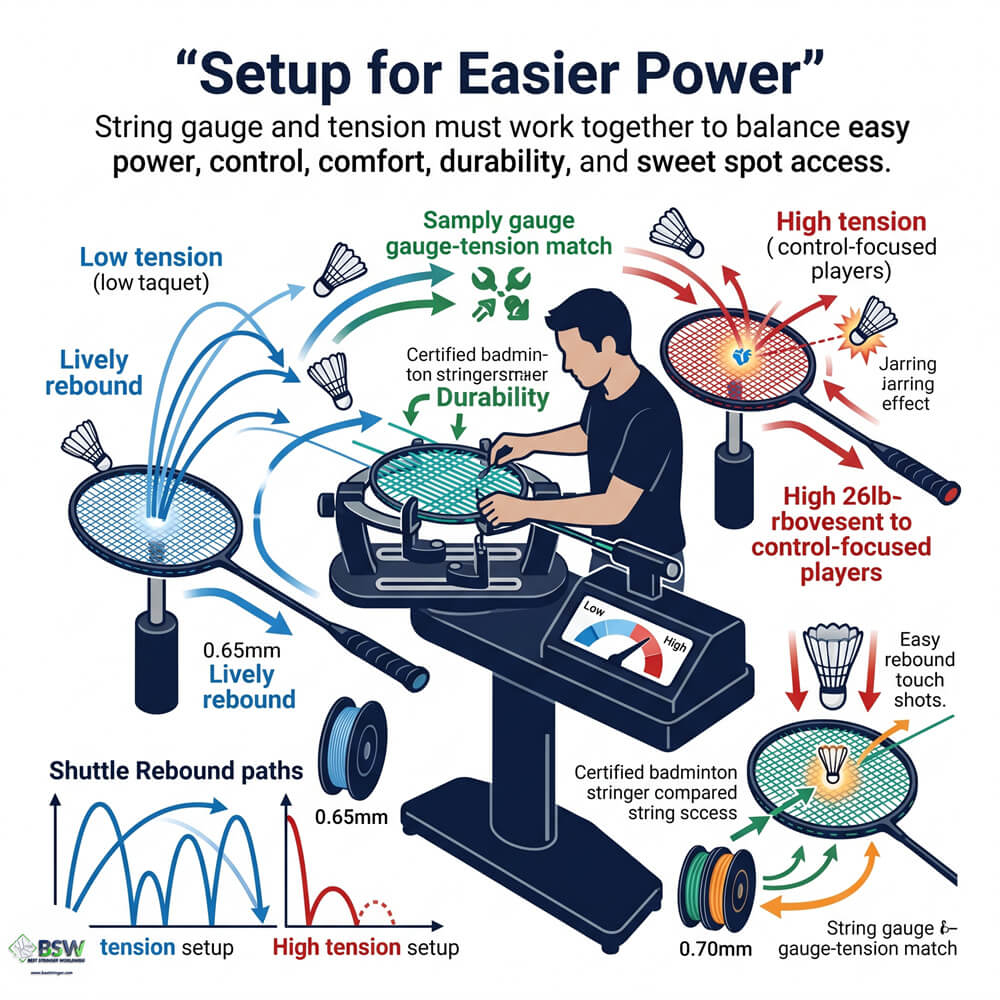
A powerful badminton frame requires the correct string gauge and tension to truly unlock its potential. Understanding this synergy is essential for all levels:
What is String Gauge? Gauge refers to the thickness of the string. Thin strings (e.g., 0.65mm) offer incredible repulsion and aerodynamic sound, which pairs wonderfully with lower tension for maximum bounce, while thick strings (e.g., 0.70mm) sacrifice a bit of crispness for robust durability.
Tension Basics. Tension is how tightly the strings are pulled. High tension (26+ lbs) offers touch and control, but only if your sweet spot contact is highly consistent. Low tension acts like a trampoline, boosting power for slower swings and providing better dwell time.
The Sweet Spot Risk. If you want more power but string your racket at an extremely high tension without the required swing speed, the sheer stiffness of the stringbed will make your shots feel weak and jarring. A professional badminton stringer will always align these factors to your ability.
1.5 Common Mistakes
Common String Tension Mistakes
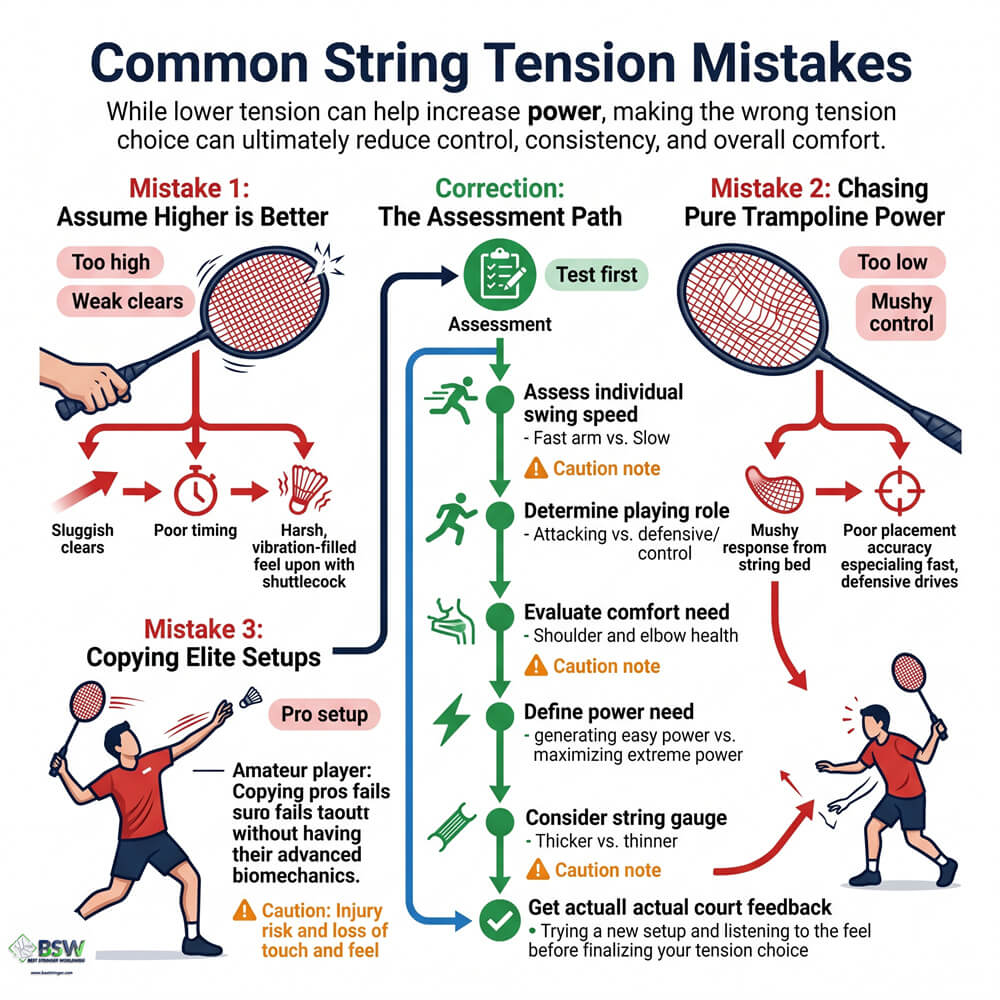
Mistake 1: Assuming Higher Tension is Always Better.
While high tension offers sharp control, lower badminton string tension produces greater power for the average player. Choosing an unsuitable high tension may reduce output or comfort for a particular player. Shoulder symptoms have multiple possible causes and should not be attributed to string tension alone.
Mistake 2: Ignoring Control and Precision.
Chasing pure trampoline power with very low tension often means sacrificing precise placement. If you cannot control the extra bounce during fast flat drives, the easy power becomes a disadvantage.
Mistake 3: Copying Pro Setups Blindly.
Using the exact high-tension strings of an elite player is a common error. Advanced control setups require advanced biomechanics; otherwise, a stiff stringbed simply tires you out and ruins your consistency.
1.6 Selection Framework
Player-Safe String Tension Decision Flow
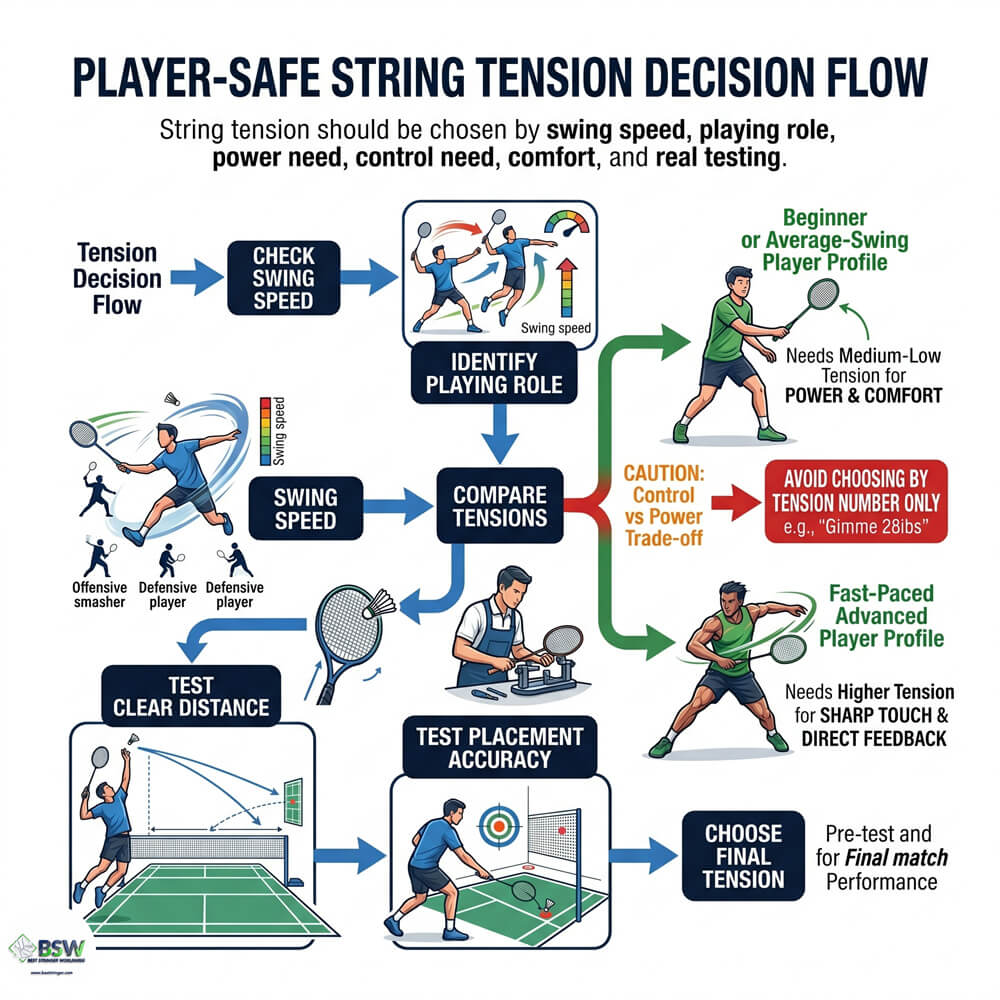
Use a repeatable decision flow to compare power, feel and placement without making safety guarantees. Use this simple framework before asking your stringer for a tension change:
Step 1: Check Your Swing Speed. Lower tension may help some average- or slower-swing players produce length, but the result must be tested. Beginners should start within the racquet manufacturer’s supported range, using a conservative test value chosen with a trained stringer or coach rather than a universal 22-24 lb rule.
Step 2: Identify Your Playing Role. Determine if you are primarily a fast-paced player requiring sharp touch and direct feedback, or a player needing the trampoline effect and sweet spot forgiveness of a softer stringbed for deep clears.
Step 3: Test for Actual Improvement. Try a lower string tension and test whether it genuinely improves your clear distance and comfort, or if the stringbed feels too mushy and reduces your overall placement accuracy.
1.7 Further Learning
The Value of Stringer Certification
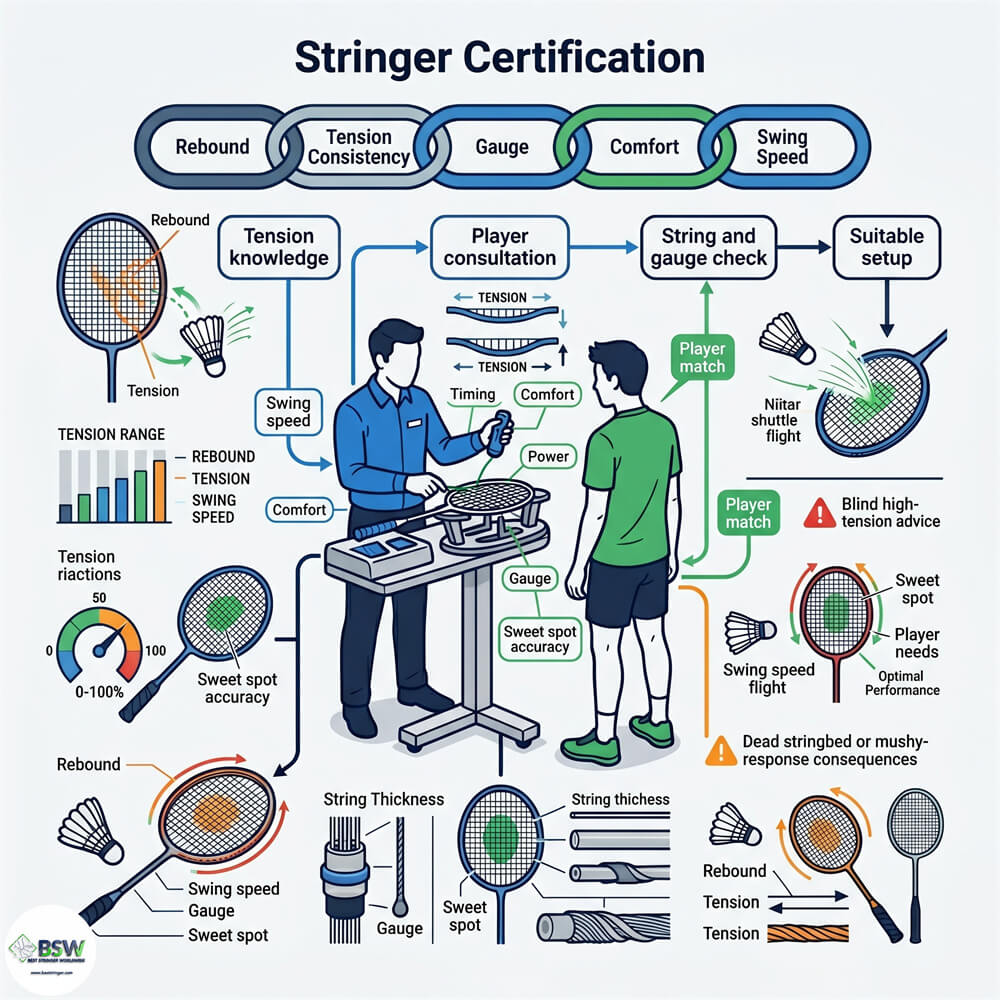
Proper tension education is a core part of a professional badminton stringing course and good stringer certification standards. A certified stringer understands that recommending “high tension” blindly without considering a player’s real swing speed is a disservice.
At Best Stringer Worldwide, we know that stringbed rebound directly influences the advice given to players. The magic is not just in pulling tension, but in the precise player consultation logic a badminton stringer uses to match string type and tension to your power needs.
BSW certification pathways teach structured setup comparison and player consultation. Training can improve decision quality, but it cannot guarantee a perfect balance, eliminate uncertainty or prevent injury.
String Tension Quick FAQ
Quick, direct answers to common questions about lower badminton string tension and power generation.
Does lower tension always mean more power?
Not always. Controlled mechanical studies reported higher shuttlecock speed at lower test tensions, but a player’s result also depends on swing, impact location, string, gauge, racquet and technique.
Why does lower tension feel more comfortable?
Lower tension may feel softer to some players, especially on off-centre impacts. That subjective comfort does not establish that the setup is safer or prevents injury.
Is lower string tension better for all players?
Not every badminton player will benefit equally. While it offers easier power and comfort, lower tension may also feel less precise for advanced players, making it less suitable for sharp, fast-paced control.
How does tension affect smash power?
Smash speed depends heavily on technique and racquet-head speed. Tension can change stringbed response, but advanced players do not universally need higher tension.
Why do some players use higher tension?
A badminton player needs the right balance. Higher tensions are chosen for their exceptional control, allowing for rapid defensive blocks, precise net shots, and direct feedback for clean hitters.
How does string type affect low tension?
Lower tension paired with a thin string gauge feels incredibly lively. A certified stringer will adjust tension based on the string’s thickness and repulsion to ensure the sweet spot remains accessible.
What should a stringer consider before changes?
A professional badminton stringer should always evaluate the player’s swing speed, timing, and comfort needs. They should never just recommend high tension for ‘professional feel’ without considering the player’s ability.
Why is stringer certification important?
A badminton stringing course can teach stringbed response, equipment limits and structured comparison. Certification records an assessment pathway; it does not guarantee safe or perfect advice in every case.
Are stringing courses necessary?
A course can help stringers build consultation and technical skills, but it is not the only learning route and does not eliminate uncertainty. Compare the syllabus, assessment and support before enrolling.
The Physics of Power: Why String Tension Matters
Player Setup: Average Swing Speed
Goal: Compare clear length and perceived stringbed feel.
Which string tension is the better choice?
Equipment Physics Select a tension setup above to prepare the simulation.
Evidence and Limits
Our guidance combines controlled stringbed research, manufacturer limits and player-specific testing. We do not treat professional-player setups as universal prescriptions or make injury-prevention guarantees.
| Stringing Attribute | Lower Tension (20-24 lbs) | Higher Tension (26+ lbs) |
|---|---|---|
| Power Generation | Controlled tests reported higher shuttle speed at lower tension; player results vary. | Firmer stringbed response; output depends on swing, impact location and setup. |
| Stringbed Feel | Softer perceived response for some players; measured vibration depends on the full setup. | Firmer perceived response with more direct feedback. |
| Sweet Spot Size | May provide a more forgiving perceived response on off-centre hits. | May feel less forgiving on off-centre hits. |
| Control & Placement | May feel less precise or ‘mushy’ for fast-swinging advanced players. | Firmer, more direct feedback that some consistent hitters prefer. |
| Player Suitability | A possible starting direction for players seeking a softer response; test individually. | A possible choice for players who prefer a firmer response; test within equipment limits. |
| Comfort & Safety | May feel softer to some players; this is not an injury-prevention claim. | May feel firmer; adjust if discomfort occurs and seek qualified care for persistent symptoms. |
Master Your Stringbed Response with Best Stringer Worldwide
Ready to upgrade your knowledge? Best Stringer Worldwide offers professional stringing consultation to teach you how lower badminton string tension and stringbed rebound affect stringbed response and measured shuttle speed. We serve badminton players worldwide especially in Singapore, Hong Kong, Malaysia, Indonesia, UK, France and Europe. Contact a trained stringer or join a badminton stringing course to establish a documented starting setup and refine it through controlled player feedback.