1.1 Material Fundamentals
Introduction to Advanced Tennis String Materials
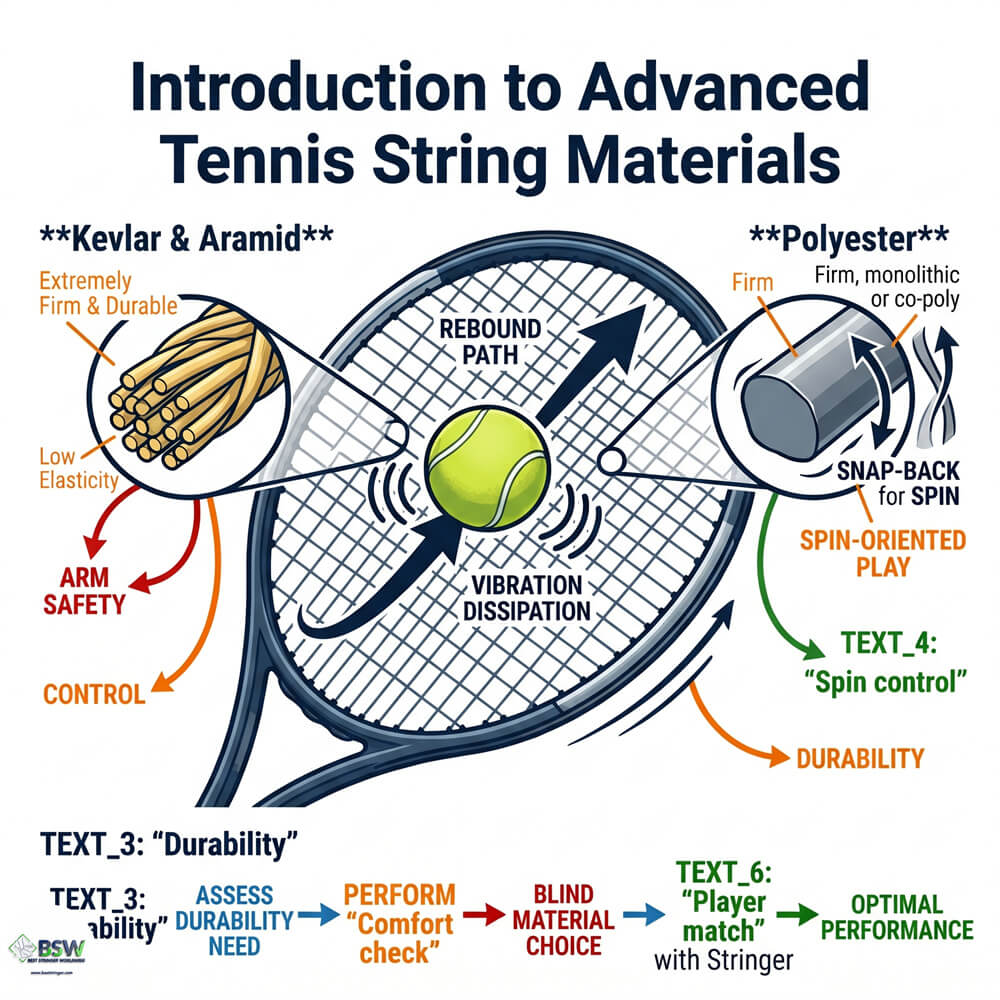
Advanced string materials strongly affect your performance and feel. In this guide, you will learn how Kevlar & Aramid and Polyester behave, how they differ in durability, stiffness, spin potential, and control, and why they are not automatically right for every player.
In short, Kevlar & Aramid provide extreme durability, while Polyester offers incredible snap-back for spin-oriented play. Mastering these concepts is crucial for any player or certified stringer, as “advanced material” does not automatically mean “better for your arm.”
Here is a simple decision flow: Step 1: Assess your need for durability vs comfort honestly. Step 2: Understand that stiffer strings are only beneficial if you can generate your own power without fatigue. Step 3: Consult a professional stringer to match string material, gauge, and tension perfectly to your stroke style.
1.2 Kevlar & Aramid
Kevlar & Aramid: Maximum Durability and Firmness
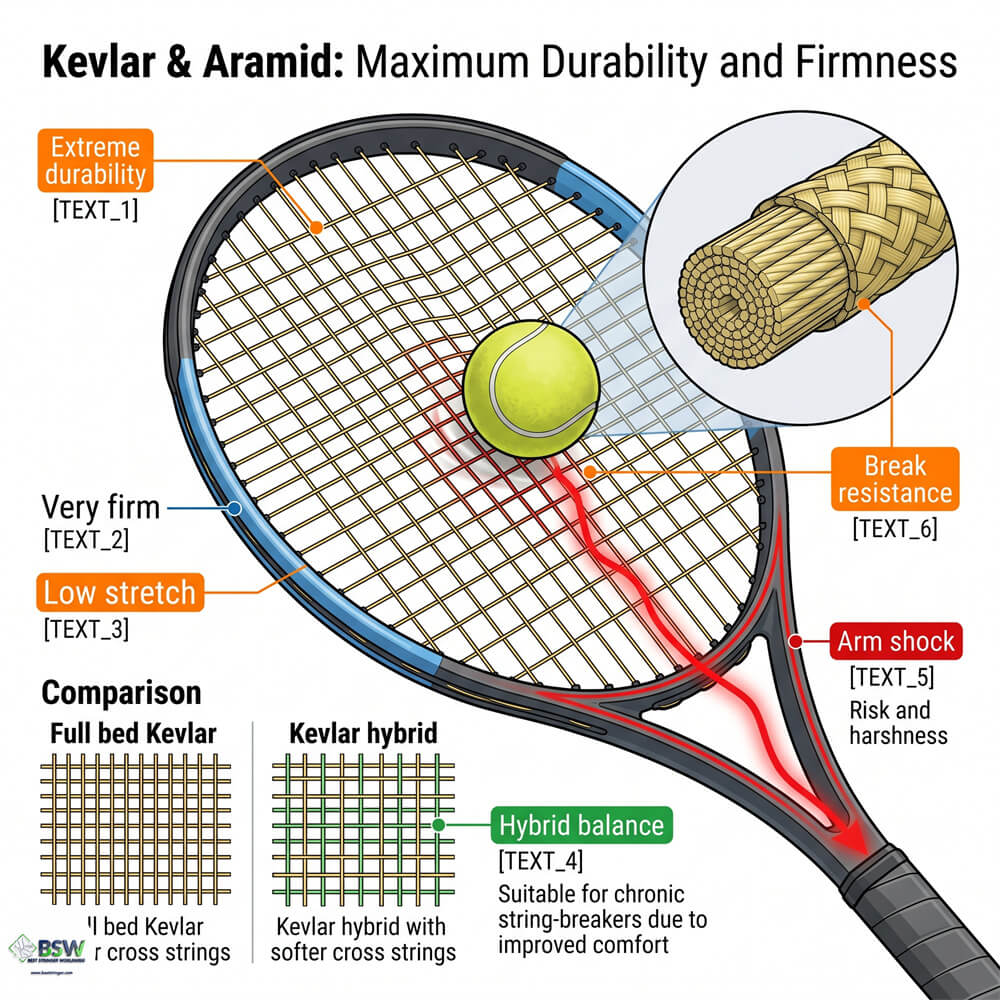
Kevlar & Aramid are advanced synthetic materials famous for extreme durability. A full bed provides exceptional break resistance, offering incredible stability and a very firm response. However, this high stiffness makes them one of the harshest string families available, suited mainly for chronic string breakers.
The construction of these strings limits elasticity. While they hold static tension incredibly well and resist notching, they do not stretch easily upon impact. This lack of elasticity means less free power and significantly reduced touch comfort compared to softer traditional strings like multifilament.
A tennis player needs the right balance between break resistance and arm safety. Because a full bed can feel too rigid and uncomfortable, professional stringers almost always recommend using Kevlar & Aramid in a hybrid setup. Pairing it with a softer cross string helps soften the overall impact while retaining the main string’s durability.
1.3 Polyester Strings
Polyester: The Control and Spin Master
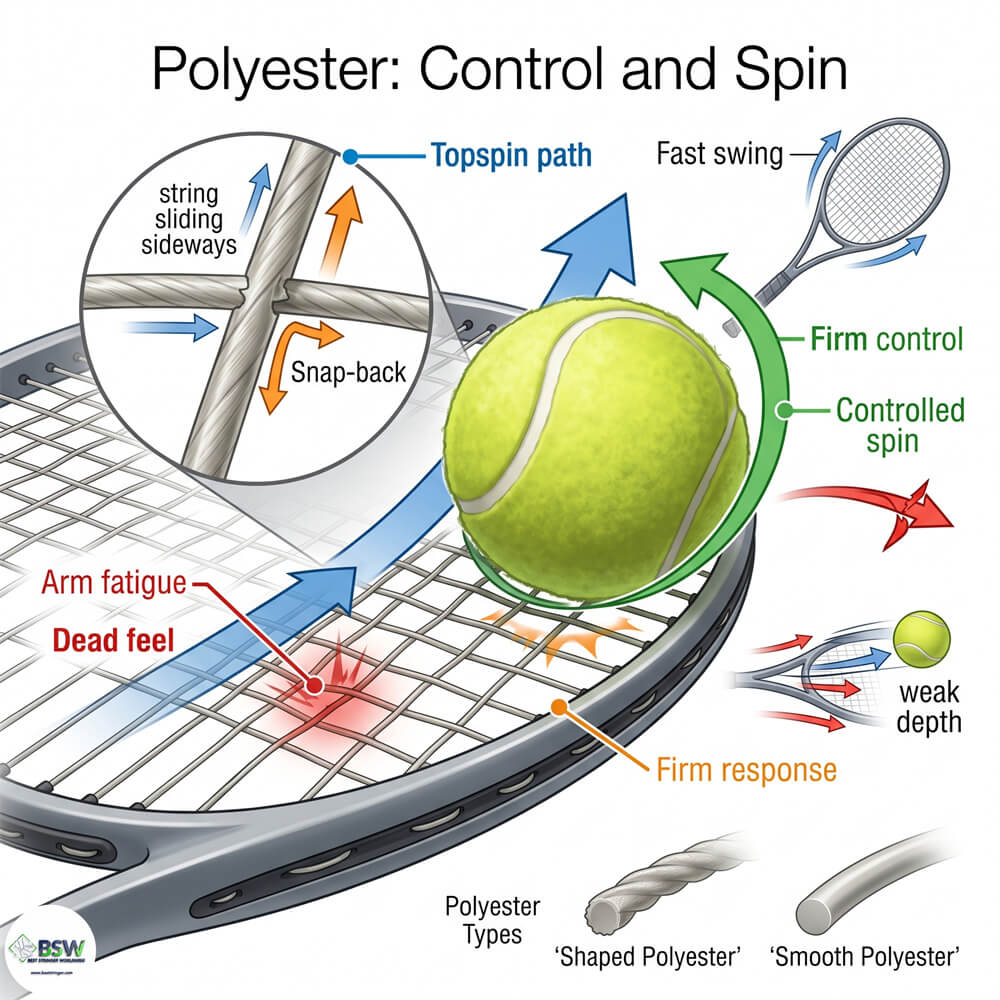
Polyester tennis strings revolutionized modern tennis by offering massive control and spin potential. The material’s firm nature and smooth surface allow the strings to snap back into place during heavy topspin strokes. However, like Kevlar, Polyester requires advanced swing mechanics and fast racket head speed to unlock its benefits safely.
While Polyester is generally less stiff than pure Kevlar, it is still significantly firmer than traditional nylon or natural gut. If you lack solid technique or rely on flat, compact strokes, a full bed of polyester can feel dead and punish you with weak depth and potential arm fatigue.
Technology advancements have introduced shaped profiles, textured coatings, and slightly softer formulations. Yet, even with these developments changing the category’s landscape, polyester remains a firm, control-oriented choice meant for players who need help taming their own raw power or who generate heavy spin naturally.
1.4 Optimizing Performance
Optimizing String Setup for Advanced Materials
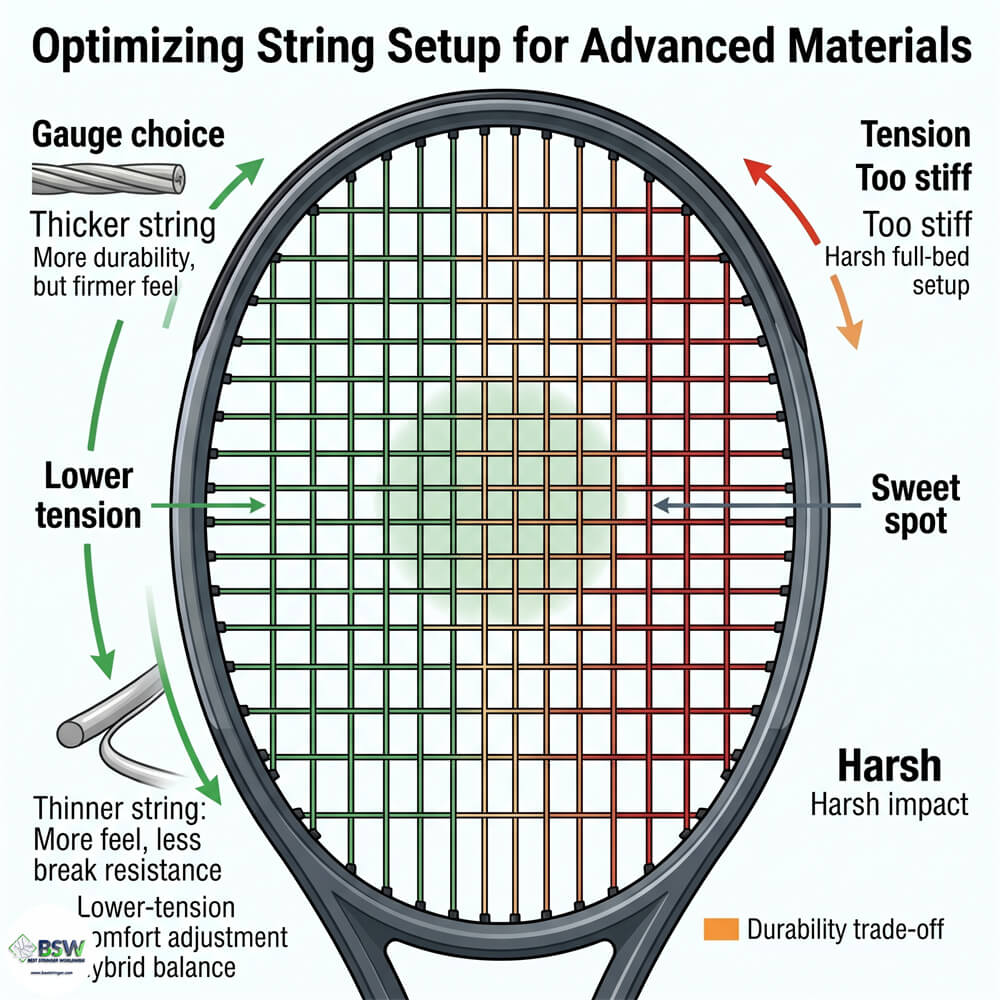
Both Kevlar & Aramid and Polyester require careful consideration of string gauge and tension to truly unlock their potential while protecting the arm:
What is String Gauge? Gauge refers to the thickness. Thicker strings (e.g., 1.30mm) offer maximum durability but can feel board-like with stiff materials. Thinner gauges (e.g., 1.20mm) sacrifice some break resistance for improved feel, spin-related response, and comfort.
Tension Basics. Because advanced materials are naturally stiff, dropping the tension is highly recommended. Lower tension acts like a cushion, opening up the sweet spot, improving comfort, and restoring some depth to your shots without losing the material’s inherent control.
The Hybrid Solution. If you want the spin of polyester or the durability of Kevlar without the harshness, hybrid setups are the answer. A professional tennis stringer will often blend these stiff main strings with softer synthetic gut or multifilament crosses to balance durability and touch.
1.5 Common Misconceptions
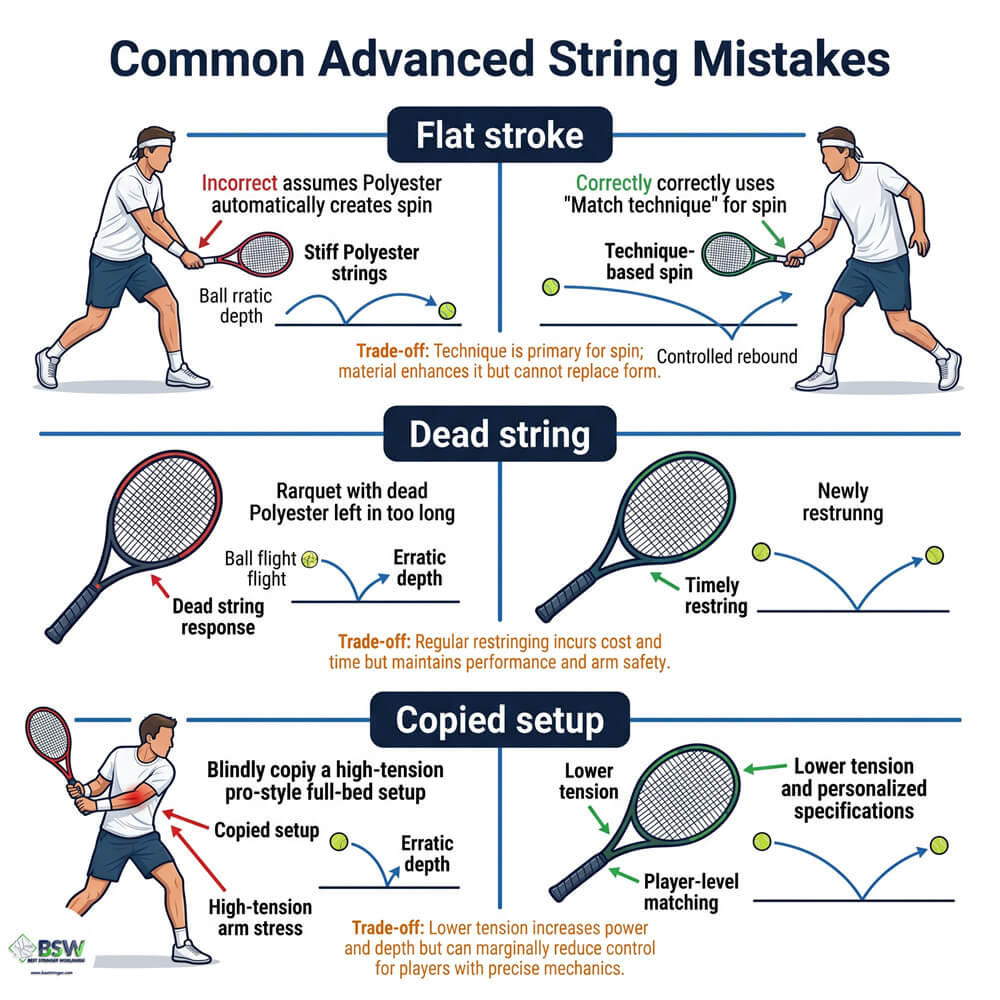
Common Advanced String Mistakes
Mistake 1: Assuming Stiff Strings Generate Free Spin.
Polyester does not automatically create spin on its own. It provides a control-oriented response that allows a player with heavy topspin mechanics to swing faster. If you hit flat, polyester will just feel stiff.
Mistake 2: Ignoring Playability Loss.
A common error is leaving Polyester or Kevlar in the racquet until it snaps. Polyester often loses its dynamic elasticity (goes “dead”) long before it breaks physically, leading to arm pain and erratic control.
Mistake 3: Copying Pro Setups Blindly.
Using the exact high-tension, full-bed polyester setup of an ATP professional is a mistake for most amateurs. Professional setups require elite biomechanics; otherwise, they simply tire out your arm and ruin your consistency.
1.6 Selection Framework
Practical String Material Decision Flow
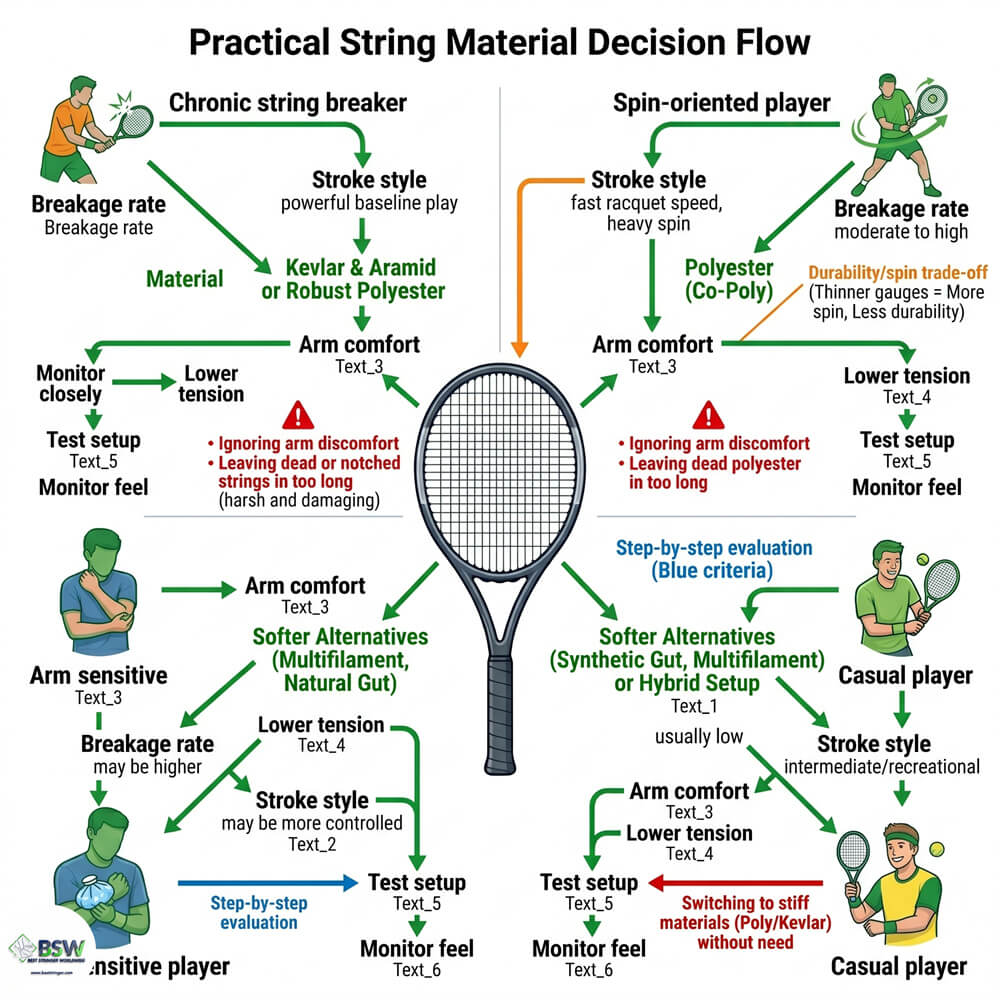
A step-by-step decision flow is crucial for balancing durability, spin, and comfort safely. Use this simple framework before upgrading to advanced tennis string materials:
Step 1: Check Your Breakage Rate. Kevlar & Aramid or Polyester are primarily problem-solvers for chronic string breakers. If your synthetic gut lasts for months, switching to advanced stiff materials will likely harm your feel without offering a necessary benefit.
Step 2: Identify Your Needs. Determine if you are a spin-oriented player needing the snap-back of Polyester, or a player experiencing extreme string wear needing the ultimate stability of a Kevlar hybrid.
Step 3: Test and Monitor. Try the new setup at a lower tension and test whether it genuinely improves your shot quality. Monitor how your arm feels, and be prepared to cut the strings out if they become harsh before breaking.
1.7 Professional Knowledge
The Value of Stringer Certification
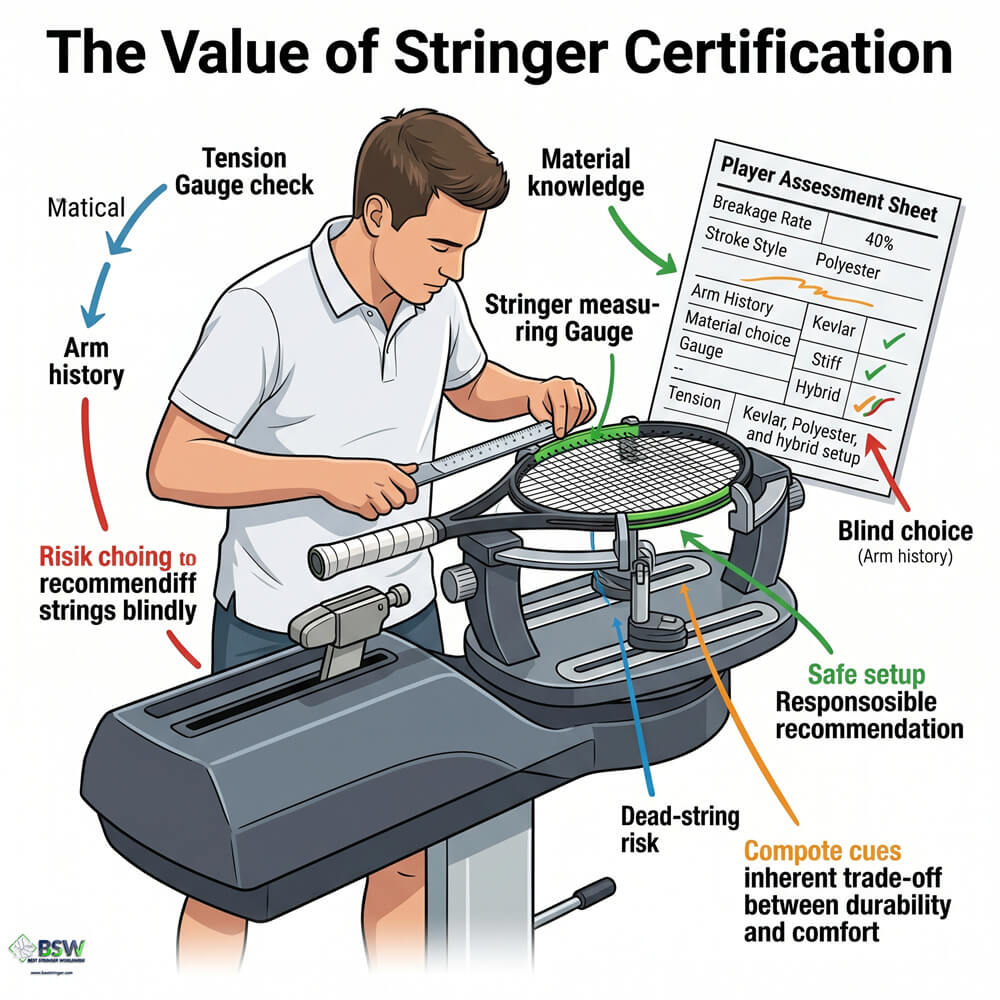
Proper material education is a core part of a professional racquet stringing course and good stringer certification standards. A certified stringer understands that recommending Kevlar or Polyester blindly without considering a player’s arm health is a disservice.
At Best Stringer Worldwide, we know that material choice directly influences the advice given to players. The magic is not just in buying the most durable string, but in the precise consultation logic a stringer uses to match material, gauge, and tension perfectly.
By prioritizing accurate equipment knowledge, our stringer certification ensures that every setup perfectly balances durability, spin, and comfort. You eliminate guesswork, avoid injuries from dead strings, and focus purely on improving your client’s game.
Advanced String Materials Quick FAQ
Quick, definition-first answers to common questions about Kevlar & Aramid and Polyester strings.
Is Kevlar always the best choice for durability?
Kevlar & Aramid are incredibly durable, making them excellent for chronic string breakers. However, because they are so stiff, they are usually only recommended in a hybrid setup. They are not the best choice if you have any history of arm discomfort.
Why does Polyester help generate spin?
Polyester strings are firm and have a smooth surface that allows the main strings to slide and “snap back” into position during a fast, brushing swing. This snap-back effect enhances the spin generated by the player’s mechanics.
Are advanced strings better for all players?
Not every tennis player will benefit equally. While Kevlar offers extreme durability and Polyester offers spin-control, both are much stiffer than synthetic gut. Beginners and players with flat strokes generally perform better with softer, more forgiving strings.
How does a hybrid setup balance performance?
A hybrid setup blends two different string materials. By placing a stiff, durable string (like Kevlar or Polyester) in the mains and a soft, resilient string (like synthetic gut) in the crosses, players get a blend of durability, spin, and improved comfort.
Why do pros change polyester so often?
Polyester often loses its dynamic elasticity and tension before it breaks physically. When it goes “dead,” the stringbed feels harsh and loses its predictable response. Professionals change rackets to ensure the strings always perform at their peak.
How does string tension affect stiff materials?
Stiff strings like Kevlar and Polyester require lower tensions than softer strings. A certified stringer will usually drop the tension by 5-10% to ensure the sweet spot remains accessible, restoring some power and protecting the player’s arm from excessive shock.
What should a stringer consider before changes?
A professional stringer should evaluate the player’s breakage rate, physical strength, stroke style, and arm history. They should never recommend Kevlar or Polyester simply based on hype without considering the player’s ability to handle the stiffness.
Why is stringer certification important?
A comprehensive racquet stringing course teaches the science behind string materials and tension behavior. A certified stringer provides safe, educated guidance to players rather than relying on brand marketing or blind guesswork.
Are stringing courses necessary?
For those wanting to master equipment consultation, yes. A stringer learns measurement consistency, material properties, and the logic to match advanced strings to player levels, serving both tennis and badminton crossover technicians effectively.
Material Behavior: String Stiffness vs Resilience
Material Impact Behavior
Select a string material below, then interact with the racquet diagram to understand stiffness, snap-back, and shock transfer.
Mode: Polyester
The Snap-Back Effect: Polyester strings are firm but smooth. During impact, the main strings slide out of position and violently snap back, generating massive spin. Requires fast swing speeds.
Mode: Kevlar & Aramid
Extreme Rigidity: Kevlar offers maximum durability but lacks elasticity. The stringbed refuses to stretch, transferring severe impact shock directly into the racquet frame (and the player’s arm).
Mode: Hybrid Setup
Balanced Performance: A professional stringer mixes stiff Kevlar mains (for durability) with softer synthetic crosses (for cushion). The stringbed yields moderately, protecting the arm while preserving string life.
Interaction Guide
Proven Specifications
Our stringing approach is based on verified equipment parameters used by top professionals. We prioritize arm safety, proper racquet mass evaluation, and playstyle efficiency over pure tension hype.
| Material Aspect | Kevlar & Aramid | Polyester |
|---|---|---|
| Primary Strength | Maximum durability, extremely high break resistance. | Excellent control, snap-back, and spin potential. |
| Stiffness Profile | Extremely rigid, minimal elasticity, firmest response. | Firm and stiff, but slightly more forgiving than Kevlar. |
| Tension Behavior | Holds static tension exceptionally well over time. | Often loses dynamic tension (“goes dead”) before breaking. |
| Comfort Level | Very low comfort; can be harsh on the arm. | Low comfort, but softer variations are available. |
| Common Setup | Almost always used in a hybrid (mains) to reduce harshness. | Used in full beds or hybrids depending on player level. |
| Ideal Player Profile | Chronic string breakers who sacrifice feel for string life. | Advanced players with fast swings generating heavy topspin. |
Master Advanced Materials with Best Stringer Worldwide
Ready to upgrade your knowledge? Best Stringer Worldwide offers professional racquet stringing courses and stringer certification to teach you how advanced string materials like Kevlar and Polyester affect performance safely. We serve tennis and badminton stringers worldwide especially in Singapore, Hong Kong, Malaysia, Indonesia, UK, France and Europe. Contact us to master tension, gauge, and hybrid matching for your clients.