1.1 Method Fundamentals
What Is the Gosen Haribito Basic Stringing Method?
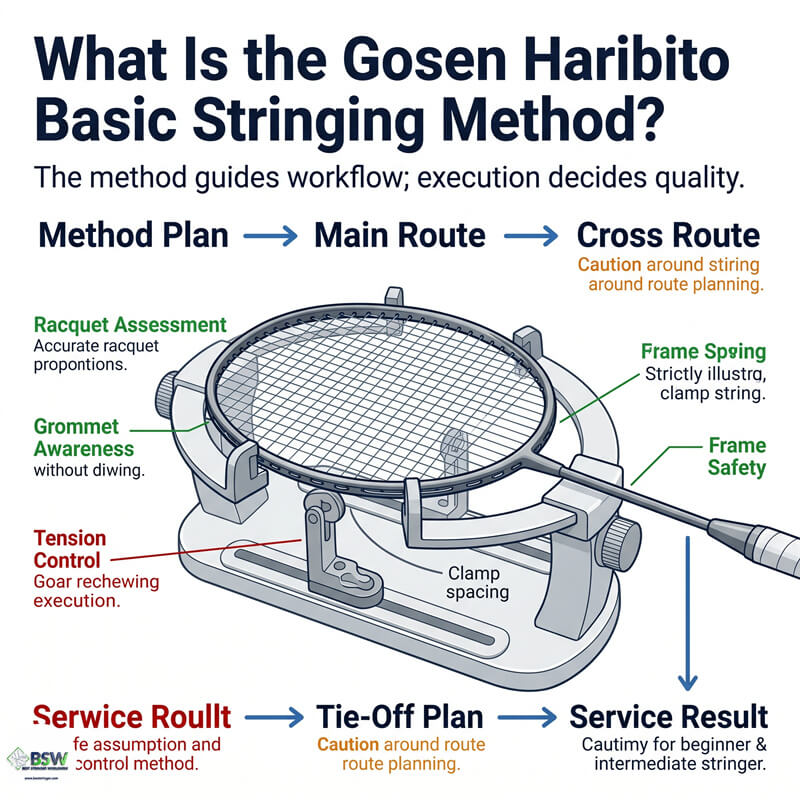
The Gosen Haribito Basic stringing method, also frequently searched as the Haribito Basic badminton stringing pattern, is a highly discussed badminton racquet stringing pattern among players and stringers. In this guide, you will learn why professional badminton stringers study this Haribito-style badminton stringing approach, how it plans the main-string and cross-string route, and why understanding stringing patterns is a core part of professional badminton stringing education.
In short, a stringing method dictates your workflow and tie-off plan, while the stringer’s technique dictates the final quality. Mastering this concept is important for any player or technician aiming to understand racquet service, as the method name alone does not guarantee perfect stringbed tension holding or frame safety.
Here is a simple professional truth:
Step 1: Assess the racquet honestly, as not every method automatically suits every frame’s specific grommet design or hole layout.
Step 2: Understand that a Haribito Basic badminton stringing pattern is only beneficial if executed with proper tension control and clamp spacing.
Step 3: Consult a certified stringer to ensure the chosen method perfectly matches your racquet’s condition, shared holes, and tension target.
1.2 Route & Workflow Planning
Stringing Patterns Explained: Route and Method Logic
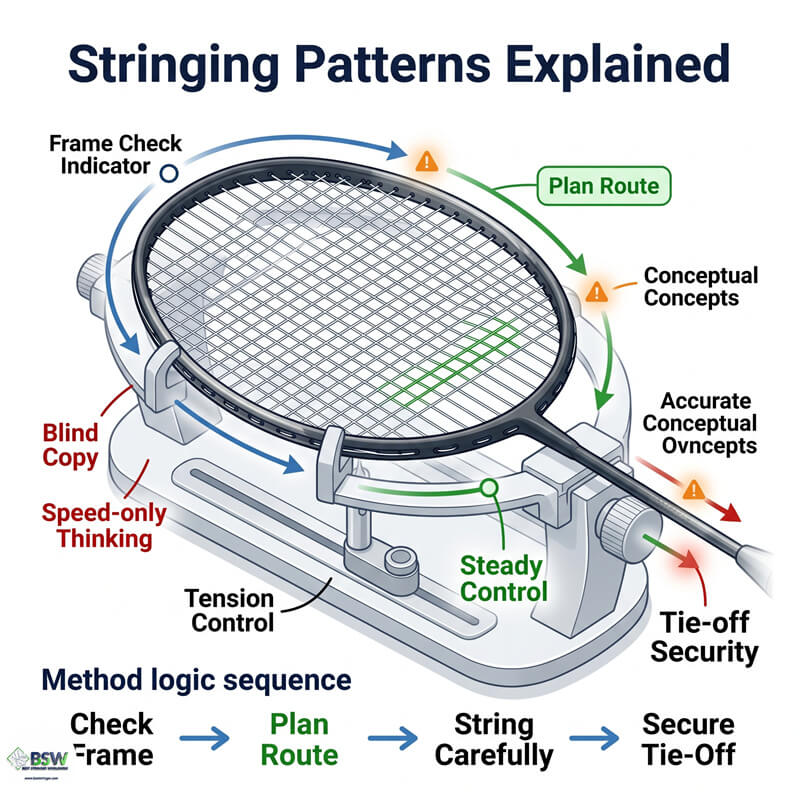
The golden rule of racquet service is that a well-planned stringing pattern can guide workflow efficiency and tie-off consistency. It is important to know that a stringing method and stringing quality are related but not the same. The method refers to the sequence and routing the technician follows, while quality refers to the actual tension consistency, clamp control, and knot security achieved during execution.
Following a specific pattern drastically alters how the stringer manages the frame. The Gosen Haribito stringing method provides a systematic routing approach, offering a practical workflow for separating main and cross strings according to specific manufacturer layouts. However, if the racquet technician focuses purely on pattern speed without maintaining proper clamp control, tension stability and racquet safety will suffer.
A badminton stringer needs the right balance between route efficiency and meticulous care. For experienced stringers handling high volumes, optimizing the string route is generally preferred. Yet, students in a proper badminton stringing course learn that solid machine execution and proper frame protection matter far more than just copying a popular brand’s pattern blindly.
1.3 Frame Support & Routing
Understanding Frame Condition and Shared Holes
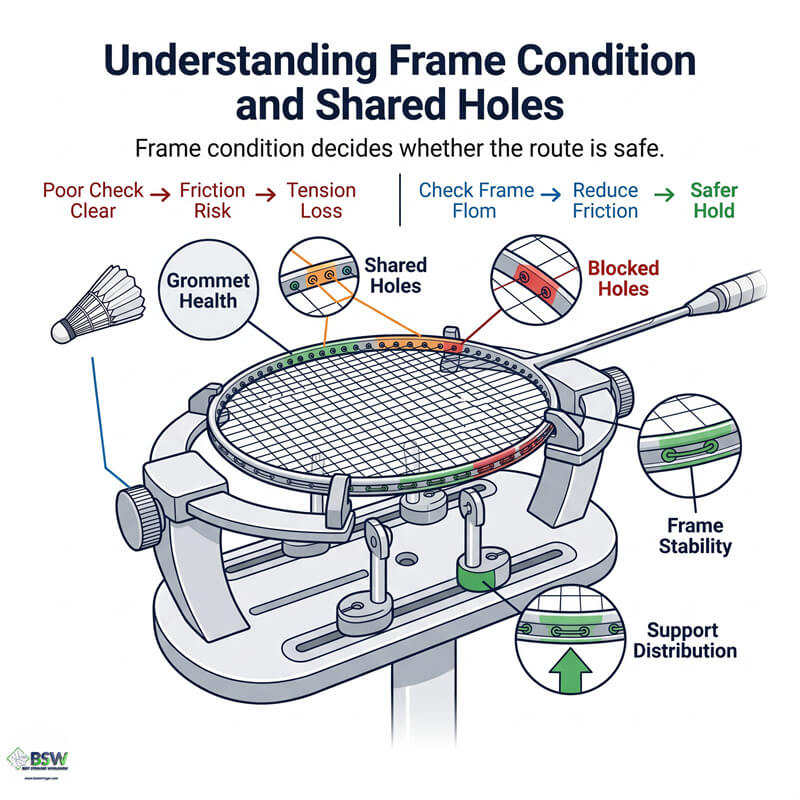
Stringbed quality is not determined by the pattern name alone. While the Gosen Haribito Basic stringing method provides a logical route for many badminton racquets, stringers must evaluate grommet health and frame stability before starting. A secure mounting system provides maximum safety, but poorly maintained grommets can cause the string to sheer or lose tension quickly if the stringer lacks technical awareness.
Understanding shared holes and blocked holes is highly critical. A professional pattern navigates these intersections smoothly, reducing friction during string pulling and dampening the risk of premature string breakage. This ensures the frame safely holds tension, even if the requested tension is slightly higher than average.
Machine support also plays a massive role in tie-off stability. A professional 6-point mounting system offers a larger area of support, ensuring that the tension distribution from the Haribito-style stringing method transfers evenly across the head, drastically reducing frame warping and ensuring long-term stringbed feel.
1.4 Tension Target & Execution
Badminton Tension Control and Pattern Execution
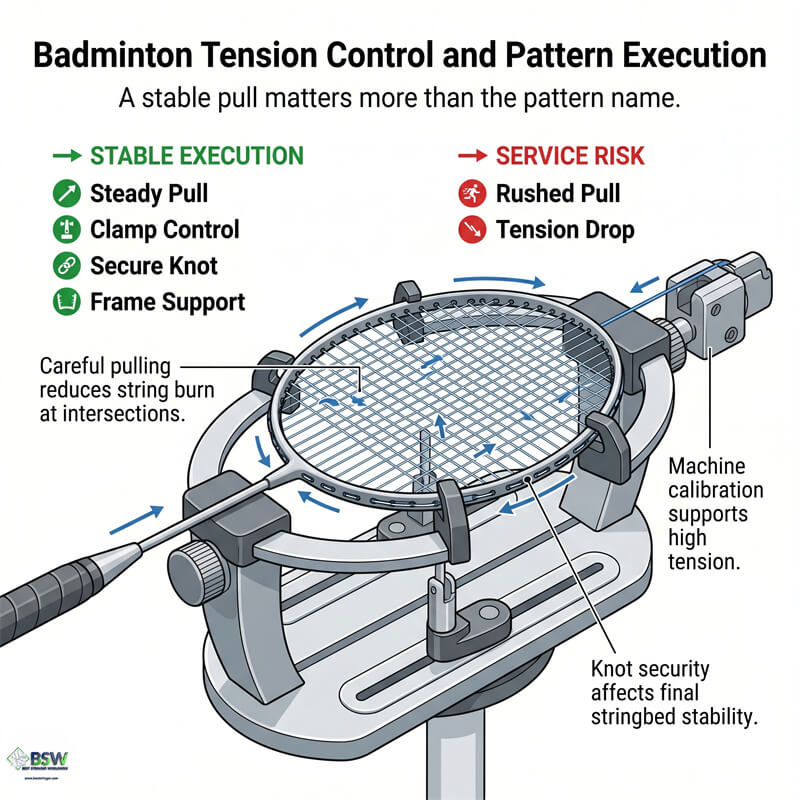
Any stringing method requires correct tension control and pulling technique to truly yield a consistent stringbed. The Haribito Basic stringing method affects tie-off planning and how the stringer manages tension across the frame:
What is Method Execution? Execution refers to the care taken during the route. Careful pulling ensures strings do not burn each other at intersections, while rushed pulling sacrifices overall tension stability for a slightly faster completion time.
Tension Basics. High tension stringing (26+ lbs) using any pattern requires extra machine calibration and frame support. If a beginner stringer copies the Gosen Haribito stringing pattern but uses poor clamp control, the final tension will be inconsistent regardless of the route taken.
The Synergy Risk. A badminton stringer should understand that stringbed performance is influenced by knot security, pulling sequence, and pre-stretch choices, not just the pattern name. Trying to force a specific method onto an incompatible frame is a recipe for disaster. A certified badminton stringer will always align these factors responsibly.
1.5 Common Mistakes
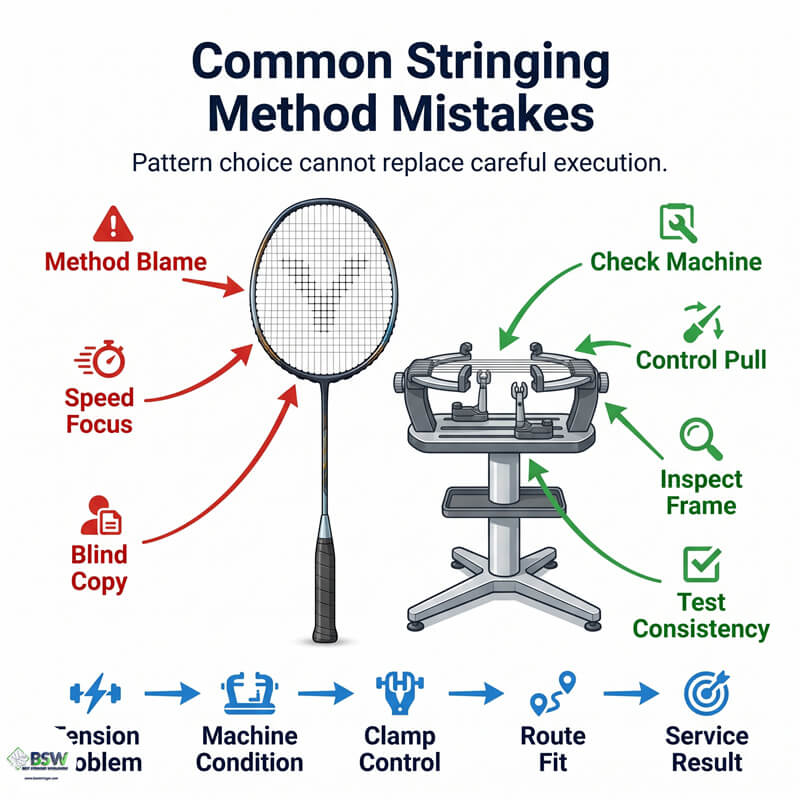
Common Stringing Method Mistakes
Mistake 1: Blaming the Method Only.
A certified stringer should not blame tension loss solely on the pattern if machine calibration and clamp maintenance are lacking. Ignoring stringer execution when diagnosing tension problems is a fundamental error in racquet service.
Mistake 2: Assuming Faster is Always Better.
While a standardized pattern helps organize workflow, assuming a faster method automatically equals better service ignores stringbed consistency. Rushing the main and cross pulling process causes tension to drop quickly and playability to suffer.
Mistake 3: Copying Patterns Blindly.
Using a Gosen Haribito-style stringing pattern seen online without understanding frame support is a common error. Copying routes without considering shared holes, grommet health, and safe tie-off rules can lead to sheer frame stress and poor durability.
1.6 Selection Framework
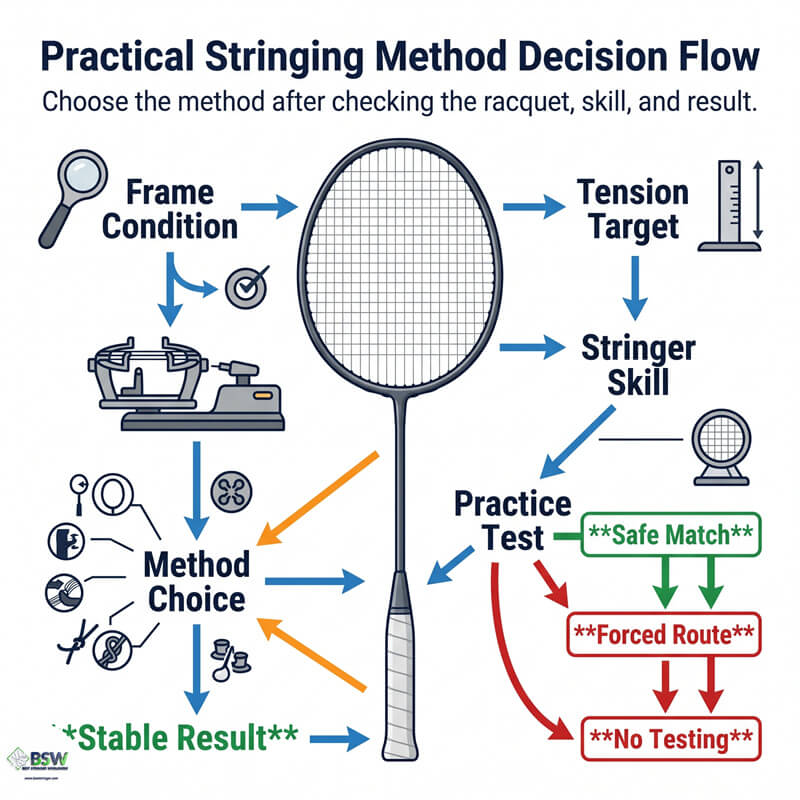
Practical Stringing Method Decision Flow
Method suitability, tension consistency, and racquet safety must be matched to the frame, not assumed blindly. Use this simple framework before adopting the Gosen Haribito Basic stringing method route:
Step 1: Check the Frame Condition. Assess whether the racquet is designed for a specific stringing pattern. Check if grommet health, blocked holes, and frame strength support the intended tie-off points safely.
Step 2: Check Your Stringing Experience. The Haribito-style method will only yield consistent tension if you can maintain proper clamp spacing and secure knots. Verify that your technical fundamentals support safe routing without errors.
Step 3: Test for Actual Consistency. Try the Gosen Haribito-style method on a practice frame. Test whether it genuinely improves your workflow, tie-off security, and tension stability, or if it only causes you to rush and make pulling mistakes.
1.7 Further Learning
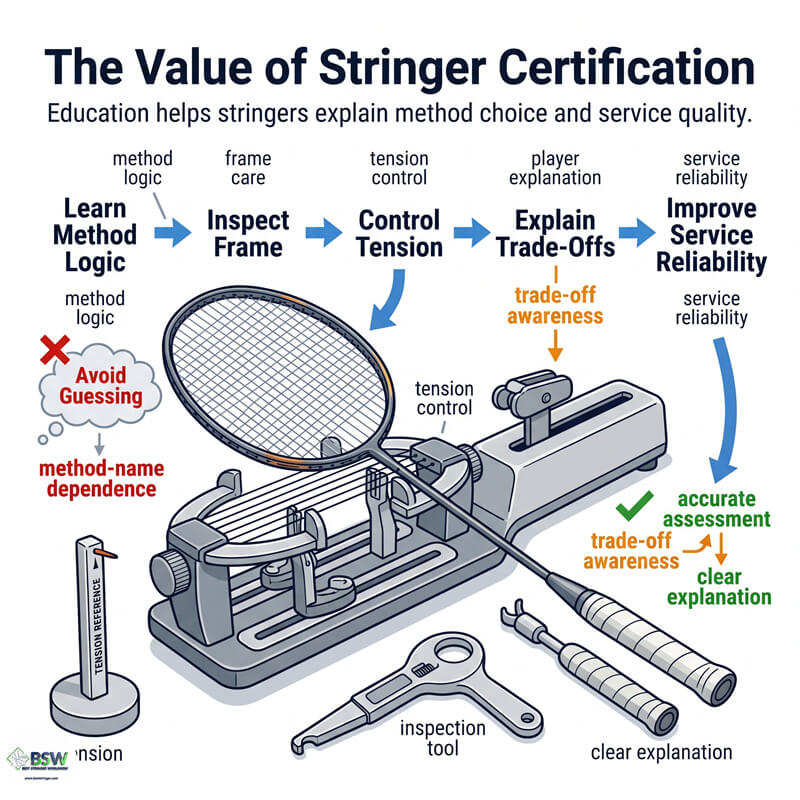
The Value of Stringer Certification
Proper pattern education is a core part of a badminton stringing course and strong stringer certification standards. A certified stringer understands that adopting the Gosen Haribito Basic stringing method blindly without considering frame condition and tension accuracy is a disservice.
At Best Stringer Worldwide, we know that workflow consistency directly influences the quality delivered to players. Real badminton stringing certification involves the ability to explain stringing methods, tie-off choices, and safety trade-offs to badminton players clearly.
By prioritizing accurate technical knowledge, our professional education ensures that a good badminton stringer understands pattern logic, tension control, and racquet care. You eliminate guesswork, safely manage complex frames, and focus purely on improving service reliability.
Gosen Haribito Basic stringing method: Pattern Logic Visualized
Haribito (HB) Stringing Pattern - Basic (HBB) (76 Hole Racquet)
Progress Controls
- Overall Progress
- Left String Progress
- Right String Progress
Display Options
- Left String
- Right String
- Hole Labels
- String Direction
Stringing Method Quick FAQ
Quick, definition-first answers to common questions about the Gosen Haribito stringing method, workflow patterns, and racquet service logic.
What is Gosen Haribito Basic stringing method?
Gosen Haribito Basic stringing method usually refers to a Haribito-style badminton racquet stringing approach or stringing pattern discussed by stringers. It is a method for planning string route, main strings, cross strings, tie-offs, and workflow, not a magic shortcut that guarantees better performance by itself.
What is Haribito Basic badminton stringing?
Haribito Basic badminton stringing means studying a basic Haribito-style stringing route and pattern logic for badminton racquets. The exact method still depends on the racquet model, hole layout, shared holes, blocked holes, and stringer execution.
Why do badminton stringers discuss Gosen Haribito Basic?
Stringers discuss it because Haribito-style stringing is part of badminton stringing education and method comparison. Serious stringers study how different stringing patterns affect workflow, string routing, tie-off planning, and service consistency.
Is Haribito Basic suitable for all badminton racquets?
It is not responsible to say it is suitable for every racquet without checking the racquet pattern. Suitability depends on the racquet’s recommended pattern, shared holes, blocked holes, grommet condition, tension target, and stringer skill.
Is Gosen Haribito Basic better than Yonex four-knot stringing?
One method is not automatically better in every situation. Gosen Haribito Basic and Yonex four-knot stringing can both be studied, but the better choice depends on racquet requirement, service standard, tournament rule, and stringer execution.
Does Gosen Haribito Basic improve tension stability?
The method name alone does not guarantee better tension stability. Tension stability depends on pulling consistency, clamp quality, knot work, string type, machine condition, and how carefully the stringer completes the job.
Does Haribito Basic protect the racquet better?
Haribito Basic can support clear workflow when used correctly, but racquet protection still depends on mounting, frame support, grommet condition, tension selection, and the stringer’s care. The method alone does not protect every racquet.
Can beginner badminton stringers learn Gosen Haribito Basic?
Beginners can study Gosen Haribito Basic, but they should first understand basic badminton stringing principles, frame support, correct tension pulling, clamp use, blocked holes, shared holes, and safe knot work. Copying the pattern without understanding can create mistakes.
Proven Service Solutions
Our stringing approach is based on verified technical parameters used by top professionals. We prioritize frame safety, proper pattern evaluation, and consistent tie-off security over pure stringing speed.
| Method Focus Area | General Stringing Focus | Haribito Basic Focus |
|---|---|---|
| Racket Suitability | General manufacturer guidelines for safe tension distribution. | Specific routing often discussed for Gosen and Haribito badminton frames. |
| Workflow Planning | Flexible routing depending on the stringer’s preferred tie-off locations. | Clear separation of main and cross strings to match specific hole layouts. |
| Stringer Skill Level | Excellent fundamental method taught in most beginner courses. | Requires advanced understanding of workflow planning and clamp spacing. |
| Tension Consistency | Highly dependent on individual stringer pulling consistency and clamp quality. | Also highly dependent on stringer execution and precise machine operation. |
| String Usage | Uses standard pre-measured string lengths or two-piece setups. | Often studied by stringers aiming to optimize main and cross string routing. |
| Frame Protection | Proven safety record when frame support and mounting are correct. | Requires identical strict attention to 6-point frame support during tensioning. |
Master Stringing Knowledge with Best Stringer Worldwide
Ready to upgrade your knowledge? Best Stringer Worldwide offers professional badminton stringing education to teach you how method logic, tension control, and patterns affect player outcomes safely. We serve badminton players and stringers worldwide especially in Singapore, Hong Kong, Malaysia, Indonesia, UK, France and Europe. Contact us to learn about badminton stringing certification and professional stringing courses.



Pattern Notes