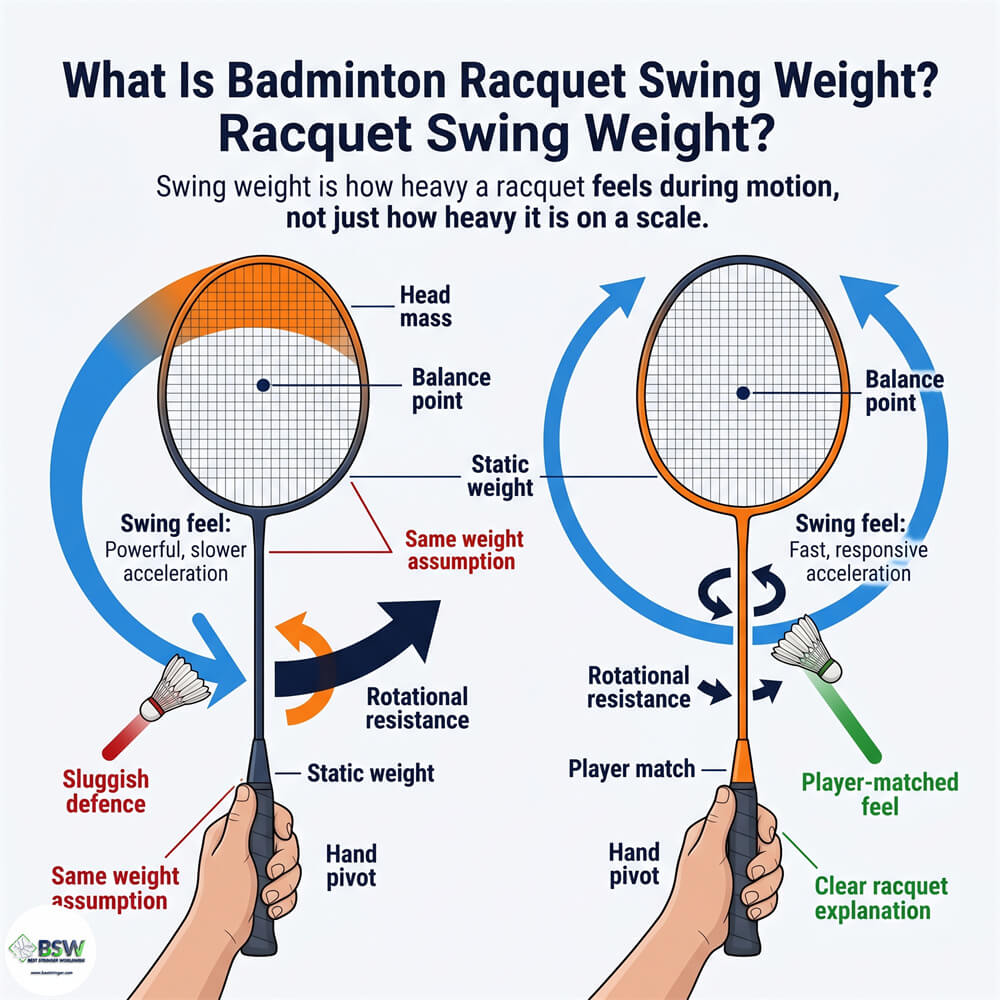
1.1 Static Weight vs Swing Weight
What Is Badminton Racquet Swing Weight?
Badminton racquet swing weight is the racquet’s resistance to being accelerated and rotated during a stroke. Unlike static weight, it reflects where the mass sits and how far that mass is from your hand, so total weight, balance point and racquet length all affect the result. A higher swing weight can feel steadier and deliver more momentum when your technique and timing support it; a lower swing weight is usually easier to accelerate for fast exchanges and defence.
Two racquets with the same scale weight can therefore play very differently. Head mass, frame length, strings and grip changes can shift the swing feel, which is why swing weight is not interchangeable with a badminton racquet weight class or a single head-heavy or head-light balance point. Compare the measurements together, then test the racquet in the strokes you actually use.
For deeper equipment analysis, see how a heavier badminton racquet can influence power. A certified stringer or experienced coach can use these relationships to explain why one frame feels stable in smashes but slow in defence, helping a player choose and set up a more suitable racquet.
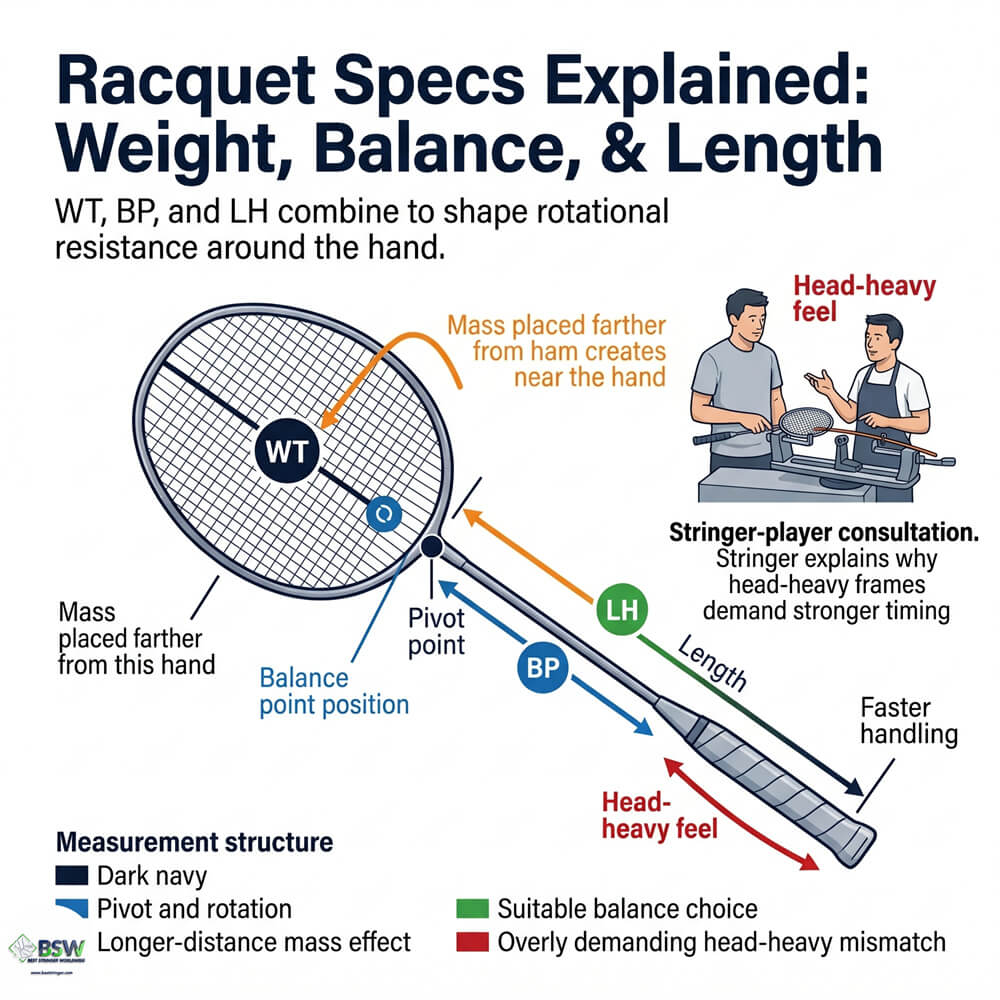
1.2 WT, BP, and LH
Racquet Specs Explained: Weight, Balance, & Length
Swing weight is directly affected by three major parameters: total racquet weight (WT), balance point (BP), and racquet length (LH). More technically, swing weight is related to the racquet’s resistance to rotation around a pivot point. In practical badminton mechanics, this pivot is located near the handle area, roughly 4 inches from the butt end, close to where most players grip the racquet.
Because the pivot point is near your hand, mass placed further away from the hand (near the head) increases the rotational resistance significantly more than mass placed near the handle. This is why a highly head-heavy racquet feels so demanding to swing.
A badminton stringer must consider these factors during player consultation. A long, head-heavy frame requires strong timing and preparation. Conversely, an evenly balanced or head-light frame provides less rotational resistance, offering a faster, more forgiving experience during quick drive exchanges.
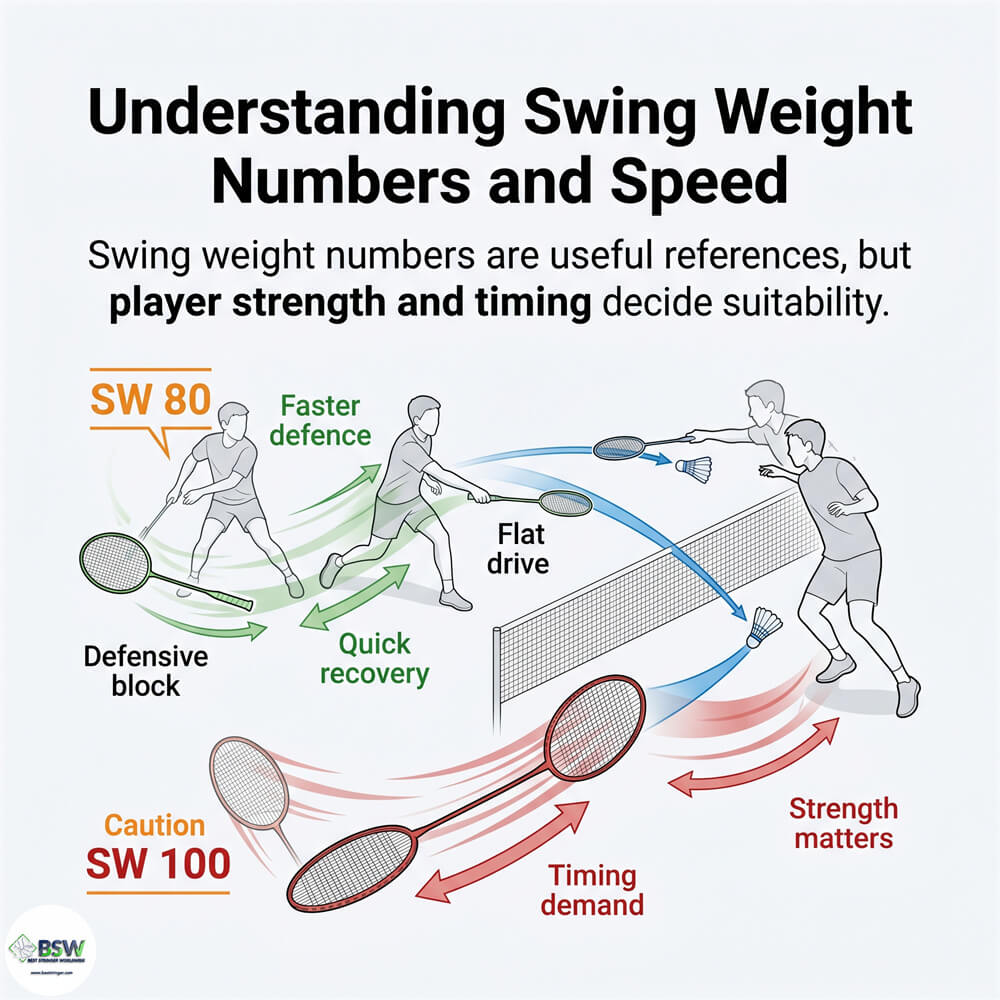
1.3 Measurement & Manoeuvrability
Understanding Swing Weight Numbers and Speed
In racquet science, swing weight relates to the moment of inertia and is typically measured in kg·cm². However, in daily use, it is usually discussed simply as a number. For instance, a very manoeuvrable badminton racquet may have a swing weight around 80, while a demanding, head-heavy attacking frame might reach closer to 100.
A lower swing weight usually makes a racquet feel easier to accelerate, leading to better manoeuvrability. It helps players achieve faster defence, quicker net interceptions, and rapid recovery during fast flat drives. This makes low swing weight racquets an excellent choice for doubles specialists and defensive players.
These numbers should be treated as useful reference points, not the absolute deciding factor. A player’s strength, timing, and technique dictate whether they can fully utilize a specific swing weight efficiently.
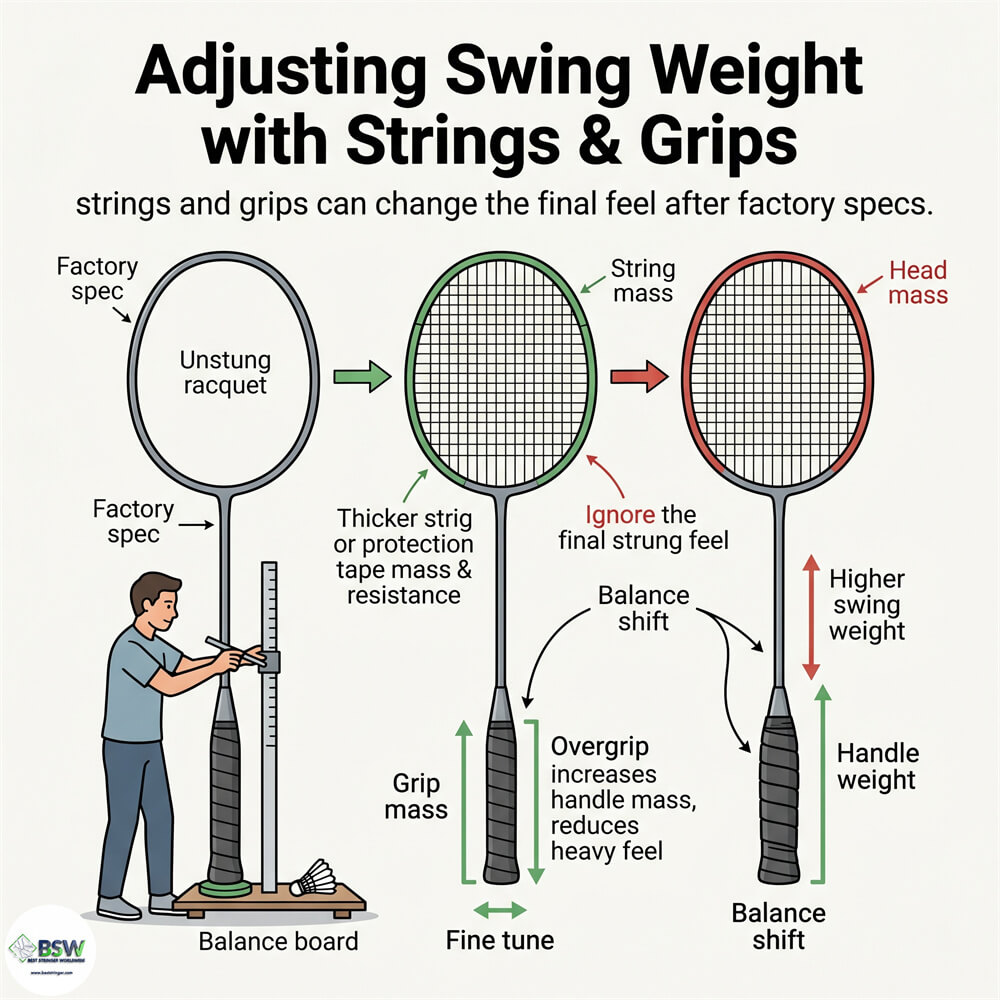
1.4 Power & Customization
Adjusting Swing Weight with Strings & Grips
Higher swing weight usually makes a racquet feel heavier in motion, reducing handling speed. However, if a player can maintain their racquet head speed, a higher swing weight delivers more hitting force and a more solid impact for rear-court smashes.
Factory Specs. Remember that factory weight and balance descriptions refer to new, unstrung racquets. Once you add strings and accessories, the final feel will change.
String Influence. Strings add mass to the head. A thicker string gauge or adding protection tape will shift the balance point forward, actively increasing the swing weight and rotational resistance.
Grip Influence. Adding a thick replacement grip or overgrip increases the handle weight. While this increases the total static weight, it moves the balance point toward the handle, making the racquet feel less head-heavy. A certified stringer can guide players on how to fine-tune these variables.
1.5 Player Suitability
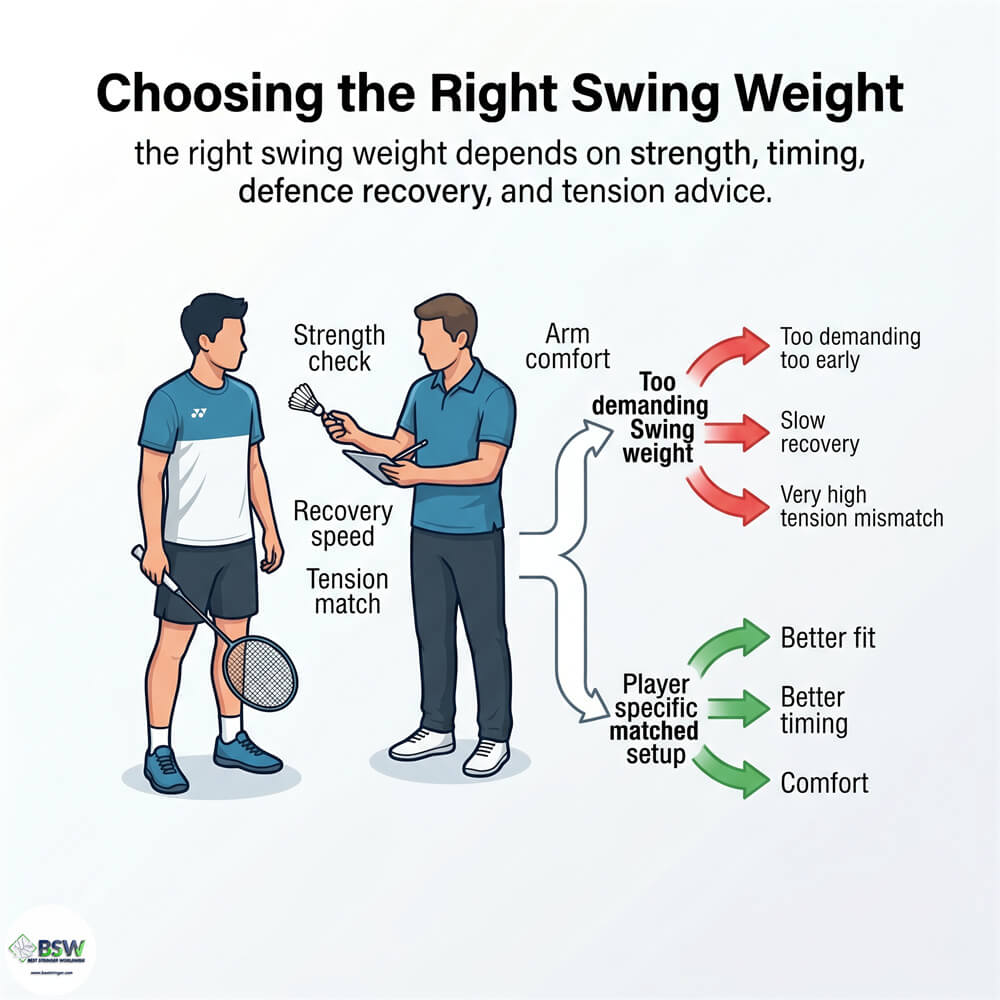
Choosing the Right Swing Weight
Mistake 1: Assuming Higher is Always Better.
While a high swing weight yields more power, using it without the necessary physical strength guarantees sluggish swings and poor timing. It heavily taxes the wrist, forearm, and shoulder, increasing fatigue.
Mistake 2: Ignoring Defence and Recovery Speed.
A badminton player who focuses purely on smash power might select an overly demanding racquet. If the high swing weight prevents quick racket recovery during fast drives, the attacking advantage is lost in defensive situations.
Mistake 3: Overlooking Tension Advice.
A racquet’s swing weight should guide stringing advice. A heavy, stiff racquet strung at very high tension may feel responsive to an advanced player, but it can feel incredibly demanding to an amateur. Matching swing weight with proper tension is crucial for comfort.

1.6 Production & Stringer Advice
High-Quality Manufacturing & Consultation
Modern high-quality badminton racquet production aims for tight consistency. Some racquets even utilize internal handle weighting or balance adjustments within the wooden handle to ensure identical models maintain a consistent balance point and reliable swing weight.
Despite this advanced manufacturing, slight variances can still occur, and adding your preferred strings and grips will always alter the factory specifications. This is where a knowledgeable racquet technician adds value.
A good badminton stringer should not simply ask, “What tension do you want?” They should consult with the player, evaluate the racquet’s static weight and balance point, and discuss how the final setup will perform. Proper assessment prevents players from ending up with a swing weight that is too physically demanding.
1.7 Stringing Education
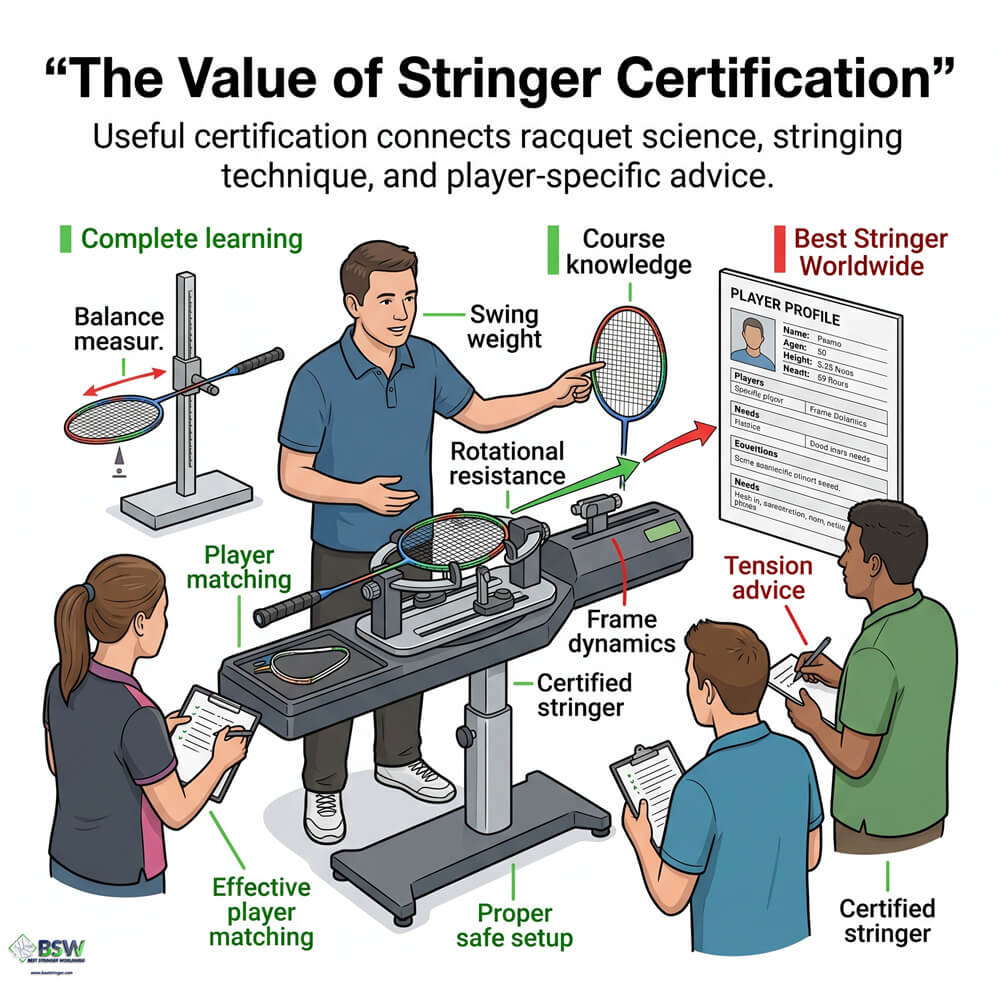
The Value of Stringer Certification
Professional racquet stringing is about much more than machine operation and tying knots. A comprehensive badminton stringing course teaches technical concepts like racquet weight, balance point, and rotational resistance so technicians can provide practical, honest advice.
At Best Stringer Worldwide, our stringing education ensures that every certified stringer knows how swing weight affects swing speed, power, and fatigue. This allows them to adjust their string and tension advice based on the actual frame dynamics, not just generic guidelines.
Through robust stringer certification, technicians learn to help badminton players balance manoeuvrability and power effectively. This equipment knowledge ensures players receive setups that match their playing style, protecting their arms and enhancing their game.
Equipment Selection Quick FAQ
Quick, direct answers to common questions about badminton racquet swing weight, balance, and performance.
What is swing weight in a badminton racquet?
Swing weight describes how heavy a racquet feels when it is swung. It is a combined result of the racquet’s total weight, balance point, and length, reflecting its rotational resistance rather than just its mass on a scale.
Is swing weight the same as racquet weight?
No. Static weight is the racquet’s mass measured stationary on a scale. Swing weight is a dynamic measurement that tells you how demanding the racquet will feel when moving through the air during play.
Why do two identical-weight racquets feel different?
Two racquets with the same static weight can feel different because of their balance point. If one racquet places more mass toward the head, it will have a higher swing weight and feel heavier to swing than the evenly balanced one.
Does higher swing weight give more power?
Higher swing weight can produce a more solid impact and generate more power, but only if the player is strong enough to maintain their swing speed. If the weight slows your swing down, you will lose power and timing.
Does lower swing weight improve defence?
Yes. A lower swing weight makes the racquet much easier to accelerate and maneuver. This provides faster defensive reactions, quicker racket recovery, and better handling during fast flat drive exchanges.
Can grip or strings change swing weight?
Absolutely. Adding strings or protection tape increases mass near the head, raising the swing weight. Conversely, adding a thick overgrip increases handle mass, which shifts the balance point and can make the head feel slightly lighter.
Why are factory specs based on unstrung racquets?
Manufacturers list specs for unstrung, unmodified racquets for baseline consistency. Once strings and grips are added, the total weight, balance point, and resulting swing weight will change, which is why player consultation is so important.
What should a certified stringer know about this?
A certified stringer needs to know how swing weight connects to physical demand and timing. They must understand that stringing a heavy swing weight frame at a high tension can cause arm fatigue for an amateur player.
How does this connect to a stringing course?
A proper badminton stringing course teaches racquet performance analysis alongside machine techniques. Stringers learn to use swing weight theory during player consultation to offer advice that truly supports the badminton player’s style.
Badminton Racquet Swing Weight Analysis
Swing Weight & Player Suitability
Consultation Simulator: Select an equipment strategy for an amateur player.
✓ Better Choice: Lower Swing Weight
Keeping the mass closer to the handle reduces rotational resistance. This allows the amateur player to swing faster, recover quicker on defence, and generate power through racket speed rather than heavy mass, protecting their wrist from fatigue.
Proven Swing Weight Assessment
Our badminton stringing course teaches verified racquet performance analysis. We prioritise player safety, proper swing weight assessment, and playstyle efficiency over pure tension guessing.
| Category | High Swing Weight | Low Swing Weight |
|---|---|---|
| Primary Feel | Feels more solid and heavy during the swing. | Feels easier to move and accelerate quickly. |
| Power Generation | More power potential if swing speed is maintained. | May provide less natural power for rear-court smashes. |
| Defence & Recovery | Slower recovery in quick drive exchanges. | Better for fast defence and rapid net interception. |
| Physical Demand | Higher demand on wrist, forearm, and shoulder. | Less demanding on the wrist and arm. |
| Stringer Advice | Assess player strength before recommending. | Useful for players who prioritize speed. |
| Customization | Reduced slightly by adding heavier grips. | Increased by adding lead tape to the head. |
Master Racquet Assessment with Best Stringer Worldwide
Ready to upgrade your knowledge? Best Stringer Worldwide offers professional stringing consultation to teach you how swing weight, balance point, and string setups affect performance safely. We serve badminton players worldwide especially in Singapore, Hong Kong, Malaysia, Indonesia, UK, France and Europe. Contact a certified stringer to find the perfect tension and gauge for your game.