1.1 Racquet Length Fundamentals
What Are the Fundamentals of Racquet Length?
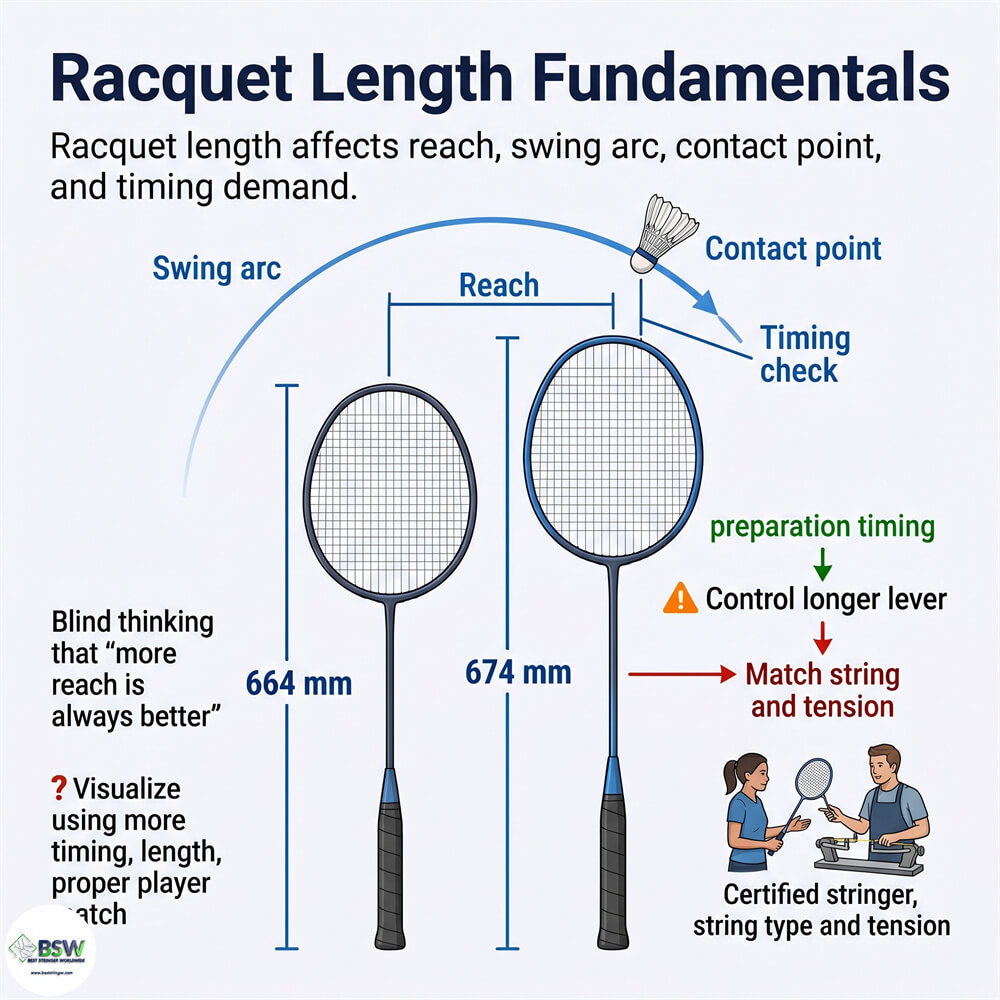
Badminton racquet length is a core equipment parameter that affects your reach, swing arc, and contact point. In this guide, you will learn how standard and longer racquets behave, and why a longer frame can support steeper smashes under the right conditions, alongside other key specs like balance point, swing weight, and string tension.
A standard badminton racquet is commonly around 664 mm, while a longer badminton racquet is commonly around 674 mm. The extra length is usually added mainly through the shaft, although some models may also feature a slightly longer frame design. Mastering this concept is crucial, as “more reach” does not automatically mean “better for every player.”
Here is a simple decision flow:
Step 1: Assess your preparation timing and footwork honestly.
Step 2: Understand that a higher contact point from a longer racquet is only beneficial if you can control the longer lever.
Step 3: Consult a certified stringer to select a racquet, string type, and tension that matches your handling ability and sweet spot accuracy.
1.2 Standard vs Longer Racquets
Racquet Specs Explained: Reach and Contact Point
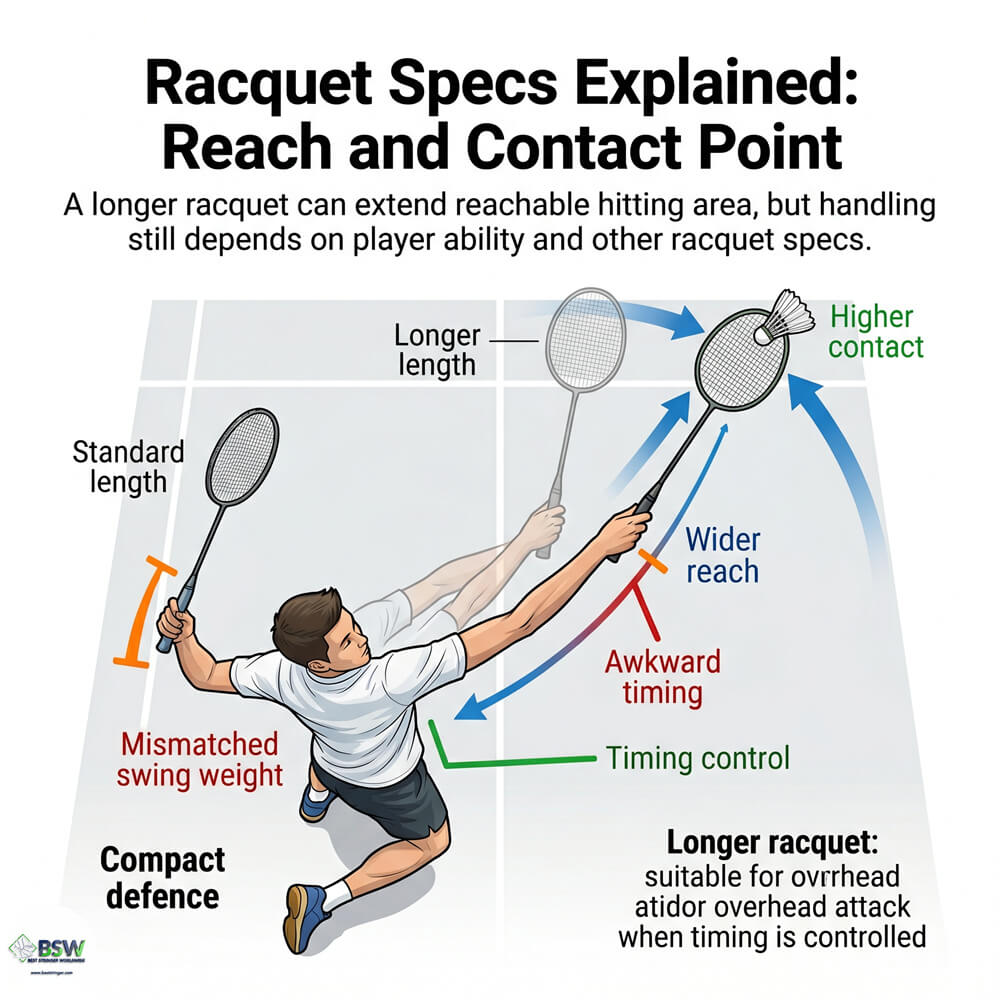
The main benefit of an extended badminton racquet is that it can raise and extend the contact point. A standard racquet length around 664 mm offers a familiar, highly manageable swing feel, making it suitable for a wide variety of badminton players. A longer racquet, extending closer to 674 mm, provides extra reach, expanding your overall reachable hitting and receiving area.
These dimensions are common reference values that can vary slightly by brand, but the physical principles remain the same. A longer racquet creates a larger swing arc. This may help increase racquet head speed when the player controls the timing well, giving an edge during overhead attacking shots. However, if the racquet feels awkward, it is often because the total weight, balance point, or swing weight is not correctly matched to the player’s ability.
Badminton racquet length analysis requires looking at the whole picture. For singles players wanting more leverage, a longer frame is often preferred. But for players prioritising fast, compact reaction speed in defense, a standard-length racquet can feel much more forgiving to manoeuvre.
1.3 Smash Angle & Attacking Potential
Understanding Smash Angle and Swing Speed
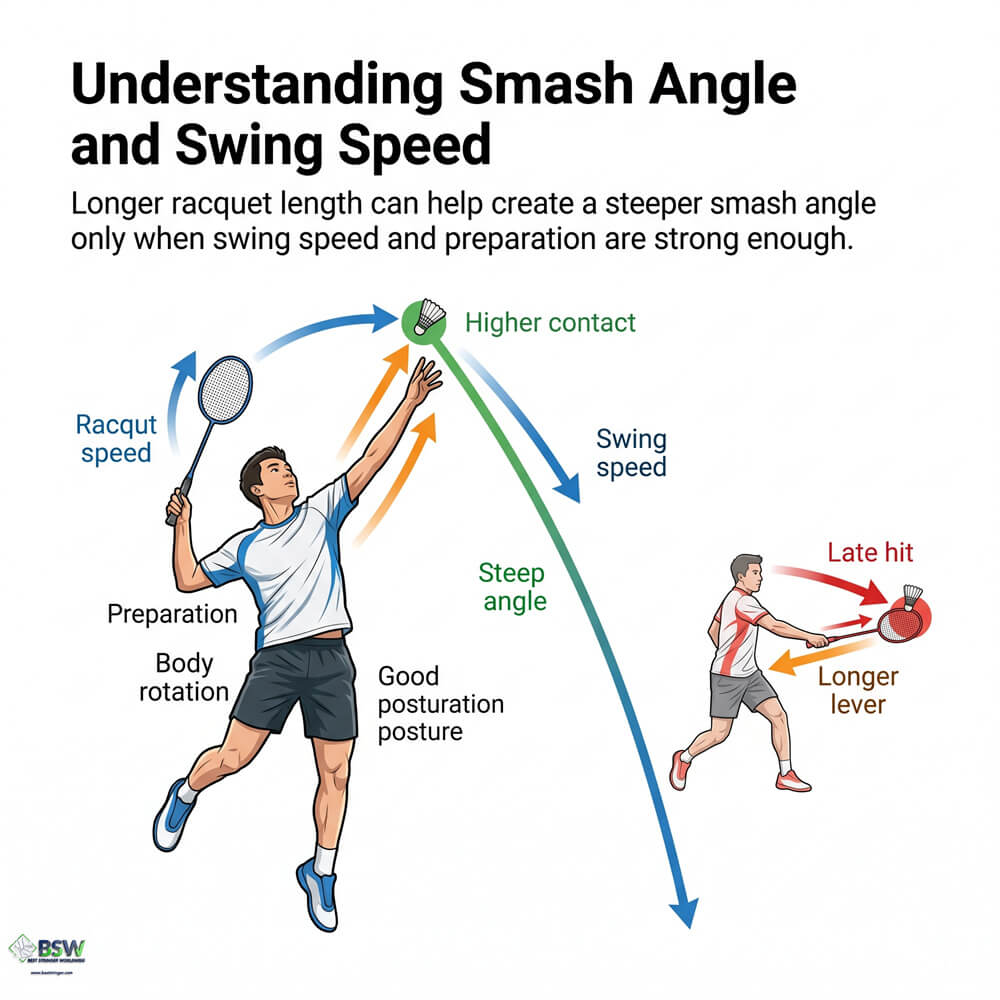
While a longer badminton racquet provides extra reach, its ability to improve your attacking potential depends entirely on how well you handle it. Because the racquet shaft length is extended, a player with good timing can raise their contact point, allowing them to take the shuttle slightly earlier or higher. This higher contact point is what helps create a steeper downward smash angle.
However, a longer lever also takes more effort to accelerate. If a player lacks solid preparation technique, using a 674 mm longer racquet can result in late hits, reducing actual smash power. The extended leverage requires proper body rotation, grip change, and a fluid swing path to maximize racquet head speed effectively.
This is why longer racquets are highly favored by players who like smashes and aggressive rear-court attacks, provided they have the strength and timing to harness the longer swing arc without compromising their consistency.
1.4 Handling & Swing Weight Basics
Badminton Racquet Manoeuvrability Analysis
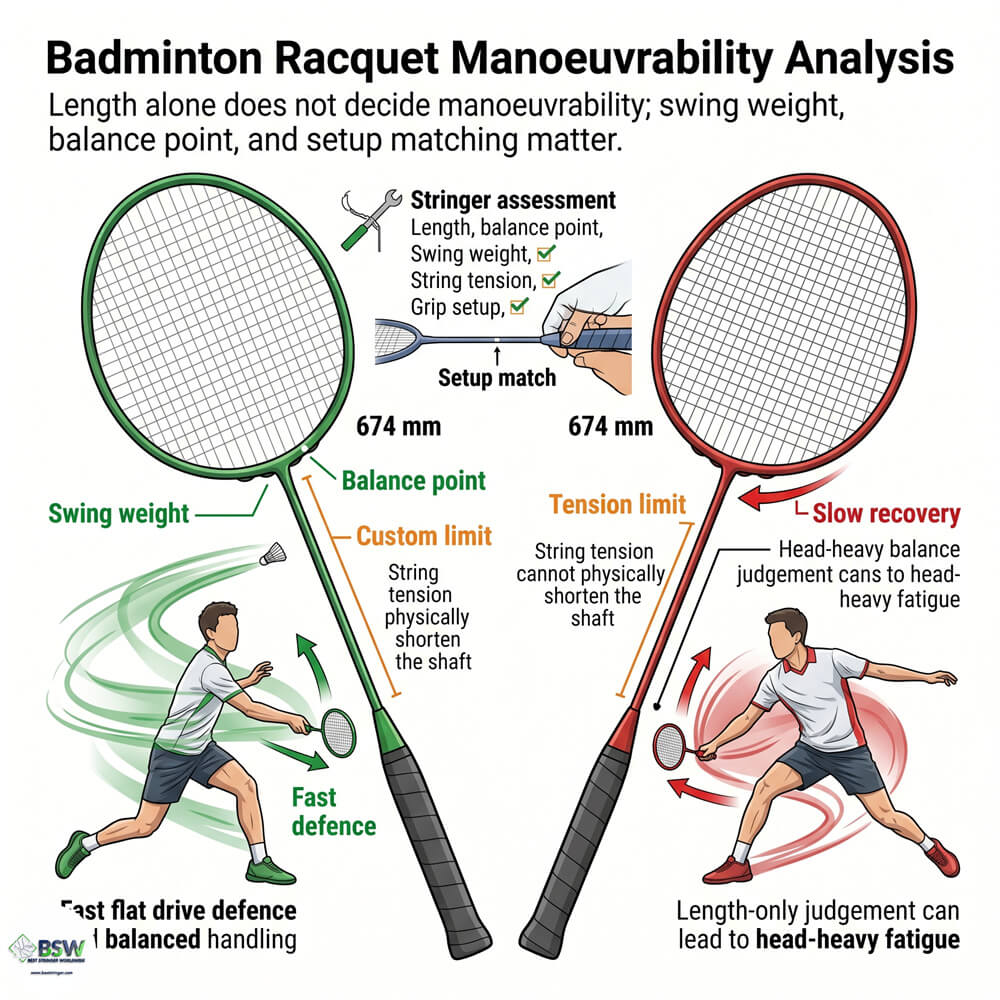
There is a common misconception that longer badminton racquets are always slower or less flexible. Actual manoeuvrability depends heavily on swing weight, not just physical length. Understanding this synergy is essential for proper equipment selection:
What is Swing Weight? Swing weight is how heavy the racquet feels while in motion. If a 674 mm longer racquet is engineered to have the exact same swing weight as a 664 mm standard racquet, its practical handling and flexibility in the air can feel remarkably similar.
The Fast Defence Factor. Length alone does not ruin your defence. However, if a longer racquet also features a head-heavy balance point, it will take more effort to recover quickly during fast, flat defensive exchanges. This is where a shorter-feeling setup might excel.
The Customization Limit. Grip setup, strings, and string tension can change the feel of the racquet bed and handle balance, but they cannot magically shorten a racquet shaft. A professional badminton stringer will assess the frame’s length and swing weight before suggesting tension adjustments to optimize your timing.
1.5 Common Racquet Length Mistakes
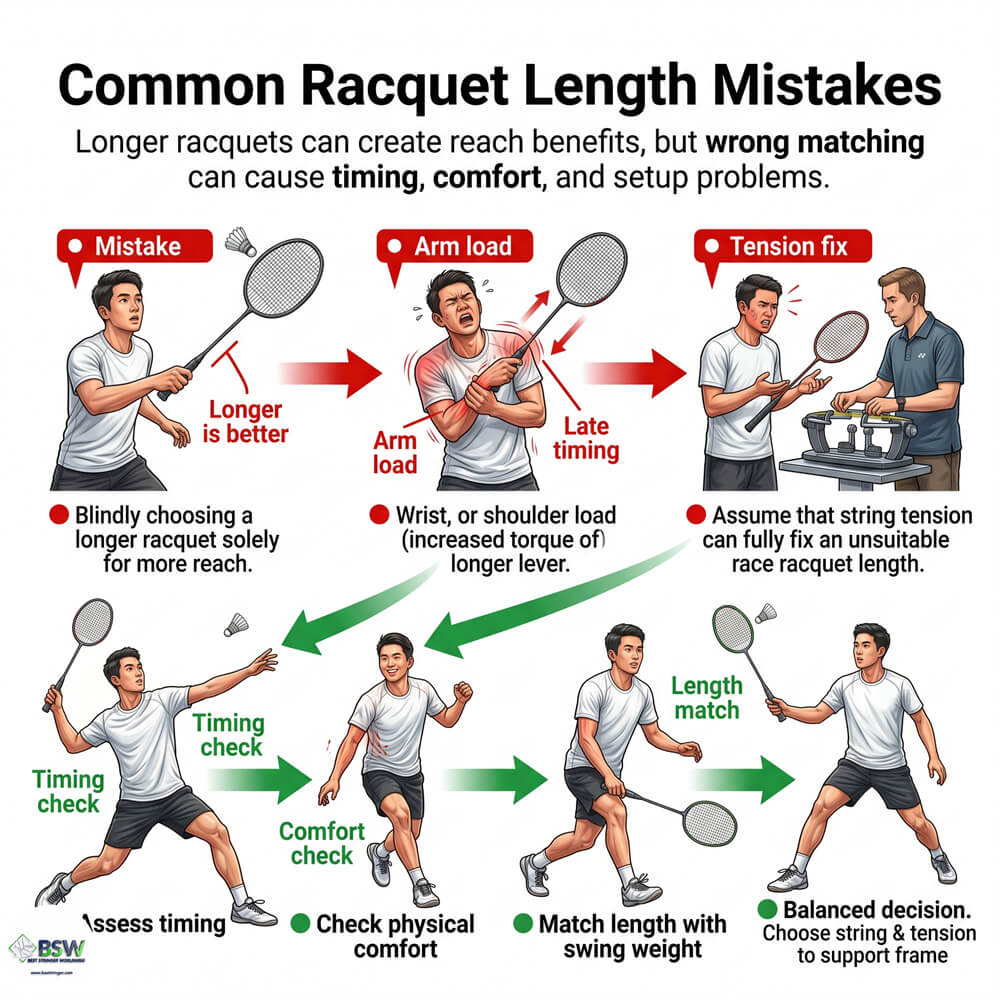
Common Racquet Length Mistakes
Mistake 1: Assuming Longer is Automatically Better.
While an extended badminton racquet LH (length) offers a higher contact point and wider receiving area, recommending it blindly to every player guarantees sluggish swings for those who are not prepared for the extended swing arc.
Mistake 2: Ignoring Physical Load.
Because a longer racquet acts as a longer lever, it may place more demand on the wrist, forearm, elbow, and shoulder. Players experiencing discomfort should reassess their racquet length, balance point, and string tension setup carefully instead of forcing an uncomfortable swing.
Mistake 3: Thinking Tension Can Fix Length.
A common error is believing that adjusting string tension can fully fix a racquet length that does not suit the player’s timing. String and tension advice should complement the racquet’s length, not fight against an unsuitable swing weight.
1.6 Length Selection Framework
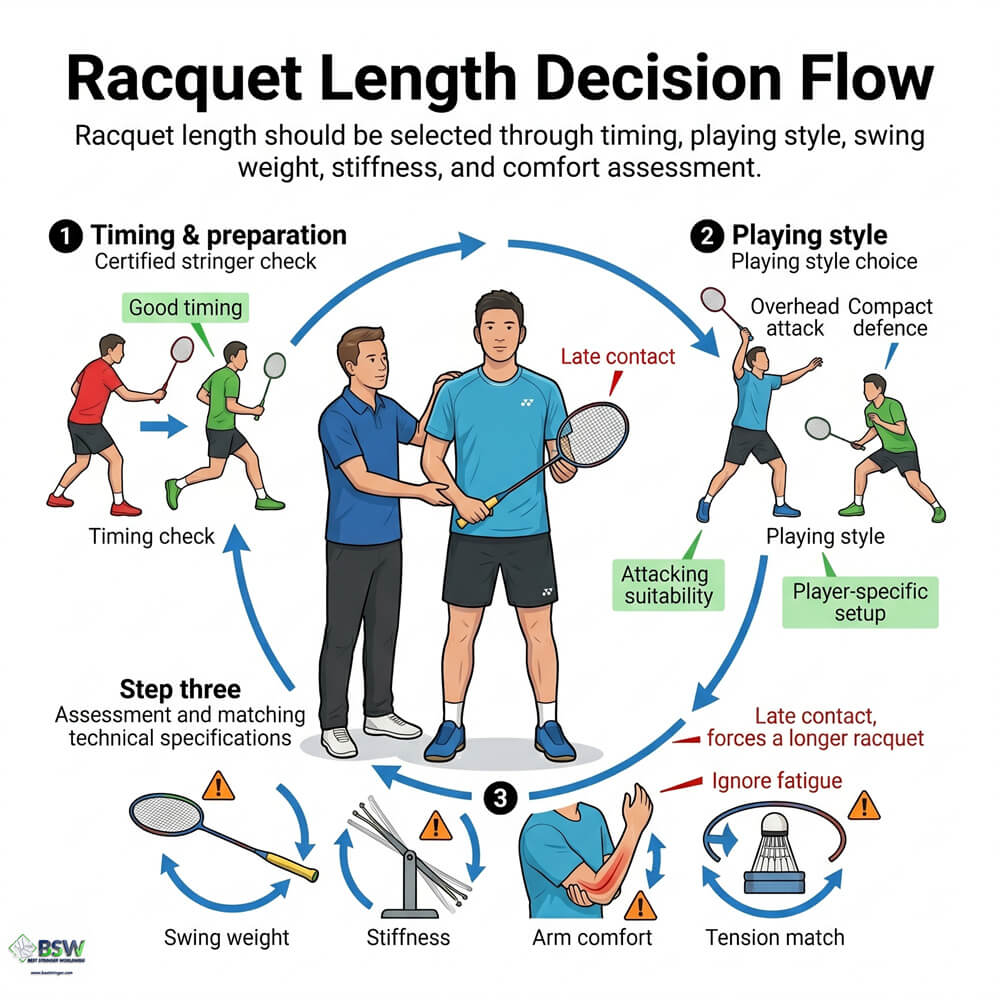
Player-Focused Racquet Length Decision Flow
Choosing to switch from a standard badminton racquet to a longer frame requires a practical approach. Use this simple framework to match racquet length to your real capability:
Step 1: Check Your Timing and Preparation. A longer racquet demands good anticipation. Beginners or developing players who frequently hit the shuttle late may find a standard 664 mm racquet much easier to manoeuvre and control until their footwork improves.
Step 2: Identify Your Playing Style. Determine if you are an attacking player who wants the steeper smash angles provided by a higher contact point, or a fast-paced defensive player who might prefer the compact handling of a shorter-feeling setup.
Step 3: Consult for Swing Weight Match. Seek player consultation with a certified stringer. They can help you assess whether the new longer racquet has a suitable swing weight and stiffness, ensuring the extra reach does not come at the cost of severe arm fatigue.
1.7 Stringer Education
The Value of Stringer Certification
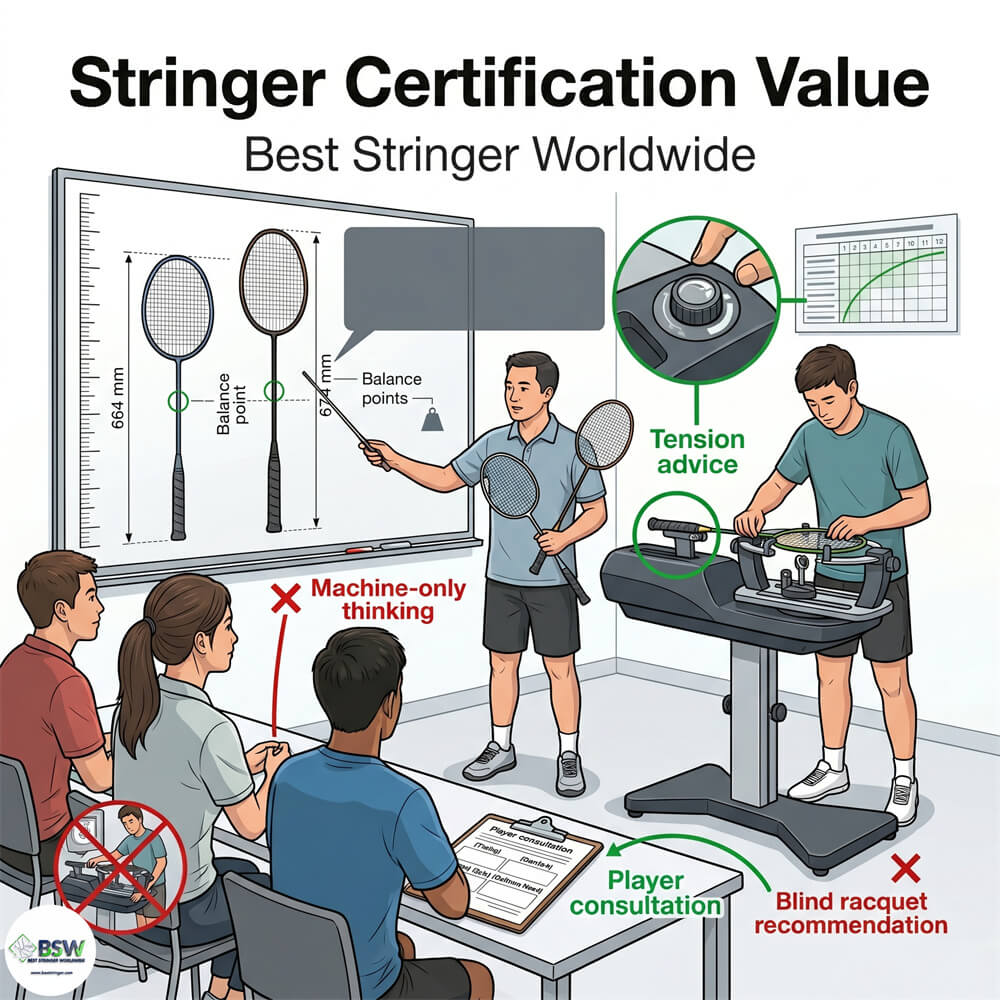
Proper equipment knowledge, including badminton racquet length guide fundamentals, is a core part of a professional badminton stringing course. A certified stringer understands that a longer racquet length impacts how a player times their swing, which in turn influences the string setup needed.
At Best Stringer Worldwide, we teach that stringer certification goes far beyond just pulling tension. A good badminton stringer performs a racquet assessment to see if an extended 674 mm frame or a standard 664 mm frame suits the player’s physical comfort, before giving specific string and tension advice.
By prioritizing player consultation, our badminton stringing education ensures that stringers support players with honest, technically accurate recommendations. This stops players from blindly chasing “more power” with unsuitable racquets and focuses instead on enhancing genuine playing feel and reach.
Equipment Selection Quick FAQ
Quick, definition-first answers to common questions about badminton racquet length and stringing basics.
What is the standard length of a badminton racquet?
A standard badminton racquet length is commonly around 664 mm. This length offers a familiar and manageable swing feel, providing a balanced mix of reach, control, and manoeuvrability that is suitable for many badminton players.
What is a longer badminton racquet?
An extended or longer badminton racquet is commonly around 674 mm. The extra length is usually added mainly through the racquet shaft, although some models may feature a slightly longer frame, extending your overall contact point.
Does a longer racquet help smash angle?
Yes, it can. Because a longer badminton racquet allows you to reach a higher contact point, it can help create a steeper downward smash angle, provided your timing, footwork, and swing speed are properly coordinated.
Does length give more power?
A longer racquet does not automatically give everyone more power. It increases the swing arc and potential racquet head speed, which improves attacking power only if the player has the physical strength and technique to control the longer lever.
Is a longer racquet less manoeuvrable?
Not necessarily. Actual handling depends heavily on swing weight. If a 674 mm longer racquet has the same swing weight as a standard racquet, its manoeuvrability and flexibility can feel quite similar during fast exchanges.
Should beginners use longer racquets?
Often, beginners are still developing their timing and footwork. A standard-length racquet (around 664 mm) may be more forgiving for late hits. A longer racquet might demand better preparation and place more stress on the wrist and forearm.
Can stringing change racquet length?
No, a badminton stringer cannot physically alter the shaft or frame length through stringing. However, a stringer can adjust the string tension and grip setup to alter the total feel, compensating slightly if the racquet feels too demanding.
What should a stringer know?
A certified stringer must know that racquet length interacts with swing weight and player style. They should consult the player regarding their comfort, smash frequency, and timing before providing specific string and tension advice.
Why is stringer certification relevant?
A comprehensive badminton stringing course teaches racquet performance analysis, not just knot tying. Stringer certification ensures professionals can explain why a 674 mm longer racquet acts differently, avoiding blind recommendations.
The Physics of Length: How Racquet Length Affects Contact Point
Proven Specifications
Our stringing approach is based on verified equipment parameters. We prioritize analyzing racquet length, matching swing weight, protecting player arm safety, and improving playstyle efficiency over purely guessing string tensions.
| Racquet Feature | Standard Racquet (approx. 664 mm) | Longer Racquet (approx. 674 mm) |
|---|---|---|
| Reach & Contact Point | Balanced reach, offering a familiar and manageable contact point for most players. | Higher and more extended contact point, creating a wider receiving area. |
| Smash Angle & Attack | Practical for all-round play, producing a standard smash trajectory. | Supports steeper smash angles and stronger attacking potential when timing is good. |
| Defence & Handling | Easier timing for many players, providing compact handling for fast reaction. | Can feel similar if swing weight matches, but may reduce fast defence if swing weight is unsuitable. |
| Physical Demand | Generally places a standard, manageable demand on the arm and wrist. | May demand more wrist, forearm, and shoulder control due to increased lever length. |
| Player Suitability | Suitable for all-rounders, developing players, and those prioritizing fast defence. | Great for attacking players and smash-focused styles with solid swing control. |
| Stringer Advice | Easier to recommend for general play; standard tension rules apply effectively. | Needs careful consultation regarding swing weight, tension, and player comfort. |
Master Your Equipment with Best Stringer Worldwide
Ready to upgrade your knowledge? Best Stringer Worldwide offers professional stringing consultation to teach you how badminton racquet length, swing weight, and string setups affect reach and power safely. We serve badminton players worldwide especially in Singapore, Hong Kong, Malaysia, Indonesia, UK, France and Europe. Contact a certified stringer to find the perfect racquet length and tension advice for your game.