1.1 Equipment Fundamentals
What Is Badminton Racquet Balance Point?
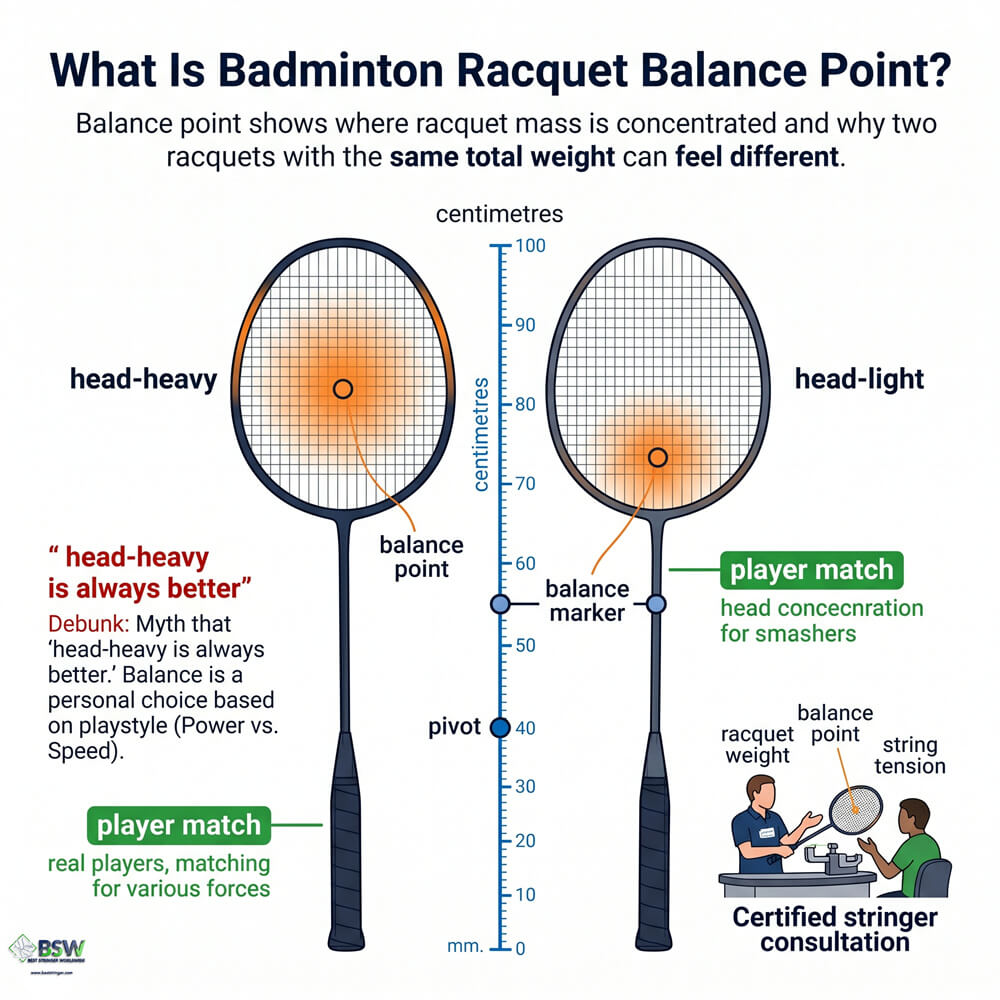
Badminton racquet balance point explains why two racquets with the exact same total weight can feel very different in the hand. If the balance point is closer to the racquet head, the racquet is called head-heavy. If the balance point is closer to the handle, it is called head-light.
Balance point is one of the most important badminton racquet performance parameters, usually measured from the bottom of the handle upward in centimetres or millimetres. In short, balance point dictates where the mass is concentrated, directly affecting your leverage, swing speed, and impact stability. Mastering this concept is crucial, as a head-heavy frame is not automatically “better for every player.”
Here is a simple decision flow: Step 1: Assess your defensive needs and hitting power honestly. Step 2: Understand that ‘more power’ from a head-heavy frame only works if you can swing it without fatigue. Step 3: Consult a certified stringer to ensure your total racquet weight, balance point, and string tension work together seamlessly.
1.2 Racket Weight & Balance
Racquet Specs Explained: Head-Heavy vs Head-Light
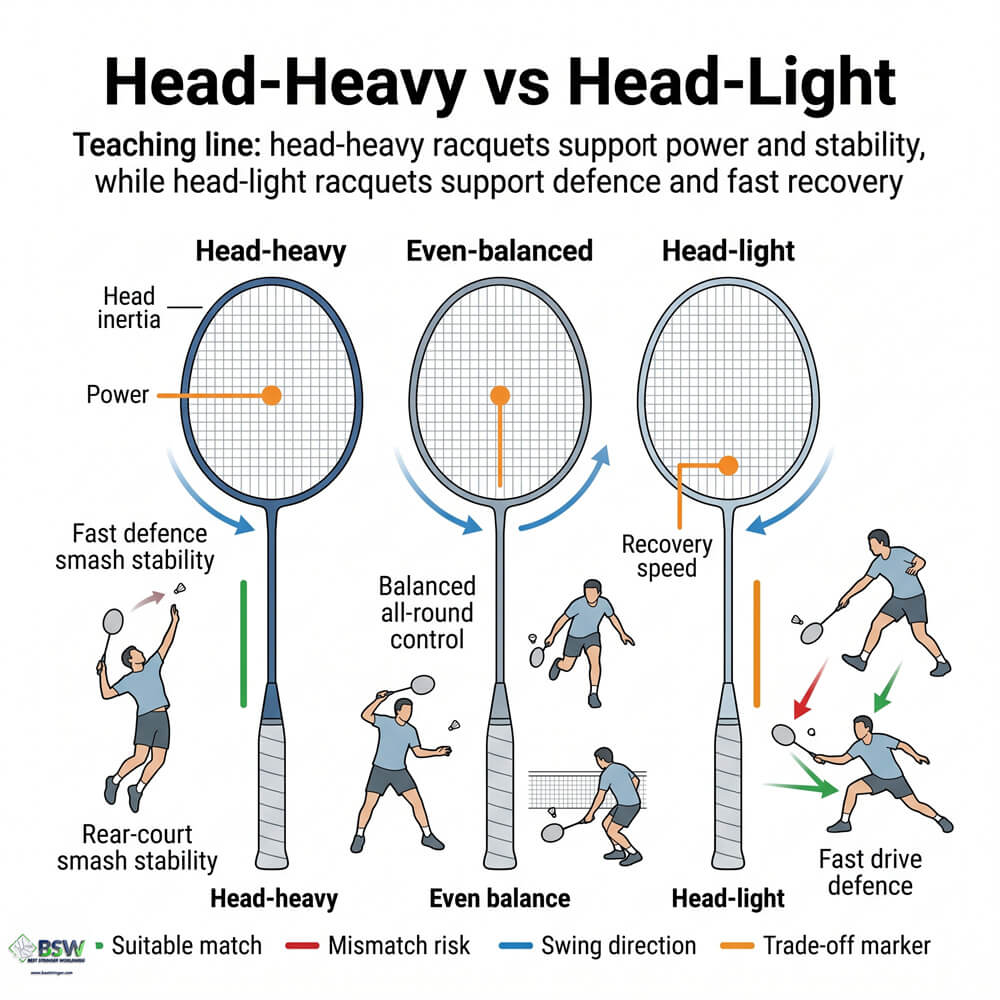
A head-heavy badminton racquet has more mass felt toward the racquet head, giving a longer leverage feel and higher head inertia. This can create stronger hitting power, heavier clears, and better impact stability when the player has enough strength and timing. However, the racquet may feel slower and less flexible in fast handling.
A head-light badminton racquet feels easier to move because more mass is felt closer to the hand. It can support faster defence, quicker drive exchanges, faster racquet recovery, and higher shot frequency. However, it may produce less hitting power and transmit more vibration or feel less stable during hard hits, especially if the racquet is too light.
An even-balanced racquet sits between these two extremes, providing a practical mix of power and control. A badminton player needs the right balance point for their style. Doubles players needing rapid recovery speed generally prefer a head-light or even-balanced frame. Attacking singles players often benefit from the extra momentum of a head-heavy racquet.
1.3 Stiffness & Head Size
The Hammer Analogy: Leverage and Inertia
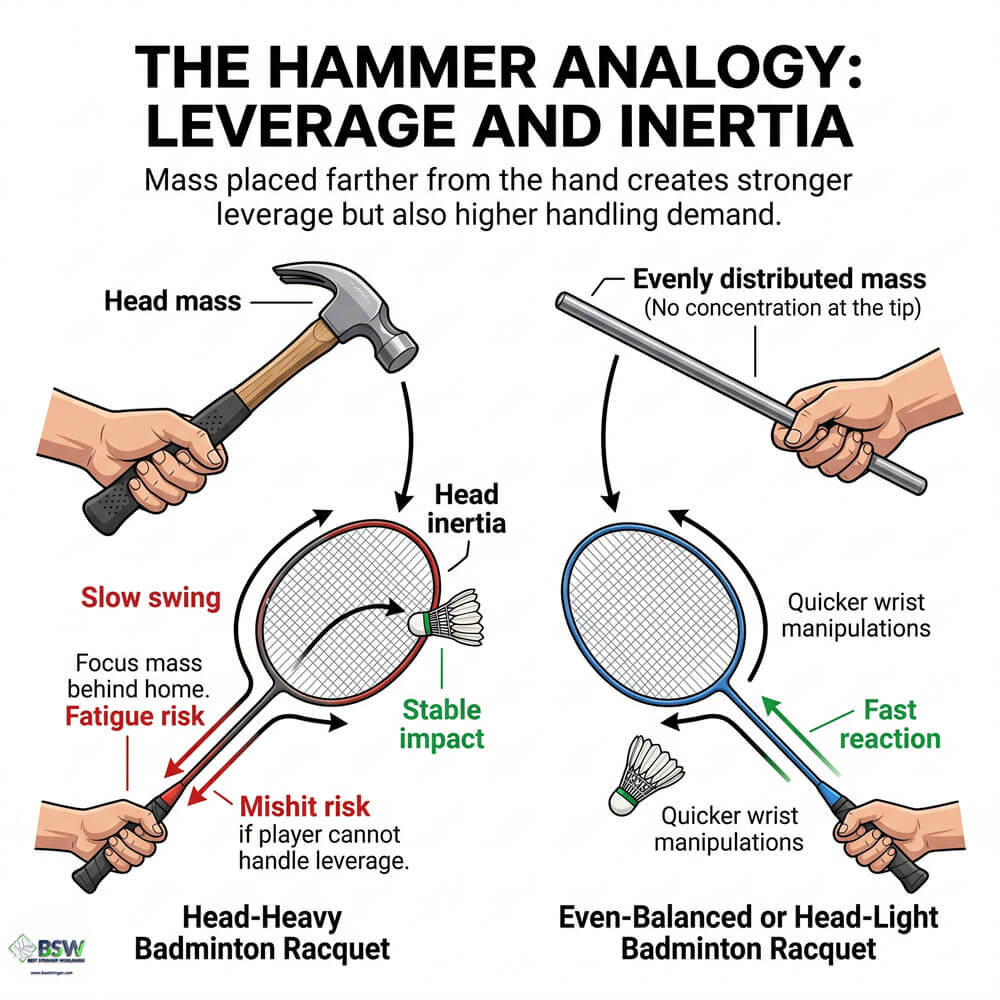
The hammer example helps explain this idea clearly. A head-heavy hammer can drive a nail into a wall much more easily because the mass is concentrated at the head, providing tremendous leverage. Conversely, a straight iron rod of the exact same total weight may be easier to swing quickly, but it is far less effective at driving force into the nail.
Badminton racquet design often uses a similar principle. A head-heavy racquet acts like the hammer, focusing mass behind the shuttlecock for a devastating smash and highly stable rear-court shots. An even-balanced or head-light racquet acts more like the well-distributed rod, allowing for incredibly fast wrist adjustments and defensive reactions.
However, badminton racquet selection must balance power, speed, stability, and player ability. If a head-heavy racquet causes you to swing too slowly or mishit the sweet spot due to fatigue, that extra leverage becomes a severe disadvantage.
1.4 Gauge & Tension Basics
Why Racquet Weight and Balance Work Together
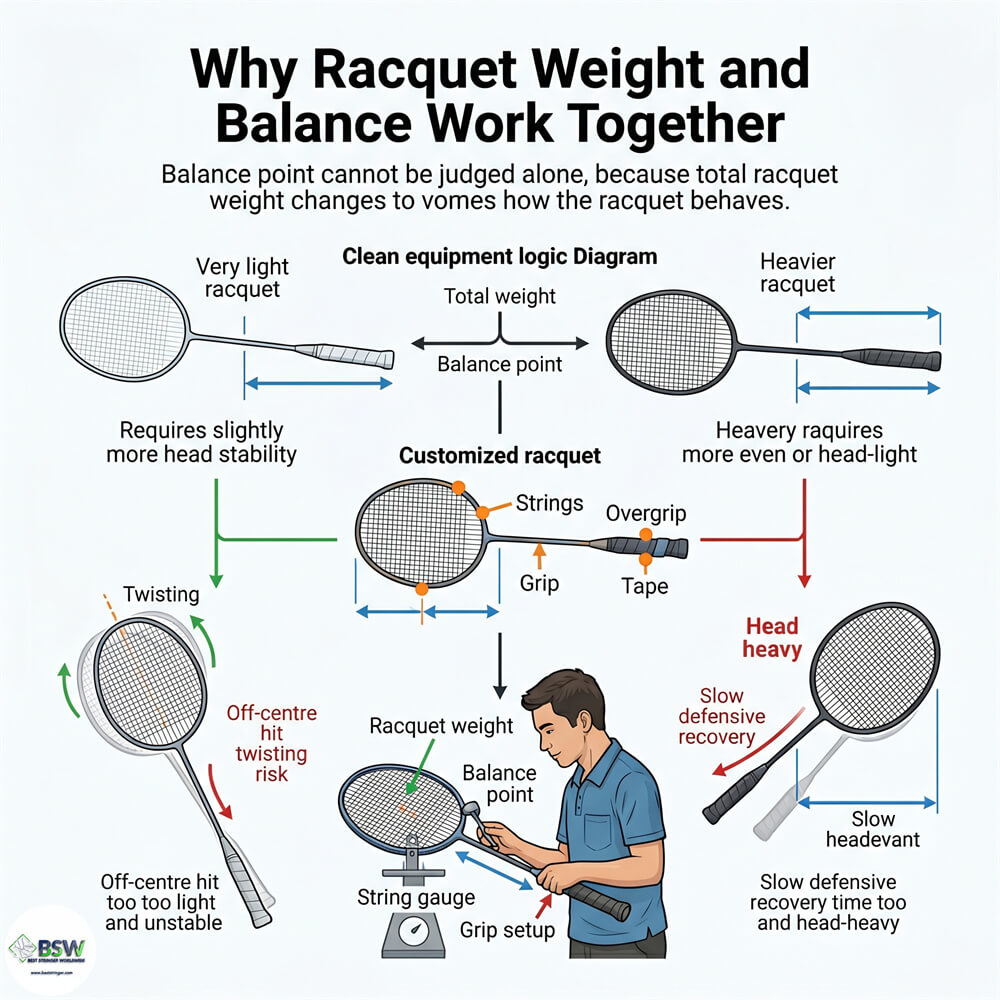
Balance point and racquet weight are closely related and must be analysed together. A badminton player should not simply ask for a head-heavy racquet without considering total racquet weight:
The Light Racquet Rule. A very light racquet may need a slightly heavier head to provide stability and power. Otherwise, it will lack impact stability and twist severely during off-centre hits.
The Heavy Racquet Rule. A heavier total racquet weight generally requires a more even-balanced or head-light design so it does not feel too slow or clumsy during defensive exchanges.
Strings and Grip Customization. Balance point is affected by strings, grip, overgrip, and tape. A heavy grip will shift the balance point toward the handle. While string tension and string type can change stringbed feel, they cannot fully replace correct racquet balance selection. A certified stringer should always consider these factors.
1.5 Common Mistakes
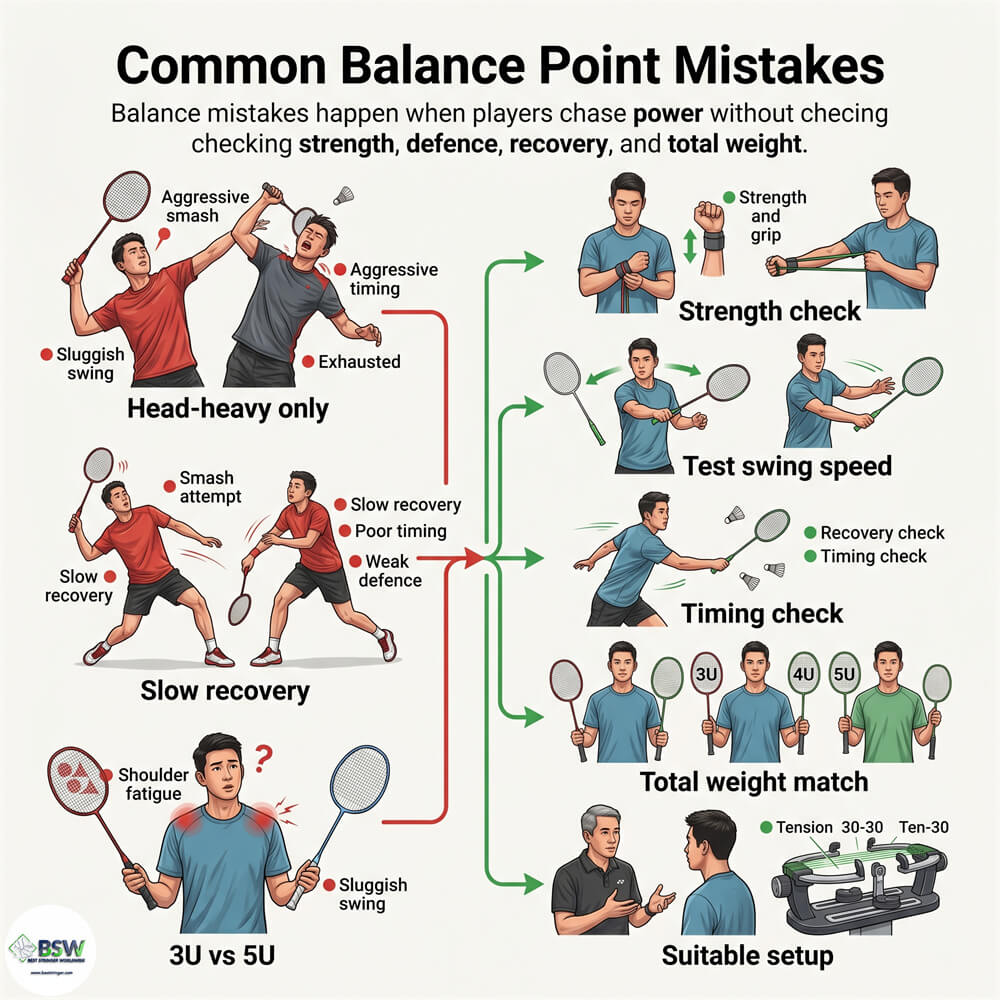
Common Balance Point Mistakes
Mistake 1: Assuming Head-Heavy is Always Better for Attack.
While a head-heavy badminton racquet helps generate smash power, choosing one without the necessary physical strength guarantees sluggish swings, poor timing, and potential shoulder fatigue.
Mistake 2: Ignoring Defence and Recovery Speed.
Chasing pure power with an extreme head-heavy setup often means sacrificing defensive maneuverability. If you cannot react to fast flat drives in doubles, the extra leverage is completely useless.
Mistake 3: Judging Balance Without Total Weight.
Asking a badminton stringer for a “head-heavy” racquet without specifying the total weight is a common error. A head-heavy 3U racquet plays completely differently than a head-heavy 5U racquet. Both specs must be analysed together.
1.6 Selection Framework
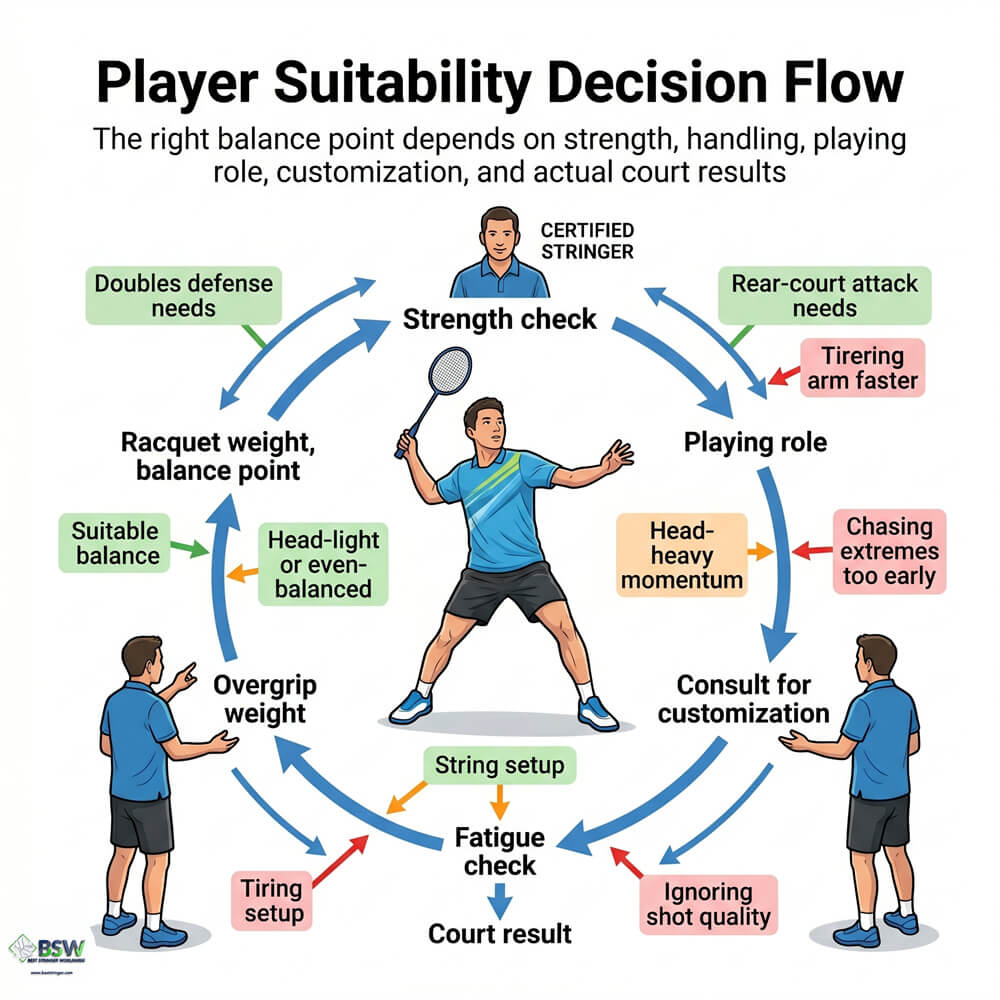
Player Suitability Decision Flow
A step-by-step decision flow is crucial for finding the perfect even-balanced, head-light, or head-heavy badminton racquet. Use this simple framework before upgrading your equipment:
Step 1: Check Your Strength and Handling. A head-heavy racquet will only yield more power if you can maintain your standard swing speed. Developing players should often start with an even-balanced racquet to develop proper stroke mechanics before moving to extremes.
Step 2: Identify Your Playing Role. Determine if you are primarily a fast-paced doubles player requiring defensive speed and a head-light feel, or a rear-court attacking player needing the stability and momentum of a head-heavy frame.
Step 3: Consult for Customization. Test whether adjusting your overgrip or string setup changes your racquet’s balance point favorably. Always test if a new balance genuinely improves your shot quality, or if it only tires your arm faster.
1.7 Further Learning
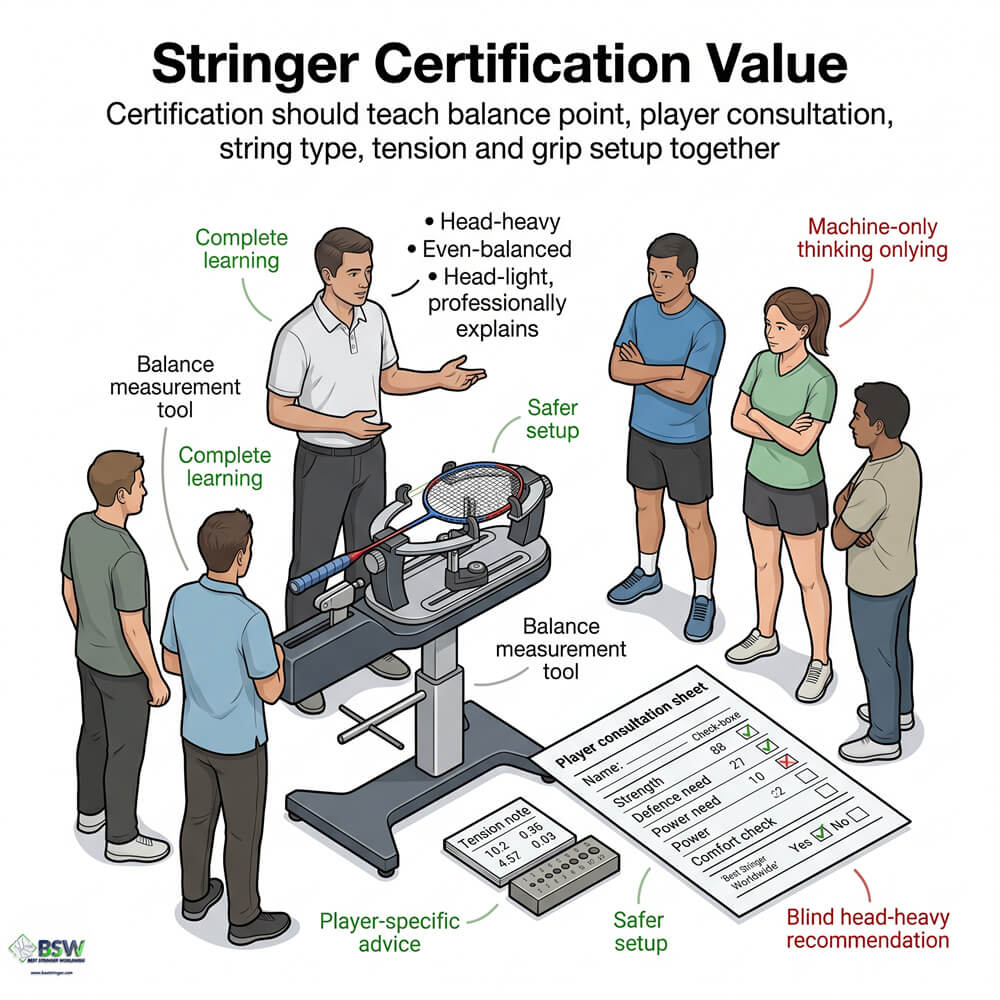
The Value of Stringer Certification
Proper equipment education is a core part of a professional badminton stringing course and good stringer certification standards. A certified stringer understands that recommending a head-heavy racquet blindly without considering a player’s real ability is a disservice.
At Best Stringer Worldwide, we know that racquet balance point directly influences the advice given to players. The magic is not just in buying a head-light or head-heavy racquet, but in the precise consultation logic a badminton stringer uses to match string type, tension, and grip setup to your frame’s balance.
By prioritizing accurate equipment knowledge, our stringer certification ensures that every setup perfectly balances power, stability, and defensive speed. You eliminate guesswork, avoid fatigue from unsuitable balance points, and focus purely on improving your game.
Racquet Balance Point Quick FAQ
Quick, definition-first answers to common questions about badminton racquet balance and equipment matching.
Is a head-heavy racquet always better for power?
Generally, yes, if you have the right technique. A head-heavy badminton racquet helps produce greater smash power because its higher head inertia transfers more momentum. However, this only applies if the player has the strength to swing it without slowing down.
What is badminton racquet balance point?
Badminton racquet balance point explains where the racquet’s weight is felt along its length. It is measured from the bottom of the handle upward. It determines whether a racquet feels head-heavy, head-light, or even-balanced.
Is a head-light racquet better for defence?
Yes, for most players. A head-light badminton racquet places more mass closer to the hand, making the racquet significantly easier and faster to maneuver. This allows for rapid defensive blocks and high shot frequency in doubles exchanges.
How does balance point affect smash power?
Smash power relies on leverage and head inertia. A head-heavy balance carries more mass through the swing arc, allowing advanced players to transfer maximum force into the shuttle for heavier, steeper smashes, provided their timing is solid.
Why do two racquets with the same weight feel different?
Because of balance point distribution. Even if two racquets weigh exactly 85g, one might have its weight concentrated at the head (feeling heavy and powerful), while the other has its weight near the handle (feeling light and fast).
How do strings and grip affect balance point?
Adding a heavy overgrip adds mass to the bottom, making the racquet more head-light. Adding thick strings or protection tape adds mass to the top, making it more head-heavy. These customizations change the final playing feel.
Can a badminton stringer change racquet balance?
Yes, to a small degree. A professional badminton stringer can adjust string gauge, add lead tape, or alter the grip setup to slightly shift the balance point, helping the player achieve a more comfortable head-heavy or head-light response.
What should a certified stringer know about balance?
A certified stringer must know that string tension cannot fully fix a wrong balance point. They should evaluate the player’s physical strength and defensive needs before recommending string and tension advice for head-heavy or head-light racquets.
Why learn balance point in a stringing course?
For those wanting to master equipment consultation, a comprehensive badminton stringing course teaches how racquet weight, head inertia, and string synergy work together, eliminating guesswork from equipment selection.
The Physics of Leverage: Why Balance Point Matters
Physics of Leverage: Racquet Balance
Discover how mass distribution dictates swing inertia, defensive speed, and power potential based on the Hammer vs. Rod analogy.
Even Balance
Provides a practical mix of power and control. Mass is evenly distributed, making it an excellent starting point for developing stroke mechanics before moving to extremes.
Proven Specifications
Our stringing approach is based on verified equipment parameters used by top professionals. We prioritize arm safety, proper balance point evaluation, and playstyle efficiency over pure tension hype.
| Balance/Spec Feature | Head-Heavy Focus | Head-Light Focus |
|---|---|---|
| Balance Point / Power | Balance closer to the head. Generates higher head inertia for stronger smashes and clears. | Balance closer to the handle. Faster swing speed, better maneuverability and rapid defence. |
| Stability & Vibration | More stable rear-court impact feel; resists twisting on hard hits. | May transmit more vibration or feel less solid if the contact is off-centre. |
| Total Weight Relationship | A light total weight often needs a head-heavy balance to maintain power. | A heavy total weight often needs a head-light balance to avoid feeling too slow. |
| Handling & Fatigue | More physically demanding in continuous fast drive exchanges. | Easier continuous swinging, highly effective for fast doubles exchanges. |
| String & Grip Effect | Adding a heavy overgrip will shift weight down and make it feel less head-heavy. | Adding heavy protection tape to the top will make it feel less head-light. |
| Stringer Advice | Recommended for players who have enough strength and timing to control the swing. | Recommended for defensive, control-focused, or rapid-reaction players. |
Master Your Equipment with Best Stringer Worldwide
Ready to upgrade your knowledge? Best Stringer Worldwide offers professional stringing consultation to teach you how racquet balance point and string setups affect performance safely. We serve badminton players worldwide especially in Singapore, Hong Kong, Malaysia, Indonesia, UK, France and Europe. Contact a certified stringer to find the perfect tension, gauge, and balance for your game.