1.1 String Softness Fundamentals
What Are the Fundamentals of Badminton String Comfort?
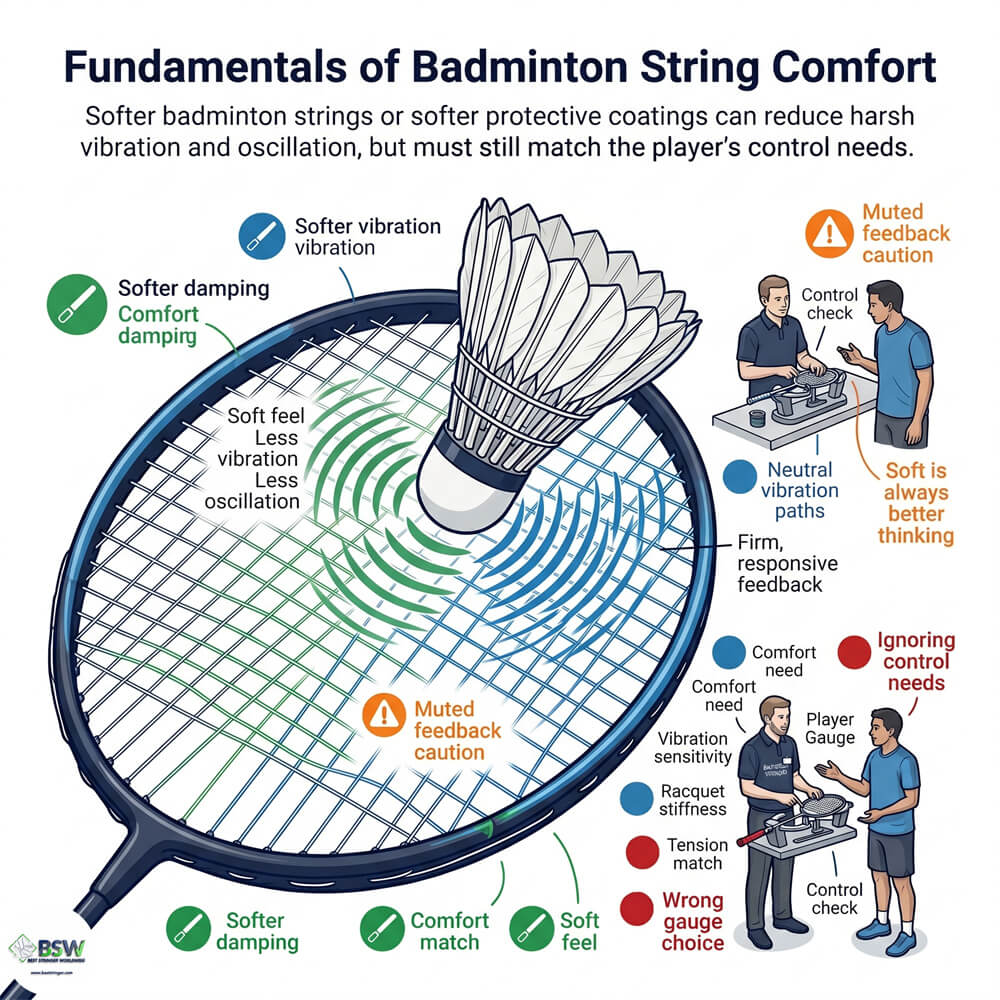
Equipment fundamentals refer to how specific string characteristics, particularly softness, combine to enhance your comfort on the court. In this guide, you will learn why softer badminton strings, or strings with a softer protective coating, produce less vibration and less oscillation when all other conditions are equal.
In short, stringbed damping dictates your impact shock, while coating softness influences your initial hitting feel. Mastering these concepts is crucial for any badminton player aiming for comfort, as a “softer feel” does not automatically mean “better for every player.”
Here is a simple decision flow:
Step 1: Assess your comfort needs and vibration sensitivity honestly.
Step 2: Understand that ‘more comfort’ from a softer string may slightly mute your sharp feedback.
Step 3: Consult a certified stringer to select a string tension and gauge that perfectly matches your racquet’s stiffness and your control requirements.
1.2 Vibration & Oscillation
Stringbed Dynamics: Vibration and Oscillation
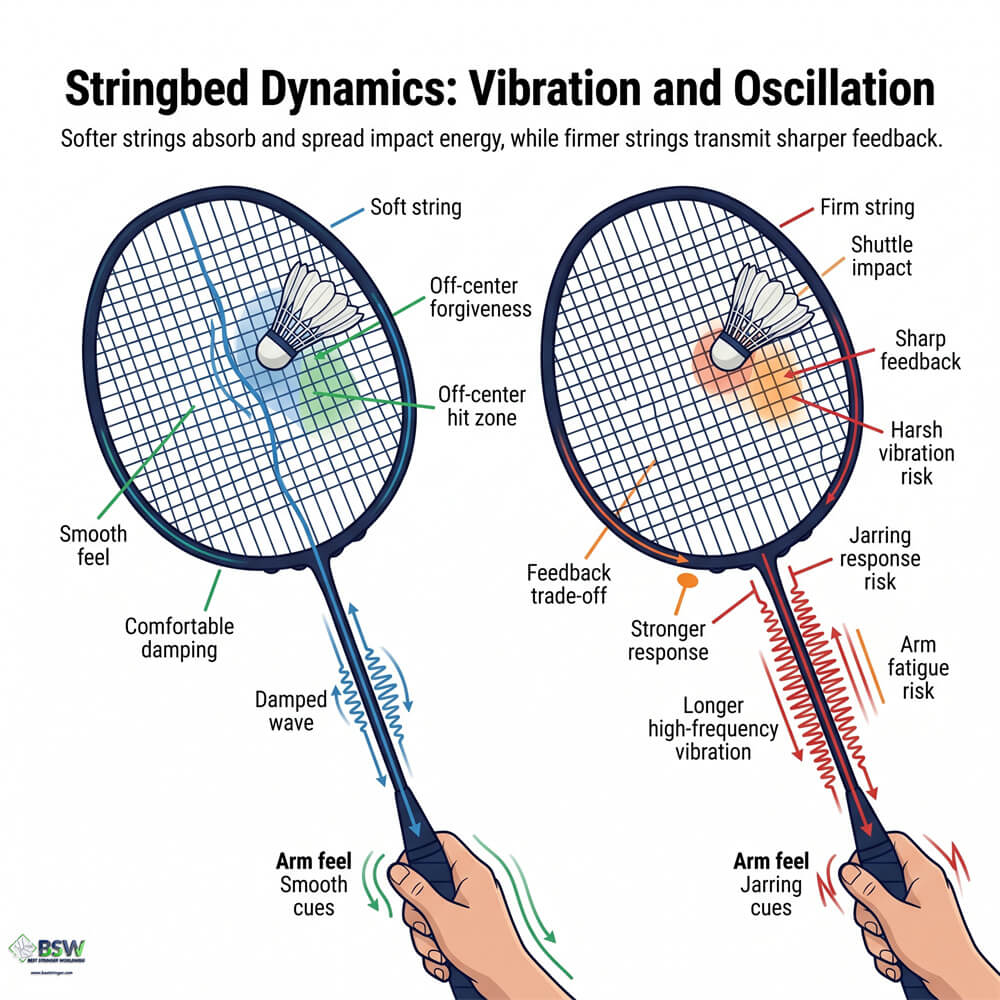
The golden rule of stringbed physics is that softer badminton strings usually produce less harsh vibration under similar conditions. This happens because a softer string material effectively absorbs and spreads impact energy upon shuttle contact. A soft badminton string provides this extra stringbed damping, offering a smoother feel, improved comfort, and a less jarring response on off-center hits.
Adjusting string softness drastically alters how the stringbed behaves after impact. Firmer strings transmit more direct energy, which advanced players use for sharp feedback and precise control, but this naturally increases the harsh, high-frequency vibration sent to the player’s arm. Softer strings sacrifice a bit of that crisp response to reduce uncomfortable oscillation and protect the arm during repetitive swings.
A badminton player needs the right balance between comfort, feedback, and control. For casual players or those sensitive to impact shock, a softer string is generally preferred. Competitive players with clean timing often benefit from the direct touch and sharp response of firmer strings, provided their technique can handle the stiffer feedback.
1.3 String Coating & Impact Feel
Understanding Softer Protective Coatings and Impact Shock
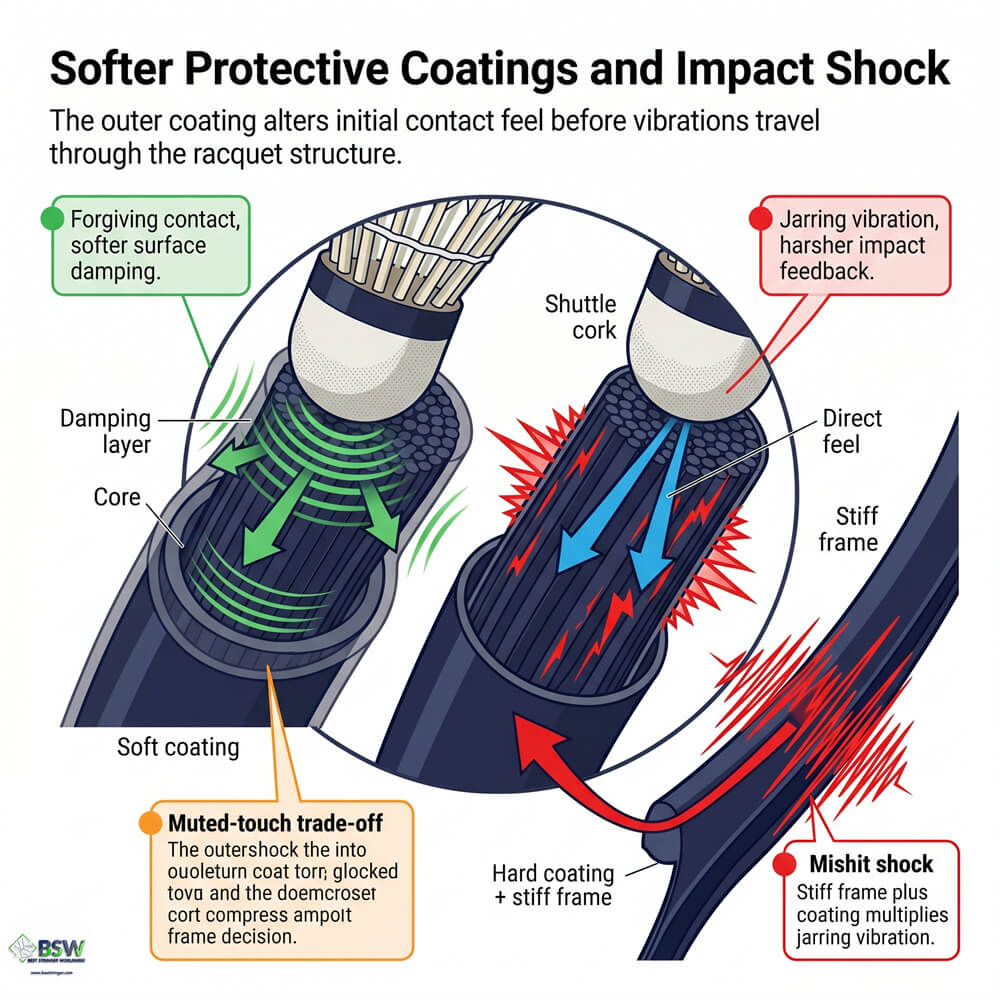
While the string core provides the baseline repulsion, the outer layer dictates the immediate contact feel. A softer protective coating provides an initial layer of damping, muting the harshness of impact before the vibration travels down the shaft. This creates a highly comfortable, forgiving stringbed, but it may feel slightly dull or muted to players who rely on highly responsive touch shots.
A harder coating is much less forgiving. It acts like a direct channel, transmitting the shuttle’s impact clearly and sharply to the player’s hand. This is excellent for precise net control, but if your technique is slightly off, a firm string setup punishes you with jarring vibration and potential arm fatigue.
The condition of the racquet frame also plays a massive role in forgiveness. A very stiff racquet frame paired with a hard string coating will multiply the vibration felt on mishits, making a softer badminton string a smart adjustment to regain a smoother, more comfortable response.
1.4 Tension & Gauge Synergy
Badminton String Tension and Comfort Synergy
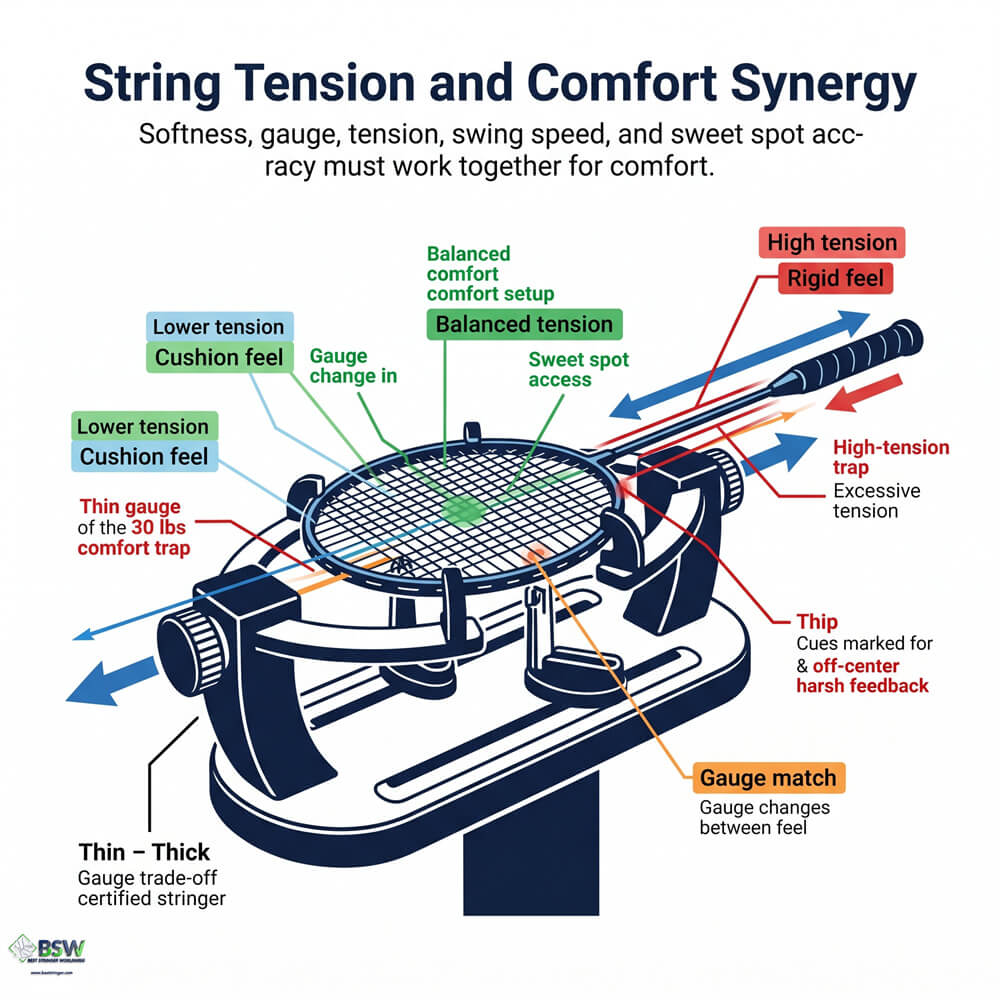
Softer badminton strings require the correct string gauge and tension to truly unlock their comfort potential. Understanding this synergy is essential for players seeking vibration reduction without losing performance:
What is String Gauge? Gauge refers to the thickness of the string. Thin strings (e.g., 0.61mm – 0.65mm) offer incredible repulsion and bite, but they can feel sharper on impact. Thicker strings generally offer a more stable, muted feel that complements a softer string bed.
Tension Basics. Tension dictates how tightly the strings are pulled, directly affecting oscillation. High tension creates a stiff stringbed that transmits more vibration and requires precise sweet spot contact. Lower tension acts like a cushion, significantly boosting comfort and damping impact shock.
The High-Tension Trap. If you select a softer string for comfort but string it at an extremely high tension without the required swing speed, the stringbed will still feel like a rigid board, transmitting harsh feedback. A professional badminton stringer will always balance string softness with an appropriate tension.
1.5 Common Mistakes
Common String Softness Mistakes
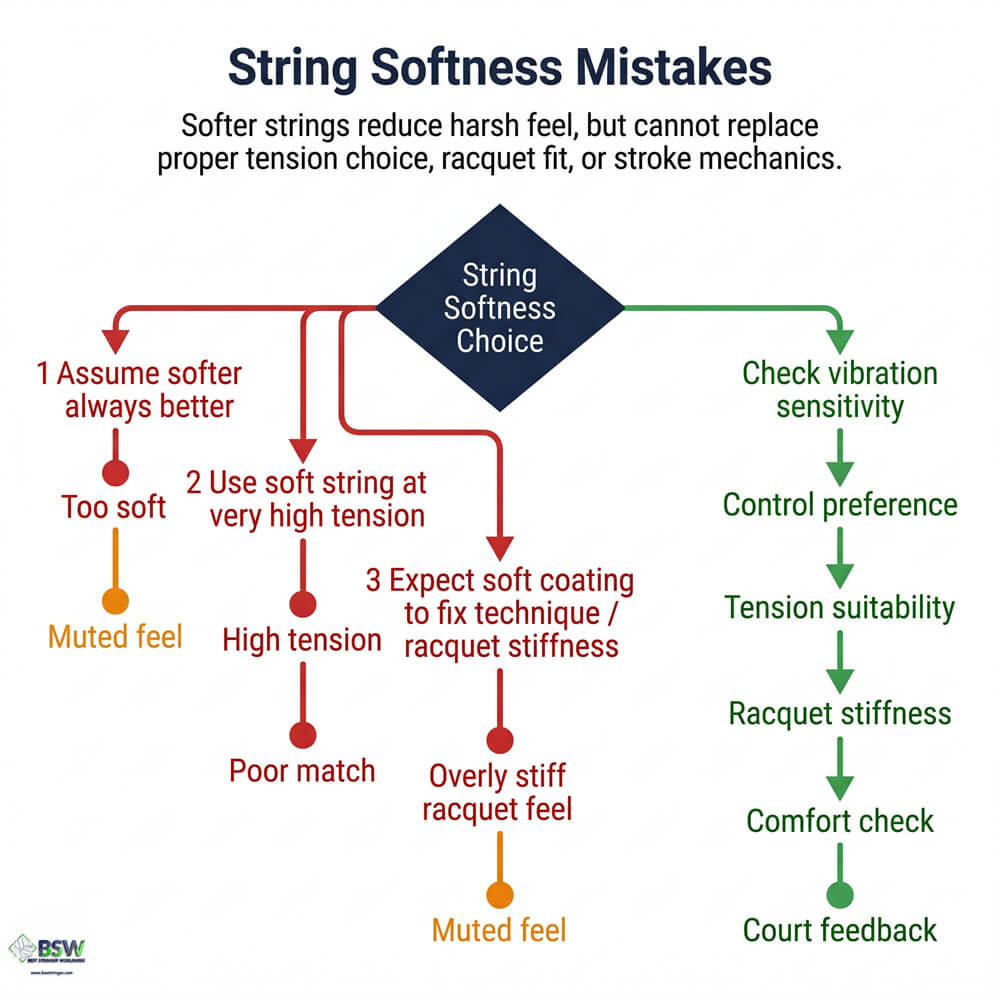
Mistake 1: Assuming Softer is Always Better.
While softer badminton strings reduce uncomfortable oscillation, choosing a highly soft setup when you possess advanced stroke mechanics can result in a dull, muted feel. Clean hitters often prefer firmer strings for a crisper response and direct control.
Mistake 2: Ignoring the Impact of Tension.
Chasing pure comfort with a soft string but pulling it to 30 lbs ruins the damping effect. If the tension is too high for your swing speed, even the softest coating will transmit harsh, uncomfortable feedback on off-center hits.
Mistake 3: Believing Soft Strings Fix Technique.
Switching to a softer protective coating provides relief from harsh impact shock, but it is not a magical cure for chronic injuries caused by poor stroke mechanics or using an overly stiff racquet shaft.
1.6 Comfort Assessment
Player-Focused Comfort Assessment Flow
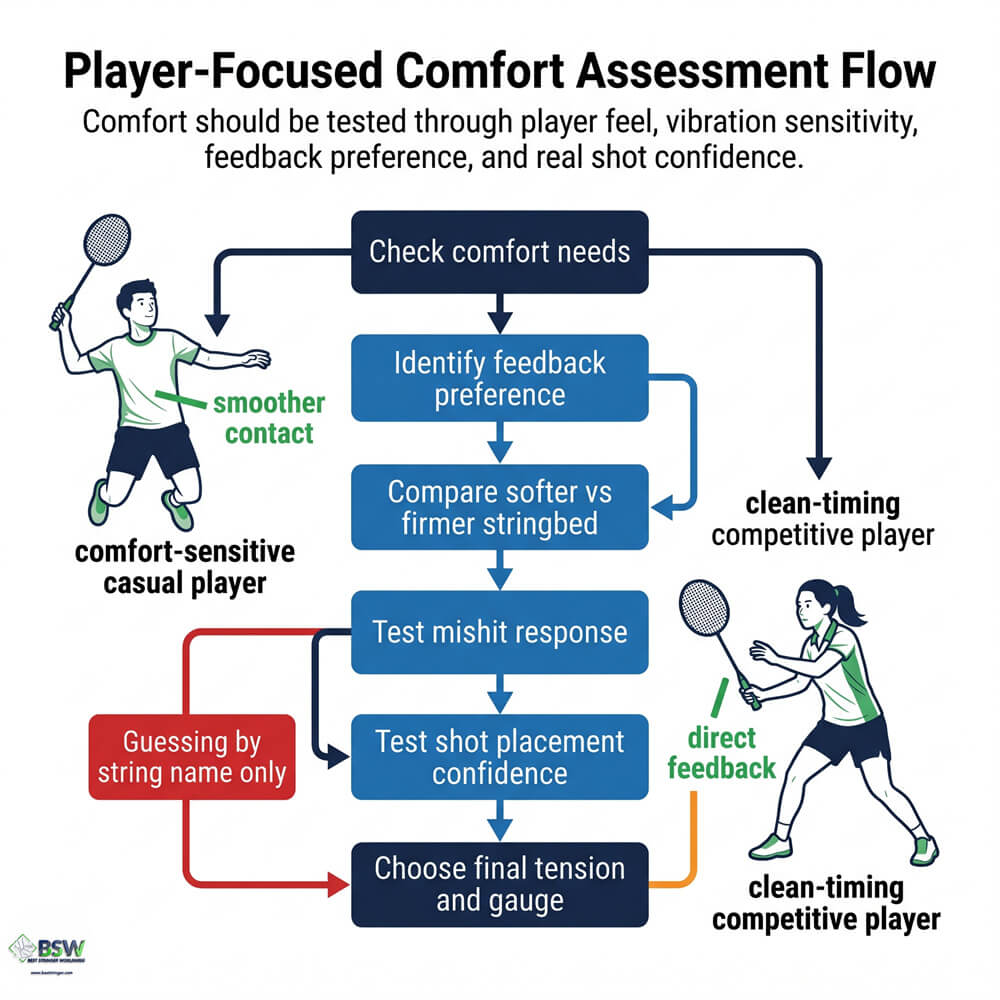
A step-by-step decision flow is crucial for balancing comfort and feedback safely. Use this simple framework before changing your badminton string setup:
Step 1: Check Your Comfort Needs. If you frequently experience sharp vibration or arm discomfort, transitioning to a softer badminton string with a smoother protective coating can provide immediate relief by dampening harsh impact shock.
Step 2: Identify Your Feedback Preference. Determine if you need the direct, sharp control response of a firmer stringbed for precise net play, or if you prefer a forgiving, muted feel that masks the harshness of slight mishits.
Step 3: Test for Actual Feel. Try a balanced or softer string and test whether it genuinely improves your playing comfort and smooths out stringbed oscillation, or if it feels too dull and reduces your confidence in shot placement.
1.7 Further Learning
The Value of Stringer Certification
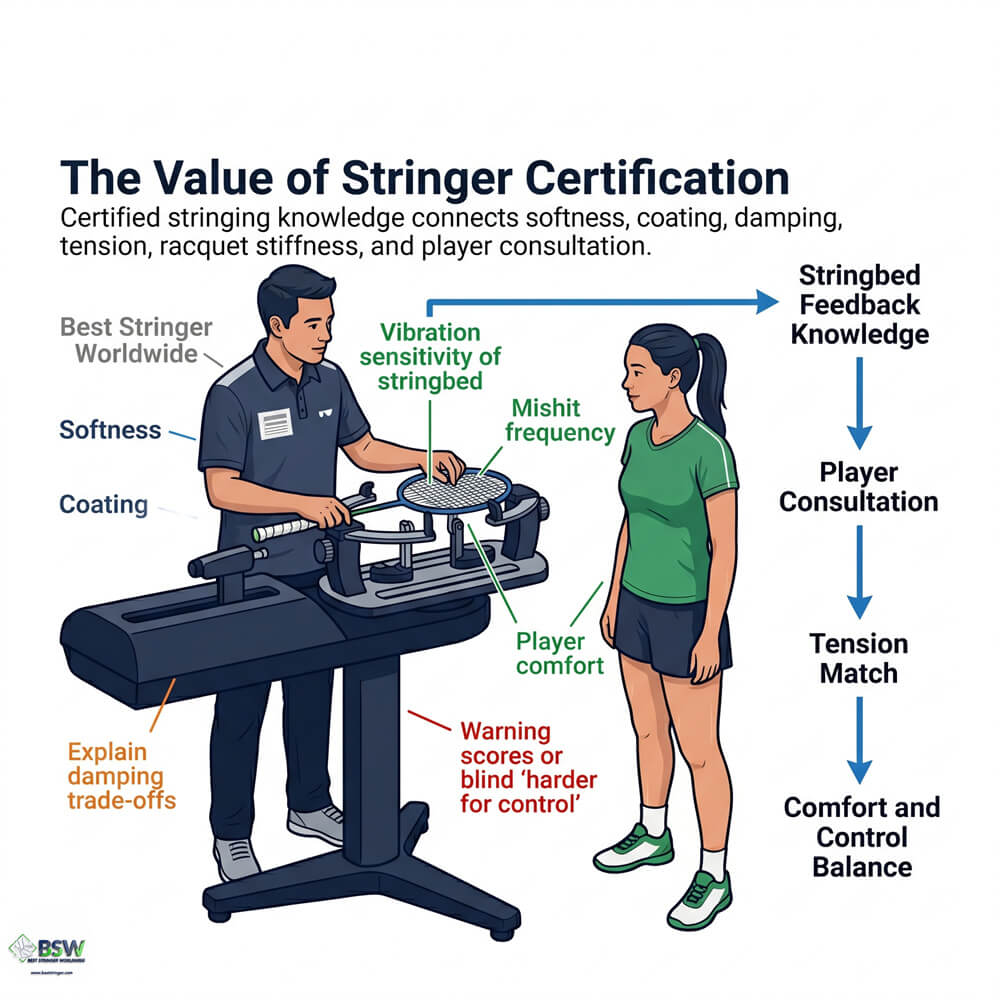
Proper string comfort education is a core part of a professional badminton stringing course and good stringer certification standards. A certified stringer understands that recommending “harder strings for more control” blindly without assessing a player’s vibration sensitivity is a disservice.
At Best Stringer Worldwide, we know that string softness directly influences the advice given to players. The value is not just in stocking softer strings, but in the precise consultation logic a badminton stringer uses to match coating softness and tension to your racquet’s stiffness.
By prioritizing accurate stringbed feedback knowledge, our stringer certification ensures that every setup perfectly balances comfort, vibration reduction, and control. You eliminate guesswork, find relief from harsh impact shock, and focus purely on enjoying your game.
String Softness & Comfort Quick FAQ
Quick, direct answers to common questions about badminton string softness, vibration, and comfort.
Do softer badminton strings reduce vibration?
Yes. When all other conditions are equal, softer badminton strings or strings with softer protective coatings usually produce less vibration. They absorb and dampen harsh impact shock more effectively than firmer, stiffer strings.
Why do softer strings feel more comfortable?
Softer strings create a smoother shuttle contact because they reduce the high-frequency energy transmitted down the racquet shaft. This stringbed damping makes the impact feel less jarring and significantly more forgiving on the arm.
Is a softer string better for all players?
No, softer strings are not automatically better for everyone. While they reduce uncomfortable vibration, they can also feel less crisp. Advanced badminton players often prefer firmer strings for sharper feedback and precise, direct control.
What does stringbed oscillation mean?
Stringbed oscillation is the visible or felt back-and-forth movement of the strings and racquet frame immediately after shuttle impact. Softer badminton strings help reduce the harsh, uncomfortable feeling of this rapid movement.
Does a softer coating reduce harsh impact?
Yes. A softer protective coating on the outside of the string acts as an initial damping layer. This softer surface reduces the sharp shock of contact, making the stringbed feel much more forgiving, especially on mishits.
How does tension affect vibration feel?
String tension dramatically changes the final feel. Even a soft badminton string will feel harsh and vibrate uncomfortably if strung at a tension that is simply too high for the player’s swing speed and sweet spot accuracy.
What should a stringer consider first?
A professional badminton stringer should always evaluate the player’s current tension, vibration sensitivity, mishit frequency, and control needs before making changes. They should never blindly recommend firm strings without checking comfort needs.
Why is string comfort knowledge important?
Understanding how string softness, coating, and damping interact allows stringers to solve real player issues, such as arm fatigue. This knowledge is a fundamental part of proper racquet stringing and recognized stringer certification.
Are stringing courses necessary?
Yes. A proper badminton stringing course teaches the science behind stringbed response, impact shock, and tension interaction. This allows a certified stringer to give highly accurate string and tension advice rather than simply guessing.
The Physics of Comfort: Why String Softness Matters
Awaiting Selection
Select a string setup above and run the high-speed simulation to analyze how coating softness and tension determine the shock waves reaching the player’s arm.
Proven Comfort Solutions
Our stringing approach is based on verified comfort parameters used by certified stringers. We prioritize arm safety, proper vibration assessment, and honest player consultation over pure high-tension hype.
| String Attribute | Softer / Balanced Setup | Firmer Setup |
|---|---|---|
| Impact Vibration | Softer String / Coating: Absorbs and dampens harsh impact shock efficiently. | Firmer String: Transmits more direct, sharp vibration to the arm. |
| Stringbed Oscillation | Softer String: Reduces uncomfortable back-and-forth movement after contact. | Firmer String: Can oscillate sharply if tension is too high for the player. |
| Overall Comfort | Comfort-Oriented: Smoother feel, great for players sensitive to hard impacts. | Control-Oriented: Less forgiving, requires solid technique for comfort. |
| Feedback & Response | Muted Feel: Gentle feedback, slightly less crisp on placement shots. | Crisp Feel: Direct and sharp response for highly precise control. |
| Mishit Forgiveness | High: Gentle on the arm even when striking outside the sweet spot. | Low: Punishes off-center hits with a jarring, uncomfortable sensation. |
| Player Suitability | Casuals & Comfort Seekers: Excellent for beginners, juniors, and sensitive arms. | Clean Hitters: Advanced players wanting direct power and crisp touch. |
Master String Comfort with Best Stringer Worldwide
Ready to upgrade your knowledge? Best Stringer Worldwide offers professional stringing consultation to teach you how string softness, coating, and tension affect vibration and oscillation safely. We serve badminton players worldwide especially in Singapore, Hong Kong, Malaysia, Indonesia, UK, France and Europe. Contact a certified stringer to find the perfect tension and gauge for your comfort needs.