1.1 String Elasticity Fundamentals
What Are the Fundamentals of String Elasticity & Power?
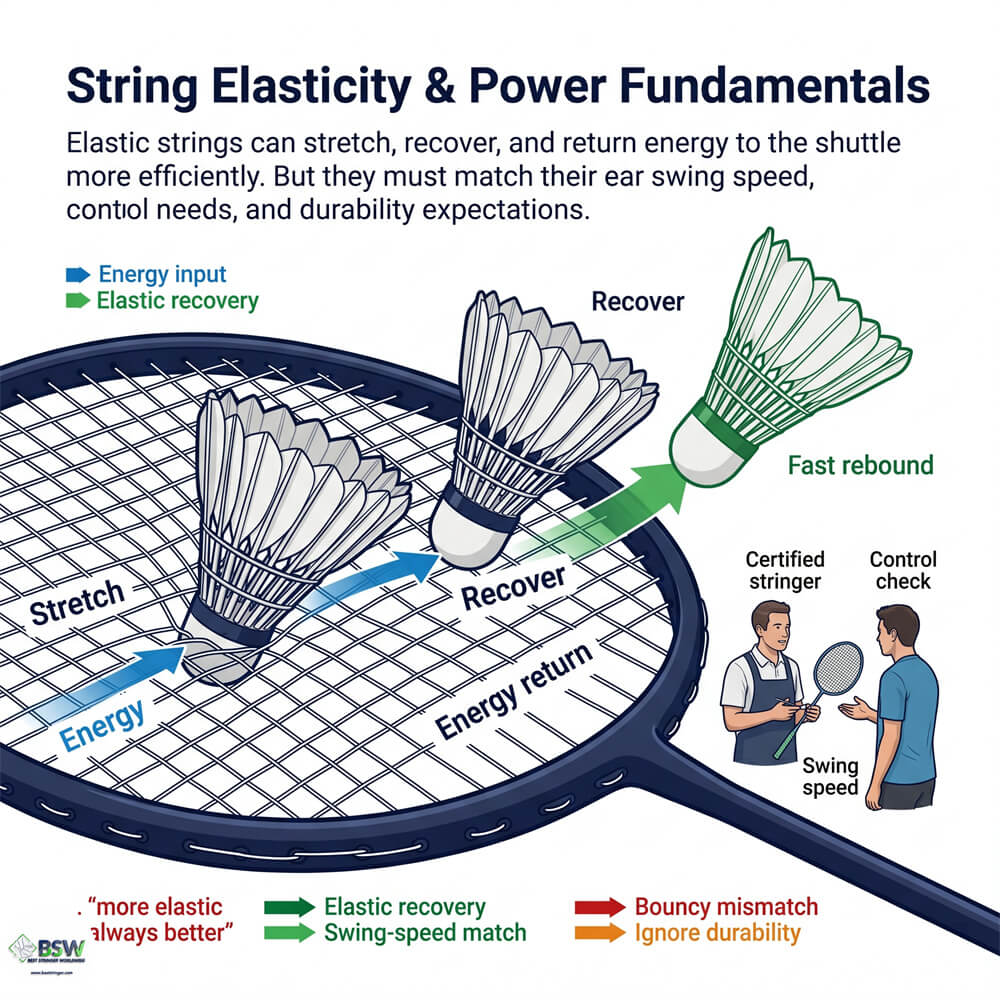
String elasticity fundamentals refer to how your badminton string behaves upon impact. In this guide, you will learn a core concept: when all other conditions are equal, badminton strings with better elasticity can usually produce more power because they stretch, recover, and return energy to the shuttle more efficiently.
In short, high string elasticity dictates a livelier stringbed response and faster shuttle rebound. Mastering this concept is crucial for any badminton player aiming to improve, as “more elastic” does not automatically mean “better for every player.”
Here is a simple decision flow:
Step 1: Assess your power needs and swing speed honestly.
Step 2: Understand that ‘easier power’ from an elastic string must be balanced with control and durability.
Step 3: Consult a certified stringer to select a string tension and gauge that perfectly matches your desired playing feel.
1.2 String Repulsion & Rebound
Stringing Theory: Repulsion and Energy Return
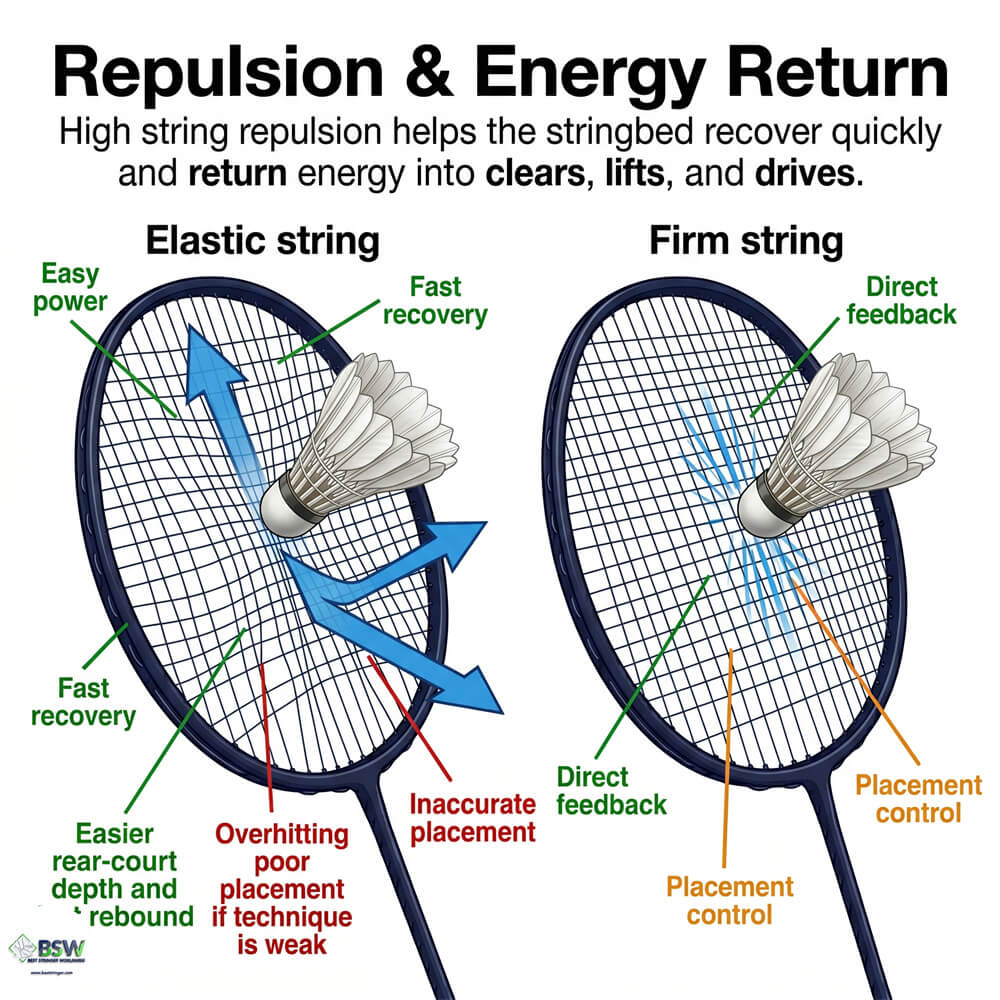
The golden rule of string performance is that badminton strings with better elasticity can usually produce more power when all other conditions are equal. This happens because high string repulsion allows the stringbed to stretch and recover efficiently. This elastic recovery transfers energy back into the shuttle quickly, creating faster shuttle rebound for easier clears and drives.
Changing to a more elastic string drastically alters how the stringbed behaves. A highly repulsive stringbed helps many players generate power with less effort, but it naturally feels bouncier. Firmer, less elastic strings sacrifice some of that easy rebound for more direct feedback and precision during sharp placements.
A badminton player needs the right balance between power, control, and durability. For players needing easier rear-court depth, an elastic, repulsive string is generally preferred. Hard-hitters or clean strikers often benefit from the stable stringbed response of a firmer string for sustained control.
1.3 Control & Durability Trade-offs
Understanding Control and Durability Trade-offs
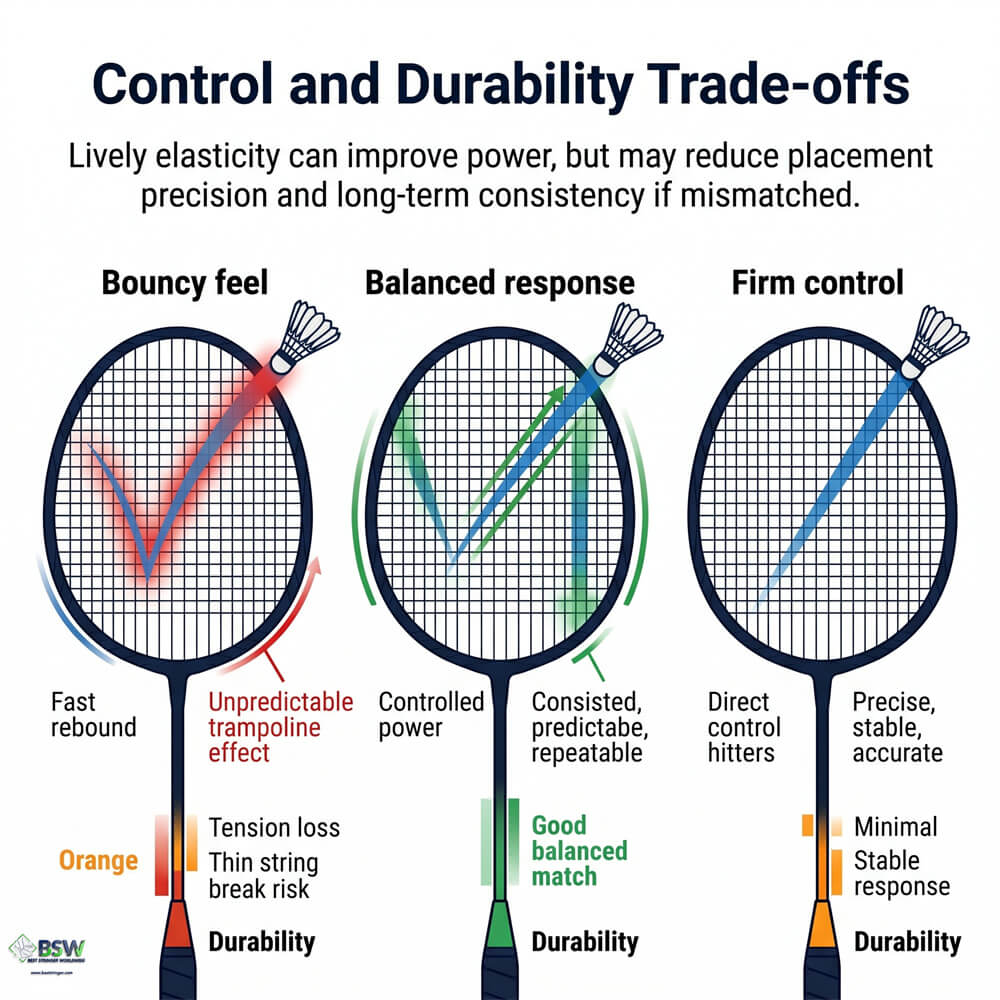
While an elastic badminton string provides excellent energy return, stringbed response dictates how you control that energy. Highly elastic strings can feel very lively and bouncy. If you lack solid technique, this extra bounce might cause you to overhit, leading to a loss of placement accuracy and making your net play feel less precise.
A firmer string, while offering less “easy power,” provides highly direct feedback. It acts with more stability, allowing players with fast swing speeds to control the shuttle smoothly without the unpredictable trampoline effect common in overly elastic setups.
Durability also plays a massive role. Depending on the string construction and gauge, a highly repulsive string may be thinner and more prone to rapid tension loss or snapping. A balanced-elasticity string offers a safer middle ground, ensuring that your stringbed response remains consistent without sacrificing too much longevity.
1.4 Tension & Gauge Synergy
Matching String Tension with Elasticity
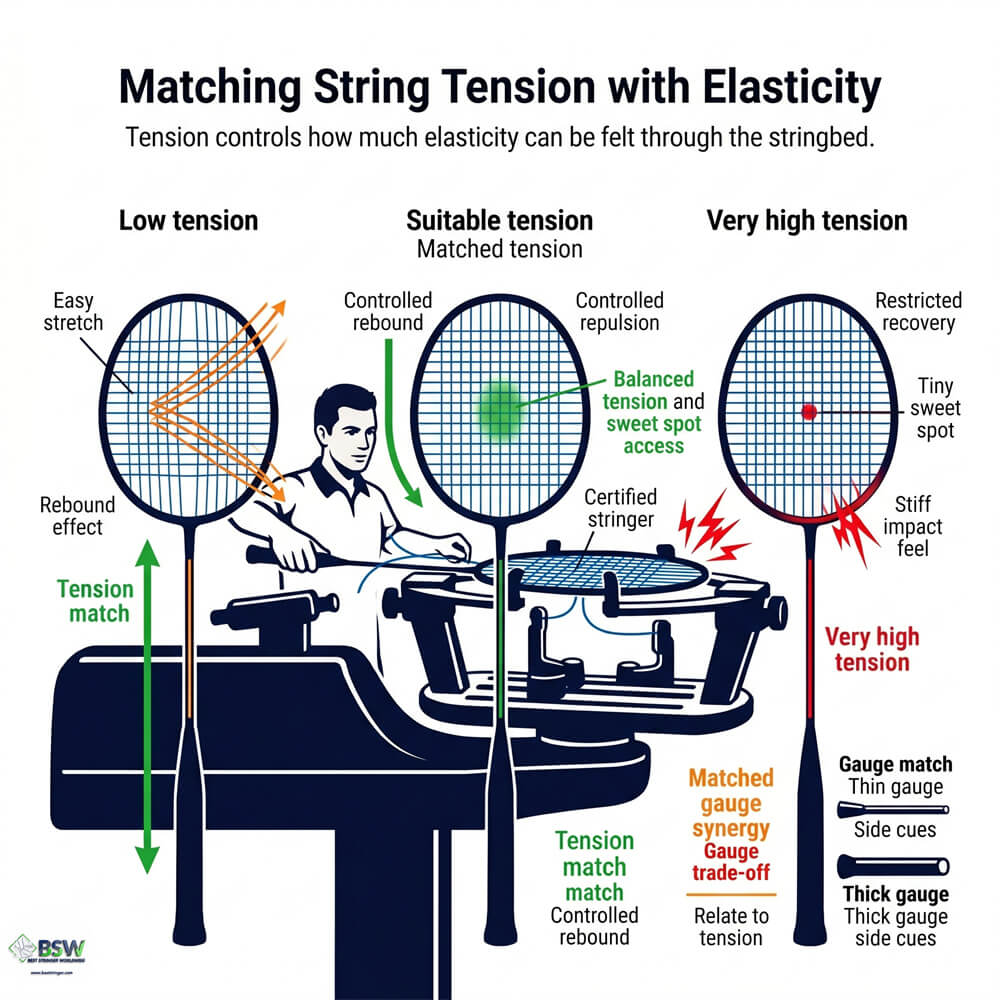
An elastic badminton string requires the correct string gauge and tension to truly optimize its power potential. Understanding this synergy is essential for all levels:
What is String Gauge? Gauge refers to the thickness of the string. Thin strings generally offer higher repulsion and an elastic feel, while thick strings sacrifice a bit of that crisp, lively bounce for robust durability and tension hold.
Tension Basics. Tension dictates how tightly the strings are pulled, directly altering elasticity. High tension restricts the stringbed, offering control but reducing the trampoline effect. Low tension allows the elastic string to stretch further, boosting easy power for slower swings.
The Sweet Spot Risk. If you select a highly elastic string for power but request an extremely high tension without the required accuracy, the stringbed will feel overly stiff, negating the elasticity entirely. A professional badminton stringer will always align these factors.
1.5 Common Mistakes
Common String Elasticity Mistakes
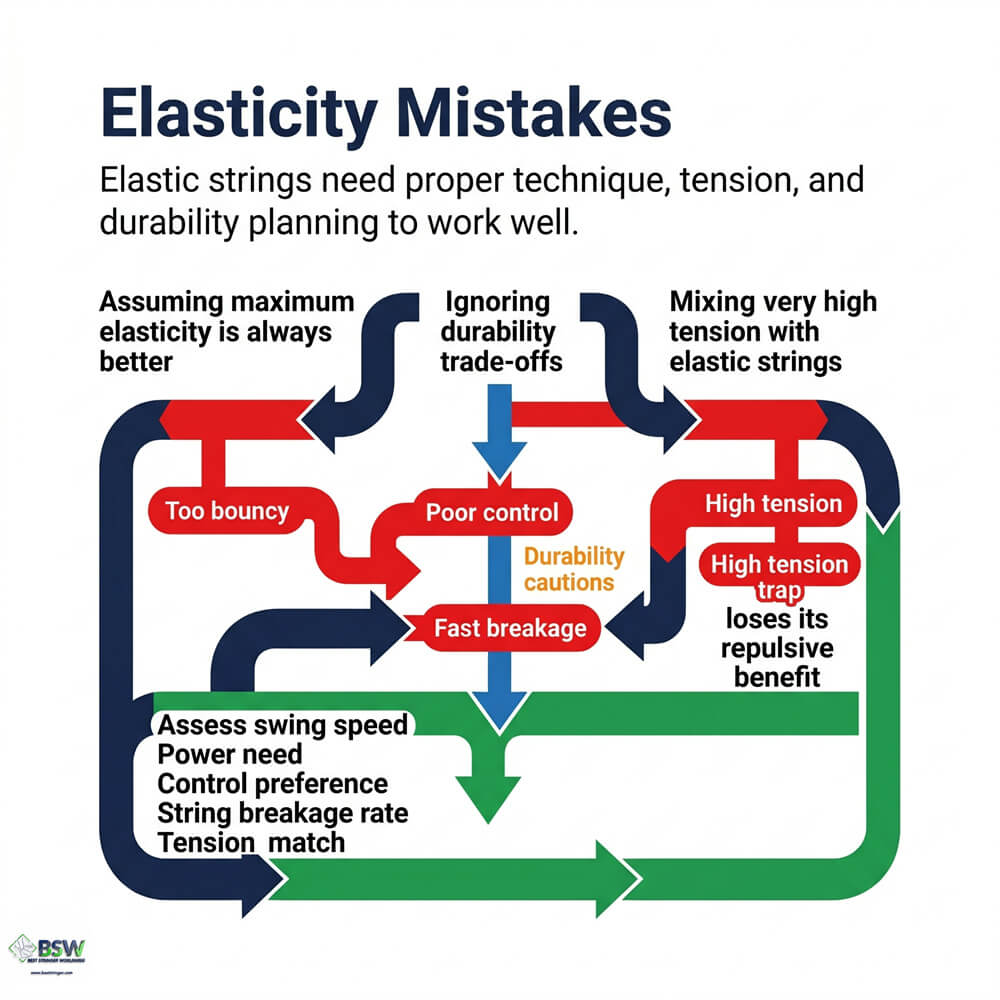
Mistake 1: Assuming Elasticity is Always Better.
While a more elastic string produces greater power under similar conditions, choosing maximum repulsion without the necessary technique often guarantees poor placement, unpredictable bounces, and reduced overall control.
Mistake 2: Ignoring Durability Trade-offs.
Chasing pure shuttle rebound with the most elastic, thin strings often means sacrificing longevity. If you play frequently and hit hard, the extra liveliness might result in rapid tension loss or frequent string breakage.
Mistake 3: Blindly Mixing High Tension with Elasticity.
Requesting high tension just because your string is elastic is a common error. Advanced tensions restrict elastic recovery; otherwise, you simply create a small sweet spot that fails to utilize the string’s natural repulsive power.
1.6 Player Consultation Framework
Professional String Decision Flow
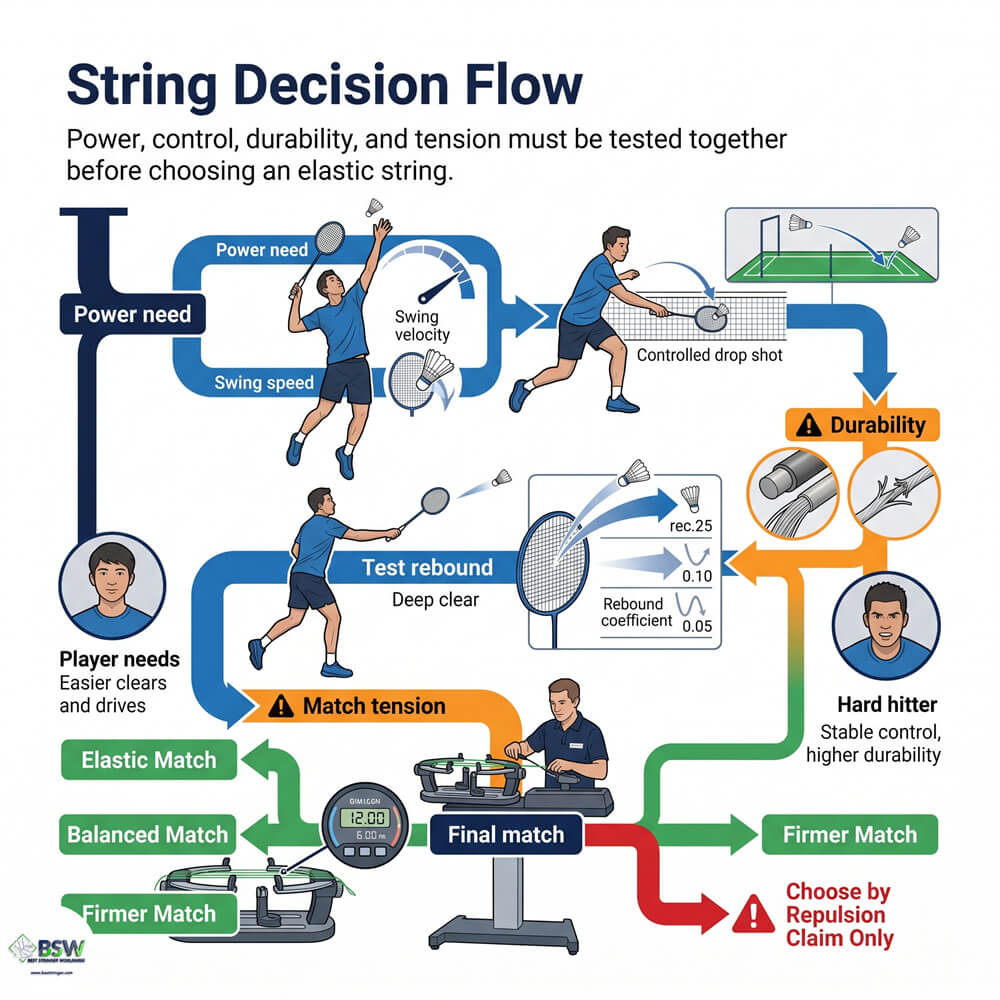
A step-by-step decision flow is crucial for balancing power and control safely. Use this simple framework before upgrading your string setup:
Step 1: Check Your Swing Speed and Power Needs. An elastic string will only provide easier power if it matches your mechanics. Players wanting help with deep clears should lean towards higher elasticity, while explosive hitters may prefer firmer feedback.
Step 2: Identify Your Control vs. Durability Needs. Determine if you are willing to trade maximum string longevity for a livelier stringbed response, or if you need a balanced-elasticity string to survive frequent hard-hitting sessions.
Step 3: Test and Match Tension. Try an elastic string and observe whether it genuinely improves your shuttle rebound and comfort, or if the stringbed response feels too bouncy and reduces your placement precision.
1.7 Further Learning
The Value of Stringer Certification
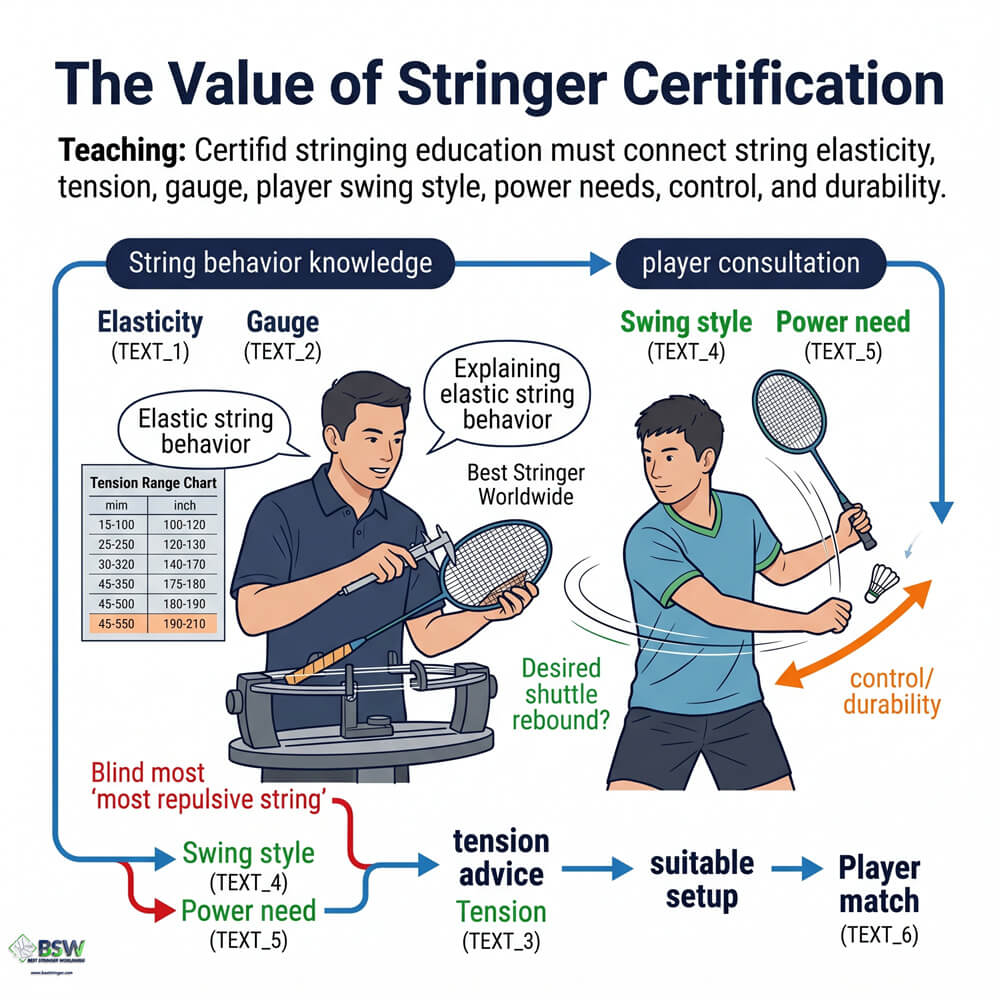
Proper string behavior education is a core part of a professional badminton stringing course and good stringer certification standards. A certified stringer understands that blindly recommending an elastic string for “easy power” without considering a player’s control needs is a disservice.
At Best Stringer Worldwide, we know that string elasticity directly influences the tension advice given to players. The value is not just in buying the most repulsive string, but in the precise consultation a badminton stringer provides to match string material, gauge, and tension to your exact swing style.
By prioritizing accurate equipment knowledge, our stringer certification ensures that every setup perfectly balances power, durability, and control. You eliminate guesswork, understand how stringbed response affects your game, and focus purely on playing your best.
String Elasticity Quick FAQ
Quick, definition-first answers to common questions about string elasticity and power generation.
Does a more elastic string always mean more power?
Generally, yes. When all other conditions are equal, a badminton string with better elasticity can produce more power because it stretches and returns energy more efficiently. However, actual power still depends on player technique and proper string tension.
Why do elastic strings feel livelier?
The efficient elastic recovery of the string creates a faster stringbed response, allowing the shuttle to rebound rapidly. This helps clears, lifts, and drives feel much easier with less physical effort required from the player.
Are highly elastic strings better for all players?
Not necessarily. While they offer excellent repulsion, highly elastic strings may feel too bouncy for some, potentially reducing direct feedback and placement control during fast exchanges for players with powerful swings.
How does elasticity affect durability?
Highly repulsive, elastic strings can sometimes have durability or tension-loss trade-offs, depending on the string’s gauge and material construction compared to thicker, firmer strings designed specifically for maximum longevity.
Why do some players use firmer strings?
A badminton player needs the right balance of power and control. Firmer, lower-elasticity strings provide sharper, more direct feedback, allowing advanced players with fast swing speeds to maintain high precision and stability.
How does string tension affect elastic strings?
String tension regulates the stringbed’s trampoline effect. A certified stringer will adjust tension based on the string’s inherent elasticity and the player’s swing speed to ensure the sweet spot remains accessible, lively, and controlled.
What should a stringer consider before changes?
A professional badminton stringer should evaluate the player’s power needs, control preferences, and durability expectations. They should not blindly recommend the most elastic string without proper consultation regarding the player’s typical swing.
Why is stringer certification important?
A comprehensive badminton stringing course teaches how string elasticity, tension, and gauge interact in real life. Stringer certification ensures stringers give educated advice based on physics rather than relying on generic marketing hype.
Are stringing courses necessary?
For those wanting to master player consultation, yes. A stringer learns to assess stringbed rebound, proper machine operation, and the logic required to precisely match an elastic string setup to a specific player’s level and frame.
The Physics of Power: How String Elasticity Works
String Elasticity Simulator
Highly Elastic Response
Maximum stringbed pocketing allows for a powerful clearing trajectory. Ideal for players needing easier depth from the rear court.
Proven String Consultations
Our stringing approach is based on verified equipment parameters. We prioritize proper string elasticity evaluation, tension matching, and playstyle efficiency over generic stringing hype.
| String Elasticity Profile | Lower & Balanced Elasticity | Higher Elasticity |
|---|---|---|
| Power & Repulsion | Balanced power suitable for clean, fast swingers. | Stronger repulsion, easier power generation for most players. |
| Stringbed Response | Firmer response, more direct feedback. | Livelier response, faster shuttle rebound off the stringbed. |
| Control & Precision | More controlled feel when matched correctly. | May feel too bouncy or reduce placement accuracy for some. |
| Durability Trade-offs | Often thicker or firmer, maintaining tension safely. | May have tension-holding or durability trade-offs depending on gauge. |
| Player Suitability | Ideal for players valuing stability and durability. | Ideal for players wanting easy clears and quick attacking shots. |
| Stringer Advice | Safer recommendation when durability needs are high. | Match tension carefully to optimize the energy return. |
Master String Elasticity with Best Stringer Worldwide
Ready to refine your knowledge? Best Stringer Worldwide offers professional stringing consultation and education to teach you how string elasticity, tension, and gauge affect power safely. We serve badminton players worldwide especially in Singapore, Hong Kong, Malaysia, Indonesia, UK, France and Europe. Contact a certified stringer to find the perfect string setup for your game.