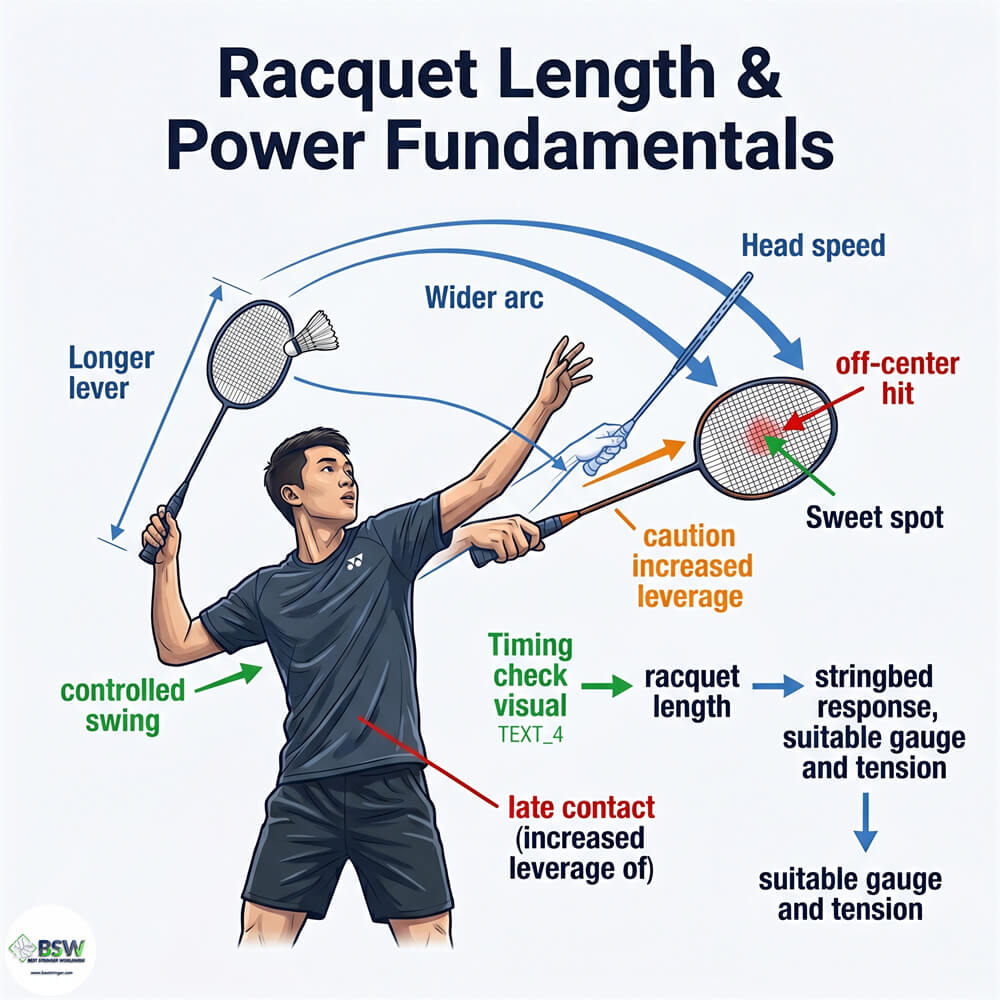
1.1 Racquet Length Fundamentals
What Are the Fundamentals of Racquet Length & Power?
Equipment fundamentals refer to how specific racquet characteristics, particularly length, combine to enhance your playstyle. In this guide, you will learn why a longer badminton racquet can produce greater power when all other conditions are equal, alongside other key specs like balance, stiffness, and string tension.
In short, badminton racquet length dictates your leverage and swing arc, while string choice dictates your stringbed response and touch. Mastering these concepts is crucial for any badminton player aiming to improve, as a “longer racquet” does not automatically mean “better for every player.”
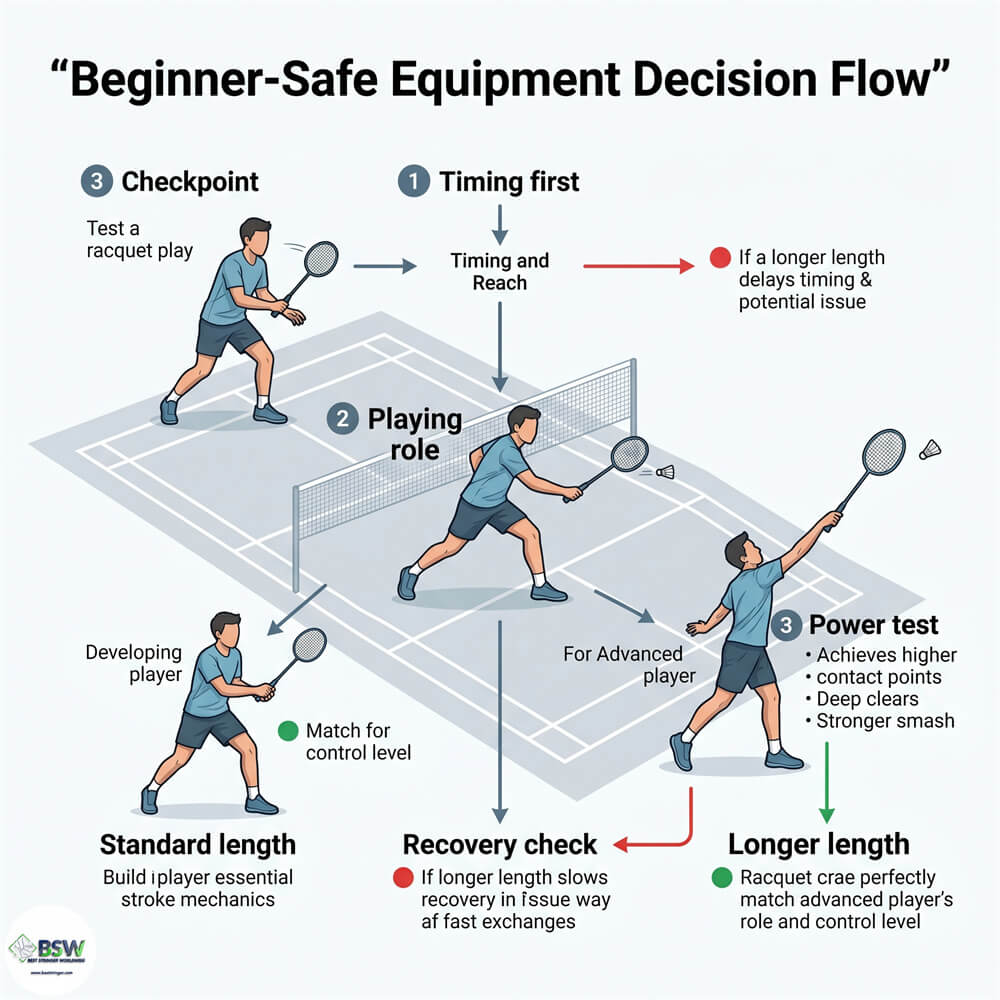
Here is a simple decision flow: Step 1: Assess your timing and handling speed honestly. Step 2: Understand that ‘more power’ from a longer lever is only beneficial if you can control the racquet head speed properly. Step 3: Consult a certified stringer to select a string gauge and tension that perfectly matches your racquet’s length and your sweet spot accuracy.
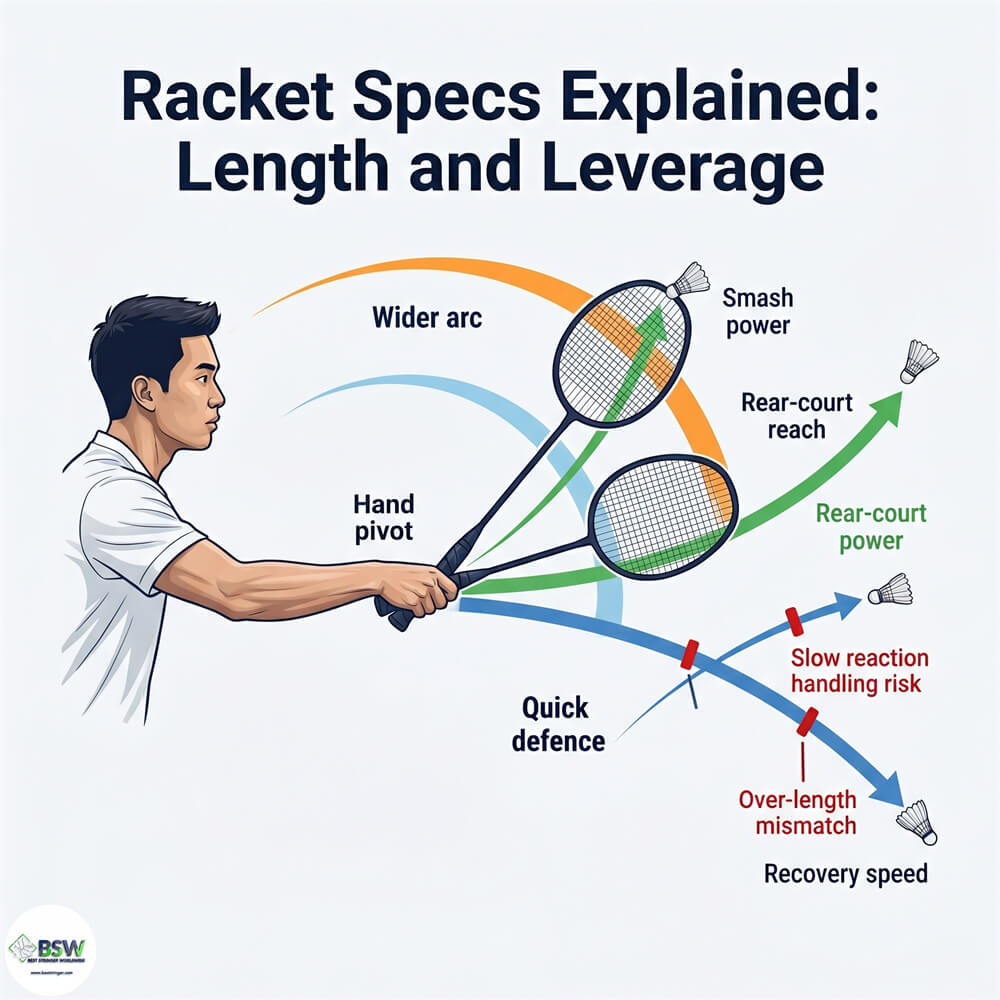
1.2 Racquet Leverage & Swing Arc
Racket Specs Explained: Length and Leverage
The physics rule of equipment is that a longer badminton racquet can usually produce more power when all other conditions are equal. This happens because a longer racquet works as a longer lever, allowing the racquet head to travel through a wider swing arc. This wider arc creates higher racquet head speed, transferring more energy into the shuttle for stronger badminton clear power and a heavier smash.
However, extending the length drastically alters how the frame behaves in your hand. While it generates more leverage for rear-court power, it may naturally slow down your defensive reaction times. A standard or shorter length sacrifices some of that overhead stroke power for rapid handling and badminton racquet control during fast flat exchanges and quick net interceptions.
A badminton player needs the right balance between power, maneuverability, and consistency. For doubles players needing rapid recovery speed, a standard length or highly maneuverable frame is generally preferred. Singles players often benefit from the extra leverage and reach of a longer racquet for sustained rear-court pacing.
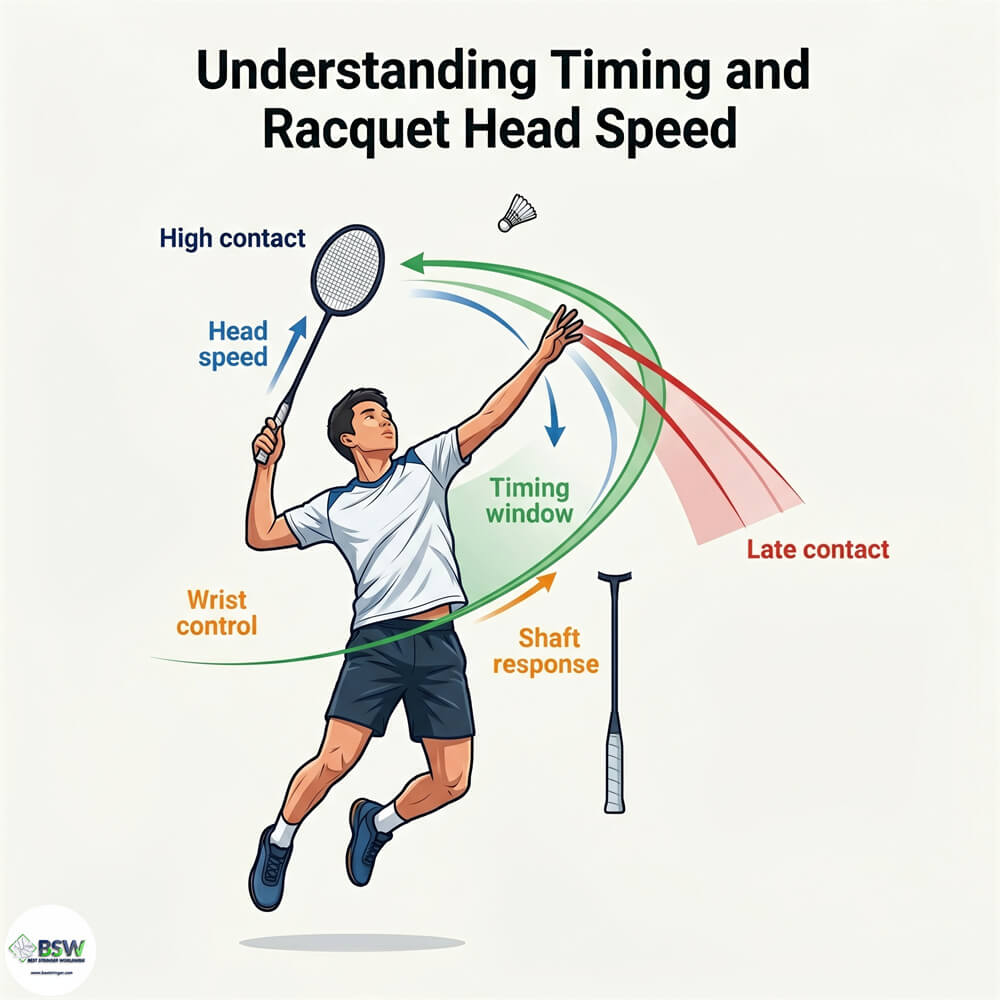
1.3 Timing & Contact Point
Understanding Timing and Racquet Head Speed
While a longer badminton racquet provides the leverage for power, your timing dictates how that energy is transferred. A longer lever requires maximum energy transfer and precision, meaning the player must have advanced timing to control the wider swing arc. If you lack solid technique, pairing a longer racquet with poor timing punishes you with weak clears and potential arm fatigue.
Badminton swing speed must adapt to the length. A longer racquet may feel slightly heavier to swing due to the extended balance point. It can store and release energy smoothly to help players effortlessly clear the shuttle, but only if their swing action is refined enough to hit the shuttle at the highest contact point.
The racquet balance and shaft stiffness also play a massive role in this formula. A stiff shaft on a longer racquet demands incredible wrist control, ensuring that the racquet head speed from your swing transfers effectively without lagging behind your body.
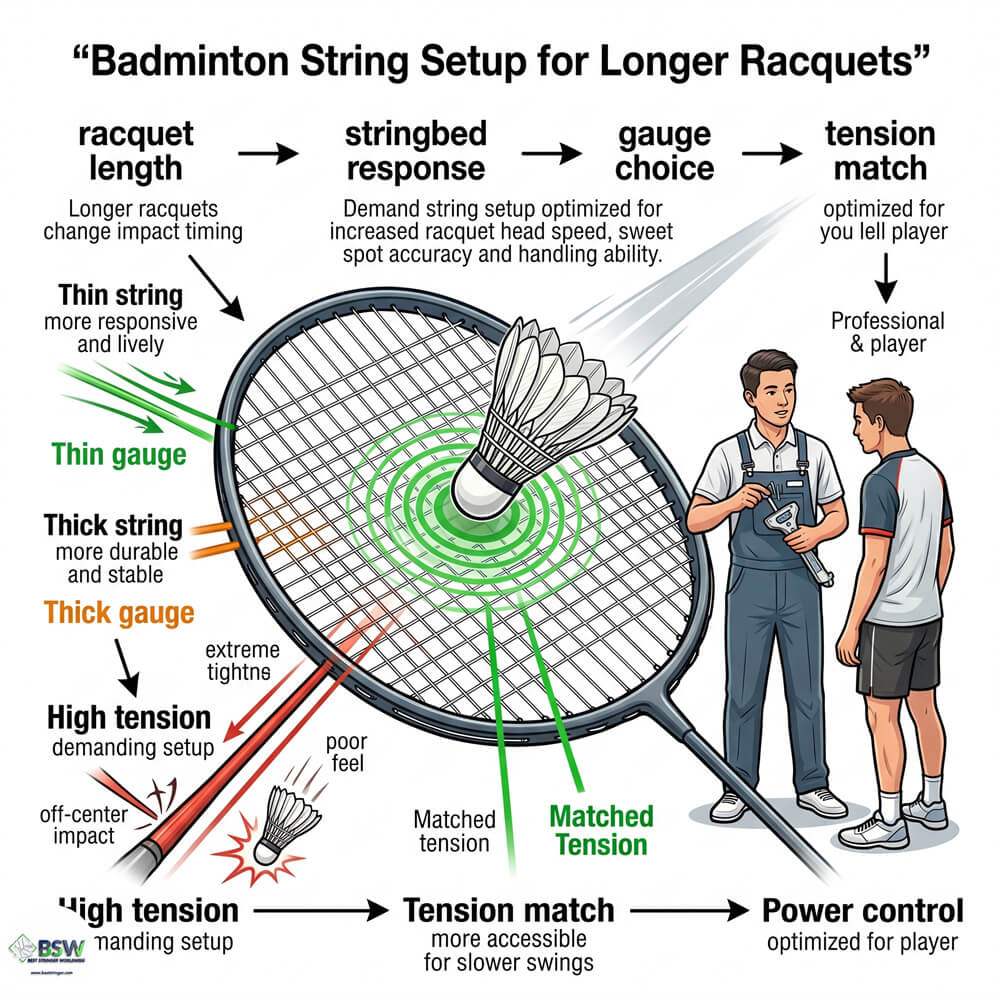
1.4 Gauge & Tension Basics
Badminton String Setup for Longer Racquets
A longer badminton racquet requires the correct string gauge and tension to truly unlock its power potential. Understanding this synergy is essential for players and badminton stringers alike:
What is Stringbed Response? The longer the racquet, the different the impact timing. Thin strings offer incredible repulsion and aerodynamic sound, while thick strings sacrifice a bit of crispness for robust durability, helping handle the higher racquet head speed.
String Tension and Power. Tension is how tightly the strings are pulled. High tension offers touch and control, but only if your sweet spot contact is highly consistent with the longer swing arc. Low tension acts like a trampoline, boosting power for slower swings that might struggle with the extra length.
The Stringer’s Advice. If you use a longer racquet for smash power but string it at an extremely high tension without the required accuracy, the sheer force of an off-center hit will feel terrible. A professional badminton stringer will always align your tension with your racquet length and handling ability.
1.5 Common Mistakes
Common Racquet Length Mistakes
Mistake 1: Assuming Longer is Always Better.
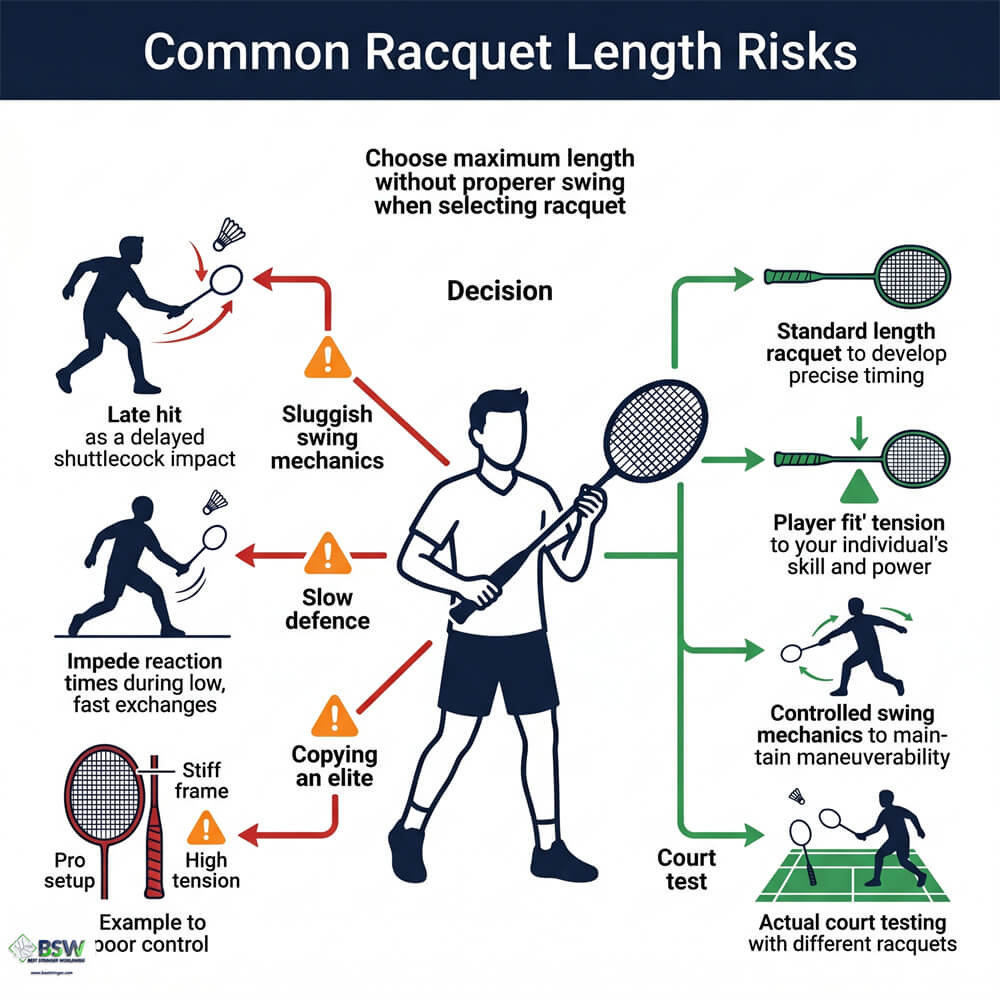
While a longer badminton racquet produces greater power under similar conditions, choosing the maximum length without the necessary swing mechanics guarantees sluggish swings, late hitting, and poor timing.
Mistake 2: Ignoring Defense and Recovery Speed.
Chasing pure overhead stroke power with a longer lever often means sacrificing defensive handling. If you cannot react to fast flat drives in doubles, the extra racquet head speed is useless.
Mistake 3: Copying Pro Setups Blindly.
Using the exact longer, extra-stiff racquet and high-tension strings of an elite player is a common error. Advanced power setups require advanced biomechanics; otherwise, they simply ruin your badminton racquet control.
1.6 Selection Framework
Beginner-Safe Equipment Decision Flow
A step-by-step decision flow is crucial for balancing power and handling safely. Use this simple framework before upgrading your badminton racquet length:
Step 1: Check Your Timing and Reach. A longer badminton racquet will only yield more power if you can maintain your standard swing speed. Beginners should often start with a standard length to develop proper stroke mechanics before transitioning to longer leverage frames.
Step 2: Identify Your Playing Role. Determine if you are primarily a fast-paced doubles player requiring defensive speed, or a player needing the higher contact point and momentum of an extended length for deep clears.
Step 3: Test for Actual Improvement. Try a longer racquet and test whether it genuinely improves your shuttle speed and smash power, or if it only delays your timing and slows your recovery in fast exchanges.
1.7 Further Learning
The Value of Stringer Certification
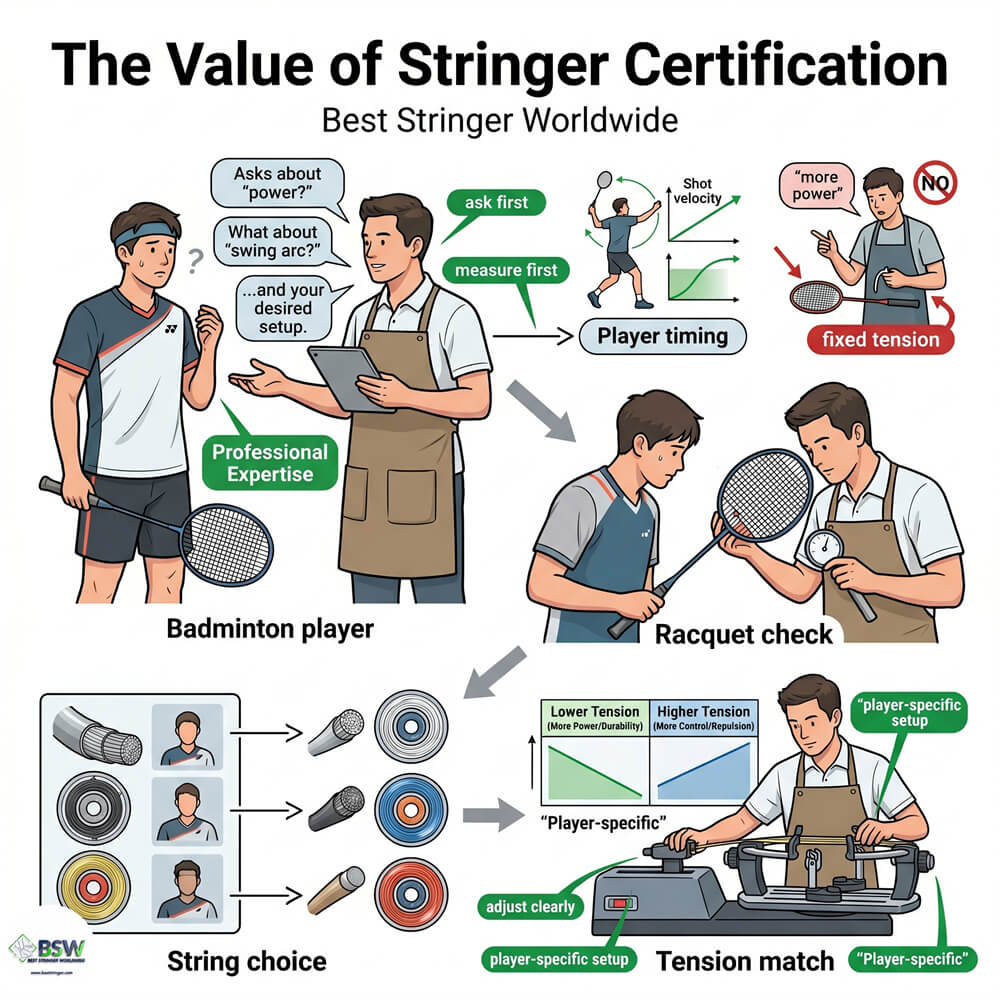
Proper equipment education is a core part of a professional badminton stringing course and good stringer certification standards. A certified stringer understands that recommending “more power” through a longer racquet blindly without considering a player’s real ability is a disservice.
At Best Stringer Worldwide, we know that badminton racquet length directly influences the advice given to players. The magic is not just in buying a longer racquet, but in the precise player consultation a badminton stringer uses to match string type and tension to your swing arc.
By prioritizing accurate equipment knowledge, our stringing education ensures that every setup perfectly balances power, leverage, and handling. You eliminate guesswork, avoid mistimed shots from over-extended racquets, and focus purely on improving your game.
Equipment Selection Quick FAQ
Quick, definition-first answers to common questions about badminton racket length and swing speed basics.
Does a longer racquet always mean more power?
Generally, yes. A longer badminton racquet can produce greater power when all other conditions are equal because it creates a longer lever. This longer lever allows the racquet head to travel faster, but only if the player has the timing to control it.
Why does a longer racquet create higher racquet head speed?
The extra length extends the swing arc. During the swing, the racquet head must cover a greater distance in the same amount of time, resulting in a higher linear speed at impact. This higher racquet head speed translates to more shuttle speed.
Is a longer badminton racquet better for beginners?
Not necessarily. While it offers more leverage and power, a longer racquet may feel slower to maneuver. Beginners who are still developing timing might struggle with the extended length, leading to late contact points and reduced defensive handling.
Does a longer racquet help with smash power?
Smash power relies heavily on racquet head speed and contact point. A longer racquet increases both, allowing players to hit the shuttle higher and harder for steeper, heavier smashes, provided their swing mechanics are correct.
Does a longer racquet reduce control?
A badminton player needs the right balance. Longer racquets can feel slightly slower in fast reactions, making rapid defensive blocks and flat drives more demanding. Standard or shorter racquets are often preferred for purely speed-based control.
How does string tension affect a longer racquet?
A longer racquet paired with inappropriate string tension can ruin your timing. A certified stringer will adjust tension based on the racquet’s leverage and the player’s swing speed to ensure the stringbed response remains accessible and powerful.
What should a badminton stringer know about racquet length?
A professional badminton stringer should always evaluate the player’s timing, control needs, and playing style. They should never just recommend a longer frame for “more power” without doing a proper player consultation first.
How does racquet length knowledge connect with certification?
A comprehensive badminton stringing course teaches the science behind leverage, swing arc, and string synergy. A certified stringer provides safe, educated guidance based on racquet performance rather than relying on brand hype.
Is racquet length important in a badminton stringing course?
Absolutely. Understanding badminton racquet length allows a stringer to anticipate how a frame will swing and flex. This knowledge is essential to match string setups to player levels, eliminating guesswork from tension advice.
The Physics of Leverage: Why Racquet Length Matters
Leverage vs. Handling
A longer badminton racquet acts as a longer lever, producing higher head speed and power. However, it requires advanced timing and sacrifices defensive maneuverability.
A standard lever offers rapid recovery speed and an easily accessible sweet spot. Highly recommended for developing players to master timing before upgrading.
🏸 Badminton Racquet Length Check
Do you understand how leverage affects your game?
Analysis Complete!
Great job! Now that you understand how racquet length impacts swing speed and power, are you ready to elevate your technical knowledge with professional stringing education?
Proven Equipment Science
Our stringing approach is based on verified equipment parameters used by top professionals. We prioritize arm safety, proper racquet length evaluation, and playstyle efficiency over pure tension hype.
Impact of Racquet Length on Playing Style
| Characteristic | Option A (Longer) | Option B (Standard) |
|---|---|---|
| Swing Speed | Higher head speed; more power potential. | Balanced speed; easier to control. |
| Handling | Can feel slower in rapid defensive exchanges. | Quicker handling; better for reaction. |
| Leverage | Longer lever; superior reach for smashes. | Standard reach; more consistent feedback. |
| Timing | Demands precise timing for the wider arc. | Forgiving timing; ideal for most players. |
| Suitability | Rear-court power hitters. | Balanced all-rounders & beginners. |
Master Your Equipment with Best Stringer Worldwide
Ready to upgrade your knowledge? Best Stringer Worldwide offers professional stringing consultation to teach you how racquet length and string setups affect swing speed safely. We serve badminton players worldwide especially in Singapore, Hong Kong, Malaysia, Indonesia, UK, France and Europe. Contact a certified stringer to find the perfect tension and gauge for your game.