1.1 Equipment Fundamentals
Understanding Racquet Weight and Sweet Spot Size
One of the most misunderstood concepts in badminton equipment is how mass affects forgiveness. Under otherwise equal conditions, a heavier badminton racquet tends to have a larger effective sweet spot. This happens because the added mass helps the frame resist twisting upon impact, making off-centre hits feel significantly more stable and usable.
While the geometric centre of the stringbed remains the same size, a heavier frame expands the area that provides a clean, stable shuttle response. However, a larger effective sweet spot does not automatically make it the perfect choice for every badminton player. If the racquet is too heavy for your strength, your swing speed drops, which ruins your timing.
This is why proper setup matters. Step 1: Understand that heavier racquets provide greater torsional stability. Step 2: Ensure you have the physical strength to swing that weight without fatigue. Step 3: Work with a trained badminton stringer to match string tension to your new racquet’s mass for an optimal, forgiving feel.
1.2 Racket Weight & Balance
Equipment Physics: Mass and Off-Centre Stability
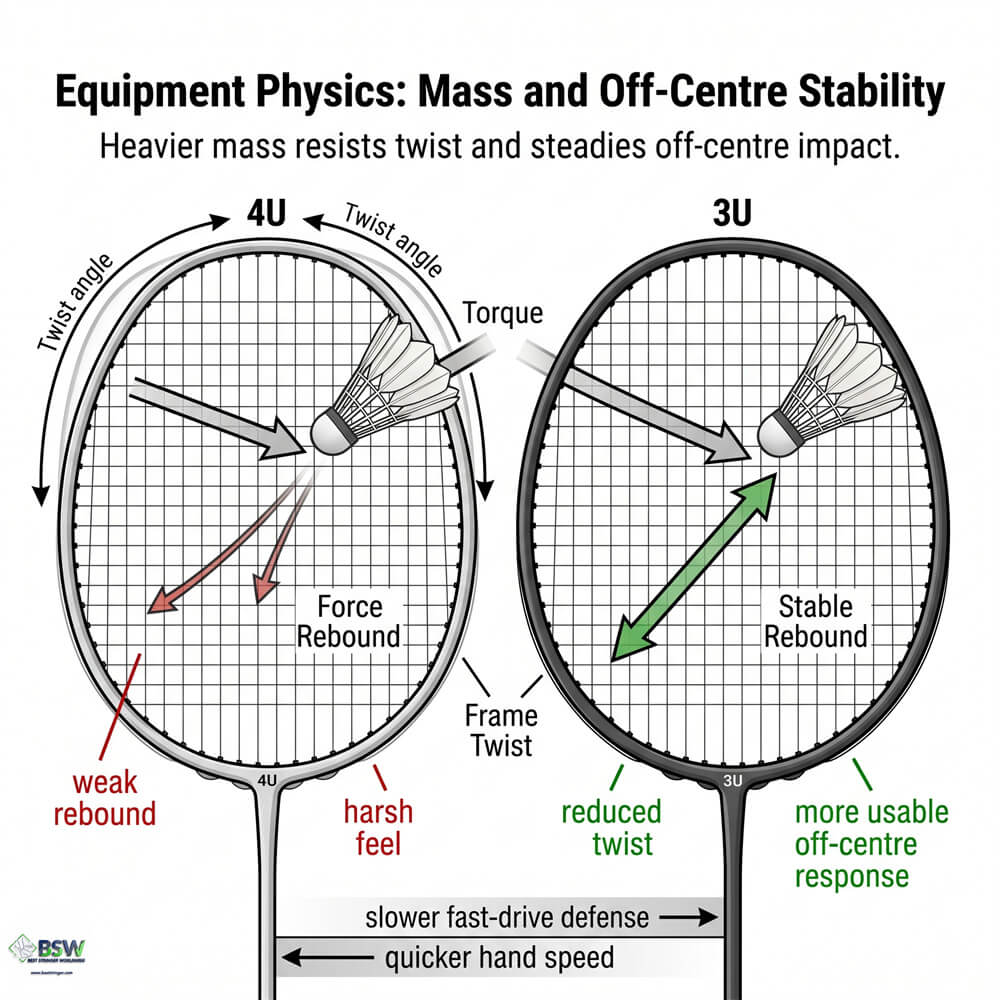
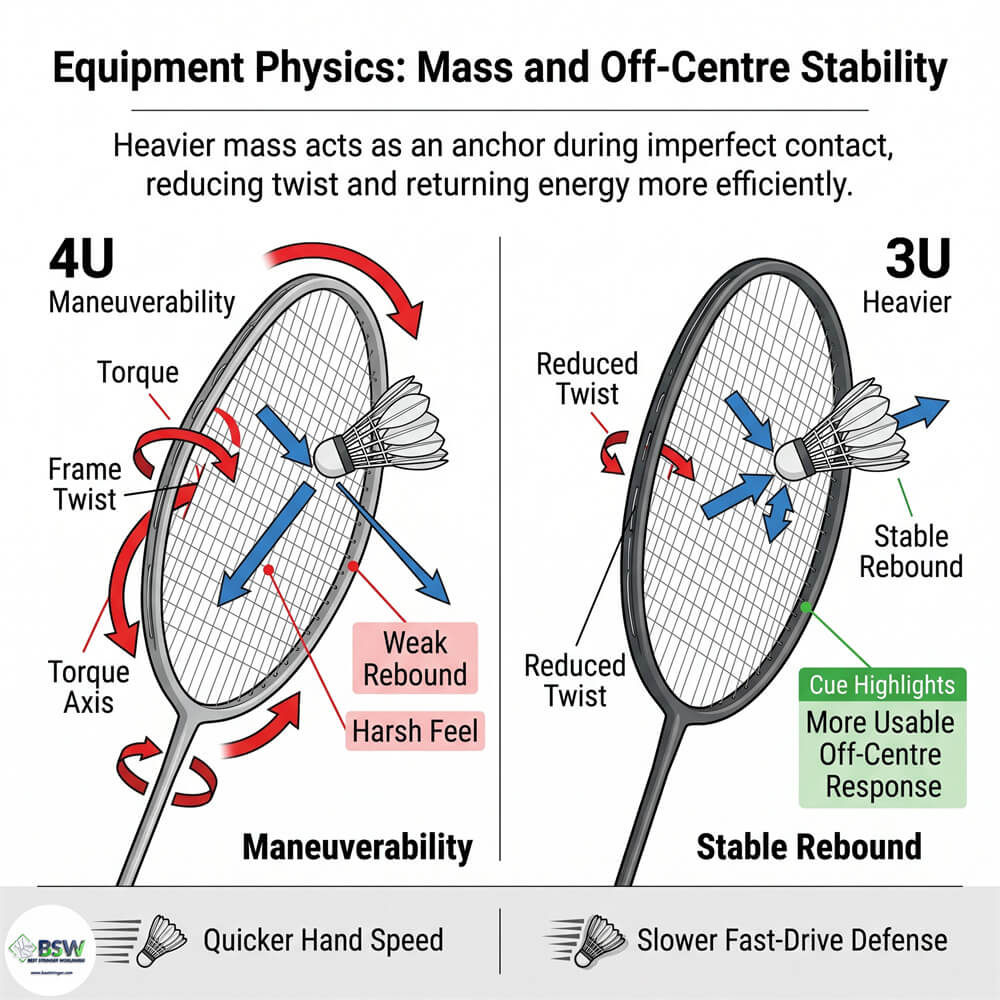
To understand why a heavier badminton racquet yields a larger effective sweet spot, you must look at torsional stability. When a badminton player strikes the shuttle slightly outside the dead centre of the stringbed, the impact creates torque. A lighter racquet frame will twist more easily in your hand, resulting in a weak shot, high vibration, and a harsh, jarring feel.
Conversely, a heavier racquet, such as a 3U (85-89g) compared to a 4U (80-84g), possesses greater mass. This extra mass acts as an anchor, significantly reducing the frame’s tendency to twist during an imperfect collision. Because the racquet stays stable, more energy is returned to the shuttle, and the player perceives a larger, more forgiving hitting zone.
However, stability comes at the cost of maneuverability. A heavy, highly stable racquet might save a poor hit, but if its weight makes you slow to react in fast doubles defense, the trade-off is negative. Choosing the right frame weight is a delicate balance of maximizing forgiveness without compromising swing mechanics.
1.3 Stiffness & Head Size
Understanding Frame Shape and Flexibility
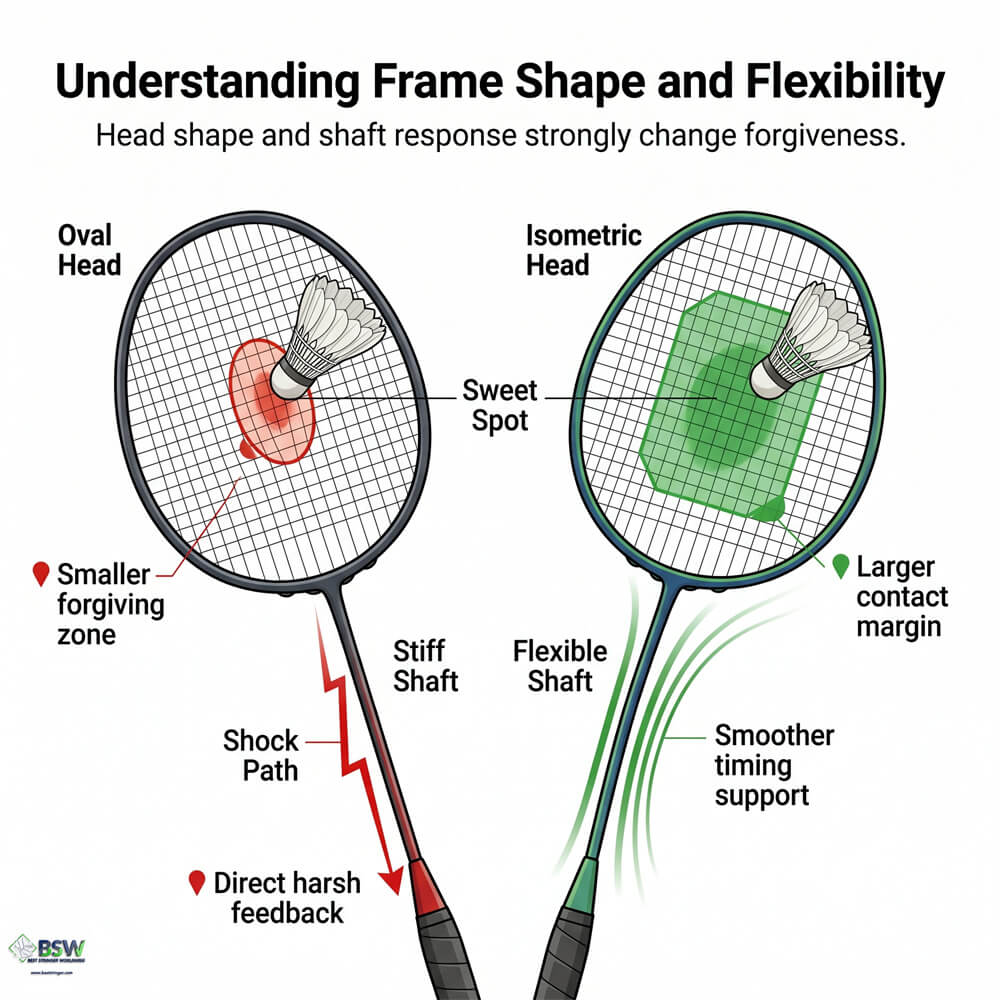
While the claim that “heavier equals more forgiving” holds true when other conditions are kept equal, you must also look at frame design. If you compare a heavy oval racquet to a lighter isometric racquet, the lighter one might actually feel more forgiving because the isometric shape physically expands the geometric sweet spot.
Shaft stiffness further impacts how the badminton player perceives forgiveness. A heavy racquet paired with an extra-stiff shaft demands flawless timing and high swing speeds. If you mis-hit with a stiff shaft, the shock travels straight to your arm. A flexible shaft, conversely, is highly forgiving, allowing for slightly delayed timing while still transferring power smoothly.
Therefore, to truly maximize the stable, twist-resistant benefits of a heavier racquet, many recreational players pair it with an isometric head shape and a medium-to-flexible shaft. This creates a deeply reliable, forgiving hitting zone.
1.4 Gauge & Tension Basics
How String Setup Changes Sweet Spot Feel
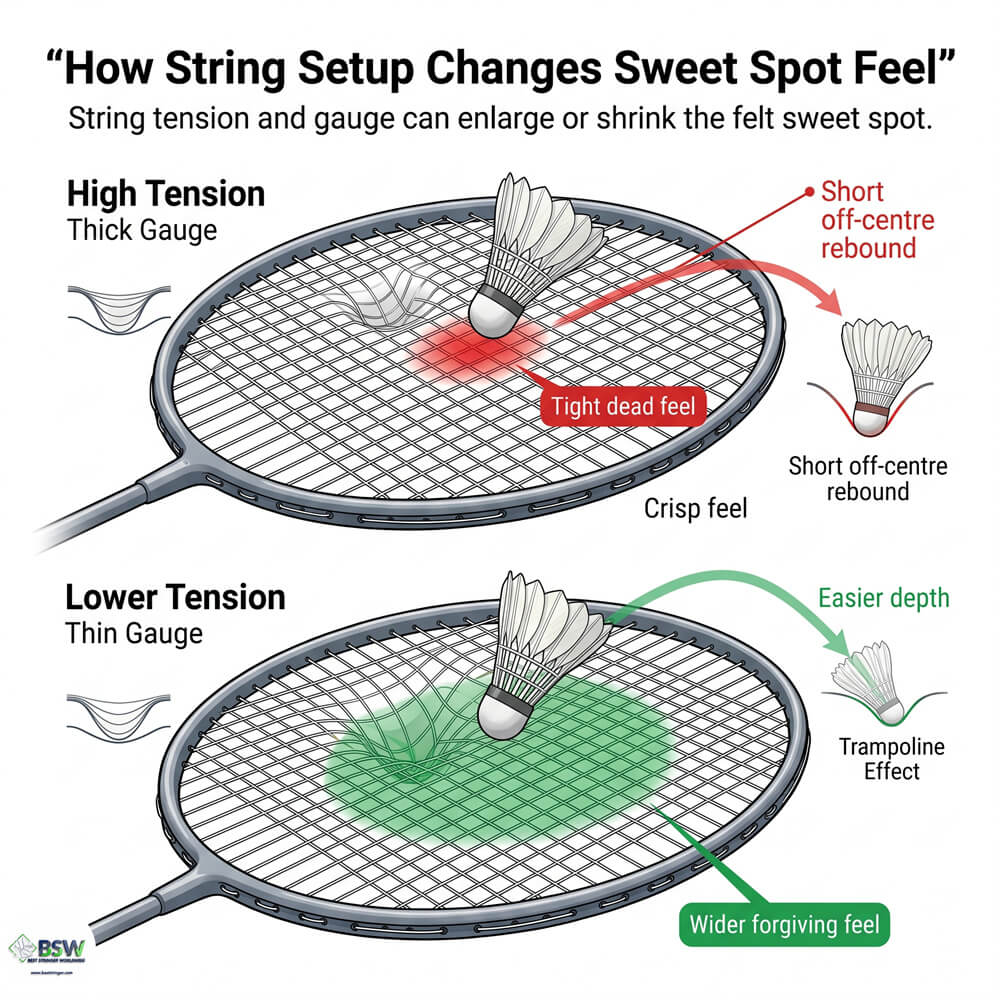
Even the heaviest, most stable badminton racquet can feel terrible if strung incorrectly. A certified stringer knows that tension directly manipulates the perceived size of the sweet spot.
String Tension and Forgiveness. High tension (26+ lbs) stiffens the stringbed, drastically shrinking the effective sweet spot. If you mis-hit at high tension, the shuttle drops short, even with a heavy frame. Lower tension (22-24 lbs) creates a trampoline effect, naturally expanding the sweet spot and providing easy depth on off-centre hits.
The Role of String Gauge. Thinner strings offer a highly responsive, crisp feel that can help amplify the sweet spot sensation. Thicker strings are more durable but can feel slightly duller, requiring the player to hit closer to the dead centre for optimal power.
The Stringer’s Influence. Poor stringing consistency can distort a player’s experience. This is why any reputable badminton stringing course teaches technical stringing logic—so a stringer can evaluate a heavier racquet and set the tension precisely to preserve its natural forgiveness.
1.5 Common Mistakes
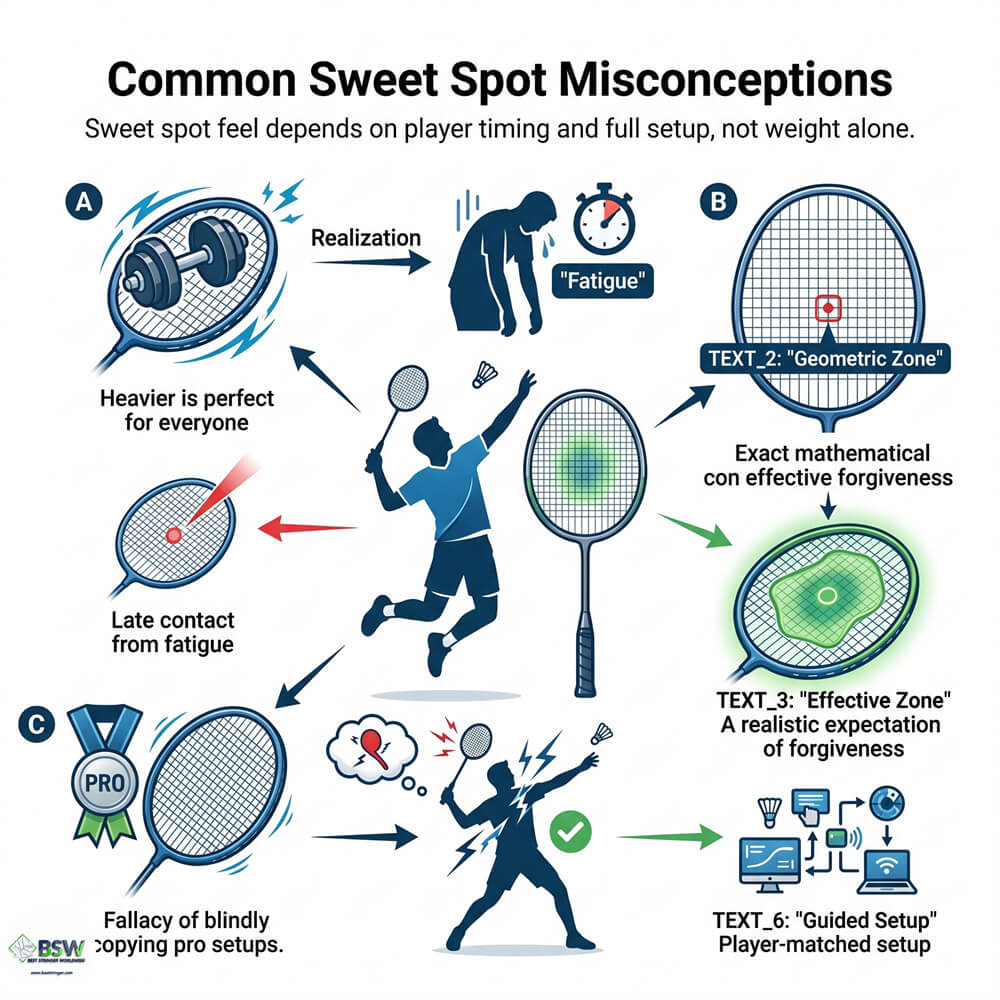
Common Sweet Spot Misconceptions
Mistake 1: Assuming Heavier is Flawless for Everyone.
While a heavier badminton racquet offers a larger effective sweet spot due to twist resistance, if the weight causes arm fatigue, your swing mechanics will break down. Poor timing will cause you to miss the sweet spot entirely, negating any stability benefits.
Mistake 2: Confusing Geometric and Effective Zones.
The actual measurable centre (geometric) does not change with weight. What changes is the racquet’s ability to maintain a usable shuttle trajectory when you miss that centre (effective forgiveness).
Mistake 3: Ignoring Professional Setup Advice.
Players often copy a professional’s heavy racquet and high-tension setup, expecting an enormous sweet spot. Without pro-level timing, this setup feels completely dead. A trained badminton stringer should always guide this choice based on your actual technique.
1.6 Selection Framework
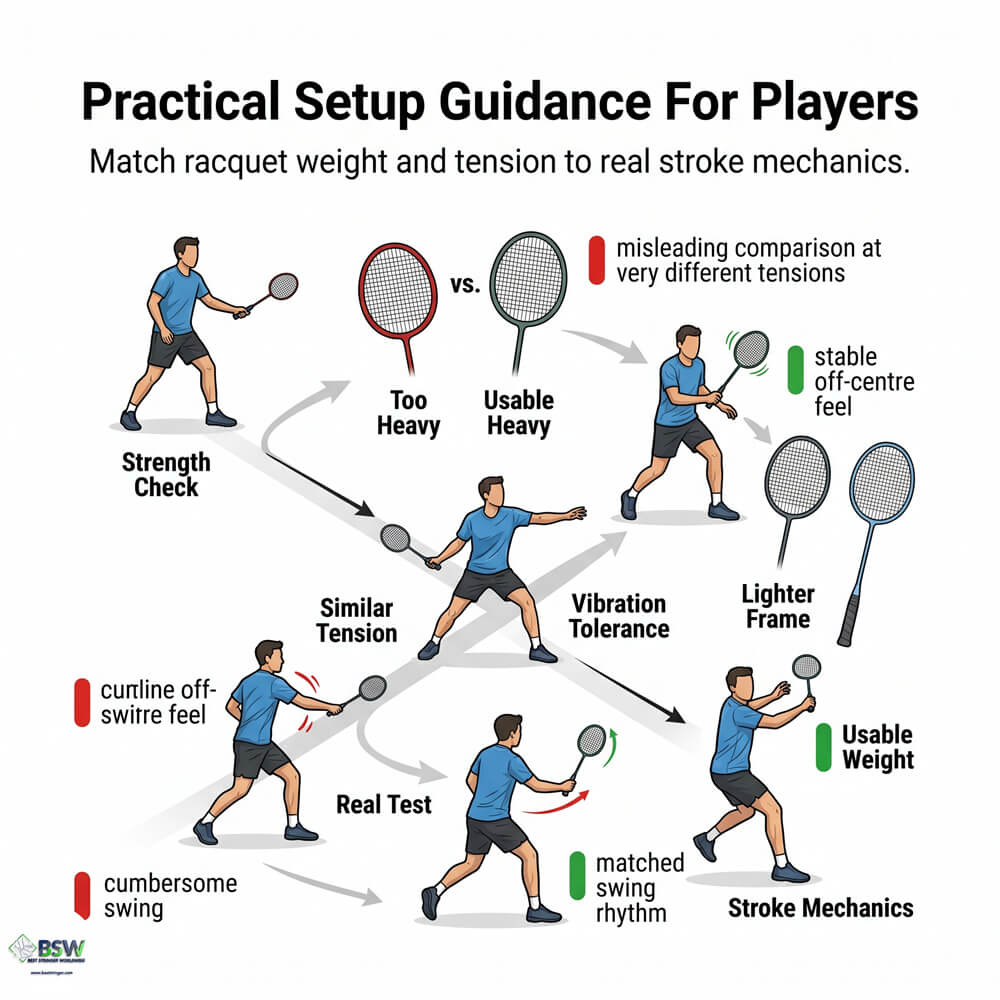
Practical Setup Guidance For Players
When selecting a racquet, understanding your physical capability is just as important as knowing the physics of stability. Use this guidance to find your ideal feel:
Step 1: Check Your Strength. A heavier badminton racquet will provide a larger effective sweet spot only if you can maintain proper stroke mechanics. If it feels cumbersome to swing, stick with a lighter 4U frame until your arm strength develops.
Step 2: Evaluate Vibration Tolerance. If you frequently hit off-centre and experience harsh vibrations, a slightly heavier frame combined with a moderate string tension can dramatically improve off-centre stability and comfort.
Step 3: Test Under Real Conditions. Always test racquets strung at similar tensions. Assessing a heavy racquet’s sweet spot when it’s strung at 28 lbs versus a light racquet at 22 lbs will give you entirely misleading feedback regarding true frame forgiveness.
1.7 Further Learning
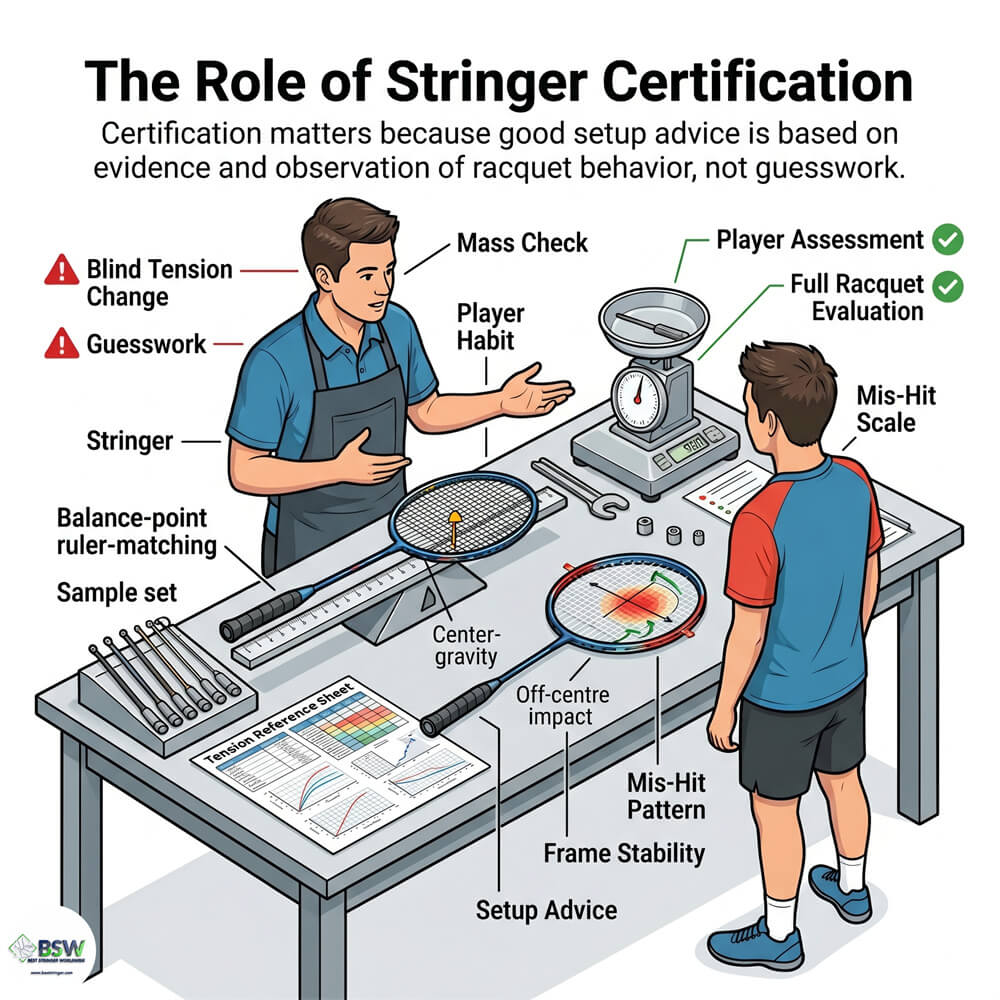
The Role of Stringer Certification
Proper equipment education goes far beyond pulling strings on a machine. This is why a comprehensive badminton stringing course and respected stringer certification standards place heavy emphasis on understanding racquet physics, including how mass affects off-centre stability.
At Best Stringer Worldwide, we believe a certified stringer must observe player habits. If a player is struggling with mis-hits, a trained stringer will not just lower the tension blindly; they will evaluate whether a slightly heavier, twist-resistant frame could improve the player’s effective sweet spot feel.
Stringer certification guarantees that badminton players receive holistic setup advice. By linking racquet weight, frame stability, and string properties, we ensure you step onto the court with a highly forgiving, reliable piece of equipment perfectly suited to your game.
Sweet Spot & Weight Quick FAQ
Clear, honest answers about how badminton racquet weight influences your effective hitting zone.
Does a heavier racquet have a bigger sweet spot?
Under otherwise equal conditions, yes. While the geometric centre size stays the same, the heavier mass resists twisting on impact. This makes slight mis-hits feel far more stable and usable, effectively enlarging the forgiving area of the stringbed.
Why does added mass feel more forgiving?
When you hit off-centre, the shuttle forces the frame to twist. A heavier badminton racquet has more momentum and inertia, so it acts as an anchor, absorbing the shock and resisting rotation much better than a lighter frame.
Is sweet spot size only about racquet weight?
No. Frame shape (isometric vs oval), shaft flexibility, and string setup all heavily influence the final feel. Weight is just one variable that adds baseline stability, but setup choices can enhance or ruin that forgiveness.
Can string tension change sweet spot feel?
Absolutely. Lower string tensions naturally create a larger, more forgiving trampoline effect. If you have a highly stable, heavy racquet but string it too tightly, the sweet spot will shrink drastically, making mis-hits feel terrible again.
Does a lighter racquet always feel less forgiving?
If all other conditions (tension, shape, strings) are exactly equal, a lighter racquet will twist more on an off-centre hit. However, players choose them because their superior maneuverability makes it physically easier to swing on time and hit the centre accurately.
What should a stringer consider before advising?
A badminton stringer must assess the player’s physical strength, timing, and typical mis-hits. Recommending a heavier racquet for its larger effective sweet spot is a mistake if the player lacks the arm strength to swing the mass without slowing down.
Why does stringer certification matter for advice?
A certified stringer understands that racquet behaviour relies on physics. Certification ensures they grasp the relationship between frame mass, torsional stability, and tension, rather than offering basic guesswork or absolute, hyped-up claims.
How does bad stringing distort racquet feedback?
Inconsistent stringing creates uneven tension across the stringbed. A badminton stringing course teaches how to avoid this, as a badly strung racquet will have a distorted, unpredictable sweet spot, making even a highly stable, heavy racquet feel unusable.
Can a heavy racquet fix mis-hits entirely?
No. While a heavier badminton racquet provides a more forgiving effective sweet spot, it cannot replace good technique. A certified stringer can optimize your setup for maximum stability, but accurate footwork and timing are still required for consistent contact.
The Physics of Stability: Why Racquet Weight Matters
Mass & Sweet Spot
Observe how an off-center hit causes a lighter racquet to twist (torsion), losing power and vibrating. A heavier frame resists this twisting, effectively expanding the sweet spot and forgiving the missed shot.
Standard Mass
Heavier Mass
Proven Specifications
Our stringing approach is based on verified equipment parameters used by top professionals. We prioritize arm safety, proper racquet mass evaluation, and playstyle efficiency over pure tension hype.
| Racquet & Setup Trait | Heavier Racquet (All else equal) | Lighter Racquet (All else equal) |
|---|---|---|
| Effective Sweet Spot Feel | Feels larger due to mass stability; very forgiving. | Feels smaller; requires more precise contact. |
| Off-Centre Stability | Resists twisting incredibly well on mis-hits. | Prone to twisting when shuttle hits the frame edge. |
| Vibration Harshness | Absorbs impact better, resulting in less jarring shock. | Transmits more shock and vibration on bad hits. |
| Physical Demand & Maneuverability | Tires the arm faster; slower to defend fast drives. | Easier to handle rapidly; less overall fatigue. |
| String Setup Sensitivity | Can handle slightly higher tensions before feeling totally dead. | Needs careful tension control to avoid a stiff, dead feel. |
| Advice from a Certified Stringer | Must match tension to player’s fatigue limit. | Optimize string type and tension to maximize repulsion. |
Master Racquet Setup with Best Stringer Worldwide
Ready to upgrade your knowledge? Best Stringer Worldwide offers professional stringing consultation to teach you how racquet weight and string setups affect the sweet spot safely. We serve badminton players worldwide especially in Singapore, Hong Kong, Malaysia, Indonesia, UK, France and Europe. Get a certified stringer certification to find the perfect tension and gauge for players everywhere.