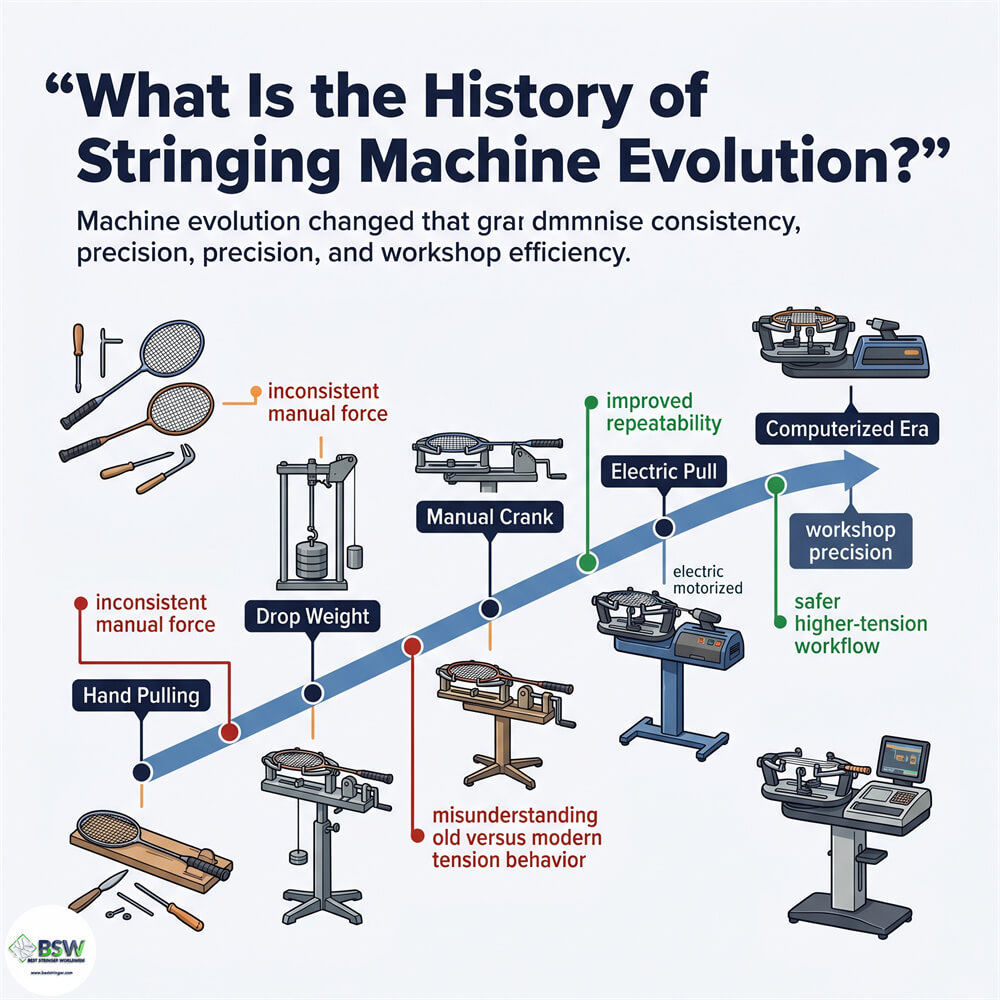
1.1 The Machine Era Begins
What Is the History of Stringing Machine Evolution?
The evolution of stringing machines fundamentally changed racquet sports preparation. In this guide, you will learn how the transition from early manual stringing to modern computerized systems redefined consistency, precision, and efficiency in the stringing workshop.
Understanding machine history is not just about appreciating the past; it explains why different tension systems behave the way they do today. Mastering this knowledge is crucial for any aspiring certified stringer, as it builds a technical foundation for intelligent equipment evaluation.
Here is a simple historical timeline: Step 1: Trace the origins from simple manual methods to drop weight designs. Step 2: Understand the workflow revolution brought by manual crank machines. Step 3: Explore how electric and computerized systems shape modern professional racquet stringing.
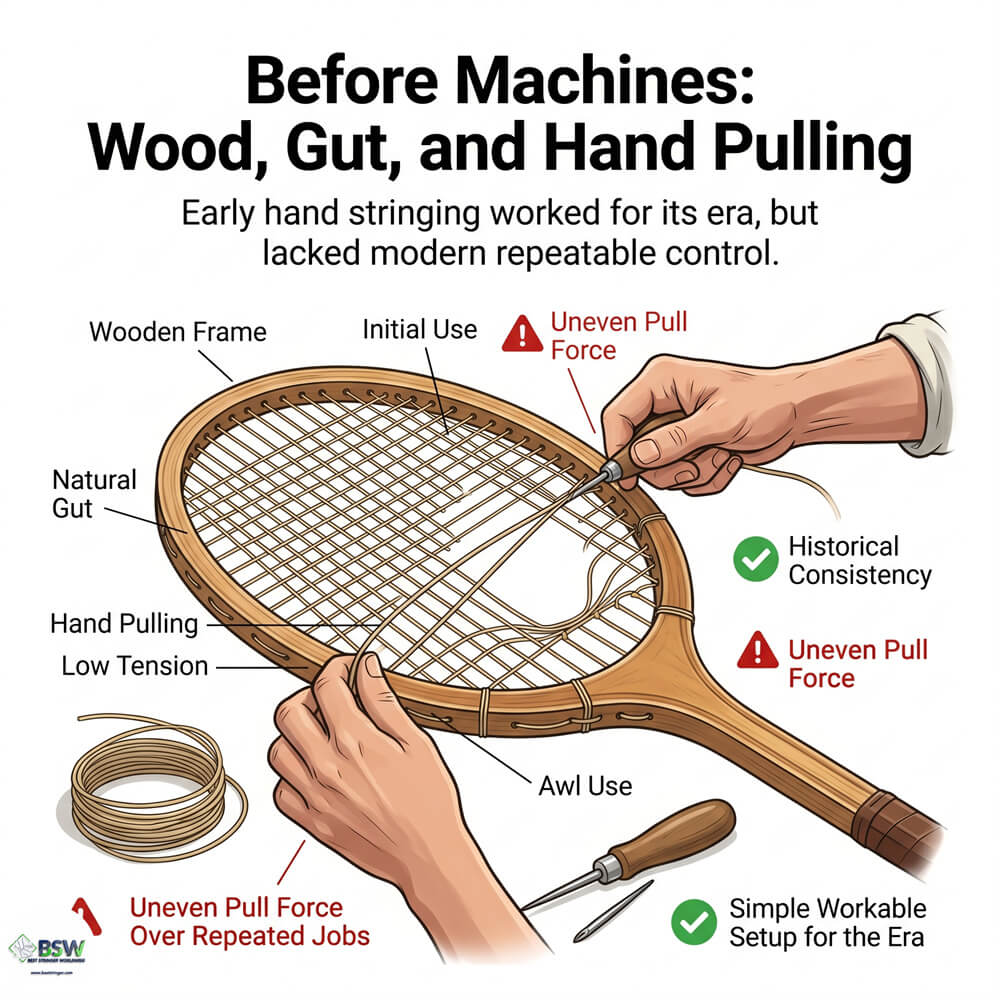
1.2 The Early Days: Manual Stringing
Before Machines: Wood, Gut, and Hand Pulling
In the early days of racquet sports, formal stringing machines did not exist. Early manual stringing relied on hand pulling, awls, and raw physical leverage. This method accurately reflected the equipment of its time primarily wooden racquets and natural gut materials that operated under significantly lower tension contexts than what modern players expect.
While manual stringing lacked the precision of modern setups, it set the vital foundation for all mechanical development. As racquets grew stronger and early synthetic strings emerged in the market, the demand for higher, more uniform tension quickly outpaced what human hands could reliably and safely deliver alone over long stringing sessions.
For today’s badminton stringers and tennis stringers, understanding this primitive starting point is incredibly useful. It highlights exactly why the first mechanical systems were designed: to provide the objective consistency, physical safety, and mechanical advantage that human hands simply could not sustain over multiple racquets.
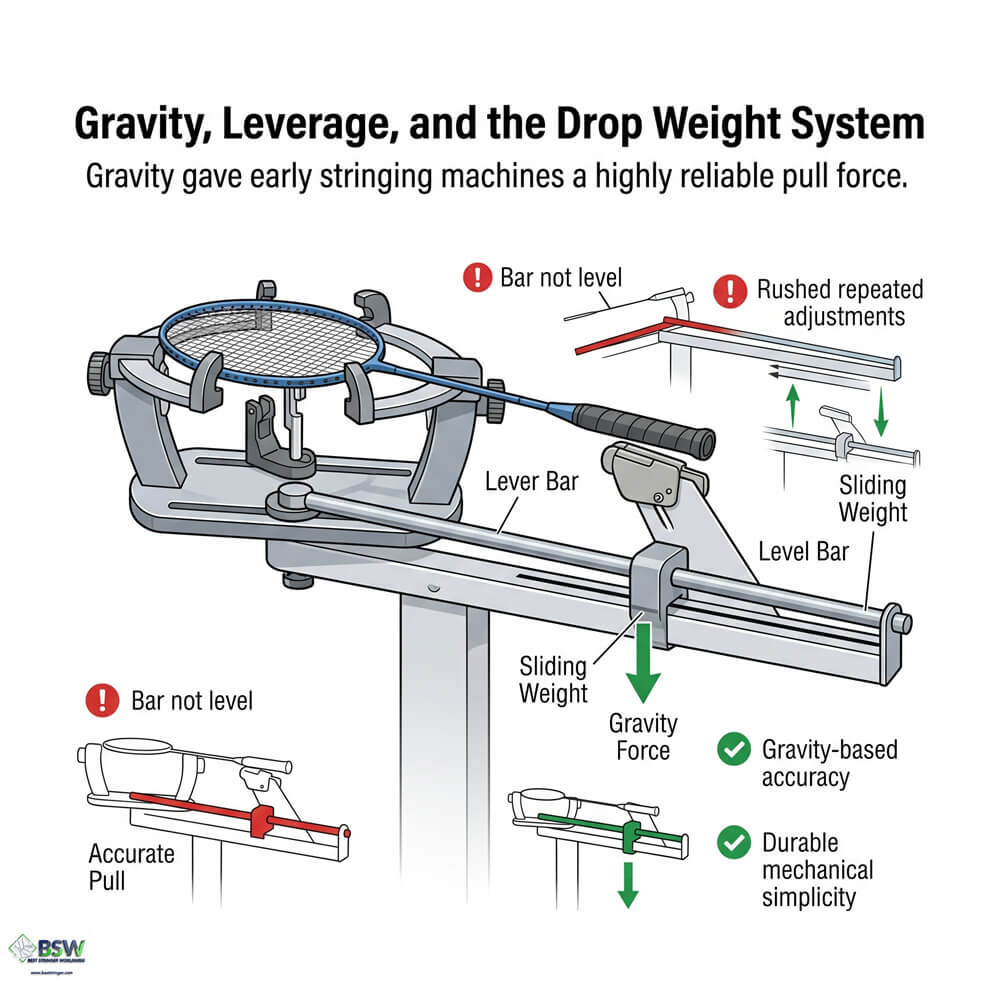
1.3 The Drop Weight Era
Gravity, Leverage, and the Drop Weight System
The introduction of the drop weight stringing machine marked a major turning point in racquet stringing history. By utilizing gravity and a heavily leveraged weight sliding along a fixed bar, these early machines brought a much-needed level of objective consistency to the developing workshop.
A drop weight machine is elegantly simple. Gravity provides a repeatable force, but practical pull accuracy still depends on correct bar angle, calibration, machine condition, mounting, clamps and operator technique. However, the manual process of repeatedly lifting, dropping, and micro-adjusting the weight makes it noticeably slower and more labor-intensive than later mechanical inventions.
Despite their age, drop weight stringing machines are far from obsolete. They remain historically important and may suit beginners, traveling players or low-volume workshops that value mechanical simplicity. Buyers should compare calibration, mounting, clamps, parts support and workflow in our guide to choosing a stringing machine and tools.
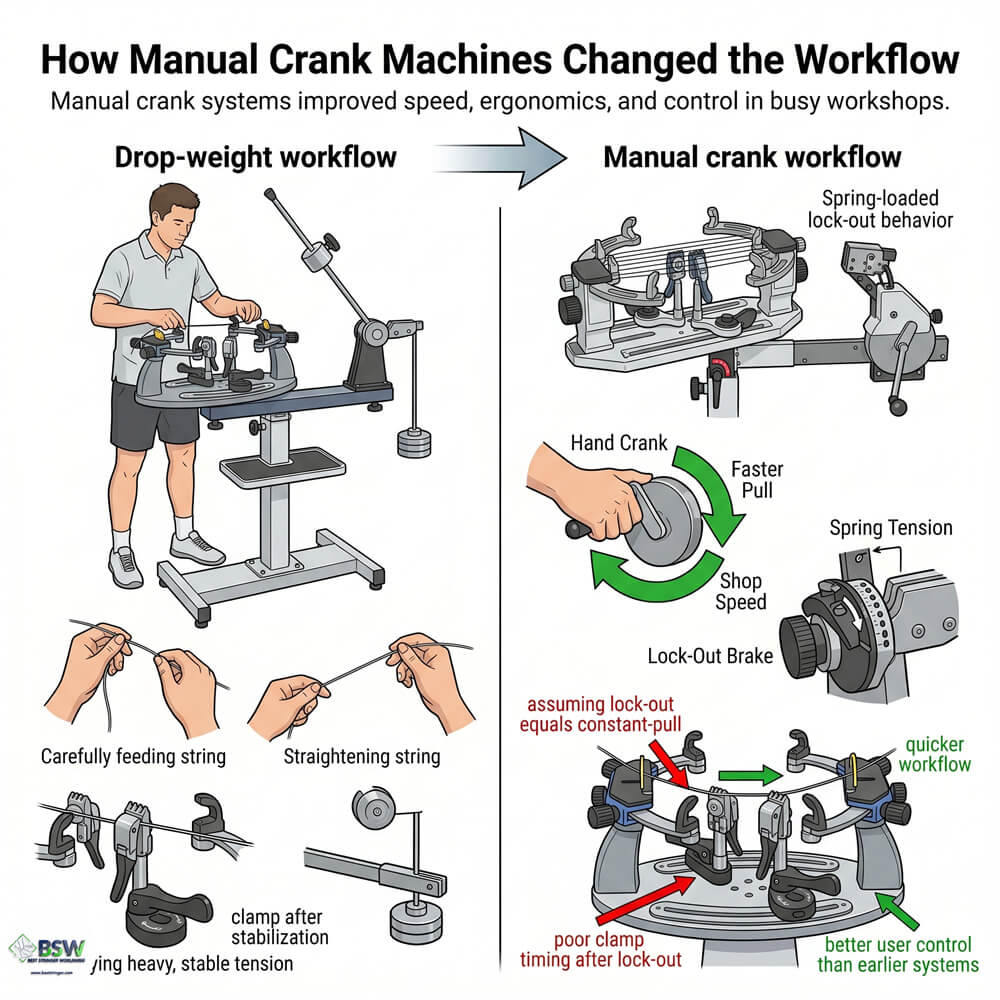
1.4 The Manual Crank Revolution
How Manual Crank Machines Changed the Workflow
As composite racquets allowed for stiffer frames and higher tension demands, the manual crank stringing machine emerged as a vital workflow revolution. By turning a hand crank to pull the string until a spring-loaded brake locked in place, stringers dramatically increased their speed and efficiency.
The Lock-Out System. This lock-out mechanism meant that once the exact target tension was reached, the pulling head stopped completely. It held the string steady while the clamp was secured, securing tension rapidly.
A Major Step Forward. Compared with repeatedly resetting a drop-weight bar, lock-out crank systems could improve workflow and operator control. Their adoption varied by period, workshop, market, budget and machine availability; they should not be described as a universal professional standard without historical evidence.
Educational Importance. For anyone taking a badminton stringing course today, studying the manual crank era is essential. It teaches how lock-out behavior differs from constant-pull operation. Review the separate guide to racquet stringing machine tension systems; actual stringbed results also depend on calibration, string, clamps, technique and timing.
1.5 The Electric Era
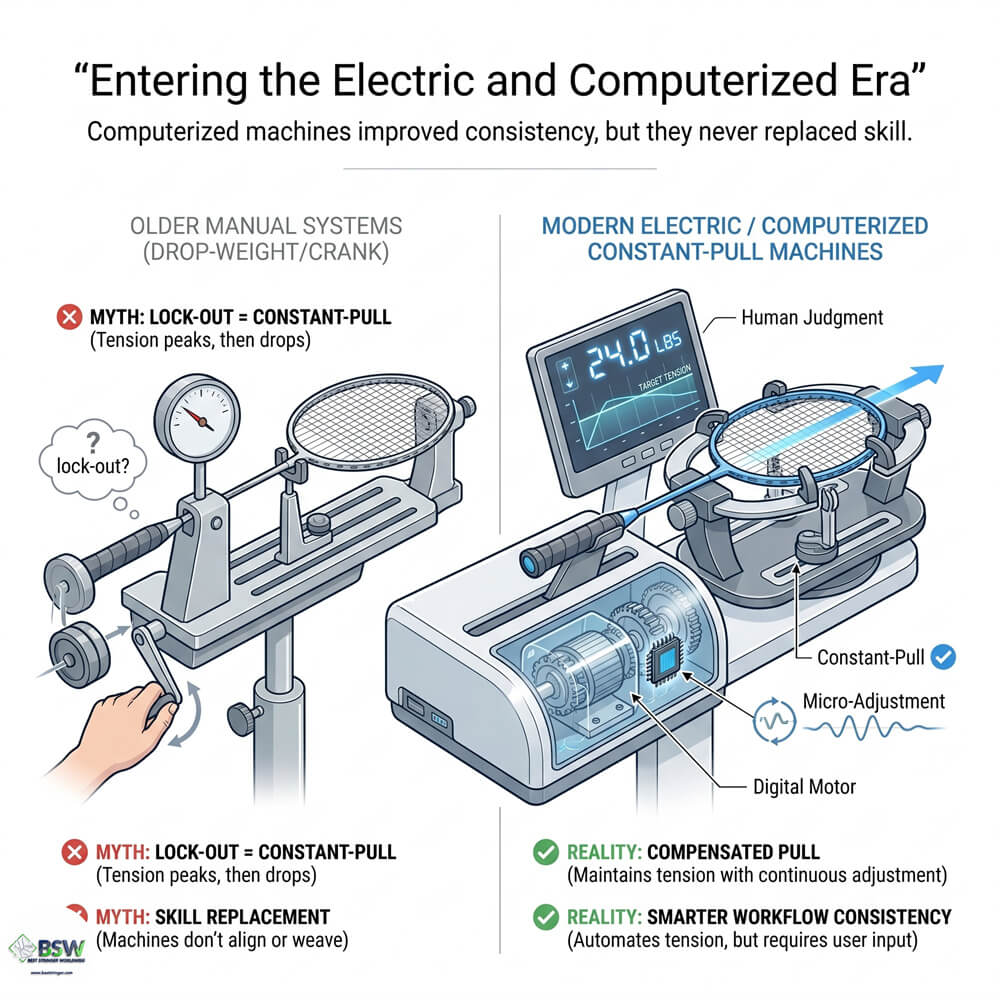
Entering the Electric and Computerized Era
Mistake 1: Assuming Simple Means Inaccurate.
It is a common misconception that older drop weight or manual crank systems are inherently inaccurate. They simply require different techniques. A skilled stringer can produce excellent results on a manual machine if they truly understand its mechanical behavior.
Mistake 2: Confusing Lock-Out with Constant-Pull.
A manual crank is generally a lock-out system: it stops active pulling after reaching the set tension. Electric and computerized machines may use constant-pull or lock-out behavior depending on the model. Constant-pull systems continue adjusting while the string stretches before the clamp system secures it.
Mistake 3: Believing Machines Replace Skill.
Computerized controls can improve repeatability when a machine is calibrated and maintained, but they do not replace human judgment. Safe mounting depends on the machine design and correct setup; see the anatomy of a stringing machine. Weaving crosses, using clamps and tying knots still depend on stringer technique.

1.6 The Global Machine Market
Understanding Production Centers and Market Scale
To fully grasp machine history, a professional stringer must understand the global manufacturing context. Use this practical framework when researching equipment:
Step 1: Understand Market Scale. The global stringing machine market is a highly niche industry. Unlike consumer electronics, stringing machines are produced in low volumes. This fundamental economic reality is why stringing machines are expensive, even when their core pulling principles are relatively straightforward to understand.
Step 2: Verify Manufacturing History. Machine labels, distributors and component origins can change across models and periods. Use manufacturer archives, patents, manuals and dated catalogues before attributing a machine to a production center or claiming that models were rebranded.
Step 3: Treat Future Trends as Projections. Portability, reliability, interfaces and automation are plausible development areas, but future designs depend on manufacturers, safety requirements, economics and user demand. This page does not predict which technology will become standard.
1.7 Professional Development
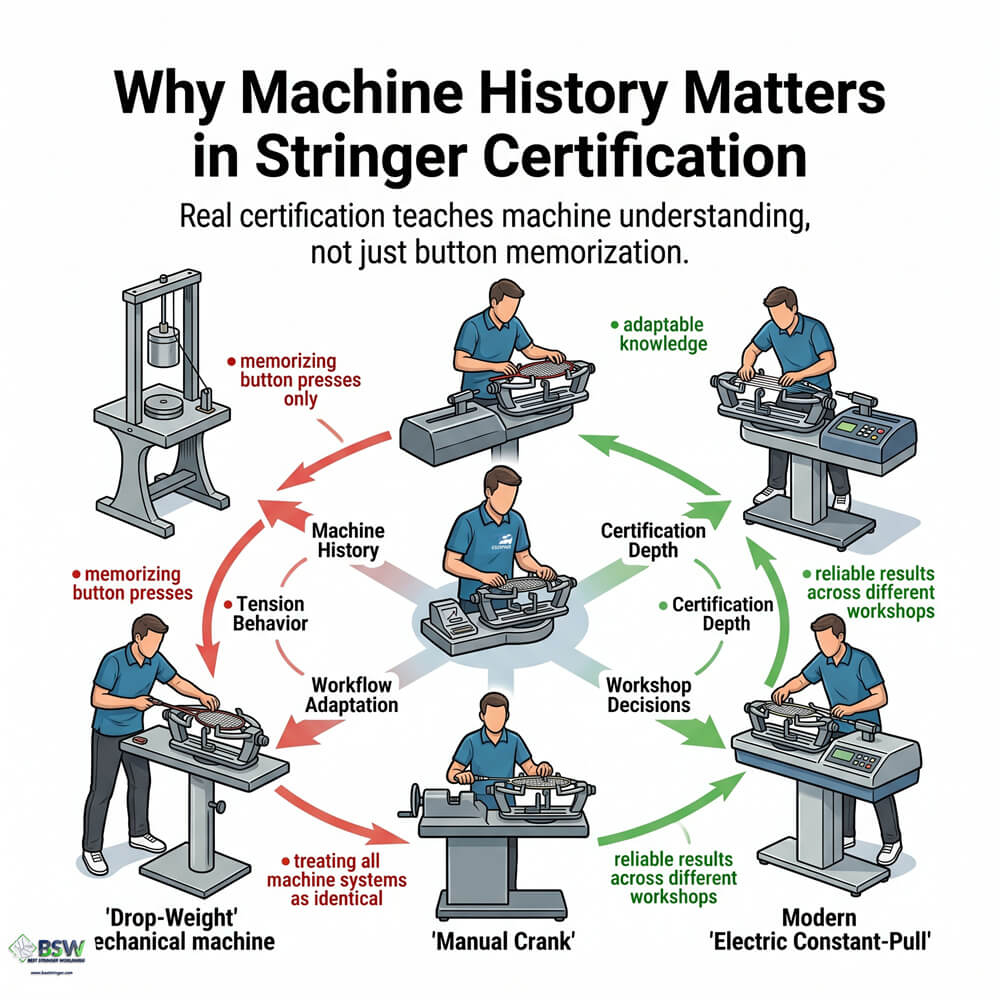
Why Machine History Matters in Stringer Certification
Understanding the history of stringing machines is a vital component of any serious badminton stringing certification. A well-rounded education goes beyond simply memorizing button presses on a new computerized machine; it builds a deep understanding of how tension is actually applied and maintained.
At Best Stringer Worldwide, we teach that equipment evolution directly informs modern stringing techniques. By understanding the mechanical differences between a drop weight, a manual crank, and an electric pull head, a certified stringer can adapt their workflow intelligently to any workshop environment.
This historical and technical grounding is what truly elevates stringer certification. It ensures that professionals can make smart workshop purchasing decisions, confidently explain tension behavior to players, and consistently deliver high-quality string jobs regardless of the machine era they are operating.
Stringing Machine Evolution Quick FAQ
Quick, definition-first answers to common questions about the history and development of stringing machines.
What was used before stringing machines existed?
Before machines, early manual stringing involved raw hand pulling and the use of awls to secure natural gut strings. This method was labor-intensive but functional for the softer wooden racquets and much lower tension requirements of the era.
Why were drop weight machines so important?
Drop weight machines introduced mechanical leverage and a repeatable gravity-based reference. Their consistency depends on correct bar angle, calibration, clamps, machine condition and operator technique, so no machine type is automatically accurate in every workshop.
How did manual crank machines change the workflow?
Manual crank machines changed workflow by using a lock-out mechanism instead of repeatedly resetting a drop-weight bar. Possible speed and ergonomic benefits depend on machine design, setup, maintenance and operator technique.
Why are computerized machines different?
Modern electric and computerized machines can use constant-pull or lock-out control depending on the model. A constant-pull design continues sensing and adjusting during string stretch before clamping, subject to calibration and the machine’s control logic.
What is the difference between lock-out and constant-pull?
A lock-out system pulls to the target tension and completely stops, holding the string static. A constant-pull system reaches the target tension but continues to sense slack, gently pulling again if the string begins to stretch during the clamping process.
Why are stringing machines expensive even if simple?
The core mechanical principles are simple, but the market is highly niche. Because global production volumes for stringing machines are very low compared to consumer appliances, the specialized tooling and development costs remain relatively high.
What is the future of stringing machine development?
Full automation is unlikely soon due to massive variations in racquet shapes and weave patterns. Future development is far more likely to focus on reliable simplicity, improved portability, smarter mounting interfaces, and easier long-term maintenance.
Why does machine history matter in certification?
A comprehensive badminton stringing course teaches history so stringers truly understand tension dynamics. Knowing the difference between drop weight, lock-out and constant-pull helps a stringer adapt technique and evaluate results. Accuracy still requires model-specific setup, calibration, maintenance and verification.
Can a great machine replace a certified stringer?
No. A computerized machine may provide repeatable pulls when correctly calibrated and maintained, but price alone does not prove accuracy. Safe mounting, weaving, clamping and knotting still depend on the machine, string and stringer technique.
The Evolution of Tension: Lock-Out vs. Constant-Pull
Why The Same Tension Feels Different
Explore an educational illustration of how lock-out and constant-pull systems respond to string stretch. The displayed motion and hardness result are conceptual, not calibrated measurements or universal outcomes for every machine, string or clamping delay.
Proven Development Principles
Our educational approach is built on a deep understanding of machine evolution. We prioritize practical workshop knowledge, system mechanics, and professional accuracy over pure technological hype.
| Machine Era / Type | Primary Advantage | Typical Use Context |
|---|---|---|
| Early Manual Stringing | Requires minimal equipment and physical space. | Historical origins, before widespread machine availability. |
| Drop Weight Systems | High durability and mechanical simplicity. | Home stringers and early professional workshops. |
| Manual Crank Systems | Changed workflow and may improve speed or ergonomics, depending on design and use. | Used by many workshops during parts of the machine’s history; adoption varied by market and period. |
| Electric Lock-Out | Motorized pulling reduces physical fatigue. | Transitional setups seeking workflow efficiency. |
| Modern Computerized | Constant-pull compensation can improve repeatability when calibrated and maintained. | High-volume modern professional stringing. |
| Future Development | Focus on portability, reliability, and ease of use. | Next-generation professional workshop integration. |
Master Machine Dynamics with Best Stringer Worldwide
Ready to upgrade your stringing education? Best Stringer Worldwide offers professional stringing courses to teach you how different machine generations and tension systems affect your work. We serve badminton and tennis stringers worldwide especially in Singapore, Hong Kong, Malaysia, Indonesia, UK, France and Europe. Contact us to elevate your stringer certification journey.