1.1 Equipment Fundamentals
The Ultimate Badminton Racket Selection Guide
Proper racquet selection for badminton refers to the systematic process of matching a frame’s physical characteristics to your unique biomechanics, swing speed, and playing role. Because every player’s physical capability and court positioning differ, there is simply no single racquet that fits everyone; a head-heavy frame that delivers booming rear-court power for a singles player might feel sluggish and detrimental to a doubles player who relies on rapid front-court defense. To help you master how to choose a badminton racket, understanding how these variables interact is critical to preventing discomfort and maximizing performance.
Use this compact decision framework to ensure a stringing-aware selection:
Step 1: Assess your player level and swing speed consistency honestly to determine your baseline power needs.
Step 2: Define your primary playing role, identifying whether you need doubles speed for defense or singles stability for sustained clears.
Step 3: Select your ideal balance point first, followed by shaft stiffness, and finally your overall weight class (such as 3U or 4U).
Step 4: Choose a comfortable grip size (typically G4, G5, or G6) while keeping in mind that you can always build it up with an overgrip for quick grip-change agility.
Step 5: Use stringing specifically your tension preference and gauge to fine-tune the racquet’s feel, always respecting the maximum tension limits printed on the cone.

1.2 Racket Weight & Balance
Racket Specs Explained: 3U vs 4U Weight and Balance
Badminton racket weight is universally categorized using the ‘U’ system, where a higher number denotes a lighter overall frame. When debating 3U vs 4U, understand that a 4U racket (around 80-84g) is considered the modern standard starting point, offering fast swing speed and reduced arm fatigue. Conversely, a 3U racket (85-89g) provides more physical mass for incredible stability and heavy momentum during full-body smashes. Always verify the manufacturer specs, as these slight weight variances drastically alter how the frame performs under pressure.
Balance point refers to the weight distribution across the frame’s length, and choosing between head heavy vs head light vs even balance fundamentally changes your swing timing. Head-heavy rackets generate maximum momentum for rear-court power but can feel sluggish and slow down defensive reaction times at the net. Head-light rackets concentrate mass near the handle, making them incredibly fast for doubles drives, net kills, and rapid defense. Even-balance rackets offer a versatile, all-around compromise for players who transition frequently between attacking and defending.
Because of these distinct traits, your discipline matters. For doubles players needing high-speed interception, a 4U head-light or even-balance frame is generally preferred to maintain front-court dominance. Singles players often benefit from the extra mass and leverage of a 3U or head-heavy racket to sustain baseline-to-baseline clears and dictate a heavier pace.

1.3 Stiffness & Head Size
Understanding Stiff vs Flexible and Head Size
Racket stiffness is a critical yet commonly misunderstood specification in any racket selection guide. A stiff shaft provides maximum energy transfer, zero power loss, and pinpoint precision, but it demands advanced timing and highly explosive swing speed. If you lack solid technique, a stiff vs flexible shaft debate ends instantly: an overly stiff shaft “punishes” inconsistent players by feeling dead, causing weak clears, and risking severe forearm discomfort due to harsh shock vibrations.
Conversely, a flexible or medium-flexible shaft is highly forgiving. It acts like a natural slingshot, storing and releasing energy smoothly to help beginners and intermediate players effortlessly clear the shuttle deep into the backcourt, even if their swing action is slightly slow or flawed. Choosing medium stiffness is often the safest bridge for improving players.
Head size and string pattern density also play a massive role in the balance of forgiveness versus precision. An isometric (squarish) head size creates a larger, more forgiving sweet spot for off-center hits, keeping the shuttle in play during defensive scrambles. Traditional oval heads prioritize ultimate precision but require you to hit the dead center of the stringbed consistently, making them strictly suited for highly advanced users.
1.4 Gauge & Tension Basics
Stringing-Aware Selection: Tension Preference and Gauge
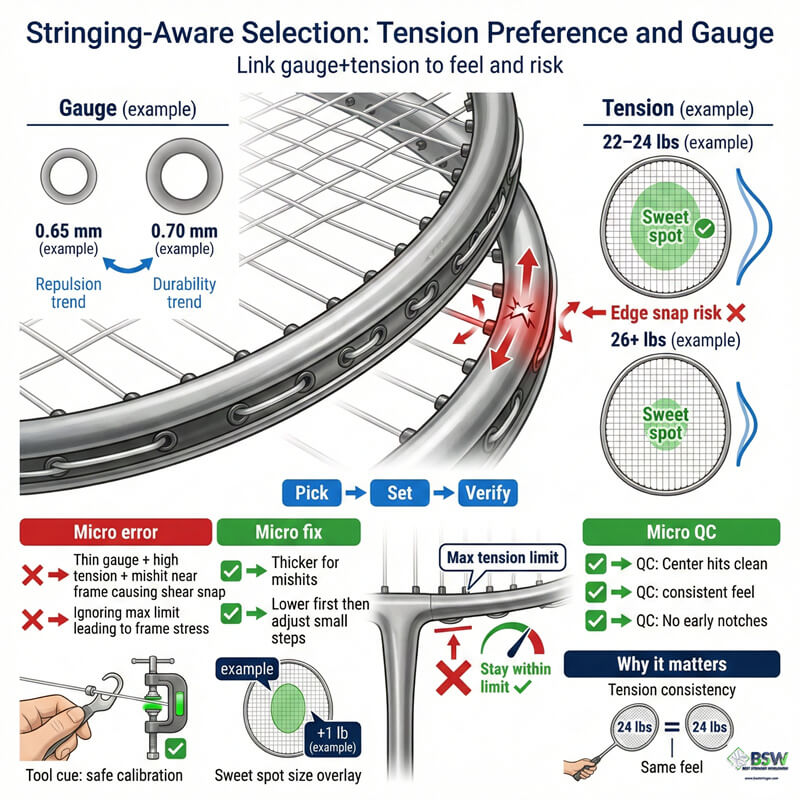
Proper racquet selection for badminton does not end with the frame; string gauge and tension fundamentals dictate how your stringbed behaves upon impact. A truly stringing-aware setup aligns these choices with your frame’s capabilities and your personal accuracy.
What is String Gauge? Gauge refers to the physical thickness of the badminton string, measured in millimeters (mm). Standard gauges vary drastically in performance and durability.
Thin vs Thick Trade-off. Thin strings (e.g., 0.65mm or 0.66mm) offer incredible repulsion, a highly satisfying aerodynamic hitting sound, and unmatched tactile feel for net shots. Thick strings (e.g., 0.68mm or 0.70mm) naturally sacrifice a bit of that crisp repulsion for robust durability, making them highly cost-effective for frequent players who mishit occasionally.
Tension Preference Basics. Tension refers to how tightly the strings are pulled, and it acts as the master dial for forgiveness vs control. Always check the maximum tension rating printed on your racket’s cone to prevent frame collapse. Higher tension (26+ lbs) yields tight control and a crisp feel, but ONLY if your sweet spot contact is highly consistent. Low tension (22-24 lbs) acts like a trampoline, boosting effortless power for slower swings while expanding the sweet spot.
The Sweet Spot Risk. High tension inherently creates a much smaller, unforgiving sweet spot. If you mishit near the rigid frame on a high-tension stringbed especially when using a thin gauge string the concentrated shear force will snap the strings almost immediately.
1.5 Common Mistakes
Common Racquet Selection Mistakes
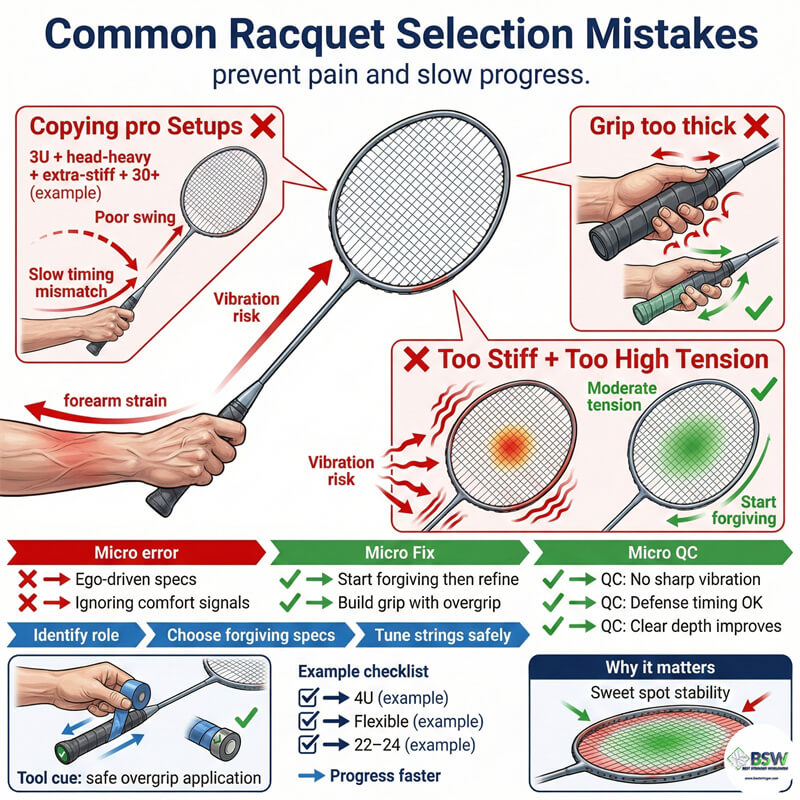
Mistake 1: Copying Pro Setups.
Using a heavily head-heavy, extra-stiff 3U racket strung at 30+ lbs just because an elite singles player uses it is a guaranteed way to destroy a beginner’s timing. This setup is highly demanding, completely hinders stroke progress, and risks severe shoulder and arm discomfort.
Mistake 2: Ignoring Grip Size Adjustments.
Buying a racket with a grip that is too thick directly out of the factory restricts your finger mobility. Always start with a smaller grip size (such as G5 or G6) so you can strategically build it up with a towel or polyurethane overgrip. This adjustment allows for rapid grip changes during fast rallies.
Mistake 3: Too Stiff + Too High Tension.
If your racket is too stiff and your tension preference is set too high, you have zero “trampoline effect” to assist your shots. This rigid combination severely punishes poor timing, resulting in incredibly weak clears, slow drives, and rapid forearm fatigue due to excessive vibration.
1.6 Selection Framework
Beginner-Safe Equipment Selection Path
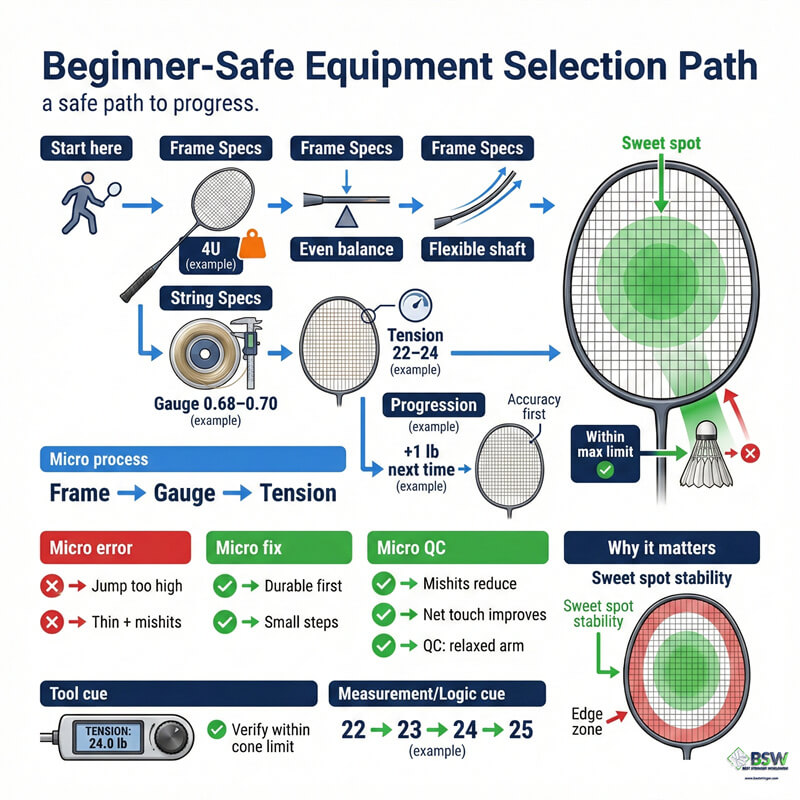
A step-by-step decision flow is crucial for progressing safely in badminton without developing bad habits. Do not let ego dictate your specs; use this simple, beginner-safe equipment selection path to find your perfect fit:
Step 1: Player Level to Racket Trait. Beginners and intermediate players should start with a 4U weight class, an even-balance or slightly head-heavy profile, and a decidedly flexible shaft. This proven combination maximizes forgiveness, prevents shoulder fatigue, and actively helps you develop proper, relaxed stroke mechanics.
Step 2: String Gauge Direction. Start with a medium or thick string gauge (0.68mm – 0.70mm). This logical choice provides necessary durability and cost-effectiveness while you are still learning to hit the shuttle accurately in the center of the stringbed without framing it.
Step 3: Tension Adjustment Logic. Start at a safe, forgiving tension (22-24 lbs). If you mishit often, lower the tension to increase the sweet spot. If you hit clean consistently and desire more crisp touch at the net, make a small 1 lb increase on your next restring. Never exceed your racket’s printed maximum tension limits.
1.7 Further Learning
Fine-Tuning With Professional Stringing
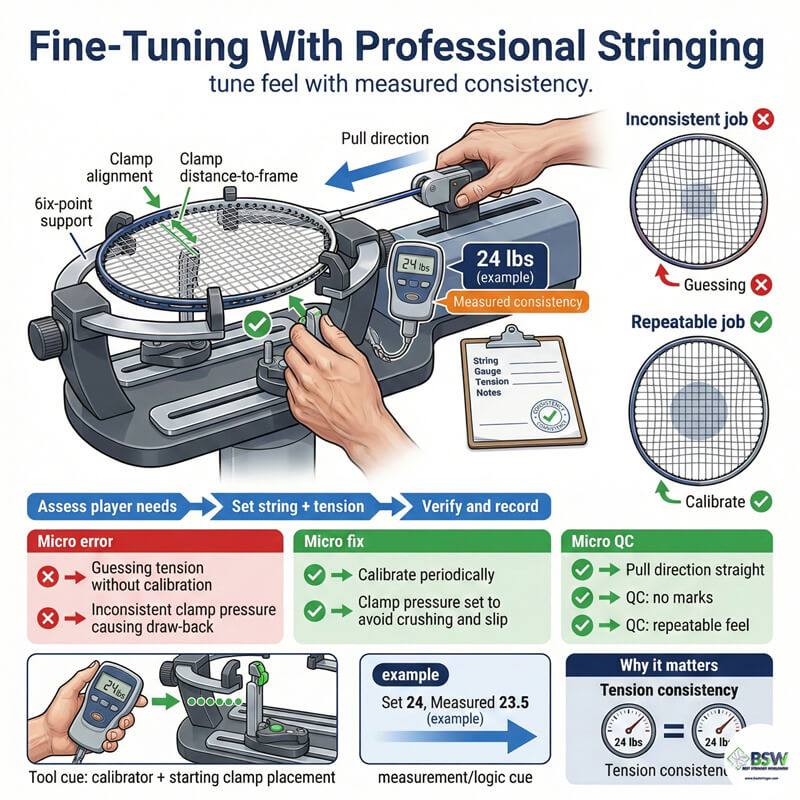
Professional badminton stringing educators understand what average players usually miss: racquet selection is only halfway complete until the stringbed is tuned. The magic is not just in buying the most expensive, heavily marketed racket, but in the precise consultation logic matching string type and tension preference to your current biomechanics.
At Best Stringer Worldwide, we prioritize helping all player levels achieve true equipment decision accuracy. A good stringer provides clear, testable guidance, ensuring your entire setup directly supports your growth, whether you play fast-paced doubles or tactical singles, completely avoiding brand hype.
We heavily emphasize measurement consistency. A 24 lbs string job should feel exactly like 24 lbs every single time you step on the court. By mastering these equipment fundamentals, you eliminate random variables, protect your arm from severe discomfort, and can focus purely on improving your technical game.
Racquet Selection Quick FAQ
Quick, definition-first answers to common questions about badminton racket and string basics.
What does racquet selection for badminton mean?
Proper racquet selection for badminton refers to the systematic process of matching a frame’s specific physical parameters such as weight distribution, shaft flexibility, and grip size to your individual swing mechanics, physical strength, and primary playing style. It ensures you have the right tool to enhance your natural movement rather than fighting against an incompatible frame.
Head heavy vs head light: which suits doubles roles?
For doubles players, a head light or even balance racket is generally the superior choice. The fast-paced nature of doubles requires rapid defensive reaction times, quick mid-court drives, and instant racket preparation at the net, all of which are perfectly supported by a frame that concentrates its weight closer to the handle.
Stiff vs flexible: what should beginners choose?
Beginners should always choose a flexible or medium-flexible shaft. A flexible shaft acts like a natural slingshot, storing and releasing energy effortlessly to help newer players generate sufficient power for baseline-to-baseline clears, even if their swing speed is relatively slow or their technique is still developing.
What does 3U/4U mean and how does it affect speed?
The ‘U’ classification defines the racket’s overall weight class, where a higher number indicates a lighter frame. A 4U racket (80-84 grams) provides excellent speed and maneuverability for defense and fast exchanges, whereas a 3U racket (85-89 grams) offers more overall mass, delivering higher stability and heavier momentum for powerful smashes.
What grip size should I start with?
Most players should start with a standard G5 (smaller) or G4 (medium) grip size. It is strategically smarter to buy a smaller grip because you can easily customize the thickness and comfort by wrapping one or multiple overgrips around the handle. A grip that is too large right out of the factory will restrict your finger mobility.
Singles vs doubles: do I need different racquets?
While not strictly mandatory for recreational play, specialized equipment traits greatly benefit specific disciplines. Singles players often prefer slightly heavier or head-heavy racquets (like a 3U) to generate sustained power from the backcourt. Conversely, doubles players typically prioritize speed, favoring 4U head-light or even-balance racquets for rapid exchanges.
How does tension preference affect choice?
String tension preference heavily dictates your racket’s performance and must align with your racket’s structural limits (max tension). While lower tensions (22-24 lbs) maximize the sweet spot and forgiveness, higher tensions (26+ lbs) increase control but shrink the sweet spot, causing severe discomfort if paired with an overly stiff racket.
What are the most common selection mistakes?
The most common mistake is purchasing an ultra-stiff, head-heavy racket strung at a highly demanding tension (28+ lbs) simply because a professional uses it. This setup punishes off-center hits and can lead to significant arm discomfort. To avoid this, prioritize a forgiving flex and use a safe, moderate string tension to aid your development.
What is the simplest beginner-safe selection path?
The simplest beginner-safe selection path involves choosing a 4U weight class, a flexible shaft, and an even-balance frame. Pair this forgiving racket with a thicker string gauge (like 0.68mm) strung at a low, safe tension (22-24 lbs) to maximize the sweet spot and minimize arm fatigue while your technique develops.
Equipment Concepts Gallery


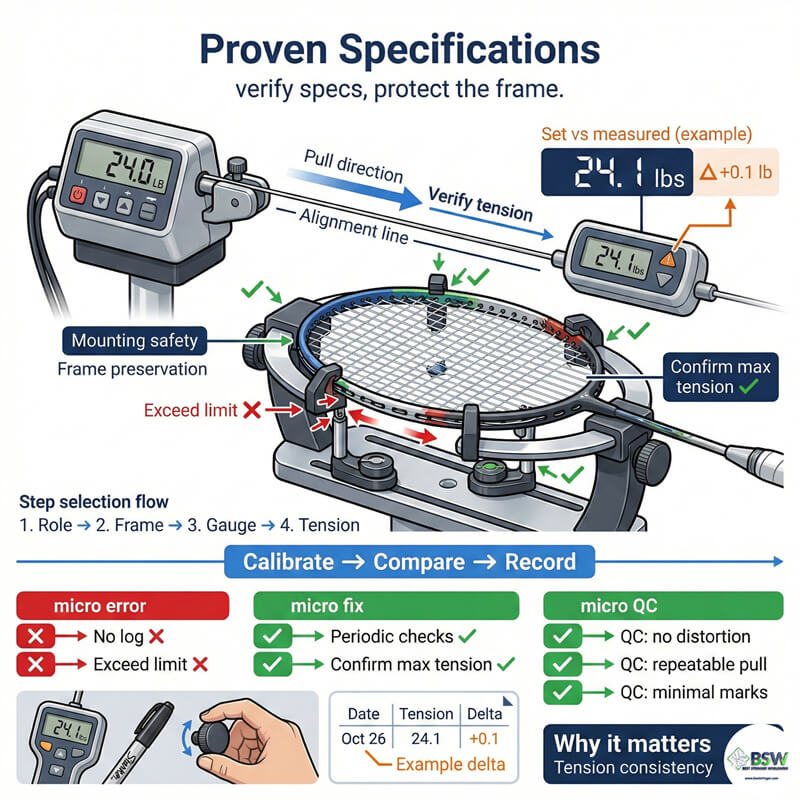
Proven Specifications
Our stringing approach is based on verified equipment parameters used by top professionals. We prioritize arm safety and playstyle efficiency over pure tension hype.
| Racket/String Spec | Trait A (Heavy / Stiff / Thick) | Trait B (Light / Flex / Thin) |
|---|---|---|
| Weight (3U vs 4U) | 3U (85-89g): Superior mass for power & stability. | 4U (80-84g): Fast swing speed for rapid defense. |
| Stiffness (Stiff vs Flex) | Stiff: Pinpoint precision, requires perfect timing. | Flexible: Highly forgiving, easy power for baseline clears. |
| Head Size (Oval vs Iso) | Oval: Maximum precision for touring pros. | Isometric: Larger, more forgiving sweet spot for all players. |
| Balance (Heavy vs Light) | Head-Heavy: Steep angle smashing momentum. | Head-Light: Instant reaction time and rapid maneuverability. |
| String Gauge (Thick vs Thin) | Thick (0.68+): Reliable durability but muted feel. | Thin (0.61-0.66): Incredible repulsion & crisp aerodynamic sound. |
| String Tension (High vs Low) | High (26+ lbs): Superior hold/control, but easily breaks on mishits. | Low (22-24 lbs): Massive sweet spot, excellent trampoline repulsion. |
Master Your Equipment with Best Stringer Worldwide
Ready to upgrade your knowledge? Best Stringer Worldwide offers professional stringing course, certification, consultation to teach you badminton racket and string basics safely. We serve students worldwide especially in Singapore, Hong Kong, Malaysia, Indonesia, UK, France and Europe etc. Contact us to find the perfect tension and gauge for your game.