
1.1 Starting Point
A Learning Path Should Begin With Your Real Experience
The correct starting point is not determined by how long you have played badminton. A coach, shop employee or advanced player may still be a complete beginner at stringing, while a self-taught stringer may already have practical experience but need stronger records, inspection habits or technical explanations.
Before choosing a course, describe what you can currently do without assistance. Have you inspected and mounted a racket? Completed mains and crosses? Used different machines? Recorded a player’s request? Checked a finished job systematically? This information is more useful than calling yourself simply beginner or advanced.
A responsible learning path uses that starting point to decide whether you need foundation education, supervised practice, service development or assessment preparation. It should not force every applicant through the same promise.
1.2 Foundation
Build Racket, String and Machine Fundamentals First
Foundation learning covers racket construction, grommets, string types, gauge, manufacturer instructions, reference tension, machine types, mounting and clamps. These subjects give the learner a reason for each action before speed becomes a priority.
At this stage, the learner should be able to identify when a racket needs closer inspection, explain why one tension number does not suit every player and prepare the machine and tools safely. Model-specific instructions should be checked rather than replaced by memory.
The aim is not to make the beginner sound professional quickly. It is to reduce avoidable errors and create a vocabulary for receiving feedback. A strong foundation makes later practical improvement more efficient because the learner knows what each correction is trying to protect or achieve.

1.3 Guided Practice
Move From Demonstration to Supervised Complete Rackets
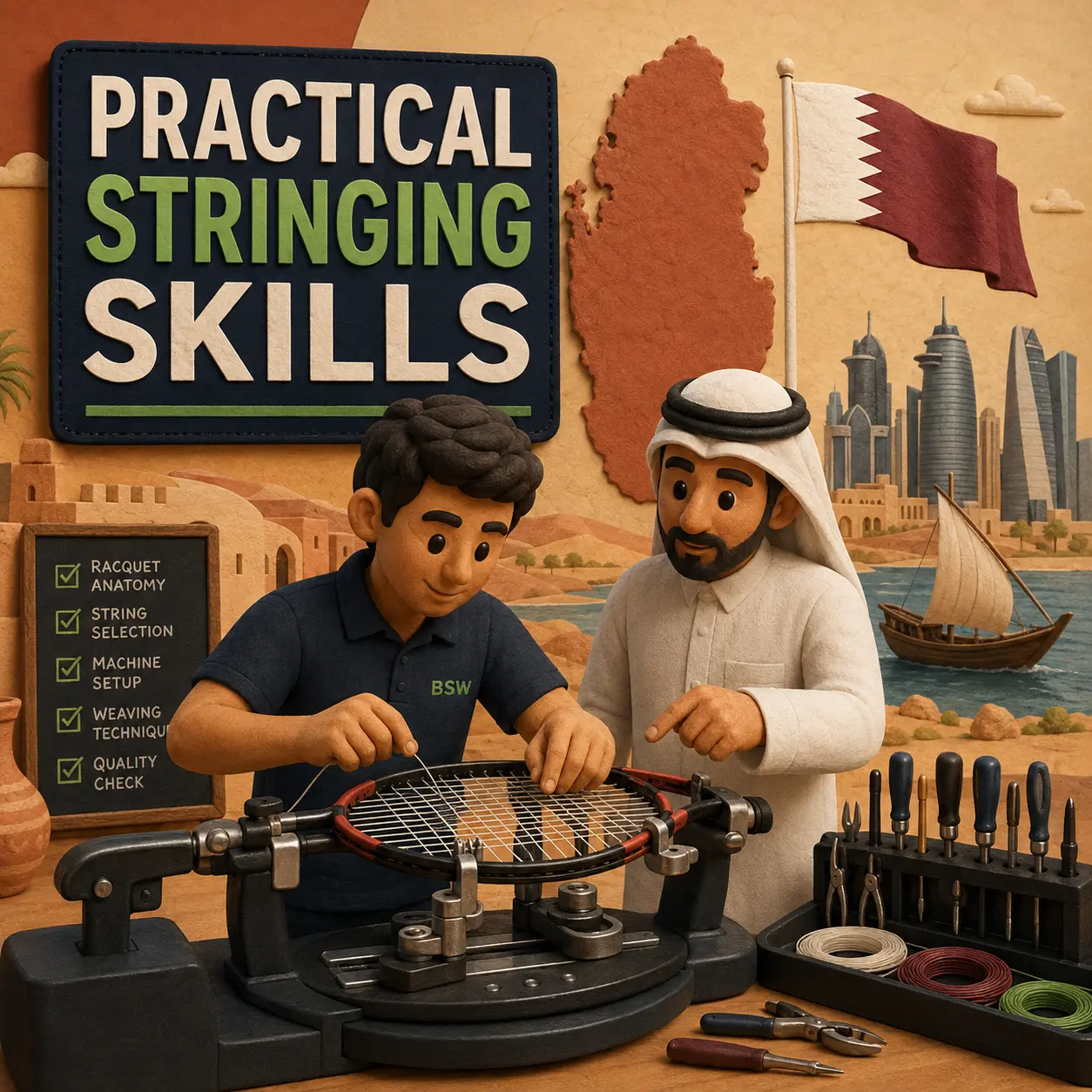
Watching a demonstration is not the same as completing the workflow. Guided practice should allow the learner to mount the frame, install mains, weave crosses, manage friction, use clamps, finish knots and inspect the job while an instructor can identify specific errors.
The learner should repeat complete rackets rather than practise isolated motions forever. Each job can be recorded with the racket, string, machine setting, issues found and improvements needed. This turns practice into evidence instead of relying on a general feeling of confidence.
Speed is secondary at this stage. A slower controlled job is more useful than a fast job with missed weaves, inconsistent clamps or poor inspection. The next stage should begin when the process is becoming repeatable, not after a fixed number of hours alone.
1.4 Service Consistency
Develop Consultation, Records and Quality Control
Once the learner can complete rackets, the path should expand into professional service. This includes recording the player’s request, checking previous setup, gaining approval for changes, inspecting existing damage and explaining the completed work.
Consistency can be reviewed through records. The stringer should be able to compare similar jobs, identify recurring mistakes and repeat an approved setup without guessing. Final checks should cover the frame, grommets, pattern, knots, cleanliness and handover notes.
Shop staff and independent stringers also need realistic turnaround promises and clear boundaries. They should know when to pause, seek advice or decline a risky request. Professional service is not defined only by finishing a racket; it includes how responsibility is managed before and after the machine work.

1.5 Assessment Preparation
Prepare for the Requirements of a Specific Certification
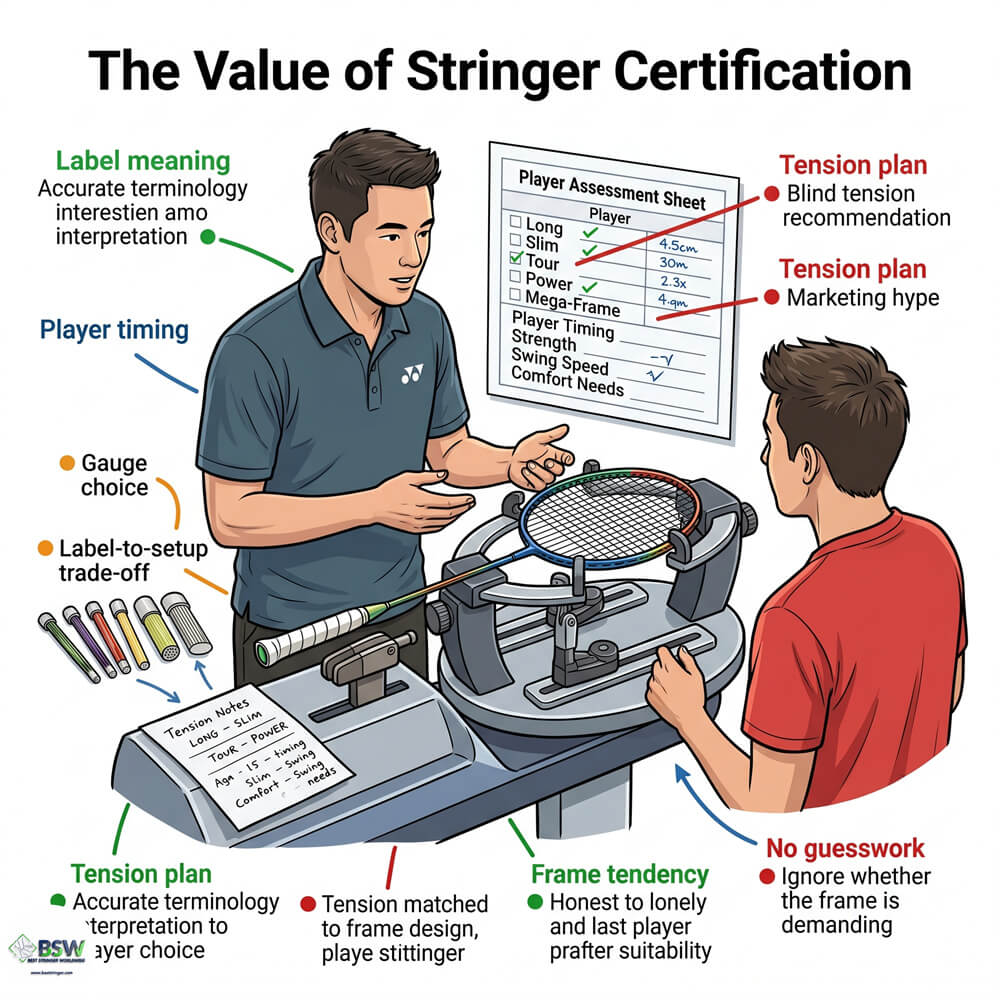
Certification preparation starts by identifying the exact credential and its requirements. The candidate should understand the theory, practical tasks, time conditions, equipment rules, quality criteria and professional standards that will be assessed.
Practice should then target the gaps. A candidate who is technically careful but slow may need workflow practice. Another may need better inspection, pattern knowledge, knots or explanation of decisions. Repeating random rackets without reviewing the assessment criteria is inefficient.
Certification organisations separate education from testing for a reason. ERSA sells online courses and certification tests as different products, and USRSA distinguishes lessons from Certified Stringer and Master Racquet Technician credentials. BSW candidates should likewise treat assessment as confirmation of requirements, not a reward for attendance.
1.6 Continuing Development
Certification Is a Milestone, Not the End of Learning
After certification, a stringer still needs to maintain equipment, review model-specific instructions, follow changes in rackets and strings, improve records and learn from difficult service cases. A credential does not make every future decision automatic.
Continuing development may include workshops, advanced courses, shop workflow improvement, tournament service exposure, machine maintenance or mentoring other learners. The next activity should be chosen because it addresses a real responsibility or gap, not only because it adds another title.
A professional learning path therefore has a cycle: learn, practise, review, assess and continue improving. BSW applicants can use the course application to describe where they are in that cycle. The answer may be a foundation course, targeted learning, more independent practice or a certification discussion.
Related BSW Course and Certification Guides
BSW badminton stringing course · How to choose a stringing course · Singapore course fee guide · Malaysia course fee guide · Certification integrity · Current schedule
Badminton Stringing Course Quick FAQ
Direct answers to the questions learners ask before choosing training, practical sessions or certification.
What is the first step in learning badminton stringing?
Begin with racket inspection, strings, reference tension, machine setup, mounting and safe process fundamentals.
How many rackets should I practise before moving on?
There is no universal number. Progress when you can repeat the relevant process safely and review your results with useful records.
When should I start accepting customer rackets?
Only when your technique, inspection, records, communication and quality checks are reliable enough for the responsibility involved.
Do I need a course before certification?
That depends on the certification requirements and your current competence. Ask which preparation route is appropriate.
Can shop experience replace assessment?
Experience is relevant, but it does not automatically replace the requirements of a certification assessment.
Is faster stringing always progress?
No. Speed is useful only when frame protection, consistency and final quality remain controlled.
Can I learn the foundation online?
Some theory can be learned online, but practical handling needs an appropriate way to practise and receive feedback.
What records should I keep while learning?
Record the racket, string, gauge, machine setting and unit, inspection notes, issues and what you will improve next time.
What comes after certification?
Continue developing equipment knowledge, machine care, service records, difficult-case judgment and advanced practical skills.
Master Stringing Methods with Best Stringer Worldwide
Ready to elevate your equipment knowledge? Best Stringer Worldwide offers professional stringing consultation and education to help you understand knot patterns, tension flow, and method execution. We serve badminton players worldwide, especially in Singapore, Hong Kong, Malaysia, Indonesia, UK, France, and Europe. Gain a prestigious stringer certification to confidently select and execute the right methods for players everywhere.