
1.1 Course Structure
What Should a Professional Badminton Stringing Course Syllabus Cover?
A useful badminton stringing course syllabus should explain the complete service process rather than teach one pattern as a shortcut. A learner needs to understand how racket construction, grommet condition, string choice, reference tension, mounting, clamps, weaving, pulling, knots, final inspection and customer records connect.
Professional training should also distinguish learning from certification. A course develops knowledge and practical habits. Certification assesses whether a candidate meets stated requirements. ERSA describes training around practical demonstrations, racket preparation, tension, string type, player needs, workflow and customer service, while its certification material separately emphasizes technical knowledge, practical skill assessment and professional standards.
For BSW applicants in Singapore, Malaysia or elsewhere, the syllabus should be read together with the confirmed intake details. A module list does not by itself confirm teaching days, venue, machine access, included materials, language, fee or assessment arrangements. Those details belong in the current course confirmation before you make travel or work plans.
1.2 Racket Preparation
Racket Inspection, Grommets and Model-Specific Instructions
Before a machine is used, learners should know how to inspect the racket frame, bumper and grommets, identify previous damage, locate shared or blocked holes, remove old string safely and record any concern that requires the player’s approval. This is one of the clearest differences between professional training and a pattern-copying tutorial.
Model-specific instructions matter because badminton rackets do not all share one universal pattern or safe reference range. Yonex publishes product-specific stringing advice, tie-off locations and main/cross instructions for individual models. That is a useful example of why a stringer should check the actual racket information instead of applying a remembered diagram to every frame.
A strong syllabus teaches the learner to separate verified information from assumptions. The racket model, condition and instructions should guide the job. A branded method name or a tension requested by another player should never replace inspection and model-specific judgment.

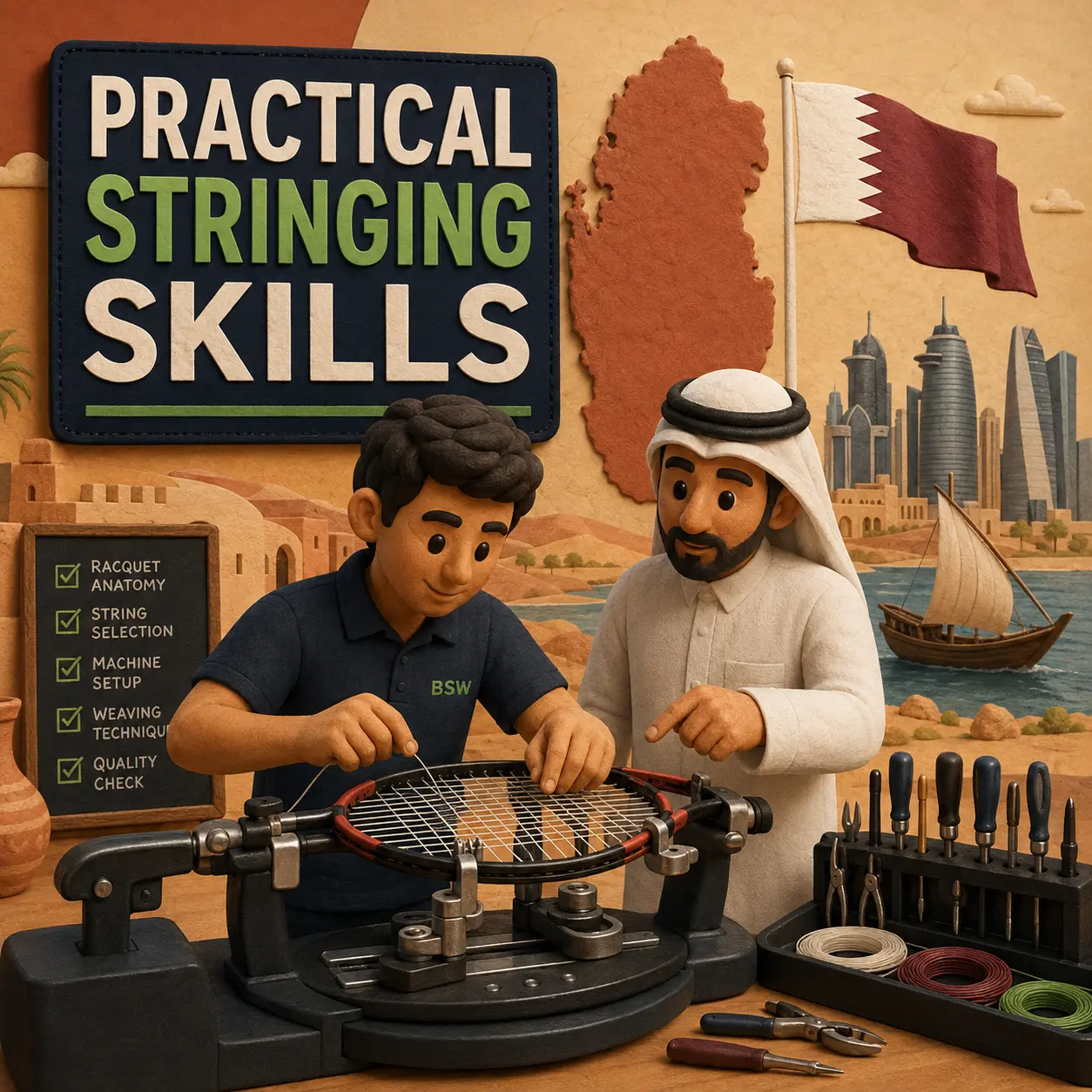
1.3 Machine Skills
Machine Setup, Mounting, Clamps and Calibration Awareness
The machine section of the syllabus should cover more than pressing a tension button. Learners need to understand the mounting system, support placement, clamp adjustment, clamp-base movement, tensioning method, string path and the signs of poor machine setup. They should practise securing the racket without unnecessary pressure and clamping close enough to the frame without damaging the string.
Calibration awareness also belongs in professional education. The exact process depends on the machine and equipment available, but the learner should understand that the displayed setting is part of a system that needs checking and maintenance. USRSA‘s professional resources include machine calibration among the reference topics for racket service professionals. Modern electronic machines may also provide features such as multiple pull speeds, pre-stretch settings and ergonomic clamp systems; those features do not remove the need for correct technique.
The syllabus should help learners compare machine types honestly. Drop-weight, crank and electronic systems can all produce controlled work when maintained and used properly. The machine is a tool; repeatable decisions and handling remain the responsibility of the stringer.
1.4 Player Setup
Strings, Gauges, Tension and Player Consultation
A course should teach how to discuss the setup with the player before choosing a number. Useful questions include the racket model, previous string and tension, what the player liked or disliked, playing frequency, comfort, durability needs and the result they hope to change. This information is more reliable than assuming every beginner, attacking player or professional needs the same setup.
Learners should compare string construction, gauge and intended response without making guaranteed performance claims. They should also understand the difference between a machine reference setting and the playing feel that results from the complete racket, string, machine, technique and environment. Manufacturer stringing advice provides a boundary for the specific model, not a universal recommendation for every player within that range.
This part of the syllabus connects technical knowledge with communication. The stringer records the approved request, explains relevant trade-offs in plain language and avoids changing the setup without consent. Good consultation is a practical skill, not an optional sales conversation.


1.5 Practical Workflow
Mains, Crosses, Knots and Final Quality Control
Practical training should move through a repeatable sequence: prepare the string, mount the racket, install mains, weave and tension crosses, manage friction, use clamps consistently, complete appropriate knots and inspect the finished job. The learner should understand why the sequence matters rather than only memorising hole numbers.
Supervised practice is important because small handling differences can create visible quality problems. Learners should be observed for clamp positioning, string twisting, blocked holes, excessive friction, missed weaves, knot security, straightening and frame protection. The course should create a safe way to identify and correct these issues before the learner accepts responsibility for customer rackets.
A final inspection should review the frame, grommets, string pattern, shared holes, knots, cleanliness and the job record. Finishing the last knot is not the end of the service. Quality control and an accurate handover are part of the professional workflow.
1.6 Professional Standards
Records, Customer Service and Certification Preparation
The final part of a complete syllabus should connect technical work with professional service. Each job record should identify the racket, string, gauge, approved machine setting and unit, date, inspection notes, authorised changes and relevant follow-up. This makes repeat service more reliable and gives the learner evidence for reviewing their own consistency.
Training should also cover clean workspace habits, communication when a racket is unsuitable or damaged, realistic turnaround promises and honest boundaries. A learner who can finish a racket but cannot document or explain the job is not yet providing a complete professional service.
Certification preparation should refer to the actual requirements of the pathway being considered. ERSA separates learning products from certification tests and describes certification in terms of technique, knowledge, practical ability and professional standards. BSW applicants should likewise confirm whether assessment is included, separate or not yet appropriate. Course attendance must not be presented as an automatically awarded certification.

Related BSW Course and Certification Guides
BSW badminton stringing course · How to choose a stringing course · Singapore course fee guide · Malaysia course fee guide · Certification integrity · Current schedule
Badminton Stringing Course Quick FAQ
Direct answers to the questions learners ask before choosing training, practical sessions or certification.
What is the most important part of a badminton stringing course syllabus?
The syllabus should connect inspection, machine setup, string and tension decisions, practical technique, final checks and service records into one repeatable workflow.
Should a course teach only one stringing pattern?
No. A foundation course may use a primary pattern for learning, but learners should understand model-specific instructions and the logic behind the sequence.
Does the syllabus need machine calibration?
It should include calibration awareness and equipment checking, even when the detailed procedure depends on the machine available.
How much hands-on practice should be included?
The current intake should state its practical arrangements. A syllabus is stronger when learners receive supervised repetition and feedback rather than demonstration alone.
Should customer consultation be part of the course?
Yes. String, tension and service decisions should be connected to the player, racket, previous setup and approved request.
Does completing the syllabus make someone certified?
No. Completing learning activities and passing a certification assessment are separate unless the provider explicitly confirms the pathway and requirements.
Can the theory be learned online?
Some knowledge can be studied online, but machine handling and practical consistency still require an appropriate way to practise and receive feedback.
Do beginners need to own a machine first?
Not before enquiring. Confirm what machine access the intake provides and what independent practice will be expected.
How should Singapore or Malaysia learners compare syllabuses?
Compare the curriculum together with the actual venue, timetable, fee, inclusions, machine access, language and assessment arrangements for the selected intake.
Master Stringing Methods with Best Stringer Worldwide
Ready to elevate your equipment knowledge? Best Stringer Worldwide offers professional stringing consultation and education to help you understand knot patterns, tension flow, and method execution. We serve badminton players worldwide, especially in Singapore, Hong Kong, Malaysia, Indonesia, UK, France, and Europe. Gain a prestigious stringer certification to confidently select and execute the right methods for players everywhere.