1.1 Equipment Fundamentals
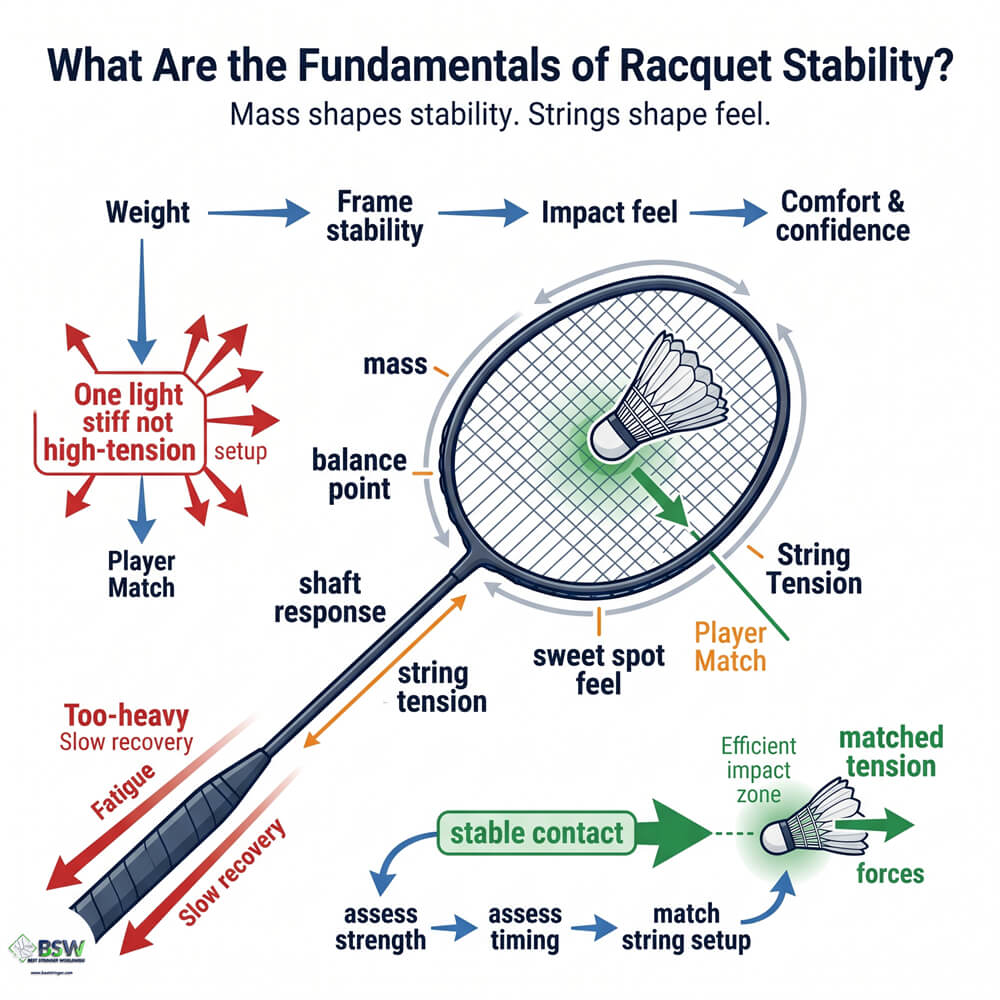
What Are the Fundamentals of Racquet Stability?
Equipment fundamentals refer to how specific racquet characteristics, particularly weight, combine to enhance your impact feel and overall comfort. In this guide, you will learn why a heavier badminton racquet generally produces less unwanted vibration and less frame oscillation under similar conditions, alongside other key specs like balance, stiffness, and string tension.
In short, racquet mass dictates your frame stability, while string choice dictates your touch. Mastering these concepts is crucial for any badminton player aiming to improve, as a racquet that feels more stable can help players experience more solid contact and confident strokes.
Here is a simple decision flow: Step 1: Assess your strength and timing honestly, as heavier does not automatically suit everyone. Step 2: Understand that a stable racket feel is only beneficial if you can swing it without fatigue. Step 3: Consult a certified stringer to select a string gauge and tension that perfectly matches your racquet’s mass and vibration control needs.
1.2 Racket Weight & Balance
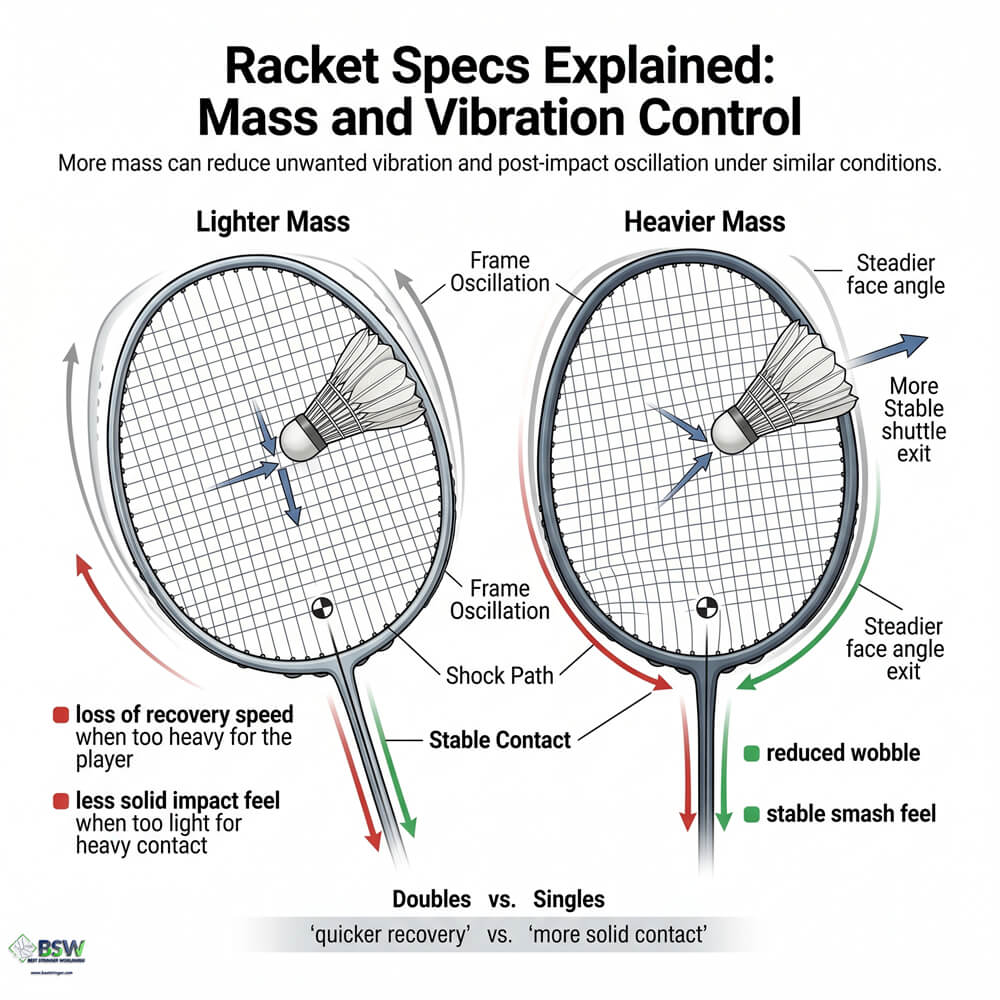
Racket Specs Explained: Mass and Vibration Control
The golden rule of equipment physics is that greater mass can reduce some unwanted vibration felt by the player under similar conditions. It is important to know that vibration and oscillation are related but not the same. Vibration refers more to the shock or buzzing a badminton player may feel in the hand, arm, or grip area after impact. Oscillation refers more to the frame or shaft continuing to move, bend, or wobble after impact.
Adding weight drastically alters how the frame behaves. A heavier 3U racquet (85-89g) provides this extra mass, offering incredible frame stability, stable clears, and a stable smash feel because the heavier frame can also reduce excessive post-impact oscillation. However, if the racquet becomes too heavy for the player’s timing or strength, swing speed and recovery speed may suffer.
A badminton player needs the right balance between comfort, maneuverability, and consistency. For doubles players needing rapid recovery speed, a lighter or head-light frame is generally preferred, even with slightly more vibration. Singles players often benefit from the extra mass and stable racket feel of a heavier racquet for sustained pacing and solid contact.
1.3 Stiffness & Head Size
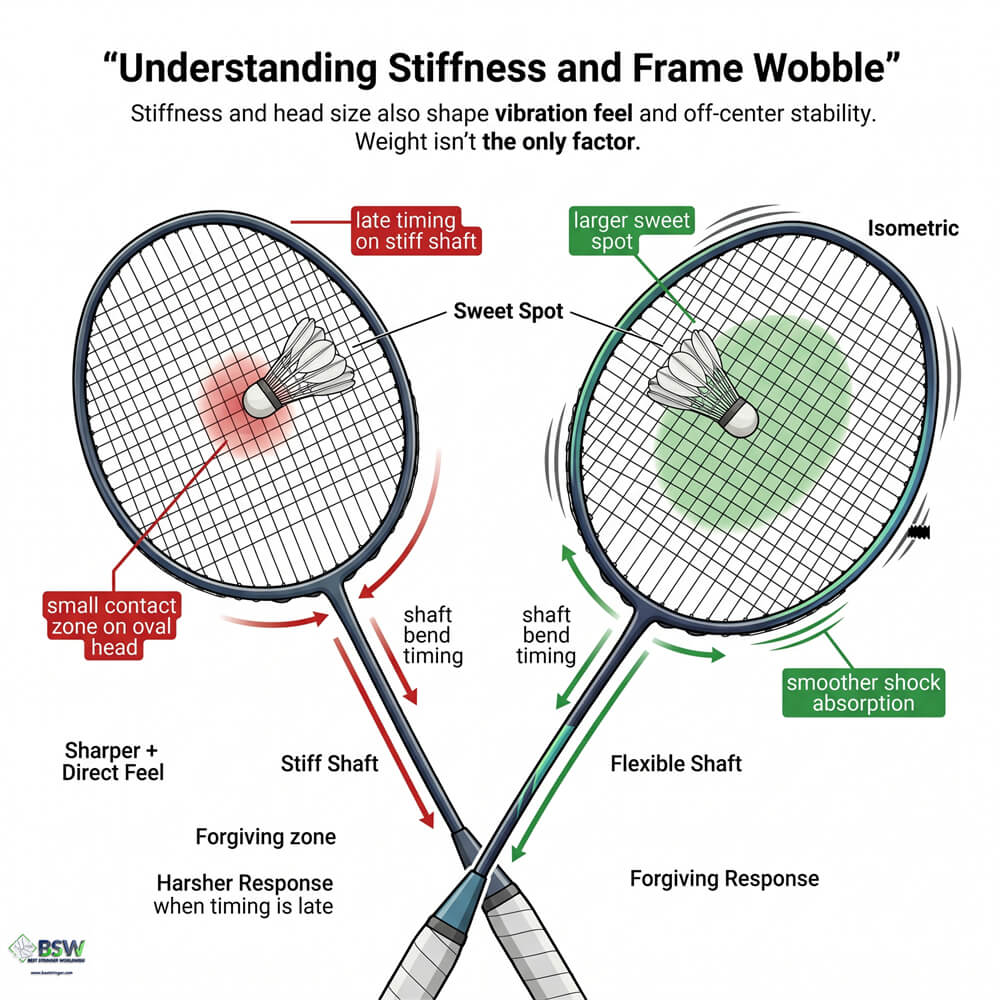
Understanding Stiffness and Frame Wobble
Vibration and oscillation are not determined by weight alone. While a heavier badminton racquet provides the mass for stability, stiffness dictates how direct the impact feel is. A stiff shaft provides maximum energy transfer, but some stiff racquets may feel more direct but harsher, increasing the shock felt in the hand if you lack solid technique.
A flexible shaft is highly forgiving. It acts like a shock absorber, storing energy and dampening badminton racquet vibration smoothly to help players effortlessly clear the shuttle, even if their swing action is slightly slower or less refined.
Head size also plays a massive role in off-centre stability. An isometric (squarish) head size offers a larger sweet spot, ensuring that the stability from your heavier racquet still transfers effectively even on slight mishits, drastically reducing frame wobble and harsh feedback.
1.4 Gauge & Tension Basics
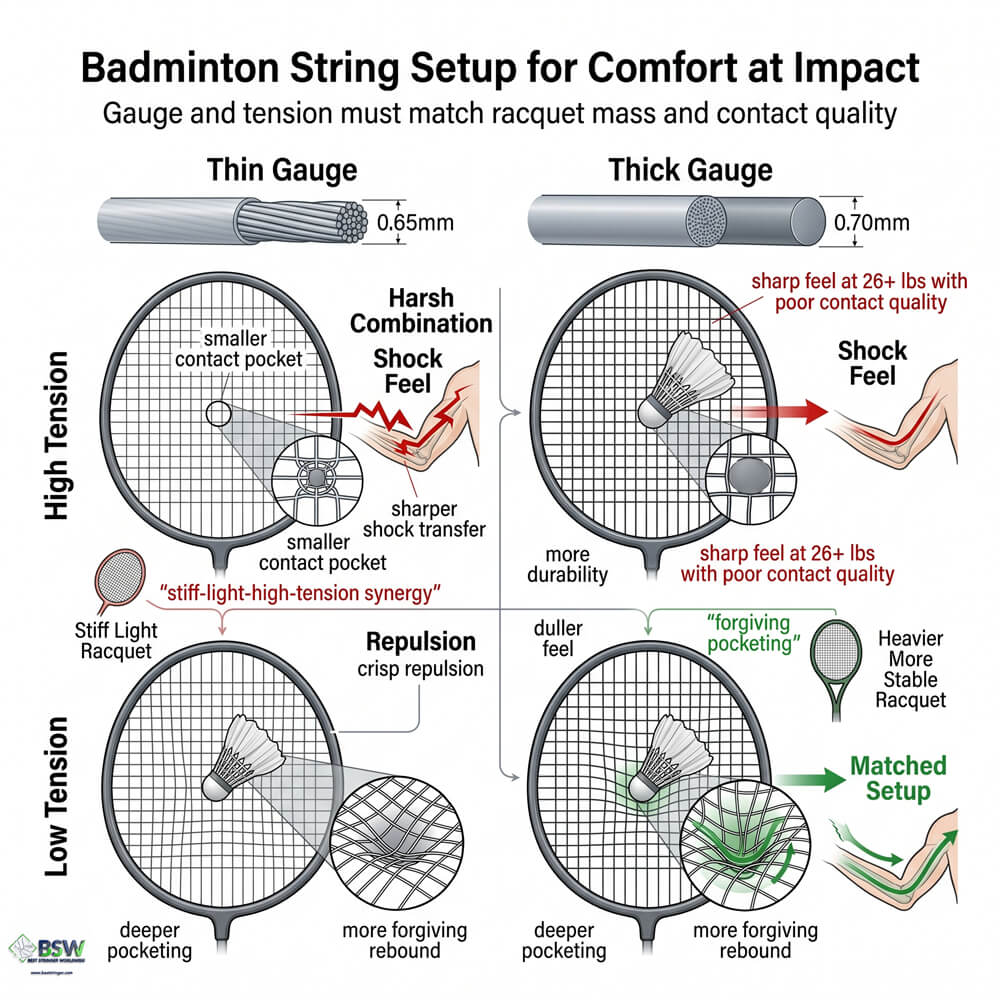
Badminton String Setup for Comfort at Impact
A heavier badminton racquet requires the correct string gauge and tension to truly unlock its forgiving feel. String setup affects what the player feels at impact, and understanding this synergy is essential:
What is String Gauge? Gauge refers to the thickness of the string. Thin strings (e.g., 0.65mm) offer incredible crispness and vibration feedback, while thick strings (e.g., 0.70mm) sacrifice a bit of that crispness for a slightly duller, more robust feel.
Tension Basics. Tension is how tightly the strings are pulled. High tension (26+ lbs) may make impact feel sharper and transmit more shock, suitable only if your sweet spot contact is highly consistent. Low tension acts like a trampoline, feeling far more forgiving and absorbing more badminton racket vibration.
The Synergy Risk. A badminton stringer should understand that player comfort is influenced not just by tension, but also by racquet mass and overall stability. Racquet weight and string setup work together; pairing a very stiff, light racquet with high tension is a recipe for harsh vibration. A professional badminton stringer advice session will always align these factors.
1.5 Common Mistakes
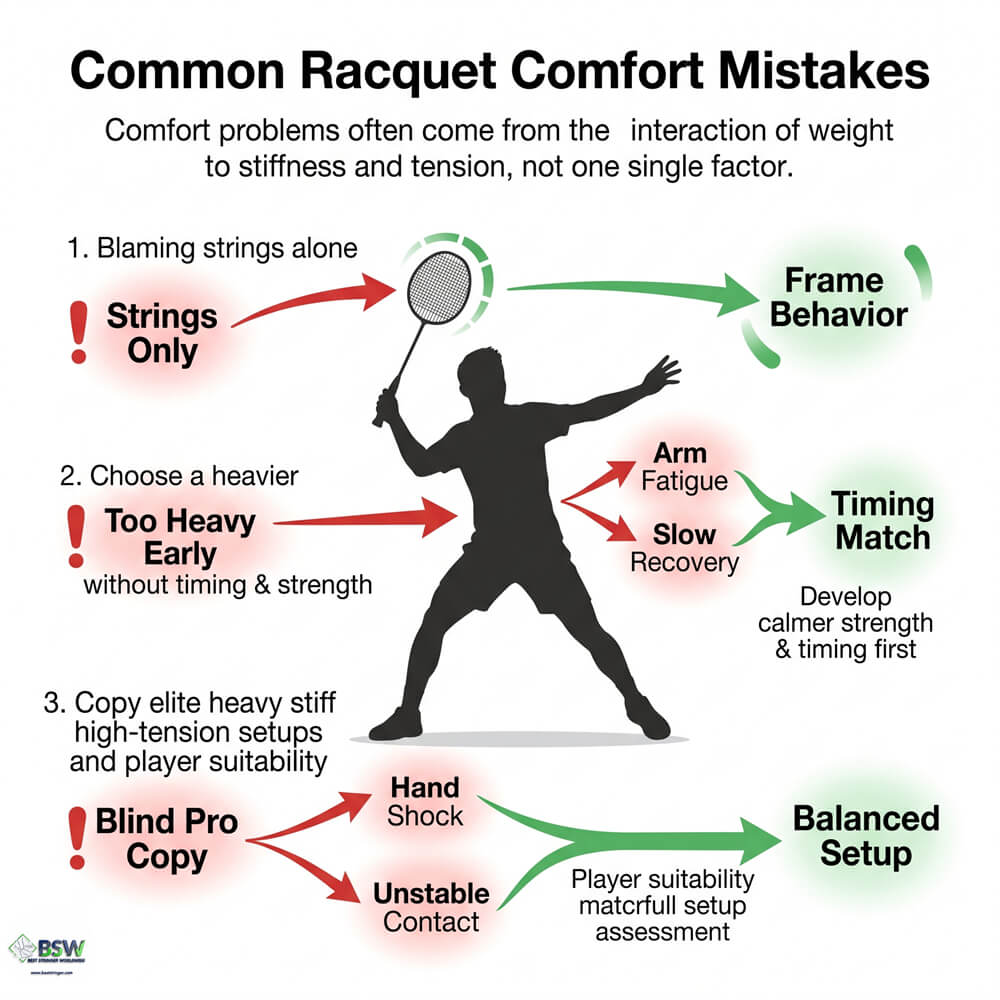
Common Racquet Comfort Mistakes
Mistake 1: Blaming Strings Only.
A certified stringer should not blame every comfort issue only on strings if the racquet weight and frame behavior are also part of the problem. Ignoring racquet weight and frame stability when diagnosing feel problems is a fundamental error.
Mistake 2: Assuming Heavier is Always Comfortable.
While a heavier racquet generally produces less vibration and oscillation, assuming heavier is always more comfortable for every badminton player ignores personal strength. If you lack the timing to swing it, your stroke breaks down and discomfort arises.
Mistake 3: Copying Pro Setups Blindly.
Using the exact heavy, extra-stiff racquet and high-tension strings of an elite player is a common error. Advanced setups without considering your strength and timing can lead to severe shock felt in the hand and excessive arm fatigue.
1.6 Selection Framework
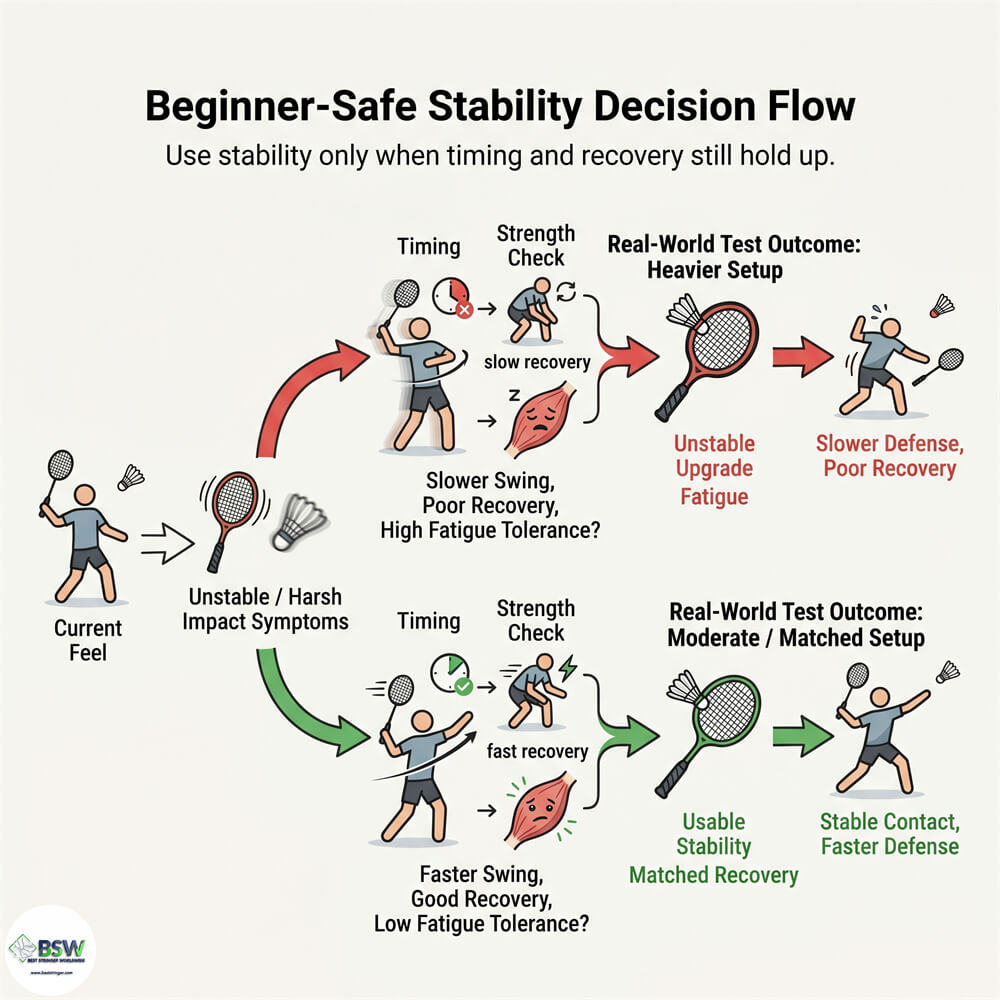
Beginner-Safe Stability Decision Flow
Comfort, stability, and usable performance must be matched to the player, not assumed blindly. Use this simple framework before upgrading your equipment:
Step 1: Check Your Current Feel. Assess whether your current racquet feels unstable or harsh at impact. Check whether your issue is from weight, stiffness, tension, or all three together.
Step 2: Check Your Timing and Strength. A heavier badminton racquet will only yield more stable clears if you can maintain your standard swing speed. Check whether your timing supports a heavier racquet without fatigue.
Step 3: Test for Actual Improvement. Try a heavier racquet and test whether it genuinely improves stability, solid contact, and comfort, or if it only slows you down and ruins your defensive recovery.
1.7 Further Learning
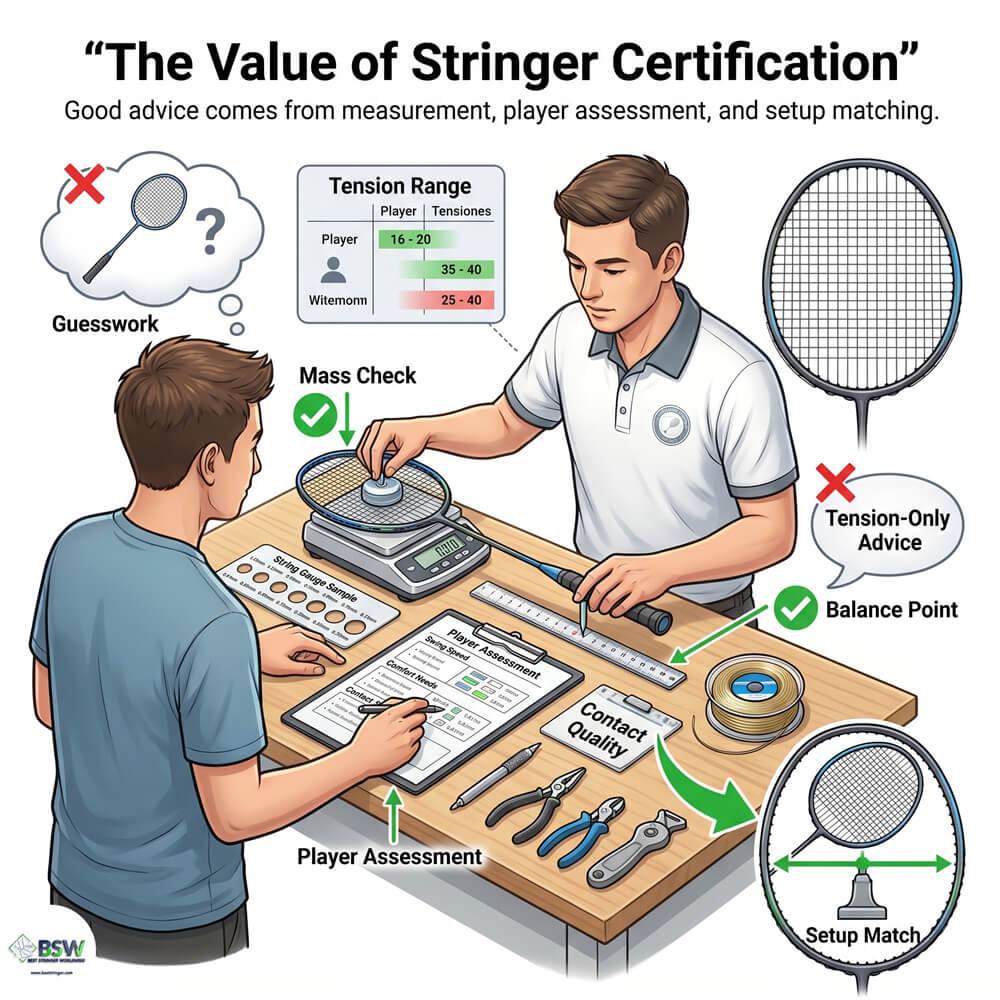
The Value of Stringer Certification
Proper equipment education is part of badminton stringing course value and strong badminton stringing certification standards. A certified stringer understands that recommending tension changes blindly without considering a player’s real comfort level and frame mass is a disservice.
At Best Stringer Worldwide, we know that racquet stability directly influences the advice given to players. Real stringer certification should involve the ability to explain racquet feel, vibration, and setup trade-offs to badminton players clearly.
By prioritizing accurate equipment knowledge, our stringer certification ensures that a good badminton stringer should understand racquet stability, impact feel, and player comfort. You eliminate guesswork, safely manage racquet oscillation, and focus purely on improving your game.
Equipment Stability Quick FAQ
Quick, definition-first answers to common questions about badminton racket vibration, oscillation, and string basics.
Does a heavier racquet reduce vibration?
Generally, yes. A heavier badminton racquet can often feel more stable at impact because greater mass can reduce some unwanted vibration felt by the player under similar conditions.
What is the difference between vibration and oscillation?
Vibration refers more to the shock or buzzing a badminton player may feel in the hand after impact. Oscillation refers more to the frame or shaft continuing to move, bend, or wobble after impact.
Why can a heavier racquet feel more stable?
The extra mass in a heavier racquet helps absorb impact forces. A heavier frame can also reduce excessive post-impact oscillation or wobbling, leading to a much more solid contact during stable clears and smashes.
Does less vibration mean better for everyone?
Not always. Not every badminton player will benefit equally from a heavier racquet. If the racquet becomes too heavy for the player’s timing or strength, swing speed and recovery speed may suffer.
Can string tension make vibration feel worse?
Yes. High tension combined with a stiff frame can create a harsher impact feel. Comfort, stability, and usable performance must be matched to the player, balancing string tension with the frame’s natural vibration control.
What should a stringer check before recommending changes?
A certified stringer should not blame every comfort issue only on strings if the racquet weight and frame behavior are also part of the problem. They evaluate timing, stiffness, and mass holistically.
Why is stringer certification important?
Real stringer certification should involve the ability to explain racquet feel, vibration, and setup trade-offs to badminton players clearly, ensuring players receive tailored, comfortable advice rather than pure guesswork.
Are stringing courses necessary for comfort advice?
Yes. Proper equipment education is part of badminton stringing course value. It teaches a badminton stringer to understand that player comfort is influenced not just by tension, but also by racquet mass and overall stability.
How does weight affect off-centre hits?
A heavier racquet often provides better off-centre stability. The increased mass resists twisting during a mishit, minimizing shaft wobble and keeping the racket face pointing forward for more consistent shot outcomes.
The Physics of Stability: Why Racquet Weight Matters
The Physics of Stability: Mass & Vibration Dampening
Observe how a heavier racquet frame resists twisting and dampens oscillation much faster upon impact, significantly reducing the shock transmitted to the player’s arm.
Standard/Light Mass
Heavier Mass
Proven Comfort Solutions
Our stringing approach is based on verified equipment parameters used by top professionals. We prioritize arm safety, proper racquet mass evaluation, and vibration control efficiency over pure tension hype.
| Racket/String Spec | Trait A (Heavier / Stiff) | Trait B (Lighter / Flex) |
|---|---|---|
| Weight (3U vs 4U) | 3U (85-89g): Greater mass reduces unwanted vibration and frame oscillation for a stable racket feel. | 4U (80-84g): Faster swing speed and recovery, but may feel less solid upon heavy impact. |
| Stiffness (Stiff vs Flex) | Stiff: Direct feedback, but can produce a harsher impact feel if timing is off. | Flexible: Forgiving feel, absorbs shock better for easier, stable clears. |
| Head Size (Oval vs Iso) | Oval: Pinpoint precision, but less off-centre stability on mishits. | Isometric: Larger sweet spot improves stability and comfort at impact on mishits. |
| Balance (Heavy vs Light) | Head-Heavy: Increases momentum and solid contact on smashes. | Head-Light: Faster maneuverability, but less mass at the top to absorb impact shock. |
| String Gauge (Thick vs Thin) | Thick (0.68+): Durable, but can sometimes feel slightly duller or harsher on impact. | Thin (0.61-0.66): Excellent repulsion, often providing a crisper, more comfortable feedback. |
| String Tension (High vs Low) | High (26+ lbs): Sharper feel, but transmits more shock felt in the hand. | Low (22-24 lbs): More forgiving, dampens vibration better for enhanced badminton player comfort. |
Master Your Equipment with Best Stringer Worldwide
Ready to upgrade your knowledge? Best Stringer Worldwide offers professional stringing consultation to teach you how racquet weight, vibration control, and frame stability affect player comfort safely. We serve badminton players worldwide especially in Singapore, Hong Kong, Malaysia, Indonesia, UK, France and Europe. Contact a certified stringer to find the perfect tension and gauge for your game.