1.1 Equipment Fundamentals
What Are the Fundamentals of Badminton Rackets and Strings?
Equipment fundamentals refer to how specific racket and string characteristics combine to enhance or punish your playstyle. In this guide on badminton racket and string basics, you will learn the exact meaning of racket specs: weight, balance, stiffness, and head size, alongside string tension and gauge.
In one line, racket choice dictates your swing mechanics and timing, and string choice dictates your feeling, repulsion, and touch. Mastering these is crucial for injury prevention and maximizing your court performance.
Here is a simple decision flow you will master: Step 1: Assess your consistency and strength honestly. Step 2: Pick a racket that aids your current weakness. Step 3: Select a string gauge and tension that matches your sweet spot accuracy without chasing professional numbers.

1.2 Racket Weight & Balance
Racket Specs Explained: Weight and Balance
Badminton racket weight is commonly categorized using the ‘U’ system, where a higher number means a lighter racket. A 4U racket (around 80-84g) is a standard starting point offering fast swing speed, while a 3U racket (85-89g) provides more mass for stability and heavy smashing. We always tell players to check manufacturer specs, as slight weight ranges drastically alter how the frame behaves.
Balance point refers to weight distribution across the frame. Head-heavy vs head-light vs even-balance drastically changes your swing timing. Head-heavy rackets generate more momentum for rear-court power but slow down defensive reaction times. Head-light rackets are incredibly fast for doubles drives, net kills, and defense. Even-balance rackets offer a versatile, all-around compromise.
For doubles players needing speed, a 4U head-light or even-balance frame is generally preferred. Singles players often benefit from the extra momentum of a 3U or head-heavy racket for sustained baseline-to-baseline clears and heavy pacing.

1.3 Stiffness & Head Size
Understanding Stiffness and Head Size
Racket stiffness is a critical yet commonly misunderstood specification. A stiff shaft provides maximum energy transfer and pinpoint precision, but only if you have advanced timing and explosive swing speed. If you lack solid technique, a stiff vs flexible shaft debate ends instantly: a stiff shaft « punishes » inconsistent players with weak clears, dead feeling, and potential arm fatigue.
A flexible shaft is highly forgiving. It acts like a slingshot, storing and releasing energy smoothly to help beginners effortlessly clear the shuttle baseline-to-baseline, even with a slower or flawed swing action.
Head size also plays a massive role in forgiveness vs precision. An isometric (squarish) head size offers a larger, more forgiving sweet spot for off-center hits, saving your strings from snapping early. Traditional oval heads prioritize maximum precision but require you to hit the dead center stringbed consistently.
1.4 Gauge & Tension Basics
Badminton String Gauge and Tension Explained
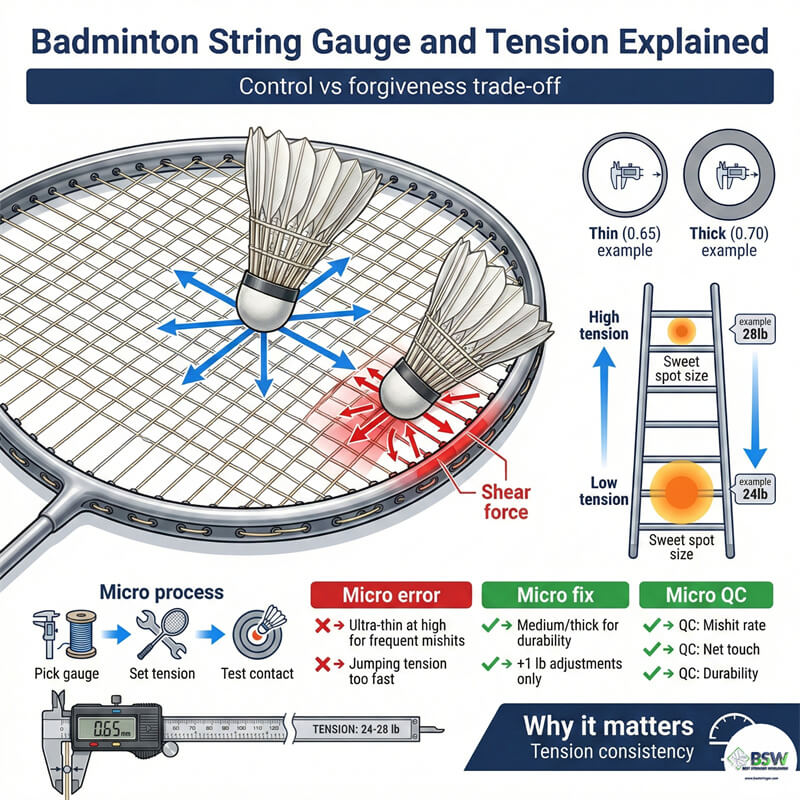
String gauge and tension fundamentals dictate how your stringbed behaves upon impact. Understanding this trade-off is essential for all levels:
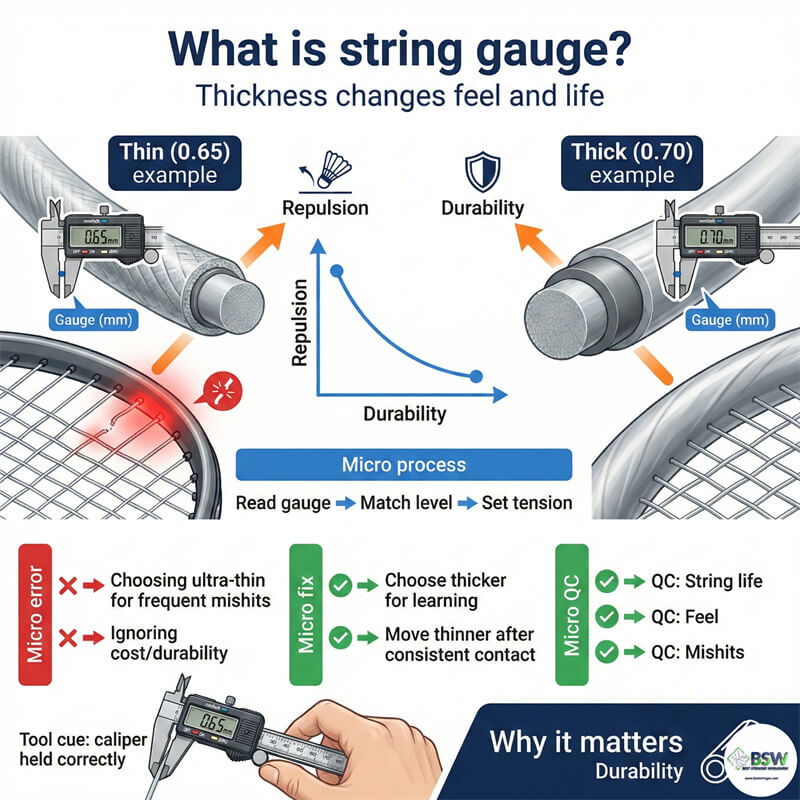
What is String Gauge? Gauge refers to the thickness of the string, measured in millimeters (mm). Standard gauges vary drastically in performance.
Thin vs Thick Trade-off. Thin strings (e.g., 0.65mm or 0.66mm) offer incredible repulsion, a satisfying aerodynamic hitting sound, and great tactile feel. Thick strings (e.g., 0.68mm or 0.70mm) sacrifice a bit of that crisp repulsion for robust durability, making them highly cost-effective.
Tension Basics. Tension refers to how tightly the strings are pulled. Higher tension (26+ lbs) equals more touch and control, but ONLY if your sweet spot contact is highly consistent. Low tension acts like a trampoline, boosting power for slower swings.
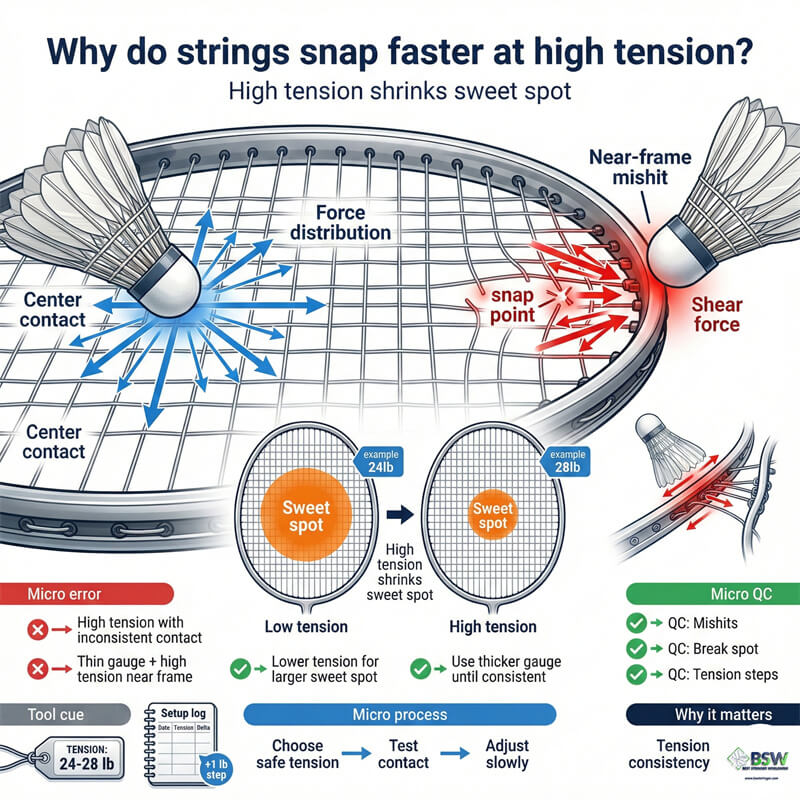
The Sweet Spot Risk. High tension inherently creates a smaller sweet spot. If you mishit near the frame on a high-tension stringbed (especially with a thin gauge string), the strings will snap almost immediately due to extreme shear force.

1.5 Common Mistakes
Common Equipment Selection Mistakes
Mistake 1: Copying Pro Setups.
Using a heavily head-heavy, extra-stiff 3U racket strung at 30+ lbs just because an elite player uses it is a guaranteed way to destroy a beginner’s timing, hinder progress, and risk severe shoulder and arm injuries.
Mistake 2: Too Stiff + Too High Tension.
If your racket is too stiff and your tension is too high, you have zero « trampoline effect » to assist your shots. This punishes poor timing, resulting in incredibly weak clears, slow drives, and rapid forearm fatigue.
Mistake 3: Thin Gauge at High Tension for Beginners.
Using a 0.65mm string at 28 lbs when you frequently frame the shuttle guarantees rapid string breakage. High tension combined with thin material cannot withstand the sheer force of an accidental mishit.
1.6 Selection Framework
Beginner-Safe Equipment Decision Flow
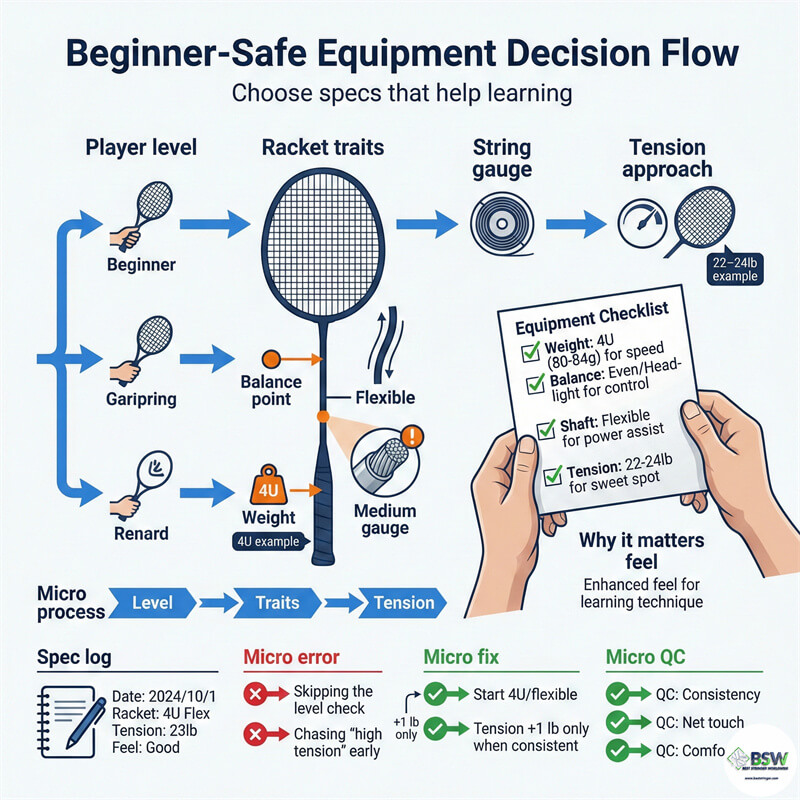
A step-by-step decision flow is crucial for progressing safely in badminton. Do not let ego dictate your specs; use this simple beginner-safe equipment selection framework:
Step 1: Player Level to Racket Trait. Beginners should start with a 4U weight, even-balance or slightly head-heavy, and a flexible shaft. This maximizes forgiveness, prevents shoulder fatigue, and helps develop proper stroke mechanics.
Step 2: String Gauge Direction. Start with a medium or thick string gauge (0.68mm – 0.70mm). This provides necessary durability and cost-effectiveness while you are still learning to hit the sweet spot consistently.
Step 3: Tension Adjustment Logic. Start at a beginner-safe tension (22-24 lbs). If you mishit often → lower the tension. If you hit clean consistently and want more touch → make a small 1 lb increase. Never exceed your racket’s max tension limits.
1.7 Further Learning
The Value of Professional Stringing
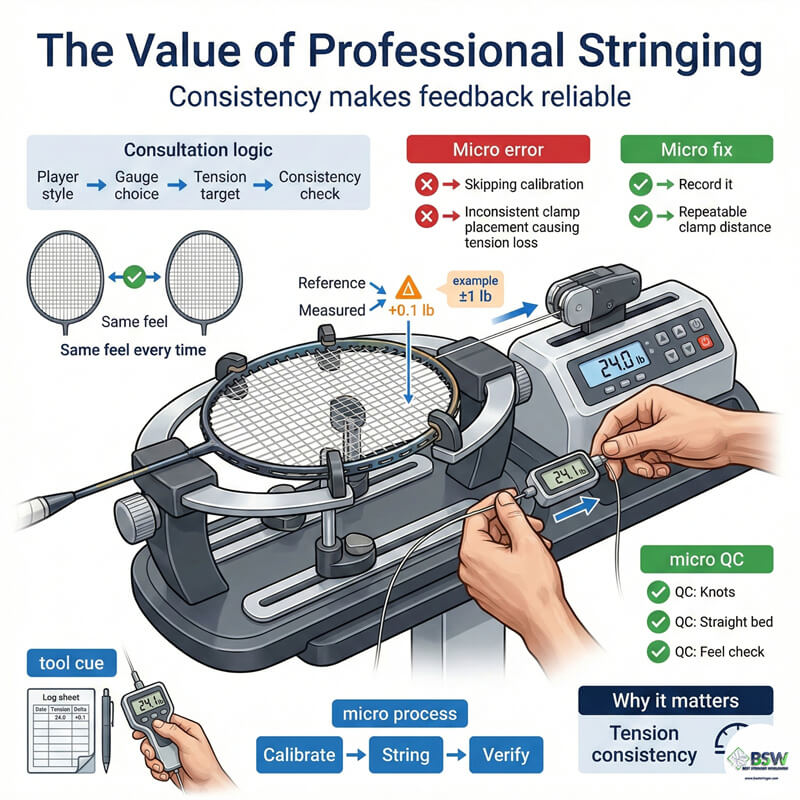
Professional badminton stringing educators understand what average players usually miss. The magic is not just in buying the most expensive racket, but in the precise consultation logic matching string type and tension to the player’s current biomechanics.
At Best Stringer Worldwide, we prioritize helping all player levels achieve true equipment decision accuracy. A good stringer provides clear guidance, ensuring your setup directly supports your growth, whether you play fast-paced doubles or tactical singles, without using brand hype.
We heavily emphasize measurement consistency. A 24 lbs string job should feel exactly like 24 lbs every single time. By mastering these equipment fundamentals, you eliminate variables and can focus purely on improving your game and enjoying the sport safely.
Equipment Selection Quick FAQ
Quick, definition-first answers to common questions about badminton racket and string basics.
What are the fundamentals of rackets and strings?
The fundamentals involve matching a racket’s weight, balance, and stiffness to your swing mechanics, while pairing it with a string gauge and tension that suits your sweet spot accuracy. This synergy dictates power, control, and injury prevention.
3U vs 4U what does it mean?
The ‘U’ system denotes racket weight. A 3U racket weighs approximately 85-89 grams and offers mass for stability and power, while a 4U racket weighs 80-84 grams and provides faster swing speeds ideal for defense and quick drives.
Head heavy vs head light what changes?
Balance point changes the racket’s center of gravity. Head-heavy rackets put more mass at the top to generate steep smashing power, whereas head-light rackets concentrate mass near the handle for rapid maneuverability and defensive reaction time.
Stiff vs flexible who should choose which?
A stiff shaft is for advanced players with explosive, consistent swings who need precise energy transfer, while a flexible shaft is for beginners and intermediate players who need « slingshot » assistance to generate power for clears.
What is string gauge?
String gauge is the thickness of the badminton string measured in millimeters. Standard gauges range from ultra-thin 0.61mm for maximum repulsion to thick 0.70mm for maximum durability.
Thin vs thick string who should pick which?
Advanced players who want maximum repulsion, crisp feel, and an aerodynamic sound should choose thin strings. Players who frequently mishit or break strings quickly should opt for thicker strings for cost-effective durability.
What is a beginner-safe tension approach?
Beginners should start at a safe tension between 22 to 24 lbs. This provides a massive, forgiving sweet spot and excellent trampoline effect. Only increase tension by 1-2 lbs when your sweet spot contact becomes highly consistent.
Why do strings snap faster at high tension?
High tension tightly stretches the string, reducing its elasticity. When combined with a thin gauge and an off-center mishit near the rigid frame, the concentrated shear force instantly snaps the string.
Are stringing courses necessary?
For those wanting to master equipment consultation, yes. A stringer learns measurement consistency, precise knot tying, and the logic to match string setups to player levels, eliminating guesswork from equipment selection.
Equipment Concepts Gallery


Proven Specifications
Our stringing approach is based on verified equipment parameters used by top professionals. We prioritize arm safety and playstyle efficiency over pure tension hype.
| Racket/String Spec | Trait A (Heavy / Stiff / Thick) | Trait B (Light / Flex / Thin) |
|---|---|---|
| Weight (3U vs 4U) | 3U (85-89g): Mass for power & stability. | 4U (80-84g): Fast swing speed for defense. |
| Stiffness (Stiff vs Flex) | Stiff: Precision, needs perfect timing. | Flexible: Forgiving, easy power for clears. |
| Head Size (Oval vs Iso) | Oval: Pinpoint precision for pros. | Isometric: Larger, forgiving sweet spot. |
| Balance (Heavy vs Light) | Head-Heavy: Steep angle smashing power. | Head-Light: Rapid defensive maneuverability. |
| String Gauge (Thick vs Thin) | Thick (0.68+): Cost-effective durability. | Thin (0.61-0.66): Incredible repulsion & feel. |
| String Tension (High vs Low) | High (26+ lbs): Control, small sweet spot. | Low (22-24 lbs): Massive sweet spot, safe. |
Master Your Equipment with Best Stringer Worldwide
Ready to upgrade your knowledge? Best Stringer Worldwide offers professional stringing consultation to teach you badminton racket and string basics safely. We serve students worldwide especially in Singapore, Hong Kong, Malaysia, Indonedia, UK, France and Europe etc. Contact us to find the perfect tension and gauge for your game.